

Matt Arnold, Chief Engagement Officer, VML South Africa, discusses data analytics – the new buzzword for business people everywhere. It’s the new north star guiding every decision we’re supposed to make. But there’s a lot of data and not a lot of understanding on what to do with it, often making data analytics more confusing and less useful than it should be.
A recent VML Marketing Insights survey revealed that chief marketing officers and other senior decision makers believe that of their marketing budgets, data analytics provides the lowest return on investment (ROI). Despite this fact, a third (33%) of respondents highlighted ‘making better use of data’ as a core focus for this year. This contradiction is an indicator for the continued internal struggle around the perceived value of data and its measurement within organisations.
All organisations have data. Every decision and action taken results in data, often way more than we know what to do with. This has seen a lot of marketers struggling to apply analytics to the data that they have to get significant value from it. On paper, the more data a business collects, the more patterns and trends businesses should be able to identify. However, not all data is equal when you weigh up its value to the organisation. Valuable data is data that is tied to business results but analysing the data effectively is what matters as that is what will equate to better decision making and enhanced strategic planning.
So, the very important question all marketers should be asking is how do you effectively harness insights from data analytics that deliver real insights to improve ROI?
It is very easy to measure a wide range of metrics that are simple to set up, interpret and report on. This is because more often than not it is harder to surface the really powerful business performance indicators. If you fall into the trap of having too many inconsequential metrics that are not delivering actionable outcomes, then there is no doubt your analytics efforts will lack business value. Measuring the wrong metrics and generating flawed insights are the top reasons for organisational analytics failures.
Upfront, you need to be clear about whether your data dictates or supports your marketing efforts. Will creativity and human touch still be part of the decision making process, or will it be completely replaced by algorithms?
Look at each report and each metric in turn and ask yourself: am I measuring what matters? What value does this have? How does this affect business goals and objectives? Take the time to understand the leading and lagging indicators and the relationships between these metrics and your goals. If the data is not surfacing decision making opportunities, then its value is questionable.
Treat your analytics efforts as an asset rather than as an expense. The way your organisation sees data has a fundamental impact on the way it is treated, resourced and evaluated. Investing time and resources into improving your organisation’s data analytics will have significant positive effects on various business functions from improving efficiency of teams to marketing effectiveness and driving growth. Understanding what is working or not and why is fundamental to improving performance and driving intelligent growth.
If you are clear and deliberate with the data that you use, the challenge is not about trying to calculate the ROI of your efforts, but ultimately quantifying your desire to grow your business. It’s more than just data, it’s what that data used effectively can do to enhance business performance.
How Can Marketers Better Utilise Their Data?
VML SOUTH AFRICA
Published Media – An Innovative Brand Strategy

Josephine Buys, CEO at The Publisher Research Council, observed that over the past few years a lot has been said about the demise of print and the perception that the traditional printed word is no longer the force it used to be.
However, it seems that we may be coming full circle as once again the written word is being used to entertain, promote and educate. This is evident when companies that are primarily focused on visual media are opting to make use of published media. Netflix for example, has announced that it will be publishing its own magazine, called Wide, to promote their own stars and programmes ahead of the 2019 Emmy Awards. The first issue is set to launch in June this year.
Buys said, ‘As the world of publishing is constantly evolving, we are seeing more innovative uses of the written word to encourage more reading. These examples are by no means a once-off, but rather a demonstration of the power of reading matter.’
A prime example of encouraging more reading takes place in London where tube commuters are able to read short stories, printed on eco-friendly paper and dispensed free by vending machines installed at Canary Wharf. Author of the short stories, Anthony Horowitz, noted, ‘What appealed to me was that I travel on the tube every single day and I see everybody buried in apps and games.’ These same vending machines have also been installed in locations across France, in Hong Kong and the US.
‘The written word provides a depth that is extremely difficult to replicate on other media platforms,’ said Buys. ‘The Publisher Research Council has made great strides in conducting research that promotes the value of reading versus listening, viewing or glancing.’
Many global studies reaffirm this with statistics proving time and time again that time spent with print media is more focused. A Newsworks survey conducted by PwC discovered that for 60% and 58% of the time spent reading newspapers and magazines respectively, readers are focused solely on that medium, concluding that a trusted medium that people choose to pay attention to is more important than ever. *
Insights from the South African Establishment Survey (ES) show that people who read earn more than their non-reading counterparts, across the entire spectrum of society. According to the ES, only half of South Africans read newspapers and magazines monthly. However, this percentage grows the higher one moves up the Socio-Economic Measure (SEM) scale. In SEM SuperGroup (SG) 5, the top 10% of the population, 77% read. This same SG also has the highest household income, demonstrating that reading is the key to success and a better life. **
Anyone who has ever studied for an exam or test knows that reading is the best way to learn, and that the longer one studies, the more familiar one becomes with the course material. Reading media, whether newspapers, magazines or online provides a depth of information unlike any other media. The ability to put it down, pick it up and assimilate information at your own pace is all too often overlooked.
‘The PRC’s online library is a rich repository of information that marketers, advertisers and media agencies can draw from,’ concluded Buys.
PUBLISHER RESEARCH COUNCIL
www.prc.za.com/pams
* https://www.printpower.eu/insight/get-the-facts-the-battle-for-attention/
IDG Grants Turn Left Media Exclusive Representation Across SA And Sub-Saharan Africa

Turn Left Media have been granted exclusive representation of IDG’s product portfolio across South Africa as well as the greater Sub-Saharan African region. Overall, IDG delivers over a million unique visitors per month, and has access to around 2.5 million opt-in subscribers across Sub-Saharan Africa.
Turn Left Media, an independent, boutique digital media sales house helping brands to reach the right high-value and B2B audiences across key digital platforms, will become the contact point for businesses interested in understanding the IDG portfolio of solutions.
Founder and Director John Bowles explained the significance for Turn Left Media. ‘As a media sales house focused on the professional audience, the IDG solutions excite us tremendously. We know the pressure businesses are under to reach relevant audiences while generating top quality leads, and with IDG in our portfolio we have the assurance that we can deliver results in the technology vertical better than ever before. IDG brings experience, knowledge, credibility and ROI to the table for its clients. We’re very proud to be associated with IDG’s solutions and look forward to the relationship.’
Neil Michael, President of IDG Global Solutions added, ‘This is an incredibly exciting step forward for our strategy in the region and joins together our work in Middle East and North Africa to provide us more complete coverage across MEA. The modern marketer needs help with targeting the right audience with the right message at the right time, building and bringing in sales pipeline to their businesses and help with their content marketing programmes. By combining Turn Left Media’s regional marketing and sales expertise with IDG’s deep understanding of technology audience and buyer behaviour and reach into Sub-Saharan Africa, we are certain that this partnership will bring incredible value to regional technology customers.’
TURN LEFT
+27823877269
johnb@turnleftmedia.co.za
www.turnleftmedia.co.za
The Influence Of People As A Marketing Channel

Pieter Groenewald, co-founder of multiple influencer marketing platforms within the Nfinity Group, has spent the last eight years of his life in the influencer marketing space. He discusses using people as channels to communicate as a way forward.
I’ve read everything I could get my hands on about the sector, studied every piece of research, reviewed case studies, listened to all the experts and opinion leaders; and gained practical experience where I hit the ground running and executed campaigns. During this time, I have seen, and continue to see, the execution of some brilliant campaigns, some average and, unfortunately, a lot of poor ones. The latter is worrisome, and we need to ask ourselves why.
The influence of people
Traditional media was always about people – think back to when radio was at an all-time high. We listened to Jeremy Mansfield, John Robbie, and Gareth Cliff’s shows back in the day, and I could go on. But the fact is, we did not tune into Five FM, 702 or 94.7, we tuned in to listen to the people, aka the radio DJs. And today this is still the case, if you haven’t converted to podcasts yet.’
Moving on to another favourite: magazines. Think about it, you buy a specific magazine to read the content, to read about the people you admire or read an opinion from a certain journalist or columnist. Again, the magazine is just the channel or platform for people to engage with other people.
Entertainment works in much the same way. If top actors are in a movie, the risk of a box office failure is almost eliminated, regardless of how bad the movie is. Why? Because we follow the actors and trust in their ability to entertain us. We don’t necessarily have the same trust in the studios i.e. Disney, Warner Bros etc. all of whom are just the channel.
Then came social media that has become the most powerful communication channel the world has ever seen. I mean, what other collective communication channel has the ability to grow Pokémon GO to 50 million users in 19 days? Or that can facilitate 41.6 million messages via Whatsapp and Facebook Messenger every minute, or 4.5 million videos viewed in that same minute in 2019?
Something happened with the advent of social media that changed the status quo painted above. People now have the ability to build their own audiences and engage with them directly. Incredibly, ‘people channels’ were born and took the market by storm on various social media channels e.g. blogs, podcasts, YouTube, Facebook, Instagram etc.
It still remains your own choice to tune in as no one is forced to be part of the audience. You connect because you want to be part of the group or tribe and see value in the relationship. This type of personalised advertising to audiences within ‘people channels’ allows for one-on-one marketing at scale, which is going to be the future of advertising.
Therefore, it is probably fair to claim that these new ‘people channels’ with their respective audiences are in fact the new media channels brands should consider within the social marketing sphere. Are they seen as mainstream media yet? Because the data definitely shows that it is.
Or, are we still caught up in the thinking that big corporates own the best media channels and the right to be called mainstream media? I believe the world has evolved and old-school thinking might be a costly line of thought, and brands might miss out on the opportunity to explore these ‘people channels’ and maximise their potential.
Marketingland reported that Facebook COO Sheryl Sandberg confirmed that the top 100 advertisers on Facebook account for less than 20 percent of the company’s total ad revenue. Digiday reported that the number of advertisers in January 2019 was over 7 million, up from 5 million in April 2017, or 40% in less than 2 years. What do these advertisers know that we don’t, as in most other mainstream channels the ratio is the other way around, i.e. 20% of clients dominate 80% of spend? It can only be because it works.
There is a need to consider whether Facebook clients or clients of other social media platforms are in fact considering the ‘people channels’ within those platforms, especially if you consider the organic reach and penetration of their content to their audiences, which is significantly higher than brand pages.
One doesn’t just include a line item into a strategy for mainstream media e.g. billboards, TV, social media or perhaps even print. Within those line items, you see detailed strategies to explore the channel in an innovative way to its fullest, perhaps being combined with other platforms and timing thereof. Why not the same with influence and the ‘people channels’ out there? It’s time for this approach to be incorporated, especially if using people as channels to communicate is the way forward.
It is only when you consider a re-classification of these ‘people channels’ as a mainstream way of communicating with consumers that you will start thinking more strategically about the channel and its uses, as well as be more creative in executing campaigns and be vigilant about holding suppliers and influencers accountable.
NFINITY
+27109002021
kevin@nfinity.co.za
www.nfinity.co.za
New SAB TV Series Shows Human-Centric Approach To Doing Business
Filmmaker Shani Kay is the brains behind the SA INC TV series, which aims to highlight and celebrate South Africa’s successes and achievements through the stories of socio-economic transformation in the real day-to-day lives of its citizens.
A new 20-part TV series airing on local TV channels throughout the year showcases SA Breweries (SAB) as an exceptional example of a company that is integral to the fabric of South African society and dedicated to changing the lives of people and their communities.
Entrepreneurs across South Africa are reaping the benefits of big businesses increasingly embracing profit-with-purpose as critical to their long-term sustainability. SAB Senior Corporate Affairs director Zoleka Lisa said that the company committed in 2016 to invest R1 billion over five years in its Public Interest Commitment (PIC) programme, 61% of which is focused on agriculture.
This local sourcing strategy saw them significantly boost the barley yield of North West farmer Mapula Vivian Seboko, among others, winning her the title of 2018 Emerging Farmer of the Year. Lisa said SAB also committed a further R200 million to build sustainable enterprises within the communities in which they operate.
Providing invaluable coaching and financial support to their small business partners, the programme has benefited people like Johannesburg hydroponic rooftop farmer Fezile Msomi and businesses such as Kevali Chemicals. Started by Funeka Khumalo, a female entrepreneur from Gugulethu, Kevali provides customised solutions in the chemical industry that focus on hygiene and sanitation, water treatment and adhesives.
Since her participation in the SAB Accelerator, Kevali has experienced 30% annual growth, with a credible list of customers that includes SAB and other multinationals, as well as a mission to inspire young girls across South Africa that it is possible to follow their dreams and succeed.
Lisa described enterprise development as a key channel to address not only South Africa’s unemployment challenge, but also to maximise exports and minimise imports. Local sourcing is an integral part of the programme, and the organisation currently sources 97% of all materials in the production of their products locally.
‘SAB is focusing on the inclusion of black-owned businesses in its supply chain, and ensuring it has a healthy pipeline of suppliers that represent the demographics of South Africa,’ she explained. This speaks to its commitment to contributing to the transformation of previously disadvantaged individuals, which is key to developing an inclusive economy.
South Africa, said Kay, is starting to see an increase in these innovative business models, which deliver profitable returns and societal value in synergy. ’It marks a critical move from a business focus on double-digit growth that can only result in an environment of ‘haves’ and ‘have-nots’. Companies are now re-identifying their purpose, redefining their values, and reconnecting with a human-centric approach to doing business that will see them into a sustainable future,’ she said.
SA INC
+27124184183
media@regency.org
regency.global/sa-inc
Xerox Launches Workplace Proofreading App
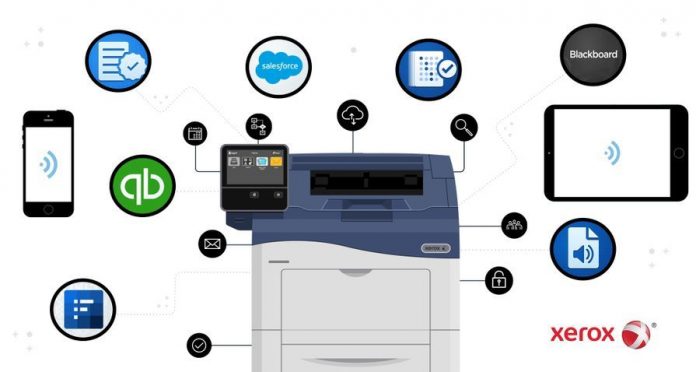
The new Xerox Proofreader Service app allows you to instantly check for spelling, grammar, syntax and even plagiarism, right from a ConnectKey Technology-enabled printer. The App is ideal for communications professionals in any industry, educators and administrators in higher education.
The Proofreader Service app lets you focus on content and not corrections. Teachers and students alike can save time and get more accurate results when working with both hardcopy and electronic formats. Scan your documents directly from the device, or upload to the Xerox Proofreader Service Portal.
The app comprises of a workplace assistant function that streamlines workflows and complex processes in any office setting with Xerox ConnectKey Technology-enabled devices.
XEROX www.xerox.com
Nfluential SA Digital Survey Reveals Impact Of Influencers’ Social Media Content
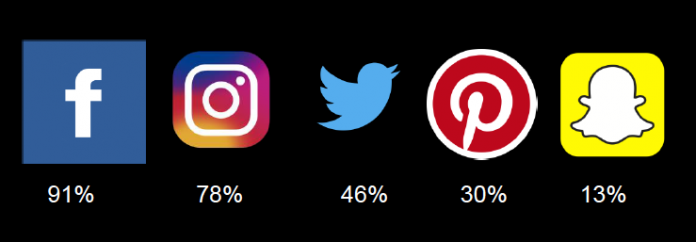
Nfluential conducted a digital survey to gain insights into South African consumers’ social media behaviour and sentiment towards influencers and their content.
The survey had 808 respondents between the ages of 18 and 65, with the bulk of the respondents being in the 26–35-year-old age group, and more female respondents. The findings showed that Facebook is still the most popular local social media platform used, with Instagram and Twitter coming in at second and third respectively. Twitter started growing in South Africa in 2018, and Instagram is growing at a rapid rate. This correlates with the feedback received in the survey, with 78% of respondents citing it as their favourite social media platform.
The Nfluential digital survey also found that users are increasingly looking for authenticity and relatable influencer content. The days of influencers promoting any and all brands on their timelines and not putting much thought into the content and copy are gone. This could mean that consumers, in general, are losing confidence in traditional advertising. They want to see content to which they can relate, that is authentic and that is not brand-heavy advertising.
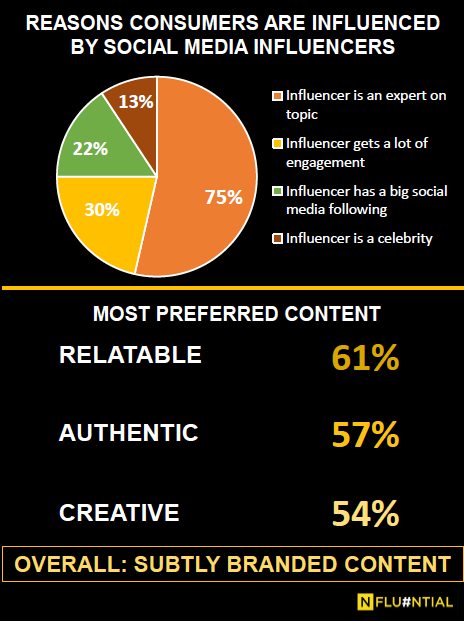
Even though the graphic above shows that consumers respond favourably to influencer marketing when it’s done right, they have their concerns.
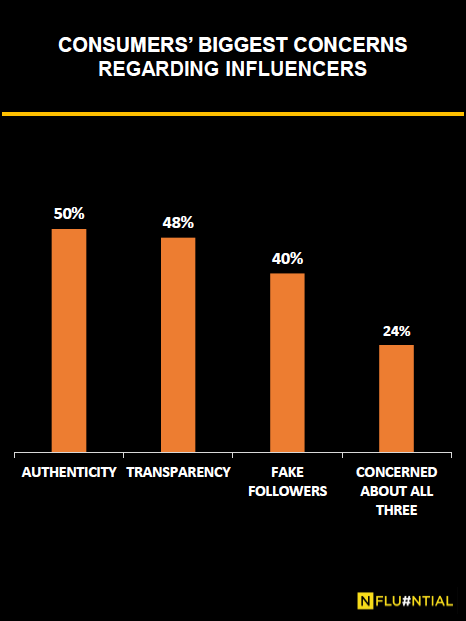
The top three concerns cited by respondents were the authenticity of influencers, transparency when they are participating in campaigns and lastly but not least, 40% said they have concerns over influencers having fake followers.
So often we think that only brands have concerns, but in the digital age, consumers aren’t easily hoodwinked. This is yet another reason why strategy is important when brands want to roll out influencer campaigns. Using the incorrect types of influencers with the wrong content can lead to campaigns falling flat.
Influencers are the perfect hybrid. While they post content that their followers can relate to or like engaging with, they are also good at weaving in product messaging that subtly provide advertising for brands. It works. Further findings showed that through authentic and relatable content, 77% of respondents were introduced to new brands, which means awareness was created successfully through influencer marketing.
NFLUENTIAL
+27109002021
www.nfluential.co.za
CADEK Media Hosting Fourth Mall And Retail Indaba

CADEK Media, the organisers of Mall and Retail Indaba, have announced that the fourth conference will take place in Johannesburg on 25 July 2019. This is a full-day conference designed for shopping centre managers, marketers, mall owners and retail executives.
The conference ensures that management stays informed on the latest retail industry trends, identifies new opportunities for growth and optimises management skills. The conference offers its delegates more than seven industry experts sharing their experiences, knowledge and know-how on managing and optimising malls and retail spaces and experiences.
Agenda Outline
- Retail and shopping centre trends and a future outlook.
- Retail opportunities and looming threats.
- Multi-channel shopping influence on brick and mortar.
- Marketing and brand building for malls and retail shops.
- Increasing footfall to malls and shops.
- Local case studies.
- Centre and shop design, and in-store technologies.
- Loyalty programmes and more
CADEK MEDIA
info@cadek.co.za
www.cadek.co.za
Vodacom Sponsors The #Loeries2019 Shared Value Category

Vodacom is sponsoring the Shared Value category at the 2019 Loeries. This category highlights the Loeries Shared Value Initiative: No-one stands alone – creative work that highlights a powerful, socially uplifting message. It comprises a showcase of brilliant campaigns that are socially useful and commercially successful.
Shared value takes corporate social responsibility much further. Harvard Business School Professor, Michael Porter and Harvard Kennedy School of Government Senior Fellow, Mark Kramer explained, ‘Rather than being charitable, corporate shared value is a management strategy in which companies find business opportunities in social problems.’
Vodacom’s Managing Executive: Brand and Comms, Abey Mokgwatsane said that the Loeries Shared Value category is in line with Vodacom’s values and a natural sponsorship fit. ‘Our commitment is to bring a meaningful, sustainable economic transformation of South Africa and beyond. We laud all companies that are creating jobs, stimulating the economy and being innovative about the way they make money, while still tackling the social issues of our times.’
Safaricom’s ‘DigiFarm’, the Kenyan mobile solution for smallholder farmers – which took gold in the Loeries Shared Value category last year – is a good example of adding value to the community while helping to build the brand experience. The app enables farmers to expand and improve their business activities by providing education, access to loans, easier purchases and eliminating the middleman when they sell their crops. It simply helps farmers to do better business while empowering their lives and their community.
Perhaps a question to be posed is, if business can be socially uplifting, does that mean it should be?
Pepe Marais, CEO of Joe Public United, and #1 ranked Chief Creative Officer in the Loeries Official Rankings, offered this hypothesis, ‘Aspiring to be bigger than yourself isn’t just a nice ideal, it’s the driving force of successful businesses.’
Marais said, ‘Any entrepreneur will tell you that there is something far greater that drives her or his business. Without that drive, most would not have made it past the first year – it is simply too tough. The challenge is that this drive is so deeply unconscious that the conscious answer often may be money.’
‘That drive is at the heart of the greater purpose of the business. Ultimately, doing business with a purpose helps you do better business. We believe that the growth of our people is linked to the growth of our creative product, which impacts the growth of our clients, and which ultimately contributes to the growth of the country.’
Mokgwatsane added, ‘Vodacom is in the business of connecting people for a better future. Technology gives us tremendous power, but ultimately, it’s what we do with it that counts. We remain committed to responding to the needs of millions of people that can benefit from the capacity of technology to democratise access to the life changing services of a connected future. By sponsoring the Loeries Shared Value category, we support companies and creatives who are using the power of shared value to inspire.’
The Loeries extended deadline for entries is 31 May 2019.
VODACOM
www.vodacom.com
LOERIES
www.loeries.com
Moving Tactics Supplies Famous Brands With Digital Menu Board
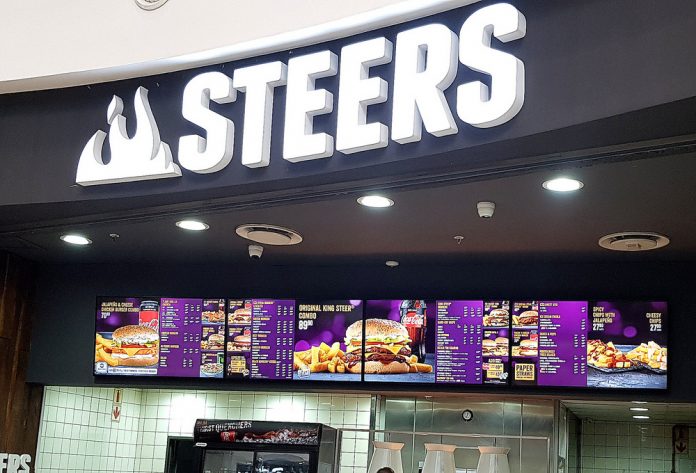
Moving Tactics has been appointed by Famous Brands as their digital menu board supplier. The appointment came about as a result of Famous Brands and Moving Tactics developing a working relationship over several years, which included the installation of digital signage, digital menu boards and audio solutions at several branded Quick-Service Restaurant (QSR) outlets across Southern Africa.
Chris Day, Managing Director at Moving Tactics said, ‘We are incredibly proud to work with Famous Brands. They are a highly respected business that is leading the QSR industry with innovative digital technologies so that they can meet the needs of and engage with their customers. As their sole digital menu board installer, we can provide them with the latest digital screen technologies and provide that consistent look and feel across their brands.’
Famous Brands refresh their digital signage networks every five years to remain technologically relevant and to ensure that the digital signage supports and complies with their brands’ refreshed in-restaurant layouts and design.
‘In the past six months, we have completed 141 installations for Famous Brands. We have completed close to 100 installations for Steers and Wimpy alone and we’re always planning new installations as their brands expand,’ said Kevin Bierman, Head of Digital Signage Solutions at Moving Tactics.
Moving Tactics have installed digital menu boards at Wimpy, Fishaways, Steers, Milky Lane, Debonairs, Fego Caffe and Mugg & Bean restaurants across the country and they are currently installing several digital menu boards with audio facilities per restaurant.
According to Bierman, ‘We develop, custom-build and install digital solutions for the various brands according to their specific needs. For Wimpy, we created kid-friendly Touch Play Tables that are installed within the play areas to keep their younger customers entertained. Whereas at Steers, we implemented a four-screen solution where the two middle screens sync, to the nanosecond, using System-on-Chip (SOC) capabilities, to draw attention to specific promotions or new products being launched.’
Adolf Fourie, Marketing Executive at Steers commented, ‘We are rolling out digital menu boards as it provides us with a lot more flexibility across our nearly 600 restaurants – to be agile and target our consumers with different messaging at different times of the day. It also allows for speed to market and flexibility at each restaurant that traditional static menu boards will never offer. We are excited by the impact these digital menu boards are making in our restaurants in driving sales and feet for our business.’
‘Digital content is easy and very quick to update without having any human interaction at store level and the screens can also be used for staff training and other company communication. Its multifaceted benefits are the reason why digital signage has become the way to communicate within QSR and retail environments,’ concluded Bierman.