Home Blog Page 341

Retail Industry Needs Consistent CX Across All Channels

Hemant Harie, managing director at Gabsten Technologies.

Hemant Harie, managing director at Gabsten Technologies, the retail industry is becoming increasingly critical when it comes to delivering tailored offerings that meet the needs and interests of individuals. A blanket approach to marketing is simply no longer sufficient.

The retail industry faces the challenge of delivering a consistent customer experience (CX) across all channels, including online and physical storefronts. The key to both of these elements is analytics, which in turn relies on ‘always on, always available’ data and 24/7 uptime. However, this can prove difficult during times such as now, during a lockdown. Without effective data management in place, including backup and recovery, this is an impossible goal.

The omnichannel experience

With the lines between online and physical stores blurring, it has become imperative for retailers to deliver what has become known as an omnichannel experience. Not only does the look and feel of an online presence need to mimic that of a store, but the entire experience should also be seamless.

Retailers are therefore having to consider gathering and augmenting data from customers regardless of their chosen channel of interaction so that the data can be analysed, and intelligent insights gained.

Subsequently, the intelligence can be used to deliver an optimised experience based on the individual needs and desires of the customer – a tailored customer experience that has become crucial to success in today’s highly competitive global marketplace. During times such as Covid-19, a competitive advantage is crucial to ensure that your business remains relevant and revenue streams continue.

All about the data

Data lies at the heart of this ability, which means that it needs to be always-on and always available with as close to zero downtime as possible. The entire appeal of online retail is its availability at any time, so any outages are detrimental. Couple this with the growing need for delivery of goods during this time. As a result, it is now imperative for retailers to understand what data they have, how it can be used, and how it can and should be protected.

This requirement is also being driven from a regulatory standpoint, with the imminent enforcement of the Protection of Personal Information (PoPI) Act legislating how customer data should be handled. In addition, retailers need to comply with the Payment Card Industry Data Security Standard (PCI-DSS), which regulates how customer payment information must be stored and processed.

Data protection is key to continuity

Data may become lost or corrupted for any number of reasons, from innocent problems like a failed hard drive or accidental deletion to more sinister issues like ransomware attacks. Regulations mean that such an instance could result in hefty fines, however protecting data is also critical for business continuity.

When using analytics, artificial intelligence, tailored marketing and shopping experiences, access to data is critical. If for any reason the data cannot be accessed, the insights gained will be negatively affected, which in turn has a detrimental effect on the customer experience. This might mean a loss in competitive advantage, which in retail could be devastating.

While off-the-shelf data management solutions are readily available today, given the critical nature of data for the retailer, it is often beneficial to seek the skills of an experienced data management provider. Managed services are hugely beneficial to retailers in assisting them to deliver the omnichannel experience and make the best use of centralised data and analytical tools in a cohesive, workable solution.

GABSTEN TECHNOLOGIES
+27876541615
sales@gabsten.co.za
gabsten.co.za

Using Global Brands To Make A Local Connection

Stuart Walsh, Head of Strategy Grey Advertising Africa.

According to Stuart Walsh, Head of Strategy at Grey Advertising Africa, the ‘beginning’ was not that far back: the early 2000’s, when the ever-increasing interconnectedness and interdependence of people around the world was awakening many brand owners to the prospect of global marketing.

Indeed, it’s been such a relatively short time since our industry-first embraced the concept of globalisation that there is still little to no best practice set down as to how to approach the task. Not very long ago, a piece of research emerged in the UK, claiming the way parents were cosseting their children was actually harming them.

By keeping their precious little angels in pristine, freshly vacuumed rooms, away from the numerous germ-laden threats posed by the dog dirt, dead spiders, muddy ponds (tadpoles optional) and various fruits and berries of dubious edibleness, not only were they depriving the children of some of the best fun a five-year-old could ever have – if you’ve never had a frog pee on your face as you pick it up to show a friend, you haven’t lived – but they were also depriving the children’s immune systems of a vital ingredient for its development: something to fight.

Without coming into contact with yuckiness, the immune system can’t build up antibodies to defend against its harmful effects. That’s the basic principle behind vaccines: expose the body to a small, almost inconsequential amount of a pathogen, and it will be stimulated into producing antibodies to defend against that pathogen should it ever return in force, bringing its big brother or something.

The researchers were first alerted that something may be up by a steep incline in the incidence of childhood asthma. They posited that the near-clinical environments parents were creating with their Dyson vacuums and anti-bacterial cleaners had robbed growing children of exposure to dust mites, pollen, germs, and other irritants. They’d robbed them of any opportunity their growing bodies had of learning to cope and combat with the ills of the real world. Plainly put, children shouldn’t just be allowed to get dirty when they play, they need to get dirty for their healthy development.

The rest is the stuff of marketing legend. ‘Dirt is Good’ is one of the most inspired positionings in the history of advertising. And what made it all the more powerful was the fact that it was for a washing powder (Persil/Omo), at a time when most washing powders were obsessed with the banalities of white versus whiter.

Here was a universal insight: all children needed to be exposed to dirt to grow healthily, and a washing powder able to remove any traces of that same dirt afterwards. The Americans would call it a home run. And it should have been. But it wasn’t. At least not at the beginning.

Unilever developed two campaigns off the initial big idea with an ad for South Africa (and other developing regions) featuring a young boy scoring a goal and celebrating by diving through mud puddles and other dirt, obliterating the white kit he was wearing. He didn’t have a care in the world because his mum used Omo, so the dirt was of no consequence. Or shouldn’t have been.

But this is where my long ramble finally gets to the topic I was assigned: ‘How global brands make a local connection’. You see, making a local connection is not always as simple as adding some shots using a local talent or changing pack-shots to reflect those in the market or even an entire re-shoot of the concept in a local setting.

The reason it’s important is because even a brilliant idea like Dirt is Good can stumble, as it reportedly did in South Africa initially. The problem was, it didn’t matter how good the washing powder was at getting dirt and stains out of clothes, those clothes (school uniform etc.) cost a lot of money and mums from disadvantaged backgrounds just couldn’t buy into this idea of wilful negligence on the part of the child in the ad, even if it was for their eventual good.

Unilever and their agencies soon realised that no matter how universal an insight may appear to be, it will always be interpreted differently by people with different value systems. You might want to be a brand seen as a leader, but what an English person sees as leadership qualities may be very different to what a South African sees. Values define culture and culture dictates how your brand is perceived. Think of how an individualist, freedom-promising brand would go down in the collectivist cultures of Asia.

Even in countries that may seem similar, there are subtle differences. The German and British levels of development and their (at the time of writing) membership of the same club might suggest a similar approach could be adopted for both. But the Germans prefer a more formal tone of voice and more seriousness than the British.

So, while the choice for brands, as they travel across cultures, is between a standardised global approach or localisation (both of which have pros and cons), the key to global brand success lies in not just adapting talent and messaging, but adapting to the actual values and therefore the culture of the region in which they market.

A standardised brand name, logo, packaging, etc. just aids recognition. Real success comes when brands become immersed in every aspect of a culture and use their outsider’s perspective to raise and solve local cultural problems. This doesn’t mean abandoning the brand’s DNA, in fact, it’s vital that it’s preserved. But you can still adapt to local culture while doing so. McDonald’s is brilliant at this with its local menu items. But it’s still the same McDonald’s they have in the US, UK, and Japan.

So the big lesson for those in their London, New York and LA offices plotting global domination with a single ad: have a chat to your people on the ground in your markets around the world. They might just have that little bit of insight that catapults your idea from being Greek to being gold.

GREY JHB
www.grey.co.za

Reworking Your Ad Spend During Covid-19

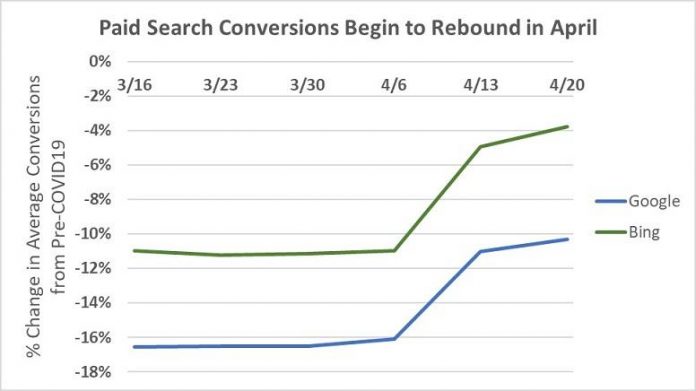
According to Mark Irvine, director of strategic partnerships at WordStream, running even limited ads now can help make re-opening more successful. As you prepare to ramp up your business, you need to ramp up your marketing in advance to make a splash on day one.

The question of when to start advertising online again seems simple, but there are so many things to consider. Should you ramp your spend back up now or is there a threshold to wait for? Should you reactivate any paused accounts or is waiting until more businesses are reopening better? How do you know when it’s time to start advertising on all channels again?

If your business isn’t ready to operate at 100% capacity yet, then think of how you can get the most out of your best customers first. As a marketer, you know that what works on one channel might not work on the other.

Here are the strategies you can start with:

1. Build out audience lists for your past customers

If you’ve got their email or contact information, you can use those customer lists in both Google Ads and Facebook to specifically target your ads to just those audiences. On average, your past customers will be three times more likely to convert from you when they search for your product than a new customer, and they often spend far more than your new customers.

2. Build lists for prospects or past website visitors and target them separately.

Someone who was considering buying from you in March is still a lot more likely to be considering your brand than someone who just started searching today.

3. Remember that new customers still take time to consider your brand, product, and the competition before buying from you

If they don’t immediately convert, don’t fret! Consider testing lower friction CTAs or adding a popup to your landing page to collect their email or contact information. Then you can add these new prospects to your drip campaigns and remarketing efforts and help them convert when they’re ready.

For more ad spend tips, visit www.wordstream.com

Primedia Outdoor Joins #SendingLove Digital Out of Home Campaign

Launched by outdoor specialist Talon Outdoor, the socially-enabled DOOH campaign is facilitated by The World Out of Home Organisation (WOO) and many of its member organisations and runs on advertising space donated by over 70 media owners across 153 cities, making it the biggest user-generated content (UGC) campaign ever to run on digital Out of Home.

‘#SendingLove’ is a new global initiative promoting messages of love that unite communities all over the world during the fight against the effects of Covid-19. The campaign shows user-generated messages of love and unity by displaying them on digital Out of Home screens worldwide with social media amplification, ensuring the messages are seen by millions – at home.

Created by Grand Visual, the campaign encourages participants to send love to those in places they cannot travel to, by getting creative with the heart-hand symbol and uploading their pictures and locations to www.sendinglove.to. Participants are then given the option to donate to the global Covid-19 Solidarity Response Fund before receiving a photo of their picture playing on-screen in their chosen city to share with friends and family across social channels.

The campaign is facilitated by Plexus, Talon’s global OOH network, who along with their partners have built a campaign with a total OOH media value of R258 million ($15 million). Primedia Outdoor is on-board to help display messages of love to people in Johannesburg, Pretoria, Cape Town, Durban, Windhoek, Lagos, Gaborone, Mbabane, Maseru and Lusaka. The system developed by Grand Visual geo targets messages to the chosen city, connecting communities to messages of love from afar in a show of global strength and solidarity.

Jorja Wilkins, Marketing and Marketing Services Executive for Primedia Outdoor said, ‘We are delighted to be on-board and displaying messages of love and unity from around the world to selected places in South Africa and Africa. Despite the constraints of lockdown, it is great to see the Out of Home community coming together to fight the effects of Covid-19, and social distancing in particular, with a campaign that connects and reassures people that we are in this together.’

Frank Bryant, Group Chief Operating Officer, Talon said, ‘It’s great to see an initial idea to share love between countries grow into a powerful multi-channel concept. Centrally coordinated by our Plexus team, the collaboration from our global network, and the industry as a whole, has been truly inspirational. The willingness to make this happen by all has delivered a media first for user-generated OOH creative whilst raising money for the global Covid-19 Solidarity Response Fund.’

Dan Dawson, Chief Creative Officer, Grand Visual said, ‘We set out with one thing in mind: to provide people with the opportunity to send love to their favourite places around the world. With an internationally understood heart-shaped hand signal at the centre of the creative, we could share the love in cities the world over despite the constraints of lockdown, with shareable content further extending the message via social channels.’

PRIMEDIA OUTDOOR
+27114751419 
jorja@primeoutdoor.co.za
www.primediaoutdoor.co.za

Data And Innovation Foster Meaningful Customer Relations

Robin Fisher, regional VP of Emerging Markets at Salesforce, says the company’s research found that standards of customer engagement are shifting again, and that marketers in South Africa are prioritising innovation in a radically altered landscape. 

Salesforce’s State of Marketing report shows that as technology drives customer expectations to new heights, marketers in South Africa have emerged as not just messengers, but engagers who foster meaningful customer relationships well beyond the first purchase. 

Robin Fisher, regional VP of Emerging Markets at Salesforce.

In addition to new regulations, marketers in South Africa expect that an expanded online population and wearables will bring transformational impacts by 2030. Marketers are anticipating that the online addressable market will increase as people get connected more than ever before. 

For this report, Salesforce collected data from nearly 7000 marketing leaders across the globe, spanning six continents, just as the Covid-19 crisis emerged. The Covid-19 crisis is forcing marketers in South Africa to rethink every aspect of their business – from strategic priorities and challenges to the technological and team skills they will need — as they navigate getting back to work during a global crisis, and then continuing to transform the customer experience to be best positioned for success in the years ahead. The insights in this year’s report are a helpful guide for marketers as they journey to recover and transform their business.

The trends revealed in the report were collected from marketing leaders from B2B, B2C and B2B2C companies across 30 countries, including 200 respondents from South Africa, which showed the following:

  • Marketing transformation takes on new urgency: the expectations and behaviours of consumers, businesses, and society at large are shifting with unprecedented speed and magnitude. Marketers are at the forefront, with 76% in South Africa leading customer experience initiatives across their companies. This involves a combination of both technological and organisational innovation. In South Africa, innovating is a top priority for marketing leaders, while balancing personalisation with customer comfort levels is a top challenge. 
  • Customer data sets the stage for empathetic marketing: as customers navigate a series of ‘new normals’, personalised, empathetic engagement has never been more important. Delivering messages and offers that resonate with an individual’s unique needs and expectations requires deep insights. Marketers are shifting how they source and manage customer data and ramping up the use of technologies like Artificial Intelligence (AI) that help them make the most of it. In South Africa, marketers are expected to go from 4 data sources in 2019 to 6 projected data sources in 2021 and 91% report the use of AI with personalising experiences in individual channels being a top use case.
  • Marketers double down on business value: as businesses shift from crisis triage to recovery and adaptation, marketers have a unique opportunity to turn trusted customer relationships into business value. Marketers increasingly track metrics like customer satisfaction, digital engagement and lifetime customer value to gain a holistic picture of what’s working and what isn’t across the customer journey. B2B marketers have a particularly strong role in business growth through account-based marketing (ABM). In South Africa, 60% of marketers track customer lifetime value (LTV) to measure success. 
SALESFORCE 
salesforce.com

Practical Tips On Advertising During A Pandemic

Herman Degener from The MediaShop.

According to The MediaShop’s Herman Degener, there is no one-size-fits-all solution here, and no panacea. However, by weathering the same storm, there are some useful nuggets of advice from the intellectuals at WARC which he feels will provide a slightly elevated sense of ‘we’ve got this’ after reading them.

Isla Prentis from our Tirisano Consulting division pointed out in her sobering post ‘A lesson in humanity ’, we are all in the same storm, but in different boats. If your daily grind is remotely related to the marketing segment, you’ll probably agree that there is more ‘how to market in a recession’ research around than you can shake a stick at. Who does one turn to in times like these for advice, especially when there’s a cacophony of opinions? The short answer is a trusted advisor, and WARC is one such advisor. 

Five actions to take now as an advertiser

1. Review your lockdown playbook

The burning question in South Africa, and globally for that matter, is: will lockdowns intensify again to combat future outbreaks of Covid-19? Using lessons learnt from the past can help a brand prepare for further recurrences. One of the big themes of the current lockdown has been acts over ads, but can brands sustain an altruistic approach?

Dale Partridge’s book ‘People Over Profits’ suggests this is a sustainable business strategy in a world of collaborative consumption, and perhaps one way to try and balance the two is for brands to invest in real actions, which consumers might applaud on social media (offline actions drive online conversations). 

2. Keep advertising, if you can

There is plenty of evidence from almost a century’s worthy of research to validate the notion that brands who maintain ad spend in a recession, will prosper post-recession. Cutting too hard has long-term impact on sales, market share, growth and ROI. Those who maintain their spend not only proposer post-recession but also recover quicker as a result. 

The advice to keep advertising won’t apply to all brands, however, as the hardest-hit companies will be focusing on saving jobs and business continuity.

Here are a few tips for those brands that are fortunate enough to keep advertising:

  • Don’t panic and stop brand advertising unless you absolutely must. Media costs are lower and there’s less noise from competitive brands in your sector.
  • Maintain brand campaigns unless it jars with the public mood. Use emotional, warm advertising that fits (and lifts) the public mood.
  • Look for tactical opportunities to create goodwill with customers: tap into first-party data and seek to enhance the customer experience. Remember it costs 5 times more to gain a customer than to retain one. Random acts of kindness in times like these are certain to drive immense positive sentiment and earned media for your brand.

3. If you have to reduce adspend, use other levers to remain visible

Even outside of recessions, there are always levers to pull that are low cost, high reward opportunities for brands. One is the use of first-party data (as alluded to above) to keep customers informed, remind them of seasonal events, and even to drive referrals and good old positive word of mouth.

In addition, brands can also:

  • Use owned assets to communicate: it’s often less expensive to target your social media page’s followers than compete for new audiences. Noting the reality of low organic reach when a brand posts an update on social media, invest in ensuring your messaging is seen by more of your opted-in audience before investing in acquiring new audiences.
  • Consider PR and partnerships to generate earned media: consider partnering with other brands or influencers who have a mutual interest in solving a particular problem, with each bringing their own expertise or capital to the collaboration.
  • Leverage your brand’s equity to collaborate with your own audiences and relevant influencers to help solve an original content challenge. This is particularly useful when focusing your limited resources in the build-up to key selling seasons. 

4. Look for signs of new habit formation

The Covd-19 pandemic and subsequent lockdowns have given rise to all manner of new consumer behaviours, chief among them being online. This is especially prevalent amongst older consumers who are adopting online shopping. The time it takes to form a new habit and the time we’ve been in lockdown are not mutually exclusive, so there are definitely opportunities for consumers to try new brands and/or products. This is because the pandemic mirrors the psychological traits where people are more likely to try new brands when they go through a life-changing event, such as marriage, a new job or the birth of a child.

A strong initial experience can help cement these new habits. This could range from free delivery of goods bought online, unexpected bonuses for new customers (akin to my point above about making your existing customers feel extra special being a winning strategy), or information about how your brand is helping frontline workers during the crisis. All these actions can create a positive memory for new and existing customers alike, which they will recall as and when we enter recovery.

 5. Innovate, or die (and no, discounting is not innovation)

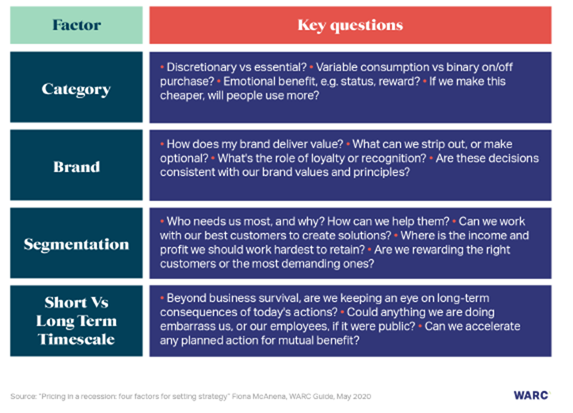
As the saying goes ‘necessity is the mother of invention’, and never before in the modern era has innovation, or ‘out-of-the-box’ thinking, been so needed both on the supply and demand side (no I’m not talking about the programmatic media buying ecosystem). WARC cautions that discounting is not innovation and it can lead to long term damage to your brand. Plus it creates downward pressure on margins. Rather rethink what value your brand creates for consumers. Here are some key questions to ask when revising price in a recession:

Given the current or at least inevitable recession, being driven by a pandemic and not an economic event, the impact is being felt across the entire value chain, from supply through to demand. Even where there has been demand, many brands have simply not been permitted to service it. 

For a copy of the WARC document, send a request to herman.degener@mediashop.co.za

THE MEDIASHOP
www.mediashop.co.za

Nedbank IMC Conference 2020 Going Virtual

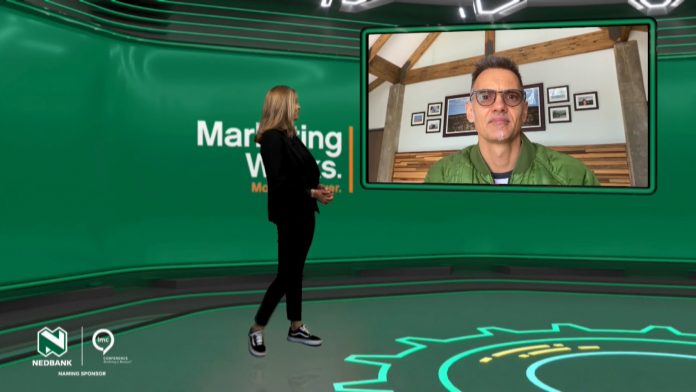
The Nedbank IMC 2020 conference was due to take place in March but was postponed. Modern Marketing is a proud media partner of this virtual marketing conference in South Africa, the event is scheduled to go virtual on 24 July 2020.

Dale Hefer, IMC CEO said, ‘Thought leadership is needed now more than ever. Business is looking to marketing to guide the way and never has marketing had a better opportunity to prove its worth at the boardroom table.’

The updated conference theme is ‘Marketing works. More than ever. Work it’ and will be screened live from a virtual studio. International keynote speaker, Fernando Machado, the Global CMO of Burger King, will be joining from Miami. Patrick Collister, author, speaker and advertising guru, will be joining from London. ‘This is no death by conference call. Our virtual studio is fantastic, and we really want our delegates to feel as though they are right there with us,’ said Hefer.

‘The good news is that there is now lots of room for more people to join us online,’ said Hefer. ‘Our Ted Talk format with 18 top thought leaders presenting in one day remains in place,’ she said.

The Nedbank IMC will be donating the interest of paid-up delegates from the original date of the conference (19 March) to the new date (24 July) to the Solidarity Fund.

  • The agenda will remain the same, although the start has moved later to 9am. Please note that the agenda may be subject to change.
  • It is recommended that you have access to WiFi of 20 megs per second or more.
  • The conference will flight on any smart device.
  • CPD (continuous development) points for MASA members will apply as before.
  • The presentations will remain online (for registered delegates only) for at least one month after the conference for easy access.
  • The winners of the Nedbank IMC 2020 bursaries will be announced.
  • There will be prizes, including cash and IMM online short courses
    .

NEDBANK IMC 
www.imcconference.com

Net#work BBDO Appoints New Partner And CCO

Roanna Williams, new partner and CCO of Net#work BBDO.

Net#work BBDO Group CEO, Boniswa Pezisa, announced the appointment of Roanna Williams as the new partner and CCO.

Williams, whose previous work experience includes Joe Public United and Black River FC, said, ‘Net#work talks about being an African agency at the southern tip of the world, ready to turn the world upside down. I am looking forward to creating impactful, behaviour changing work with the team.’

Marking the agency’s 26th anniversary, Pezisa paid tribute to their founders, ‘Our agency was born 26 years ago today, at the height of the state of emergency – a time when our country was in a lockdown of a different kind. Only Mike Schalit and Keith Shipley – the eternal optimists – would see it fit to create and build something new against that kind of backdrop. They will keep sailing their ships of creative for good. They still have so much to give.’

‘In the middle of a global crisis, a milestone anniversary, and a significant appointment, I wanted to remind you that the agencies that will triumph are the fearless ones, the ones who will do things differently, who will innovate and re-innovate, and move on. It is not lost on me either that at this time, Net#work BBDO will be led by two women: a streetwise girl from Zola who doesn’t suffer fools and a creative that is much more: a tireless creator,’ said Pezisa.

NET#WORK BBDO
+27119124444
info@networkbbdo.co.za
www.networkbbdo.co.za

Spheralytical Announces Chief Marketing Officer

Shannon Atherfold new Chief Marketing Officer at Spheralytical.

Spheralytical appointed Shannon Atherfold as its Chief Marketing Officer with effect from 1 June 2020.

Dr Jan van Niekerk, the company’s CEO said, ‘We are excited to welcome Atherfold to the Spheralytical team. We can now truly offer clients everything from A-Z, eliminating the need to consult with multiple agencies. Atherfold, who has 13 years’ experience in the communication’s industry, will help us expand our offering to include expert copywriting, PR, positioning, crisis communications and media training. She will also drive the growth of our data science division, where we will assist clients in analysing and monetising their data.’

Atherfold was previously Head of Digital at global communications consultancy, Instinctif Partners Africa, where she was responsible for the digital, content and creative practice area. 

Her focus includes digital audits and strategies, search engine optimisation (SEO), search engine marketing (SEM), social media, web diagnostics and workshops. In addition to being a digital and accredited SEO practitioner, Atherfold has a solid knowledge of corporate communications and public affairs, and is a specialist writer.

SPHERALYTICAL
+27119120000
info@spheralytical.com
spheralytical.com

Modern Marketing Launches LIVE Platform For The Latest Digital Industry Trends And Content

Keeping up with the global trend of being agile and maximising online technologies, Modern Marketing’s new LIVE online platform will allow audiences to experience product launches, webinars, events, video tutorials and the latest industry trends from the comfort of their personal spaces.

The LIVE Platform will feature interactive content across different online platforms (Webinars, YouTube, Twitch, Facebook Live and more).  Attendees will have the chance to: speak to industry professionals; learn new skills in our more technical webinars featuring industry experts; address business bottlenecks; be introduced to new products; discuss the latest industry trends as well as experience virtual demonstrations of the latest product launches and more. 

The LIVE platform is an opportunity for you to connect with our large audiences, demonstrate your latest product launches while addressing educational industry trends, and offer value in the form of technical expertise and industry experience, as well as helping businesses to re-evaluate their processes; change their entire way of working, step up, innovate and find the opportunities.

View our exciting content so far here: https://modernmarketing.co.za/live/

MODERN MARKETING
+27114501650 
info@modernmarketing.co.za
www.modernmarketing.co.za
This is Modern Marketing