TransitGo is an insights community developed by Transit Ads in partnership with Opinion Solutions, a mobile research company that provides consumer-centric mobile research services and engagement platforms that consumers can relate to.
Transit Ads put its time behind closed doors during the nationwide lockdown to good use and developed the new product, that can provide brands with regular insights directly from their targeted consumers. TransitGo is the first of its kind in South Africa and taps into the country’s diverse commuter market, with a focus on using simple research techniques to gather valuable insight from commuters in key commuter nodes around the country.
TransitGo is an effective research solution that is now able to deliver tangible results and insight for brands and will greatly enhance our understanding of this very important consumer segment.
It also provides consumers with a platform on which to express their opinions on the advertising they are exposed to, whilst embracing a more consumer-centric marketing approach. All of this through a series of panels, with a minimum of 1000 commuters on each panel at any given time. Surveys are released once a week and commuters are incentivised for their time.
Survey topics include questions on a vast range of industries and behaviours, including shopping habits, shopping behaviours, brand recognition, effectiveness of transit media platforms and more. Further to that, questions can be altered almost instantaneously, providing brands and advertisers with even more granular detail pre, during and post-campaign.
‘Research is such an important marketing tool, as it has the ability to inform and direct a campaign, particularly if you’re gathering first-hand insight from your target audience,’ said Shamy Naidu, Transit Ads Executive. ‘For example, research conducted prior to the start of a campaign can deliver findings that result in the adjustment of campaign messaging, with a more tailored approach focused on the commuter segment in question. Very simply, Transit Go is a highly-effective research tool that is all about determining exactly what your target audience wants to see and hear.’
‘We are creating an opportunity to gain insights into the commuter market that cannot be done anywhere else,’ said Naidu. ‘Not only can we test the effectiveness of an ad on Transit TV, for example, but we can now also do research into what time of the month/day is best to play a certain ad for it to resonate more with commuters. By conducting research over an extended period of time, we can also start identifying key trends within the commuter market.’
Insights
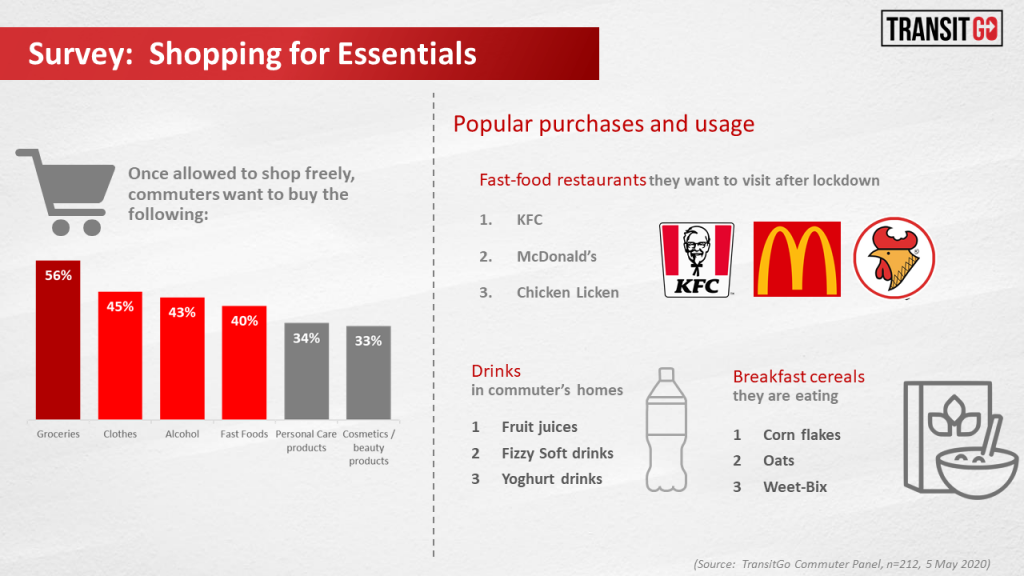
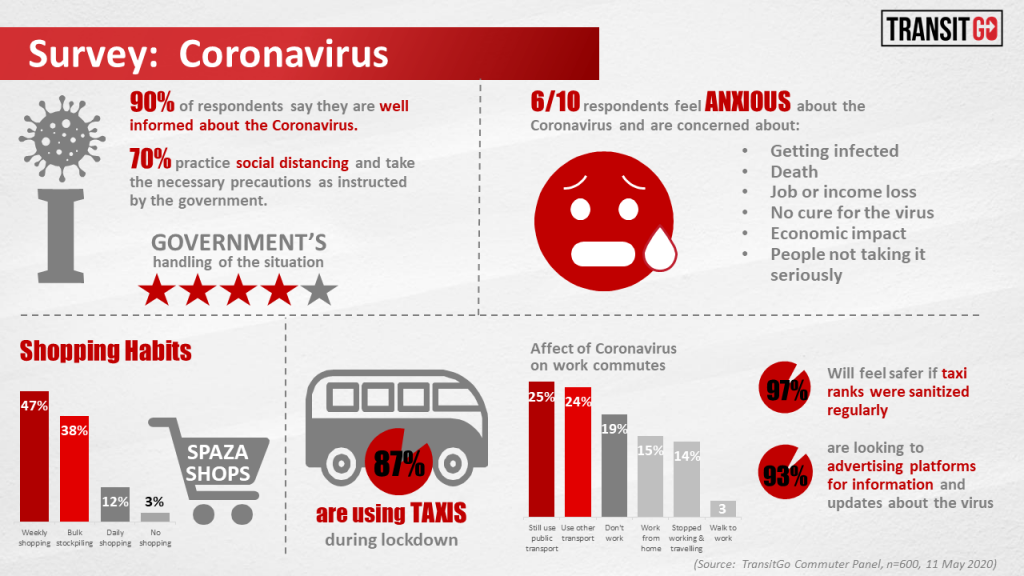
Insights need not only be based on extended or continuous research studies but can also take the form of dipstick research when the need arises. By way of example, a TransitGo sample study around behaviour during the Covid-19 pandemic delivered some interesting results (shown below).
‘Now more than ever, commuters are digitally savvy and as a result enjoy increased levels of convenience, simplicity and knowledge. Engagement with them today is on their terms. They want to co-create, share their opinions about a product and service, and more so than ever, they expect to be heard, so research and gathering feedback from them must evolve,’ said Tanya Tonder, Managing Director of Opinion Solutions.
Specialist youth agency HDI Youth Consultancy has merged with marketing experts Yellowwood to ignite growth in the youth market space. Housed within the South African collective of TBWA\, The merged entity is geared to maximise insights covering the full spectrum of the South African youth market.
It will leverage HDI’s existing knowledge base, IP and tools, which will combine with the structure, insights and intellectual firepower of Yellowwood to create a formidable proposition. According to TBWA\SA Group CEO, Luca Gallarelli, the merger has been in the pipeline for quite some time and in line with other shifts aimed at creating greater clarity and synergy across the TBWA\SA collective throughout the region.
‘HDI was established as a specialist agency in 1996 and this merger builds on its strengths as a pioneer in the development of the youth market. This merger is a significant investment in this space designed to harness the implicit strength of Yellowwood and consolidate its role as a central part of Africa’s most integrated communications collective.’
The offering will integrate into and collaborate across the rest of the TBWA group in South Africa, comprising a South African collective of more than 500 creative minds across TBWA\Hunt\Lascaris, Grid Worldwide, Sting Content Production and Magna Carta. It also provides a strengthened area of capability across the TBWA collective on the continent, which expands into 47 countries across 28 agencies.
The consolidated entity will be headed by Yellowwood MD Refilwe Maluleke, who said that the merger strengthens the consulting offering of Yellowwood through the youth capabilities, insights and tools of HDI while sharpening and enhancing the executional ability of HDI.
Keeping track of how youth interact with and respond to brands is imperative in the digital age and market-leading HDI initiatives like the annual youth brand preference and consumer behaviour survey, Sunday Times Gen Next – now in its 16th year – and #thenext campaign – a new initiative aimed at developing key insights affecting the youth market during the Covid-19 pandemic – will be fully supported and developed further through this merger.
TBWA\SA is committed to supporting the development of youth across the country and believes a vibrant and educated youth sector is crucial if South Africa’s economy is to reach its full potential.
‘The Covid-19 crisis has given everyone an opportunity to pause and reset, an opportunity we intended to capitalise on. As the collective in South Africa continues to reshape itself in line with the ambitions we’ve set for ourselves, we’re excited that this move ensures TBWA\SA is extremely well placed to benefit from the future growth of the youth market across Africa,’ said Gallarelli.
Accenture has appointed Haydn Townsend to head Accenture Interactive in Africa, a new breed of agency that is digitally-focused, experience-led and engineered around experiences and outcomes.
Vukani Mngxati, Chief Executive Officer of Accenture in Africa said, ‘It gives me great pleasure to announce the appointment of Townsend. He is an exceptional leader with solid cross-functional marketing and advertising experience in areas such as brand management, sales, activations, digital, social and sponsorship.’
Townsend’s career spans value contribution in various leading management roles on both client-side and in the agency world. Prior to joining Accenture Interactive, he was the Group CEO for Wunderman Thompson. He has worked at Multichoice, Warner-Lambert, Pfizer, GHFM and others before crossing the floor to Ogilvy, The Jupiter Drawing Room and Aquaonline – to mention a few, in the past 25 years.
‘I’m excited to be part of the Accenture Interactive business, where I’ll be able to focus more on innovative experiences, tapping into the scale of our parent company and building consumer-facing digital and communication offers for brands,’ said Townsend.
‘What fascinates me about Accenture Interactive is the fact that its offerings speak to what today’s CMOs need. In the past, the biggest lever we could pull in the marketing mix was communication. Whilst it certainly hasn’t died, we have seen brands that offer better consumer experiences delivering greater ROI. Accenture Interactive owns the customer experience space and believe the digital transformation, done right, requires overall business transformation. This is what the future looks like today,’ added Townsend.
Mngxati stated that the future of business will be more driven by experiences and new ways of engaging with customers. ‘It has been critical for us to strongly focus on design and experience-led capability. This has been affirmed through some of the acquisitions we made globally in the past,’ said Mngxati.
South African full-service PR and Communications agency, Greater Than, has announced its sister company, GTi Communications. Based in Israel, GTi Communications will be servicing the European, Middle Eastern and African markets (EMEA).
Having insight and hands-on experience into the world of business, Owner and Managing Director, Galia Kerbel, who immigrated to Israel 3.5 years ago, saw a gap in the market that needed to be filled. ‘Over the years, Greater Than has established itself as the full-service PR and Communications partner of choice to some of the world’s leading brands and companies. With this proven track record, we’re excited to expand our integrated offering into new markets and contribute real business value to our clients through our strong global network, local expertise and commitment to delivering hard-hitting measurable results,’ commented Kerbel.
She continued, ‘A majority of brands structure their operations and marketing efforts according to international regions, of which a major one is EMEA. As we have the insights, capabilities and network to launch and grow our client’s brands within this viable market, this is a perfect opportunity for global brands. Together with Greater Than’s long standing in-country partner, Eclipse Communications, as well as additional like-minded, in-country partner agencies, we are able to offer an EMEA solution based on our widely spread expertise.’
The company will serve local brands wanting a reputable communications agency on-board to grow their business in Europe, the Middle East and Africa. ‘Since the mother-tongue in Israel is Hebrew and with our experience in the industry, we were perfectly positioned and skilled to create clear and effective messaging that makes an impact,’ commented Kerbel. GTi Communications will also service global brands looking for an in-country partner in Israel that offers Western service with local expertise.
‘Our differentiator is that we deliver service excellence as well as results. We are also able to bridge various gaps for our clients – mainly culture and language gaps. We understand the intricate and critical nuances to deliver on-strategy and day-to-day implementation and opportunities.’
According to Stuart Walsh, Head of Strategy at Grey Advertising Africa, a market segment is not a group that just shares similar demographics; it is a group of consumers who think, behave, or respond in similar ways to similar events or stimuli. For it to be useful, a segmentation scheme must meet two simple criteria:
1. It must explain the variance in particular behaviours better than other available variables.
2. Consumers within segments should have more in common with each other than with people outside the group.
Stuart Walsh, Head of Strategy, Grey Advertising Africa.
Apart from these objections, and those from psychology, is the inherent cultural bias that accords events like 9/11 far more significance than events that may have been more directly experienced by the 1.5 billion ‘Millennials’ who live outside Europe or USA e.g. the 1994 South African election. Even if generation theory really were scientifically sound, would it serve a useful purpose in marketing? Are generations a good way of segmenting markets?
As Professor Mark Ritson said, ‘Unless you can prove that this demographic group actually thinks and behaves differently from others, your segment is not a segment at all. It is just a crap stereotype on which you will first pile a bunch of assumptions and then later your product.’ Unfortunately, as he added, time after time and study after study what the researchers actually find is that, ‘Apart from being younger, friskier and poorer than the oldies ahead of them on the demographic motorway of life, they are actually remarkably similar to everyone else.’ In fact, what research repeatedly shows is that supposedly different older cohorts are just as likely to agree with a Millennial as disagree.
‘Todd Yellin, vice-president of product innovation at Netflix, has described traditional demographics as ‘almost useless’ because there are ’19-year-old guys who watch Dance Moms, and 73-year-old women who are watching Breaking Bad and Avengers.’
In fact, demographics have only ever offered a rough proxy for expected behaviour. Lumping consumers into generations based on when they were born is among the crudest forms of demographic segmentation, and when we live in a world rich in behavioural data, so unnecessary. Past behaviour is a far better and easier predictor variable than a generation-demographic.
Basing decisions on flawed theory and massive generalisations that perpetuate stereotypes rather than let us see people for the individuals they are, will always lead to poor advice and bad strategy — ideas that will end up wasting resources on special treatment and prioritisation for groups who do not actually warrant it.
Google the phrase ‘generation gap’ and you will be rewarded with 16.5 million results to sift through. Even Bing will find 6.7 million hits for you. And Yahoo will reveal just under 7 million. Clearly, there is a lot being said by a lot of people in a lot of companies on the topic of generations.
What a pity then, that so much of it is unadulterated nonsense. The idea of generations, distinct, neatly defined groups of people who are roughly the same age and who’d have been influenced by the same set of events, is not a new one. Even Cicero mentions them, ‘What nobler employment, or more valuable to the state, than that of the man who instructs the rising generation?’ And that was in 43B.C., so it’s safe to say the concept goes back a few years.
Contemporary generation theory rests on the assumption that cultural events determine personality and value systems more than do life experience and circumstance. And that these values will remain relatively constant as a person ages. Simply put, when you were born affects your attitudes, values, and behaviours more than your life experience, social class, circumstance, politics, etc.
Sound familiar? It is the kind of logic you find in the horoscope section. And just like astrology, while the idea of generations has some intuitive appeal — who does not know someone fitting the Millennial or Gen-X bill perfectly? — the science just does not support it. What the science explains instead is that most of the findings showing distinct generations can be explained by other causes, or have serious scientific flaws, or both. Solid evidence for any of the major aspects of the theory is completely lacking.
Science shows that a large part of generation theory can be explained by Inappropriate Attribution of Cause. For example, Millennials may very well score lower on job satisfaction than Gen-Xers. But are Millennials really a less satisfied generation? Early in their careers, Xers were also less satisfied than baby boomers. As people get older they are more likely to leave jobs they do not like and migrate toward ones they do.
Similarly, on average, Millennials are no more narcissistic now than Xers or boomers were when they were in their 20s. Because people in their 20’s have always tended to be narcissistic. They may be more narcissistic today than Xers today, but they are not as unique a generation because of that.
A final example is an assertion that Millennials are ‘financially illiterate’. Perhaps they are. But then, who in their early twenties is not? There is not a Boomer or Xer alive who could balance a chequebook at that age.
All of these are examples of just one particular type of Inappropriate Attribution of Cause, the Age Effect, where observed differences aren’t really part of some extraordinary new psychographics to have evolved in our species. They are just part of a phenomenon scientists define, in technical terms, as ‘being young’.
So, if you’re ‘excited by the opportunities the Millennial generation offers for your brand’, sadly, we are not the agency for you. But if you go back to Google and search ‘generation consultant’, you’ll find there’s a good few million companies who will gladly take your money.
Denny Mushrooms wanted to show their solidarity with the restaurant industry and at the same time raise awareness around mushrooms as a delicious and healthy ingredient. The company tasked Workbench with creating a campaign in a very short space of time against the marketing objective.
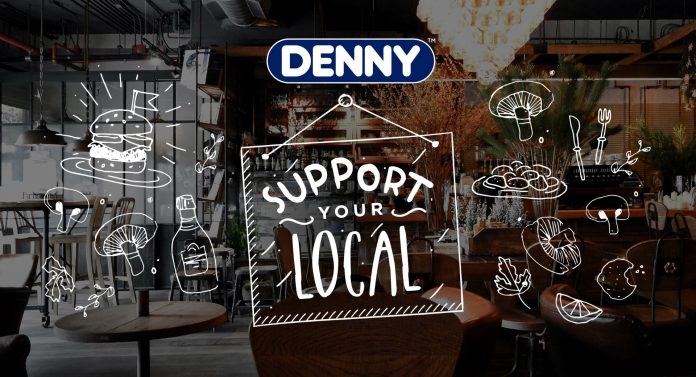
Workbench conceptualised the Denny Support your Local initiative, which called out to communities to support their local eatery during the Covid-19 pandemic. Allied to the campaign was communicating to the restaurants to get them to register a crowdfunding account and register on the microsite, www.dennysupportyourlocal.co.za, which is still open for contribution. In four weeks, 123 restaurants registered on the microsite. There are now over 37,700 visits to the microsite, 12,711 total votes and the ROI on awareness is: 1:10
The question was: how do you take a limited budget and timeframe and turn it into an impactful brand campaign that not only does good for the brand but also does good for the brand’s clients and the community at large?
The call to action and the awareness campaign was delivered in terms of encouraging the general public to vote for their favourite eatery and help raise funds. Denny committed to giving the restaurant with the most votes R10,000 and a three-month supply of mushrooms.
Michael Cook, Managing Director of Workbench, said, ‘These unprecedented times have made all brands relook at their strategies and spend. Gone are the days of bulky agencies who theorise more than making things happen. Creativity has always been about being resourceful with what you have, and letting constraint push you further and faster.’
Martin Sing, Head of Planning at Workbench, said, ‘Together, with creative partners – Twiga Communications, No Menumedia specialists, The Squad and 1cstm – the campaign was synchronised in such a way that it achieved way more than expected, and added to CSI projects already implemented by Denny Mushrooms. The beauty of the initiative is that it lives on beyond the campaign timeframe. It will continue to provide awareness and an avenue for communities to support their local eatery, which is great.’
Samantha McChesney, Denny Mushrooms Marketing Director, said it was important that the Denny brand stood up and was counted in the crisis. ‘Even though our business was under pressure, the Workbench team found a way to achieve our brand objectives as well as provide a platform that tastefully and genuinely helped restaurants. The feedback has been wonderful.’
Michael Gullan, co-founder and Managing Director of G&G Digital, states that while adjusting to a new way of working, businesses are embracing technology and employees are learning new skills, as they look at digital tools and platforms to stay connected and productive.
The Covid-19 pandemic forced millions of people around the world into lockdown and social distancing to help control the spread of the virus. This public health crisis is also driving businesses to implement remote working to ensure business continuity.
Webinars are essential in today’s environment, as they put back the human connection and assist in enhancing collaboration that many people crave while working remotely.Marketers may be in crisis mode right now, but the benefits of webinars present a new tactical opportunity. All you need to do is move fast and get your webinar strategy in order to replace the revenue you were generating from areas that are no longer an option.
Webinars have a myriad of performance-enhancing benefits that include the ability to engage with small to large groups, interact with the audience in real-time, record sessions, as well as reporting and analytic tools. Whether a virtual team building, onboarding of new employees, launching a new product or service, or a product demonstration, webinars are a powerful tool that can assist organisations strategically.
Here are four ways webinars add value
Encourage open dialogue
Webinars allow for real-time questions from the audience, no matter where they are. Presenters can easily weave audience questions and comments into the presentation and provide real-time feedback. As webinars are live events, they are more conversational as presenters can ask the audience questions, encouraging engagement.
Position organisations as industry experts
Inviting experts to join in, organisations can expand their reach to other businesses and potential customers, as they position themselves as leaders in their industry.
Soft selling
By using webinars effectively, businesses can teach, and sell their products or services at the same time, in a more organic way. And the registration process allows organisations to build a database, along with an opportunity to attract new customers.
Gaining insights
Although webinars are live events, they can be recorded to review and use in the future. These recordings offer opportunities to gain insights into attendees’ behaviour and inform future topics. And if used successfully, analysing questions asked during webinar sessions can also help inform an organisation’s content strategy.
Webinars are much more than a product launch or demonstration. They are an excellent marketing tool that offers organisations an opportunity to convert attendees into customers, all while being cost-effective to deliver an essential marketing role. With an opportunity to expand the business and stay top of mind, webinars are the beginning of a new way to engage organisations and take your business to the next level.
Our Modern Marketing Digital TrendCamp video features Billy Lascaris, Managing Director of Matriarch Marketing JHB, whose video focuses on recession-proofing your brand.
The video is live on our YouTube channel – don’t forget to subscribe to the channel for more videos on advertising/branding/marketing trends and topics.
Send a 3-4 minute audible video of yourself at home. The video should be about a general advertising/branding/marketing trend/topic (not a product or company promotion).
As lockdown restrictions continue, being purposeful as a brand matters more than ever before. Kantar and SA Breweries share the importance of looking beyond consumer insights to also tap into cultural aspects when amplifying brand purpose from within, during the Covid-19 pandemic and beyond.
Some brands are still figuring it out, but it’s been proven time and again that brands with true purpose are growing, with Kantar Futures, Global Monitor and Kantar Purpose 2020 studies revealing that 80% of overperforming companies link everything they do to a clear brand purpose.
The essence of brand purpose is about defining your brand’s role in society to make better decisions, communicate more clearly and get behind what matters. Kantar’s global BrandZ tracking data shows that brands with a recognised commitment to purpose have grown twice as much over the past decade as those without it. The current Covid-19 pandemic has further amplified the need for brand purpose. Without it, you’re flying blind as life as we know it has fundamentally changed.
Where a crisis usually affects just one sphere of life, the impact of the Coronavirus has put our physical, emotional, social and financial wellbeing under threat, with the latest Kantar Covid-19 Barometer results for South Africa showing that we’re disproportionately concerned about the financial aspect. As such, consumers are now reflecting on what matters and reprioritising budget over blind consumption and impulse buys.
With 67% of consumers choosing tried and tested brands and 81% of consumers expecting a reassuring tone, it’s time for brands to act as a North Star in offering a measure of consistency in these turbulent times.
The double-digit surge in TV and social media use under isolation shows that consumers are more receptive to brand messages now, but be clear on your brand purpose as 91% of consumers say brands should talk about how they could be helpful in the new, everyday life. Brand purpose is what will help us get through the current crisis and prepare for the world beyond.
Four guidelines to being purposeful in the pandemic
1. Be clear
Define your brand’s role in society and be flexible to evolve to meet the new cultural context. Brands that are clear and authentic about their purpose are usually the first to engage with consumers in times of crisis, using this as an opportunity to build emotional connections. To get this right, brands need to identify the societal tensions and problems in a culture that the world is grappling with, then step up to define their brand’s unique role in solving the issue. In a time of crisis, those societal tensions are magnified and show up in new ways, making it the perfect time to communicate your brand values.
For example, to the societal tension of society setting unrealistic beauty standards with Photoshop, Dove responds as the champion of real beauty by boldly saying that courage is beautiful, garnering brand love for sticking true to its purpose:
2. Be authentic
Brand purpose must be anchored to the brand or category’s functional and emotional benefits, congruent with what consumers have always known about how the brand shows up in the world. This creates a golden thread connecting everything the brand is about to an authentic purpose. So, stick to what your brand stands for, as being inauthentic looks opportunistic in times of crisis. Without authenticity, brand purpose falls flat. Don’t be tempted to greenwash or exploit the crisis to your brand’s benefit as consumers are increasingly vigilant of opportunistic tactics.
Watch this TedTalk with Lifebuoy’s Dr Myriam Sidibe to understand how they’re excelling at promoting their reason for being – protecting society’s most vulnerable, while showing up with care and confidence as they stand for functional germ protection and emotional peace of mind:
3. Be active
At best, brand purpose creates movement in a tangible way by showing up when it matters most. At least 88% of consumers say they want brands to inform them about their efforts to face the situation, so now is not the time for brand purpose to live on a page or in silos in your organisation. Brand purpose is activated through communication touchpoints, brand activations and platforms as the Kantar Purpose 2020 study shows that 67% of overperforming companies deliver consistency across touchpoints. In times of crisis, activating your purpose means showing up when it matters most.
For example, Vodacom’s brand purpose is about connecting people today for a better tomorrow, and as such, it has collaborated with Discovery on virtual medical consultations during the crisis, offering the full school curriculum online and provided medical workers with much-needed technologies to track Covid-19 cases. It’s tangible action in line with their brand purpose.
4. Be an inspiration
To effectively engage with consumers, you need to infuse your brand purpose throughout the organisation. The call centre needs to be as passionate about the brand purpose as the CEO. Leadership needs to be brave and inspire hope in our darkest hours. This comes from the type of leader that MIT calls a ‘transcender’, who goes after institutional success while or by seeking benefits that are best for society and the world at large. Kantar Purpose 2020 shows that 85% of overperforming brands have a purpose supported by C-Suite leadership, so ensure your purpose is clear throughout the company.
The world is now at a watershed moment, where we can follow the old, broken model of chasing money and self-interest, of profit as the sole end, at the expense of people and the planet. Or we can bravely create a new world, where purpose fuels profit and profit fuels even greater impact. Imagine a world where brands and businesses solved society’s biggest issues and, in return, consumers chose those companies more often – creating a virtuous circle and ecosystem, where all players have a positive role, all roles are valued and society thrives.
Laurence D Fink, chairperson and CEO of BlackRock Asset Management said, ‘To prosper over time, every company must not only deliver financial performance, but also show how it makes a positive contribution to society.’
SA Breweries’ perspective on brand purpose
Covid-19 has presented an interesting opportunity for SA Breweries to fulfil its brand purpose, despite being unable to sell beer for over 60 days now.
Week one: Castle Lager has long sponsored South Africa’s national sporting teams, so it’s fitting that on the day lockdown was announced, they aired a commercial to support the ‘new national team’ – the attackers, defenders, keepers and captains on the frontline.
Week two: The benefit of their global footprint is the ability to share ideas quickly and scale them, such as the production of hand sanitiser and shields – taken as best practice from Brazil, thousands of bottles of sanitiser were produced in South Africa, which were distributed in partnership with government.
Week three: With restaurants and bars affected by lockdown restrictions, it was Stella Artois’s opportunity to set up a platform for consumers to pledge support in the form of post-lockdown redemption vouchers. The brand added 50% to the bill and has received over R1m in donations so far.
Week four: With Easter approaching, there was a strong need for a sense of belonging in a time where many usually go home to visit loved ones. Castle Milk Stout exists to celebrate heritage, so took the opportunity to urge elders to stay home with the message #HlalaEkhaya.
Week five: Now the attention was firmly on SAB’s tavern partners, suddenly unable to provide for their families. SA Breweries stepped up by partnering with Shoprite Checkers to distribute food vouchers, with 14,000 of the vouchers redeemed in just a few days.
Week six: With the surge in gender-based violence under lockdown, it was fitting to set up a WhatsApp helpline with Lifeline for those who couldn’t talk as their abuser may be in the next room. This initiative ties in with Carling Black Label’s call to recognise the champion within all men.
Most recently, Castle Lager celebrated its 125th birthday while under lockdown in 2020 and in solidarity with all those who had to put their own birthday celebrations on hold, pledged a voucher for 12 Castle Lagers. Set to be redeemed when we can all get together again, there have been 40,000 registrations to date.
This marketing run wasn’t about telling a story or making a statement, but an effort to reduce suffering and assist the frontline – all causes that touched the business and the families that form part of their value chain in wanting to make a real difference. It’s an incredible example of transcending to your true brand purpose quickly under pressure. Now more than ever, it’s on all of us to be brands that consumers can rely on, as there is no one-size-fits-all silver bullet for winning in these times.
Retail Industry Maintaining Consistent CX On All Channels
The Coronavirus has shaken up our assumptions and forced us to work, shop, consume media and interact with others in new ways. Whether brands like it or not, that means customers are re-evaluating many of their entrenched purchasing preferences, according to Grant Lapping, Managing Director at DataCore Media.
And right now, we’re collectively going through a profoundly lifechanging event in the form of the Covid-19 pandemic. These changes are mostly to do with people looking towards digital channels for convenience and safety during a time of physical distancing. Because we’re encouraged to stay home for the sake of our own health, growing numbers of South Africans are shopping online rather than going to the shops.
Grant Lapping, Managing Director at DataCore Media.
Charles Duhigg’s book, ‘The Power of Habit’ argues that one of the best groups to market to is pregnant women and new parents. Not only are they less price-sensitive, but they are also more likely to try new brands and products than most other groups. There is nothing quite like a life-changing event to break the habits that someone has built up over years and decades.
Some retailers are reporting increases in online demand in the order of several hundred percent and commentators say the Coronavirus has helped to push mass e-commerce adoption forward several years. This caught some incumbents wrong-footed – some large supermarket chains, for example, battled to accommodate a surge in demand for home delivery slots.
We are seeing similar effects across other markets. For example, when the pandemic is over, many people could stick with their home fitness routines rather than going back to the gym. Some may have learnt to cut and dye their own hair at home via online tutorials. More than a few will have realised how much money they were spending on takeaways or eating out.
Digital-born companies adapt more easily
Digital-born companies have been better able to adjust to the new world, and some of them have undoubtedly already hit their revenue targets for three or five years into the future. UCook, for example, was positioning itself for a world where people are moving away from dining at restaurants to eating at home.
Its dinner kits were in massive demand once the lockdown started, and it needed to limit orders to existing customers because it couldn’t keep up with new signups. It has since adapted with simpler recipes and fewer suppliers, which will create efficiencies that will benefit the business long past the lockdown.
HomeChoice, a homeware omnichannel retailer, meanwhile, managed to rapidly get its call centre agents ready for work-from-home. It could only ship limited essential products during the level 5 shutdown, yet continued to advertise and market aggressively. It built up its funnel by taking advantage of lower advertising costs and higher traffic on major platforms with less competition for quality audiences.
New habits are forming
As people try out digital channels more from need than choice, they become familiar with digital brands and experiences. They’ll often find them to be simpler and more convenient than the old ways of doing things. It will start as something they do to get through the lockdown, but eventually, it will be what they do by default.
In this environment, the pressure is on the challenger brands to provide a delightful, no-regrets experience, so that customers will stick with them after the lockdown is over. For incumbents, the question is: what they can do to bring customers back before a digital competitor becomes their first choice?
For many brands, this will start with the acceptance that consumer behaviour is likely to change permanently, as it tends to do after every major societal disruption. Those that have lagged in digital adoption will need to invest in enhancing their digital experience – from the front-end touchpoints to the logistics in the backend.
The transition won’t be an easy one, but there are benefits for traditional brands that take digital change seriously. For example, retail chains might be able to downsize their stores in upmarket suburbs in favour of home delivery. They can shave their rent costs, potentially boost basket sizes and use the customer data they collect to offer a stickier customer experience.
Depending on which politicians and scientists you believe, Covid-19 will be with us for a year to two years more. When we emerge from the crisis, the world of the consumer will have changed. Having shopped online for two years, for example, many people will be in no rush to do big monthly shops at the mall.
Companies that adapt at speed and scale during the lockdown will be best positioned for the next normal, whenever it emerges. Brands that do not reinvent themselves during this time to be digitally-led may struggle to remain relevant. Consumers are embracing digital – which means half-hearted digital strategies are no longer enough for brands that want to thrive in the future.