Home Blog Page 288

Ciclope Africa Festival Marks Another Celebratory Milestone For Joe Public United

Ciclope Africa Festival Marks Another Celebratory Milestone For Joe Public United

Every year, the Ciclope Africa festival showcases the continent’s best in film craft across a broad spectrum of film formats, including commercials, short films and music videos. Joe Public United has been named Advertising Agency of the Year for the third consecutive year at the Ciclope Africa Festival.

This came as the crowning achievement at the end of a (virtual) ceremony that saw Joe Public United with industry partner Romance Films being awarded across two categories, together with their client, Chicken Licken®. The brand emerged as a regular jury favourite in the categories of ‘Direction (over 90”)’ and ‘Animation’ for the ‘They Also Crave It’ campaign.

The show’s award selections were made after two rounds of online judging, followed by a video conference sitting. The final winners were decided by the top producers and creatives who comprised this year’s panel.

The integrated brand and communications agency is honoured to be recognised amongst some of the top film houses on the continent, viewing this as an affirmation of the success of a conscious drive to focus on excellence in film craft and emotive storytelling for their clients. Part of this drive is to demonstrate to clients the value that producing creative films at an award-winning international standard can contribute to the growth of their brands.

‘It is such an incredible honour to be judged as the top agency for the third year in a row. The diversity of the awards we received marks our commitment to delivering excellence across every aspect of the growth of our people, clients and country. At the same time, we are fortunate to have forged incredible alliances with clients who share our uncompromising belief in great creative work as a driver for proven results,’ said Xolisa Dyeshana, Chief Creative Officer, Joe Public Johannesburg.

JOE PUBLIC 
+27 10 591 7770
info@joepublic.co.za
www.joepublicunited.co.za

Warc Rankings Position Grey Group As Number One In Creative Effectiveness

Warc Rankings Position Grey Group As Number One In Creative Effectiveness

Each year, Warc, the global authority on effective marketing, tracks the results of the top global and regional awards shows for creativity, media and effectiveness for the Warc Rankings, the ultimate benchmark for advertising. Grey Group has ranked number one in creative effectiveness.

To assess how often creative work is also effective, and to uncover the main characteristics of ideas that are highly awarded for both creativity and effectiveness, Warc has analysed the results data from the creative and effectiveness awards shows tracked by Warc Rankings between 2015 and 2019. The findings are now published in Warc’s latest research, ‘The Health of Creativity’.

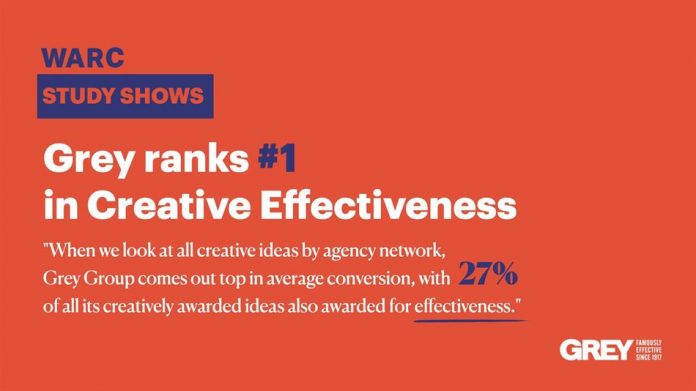
Research of all creative ideas by agency network, show that Grey Group comes out top in average conversion, with 27% of all its creatively awarded ideas also awarded for effectiveness. This rises to 50% of all highly creative ideas.

‘Grey has helped to launch, sustain, renew and reinvent great brands for many of the world’s great marketers for over 100 years. Our goal has been to be the world leader in applying creativity to solve our clients’ business challenges. To live, breathe and fulfil our ‘famously effective’ credo: crafting big, powerful ideas that resonate in culture to drive brand and business success, said Paul Jackson, CEO, Grey Advertising Africa.

‘We are delighted that Grey has come out on top as the most successful of all the major agency networks in creative effectiveness. Increasingly, advertising is an art and a science. The magic and the power of Grey’s ‘famously effective’ vision has made us a winner at both.’

The Warc Rankings provide the ultimate and independent benchmark for excellence in creativity, media and effectiveness. Their methodology is rigorous and transparent using five key stages to produce unbiased results.

The Warc Rankings are created with the industry, for the industry. They collaborate with marketers at all levels across agencies and brands to ensure the rankings remain relevant.

GREY JHB
+27 11 706 3060
www.grey.co.za

Machine Represented With Three Judges At 2021 Bookmark Awards

Machine Represented With Three Judges At 2021 Bookmark Awards

Ruddy Gatare, Robyn Campbell and Sarah Browning De-Villiers from Machine have been selected to judge at the 2021 IAB SA Bookmark Awards.

Campbell, managing director of Machine_ and head of the IAB SA Agency Council, will be the jury chair for the builders panel. Campbell said this year’s show will shine a light on the importance of effective work following the unprecedented year that was 2020. ‘At Machine, we believe in work that works, so I’m excited to see how the industry delivered just that during a time when brands needed it most. If brands ever wondered about the importance of marketing, I think last year reminded everyone of the power of enhanced customer experience, innovative digital marketing and the importance of connecting with consumers.’

In 2020, the IAB SA formed their new digital content marketing committee, which is led by Machine’s chief content officer Browning-De Villiers. So, naturally, she is thrilled to see the introduction of two new content marketing categories in this year’s show. ‘Content marketing puts the audience at the centre of marketing strategies and fundamentally understands the importance of adding value before pushing a product. I can’t wait to see the content marketing case studies and excellence that these new categories will unlock,’ said Browning-De Villiers.

Gatare joins the youth action jury panel, serving his innate passion for youth development in South Africa – which was recognised in 2020 when he was asked to join the IAB SA youth action council. ‘What an honour and privilege it is to be selected as a jury member; this is something I’ve always wanted to be part of. What’s even more exciting is that this is the first-ever youth action panel. We’ll be judging the work of future talent in our industry and this recognition is one of many ways we can truly invest in breakthrough talent.’

This year’s IAB SA Bookmarks will encompass digital advertising and marketing work that falls into eight categories: marketing, performance marketing, builders; publisher, social, community and influencer marketing, innovative engineers, best digital student and special honours.

MACHINE
+27 87 255 0334
jamie.rossiter@thisismachine.co.za
ThisIsMachineFacebookPage

Increasing Intrinsic Incentives Creates True Customer Loyalty

Increasing Intrinsic Incentives Creates True Customer Loyalty
Glenn Gillis, CEO of Sea Monster.

Glenn Gillis, CEO of Sea Monster, says the problem with most loyalty programmes is that they are better categorised as rewards programmes. These are built around the concept of extrinsic incentives or, more simply, the external reasons or rewards that motivate the buyer. For example, a shopper would collect points for making a purchase and then receive a discount the next time they shop.

Businesses and marketers alike employ extrinsic incentives because they are easy to quantify. But they are expensive (someone has to pay for that free coffee, after all). Conversely, intrinsic incentives are cheaper to maintain, but harder to grasp – because they boost individual satisfaction and feelings such as a sense of belonging, or creative expression, for the customer.

Developing intrinsic incentives or motivation requires more effort, but it is worth it. Appealing to these internal forces can help businesses connect with people on a far deeper level and earn their trust and loyalty for years to come.

This all sounds great, but you could well ask how it is actually possible to achieve. At a most basic level, it is about creating that feeling you get when you walk into your local pub and they know your name or when you visit your favourite coffee shop and they remember your order. These actions tap into our feelings of belonging, which is an intrinsic motivation. The difficulty then, is how to harness this when most of our shopping has shifted online, and to deploy it on a larger scale.

One example is digital platforms like iMessage, Snapchat and even work-oriented apps like Slack and Gmail allowing for creativity and self expression by integrating secondary social media app Bitmoji, which allows people to create cartoon avatars. The avatars can then become comics, GIFs, expressions and reactions that can be used when communicating on these platforms.

Traditionally, websites have been about one-way communication only, although this is now changing with chatbots becoming more widespread, but examples of interactive web based platforms (beyond e-commerce of course) that allow for more interaction are only now starting to emerge. We also need to find ways to do this that hook in both extrinsic and intrinsic motivators, hopefully in a way that is largely positive.

Companies can also tap into your darker emotions, using intrinsic incentives in a negative way. For example, some users are deleting their Facebook profiles in favour of cooler or newer social networks. To encourage them to stay, every so often Facebook ‘gifts’ users those ‘celebrate your nine-year friendship anniversary with John Smith’ posts, compiling all those together moments. Yes, this might tap into some positive emotions and memories, but it also triggers the fear of missing out: if you leave Facebook now, all those photos, messages and status updates connecting you will be gone forever. So you keep your Facebook account for another day.

One thing that the pandemic and the massive shift to online shopping has shown us is that consumers don’t really care where their stuff comes from. It is just about where it is cheapest, and who will deliver soonest. The exception is when we have the opportunity to support a small business, which plays into our emotions of empathy and community – an intrinsic incentive.

In order to survive the pandemic and beyond it, having customers come back for more is incredibly important. For a company that wants to start creating true customer loyalty, increasing intrinsic incentives almost universally creates stronger relationship bonds when it comes to loyalty and advocacy.

SEA MONSTER
https://www.seamonster.co.za

Ogilvy And Cadbury’s Campaign Wins Marketing Achievement Award

Ogilvy and Cadbury’s Campaign Wins Marketing Achievement Award

The Marketing Achievement Awards celebrate the marketers and brands who have promoted the value of marketing in driving strategy and business growth. Ogilvy Johannesburg’s work for Cadbury Dairy Milk South Africa, titled ‘The Little Generosity Shop’ was recently awarded the Purpose-Led Marketing Award at the Marketing Achievement Awards, during a virtual ceremony hosted at the beginning of the month.

The ‘Little Generosity Shop’ is a campaign that aimed to highlight the plight of orphans in South Africa, who do not have access to toys, books, and games, and demonstrates how with a little generosity, we can all make a real difference.

Nadia Mohamed, Marketing Director at Mondelēz International (Africa), ‘The Little Generosity Shop is one of the first campaigns that we launched to showcase Cadbury’s new positioning of Generosity, moving away from the previous positioning of Joy.’

‘Generosity is more than a marketing campaign, it’s a perception shift that had to take root in the hearts of consumers to affect positive change. The Cadbury brand’s traditional rhetoric has been replaced with a tangible touchpoint that taps into the ethos of the moment, which is kindness,’ said Mohamed.

Through ‘The Little Generosity Shop’, Cadbury raised over 100,000 toys, books, and games in its first year, and has since inspired their social mission of igniting a love of reading in children under 10 years old.

Matthew Barnes, Chief Creative Officer at Ogilvy Johannesburg, said, ‘The idea of ‘generosity’ means different things in different markets. In South Africa, it taps directly into the hyperlocal notion of ubuntu – a long-held belief that the individual flourishes only when the community around them flourishes.’

‘Generosity is a message that is founded from Cadbury Dairy Milk’s brand promise – ‘a glass and a half’ of milk in every pound of chocolate. The idea that just like their ingredients, there is a generous and giving spirit in every one of us,’ said Barnes.

Mohamed added, ‘Cadbury as a brand is all about goodness, and how Cadbury shines a light on the generosity of others. One of our three anchoring values as a business is to do what’s right, and at the heart of this lies our goal to become more consumer centric in our marketing efforts. Relevance and resonance are guiding lights – particularly when trying to tap into the modern currencies of kindness and sustainability.’

Tracey Edwards, Managing Director at Ogilvy Johannesburg, said, ‘As an agency partner, we believe in creative excellence (giant ideas) that drive giant growth for brands. The Little Generosity Shop is a remarkable piece of work; the success of the campaign speaks volumes. We’re excited to extend the concept of generosity this year, through more impactful brand storytelling. Well done to Mondelez and the Ogilvy team for the outstanding achievement.’

OGILVY 
+27 11 709 6600
joburg@ogilvy.co.za
www.ogilvy.co.za

Strategically Using Data To Optimise Customer Experience

Strategically Using Data To Optimise Customer Experience
Wynand Smit, Inovo CEO.

Inovo CEO Wynand Smit says detailed analytics, which is only possible with good data, can drive efficiencies throughout the business.

Optimising customer experience (CX) by leveraging emerging and new technology results in a host of positive spin-offs for businesses but it must be approached in a methodical and strategic manner. Every intervention or technology application relies on how a business collects and associates data with its customers.

Ultimately, customer service, and by extension, the customer’s experience, lies in the expectations that are set and how the business is measured against those expectations. There are a number of ways to make this more efficient and proactive, but they rely on getting the basics right, in other words, how the data that already exists in the business is used.

Most businesses have data already. This comes in the form of in-bound phone calls, emails, web forms or even walk-ins to physical shops and using store cards. The first port of call lies in being able to use this data to identify the customer efficiently.

A challenge we often encounter is that a business does have data, but it is primarily focused on information about the customer’s business relationship with the business – products and services.

To improve CX, the associations need to move beyond product and towards preference. You absolutely need to get to a point where you can store a customer’s preference. For example, imagine the system picks up that the customer has spoken to the business before and interacted with a particular call centre agent and rated them 10 out of 10. That is valuable information that stores this customer’s preferences. By building up a repository of this type of information, the business is laying the foundation to start using predictive models driven by artificial intelligence (AI), for example.

However, if a business cannot efficiently identify a customer and associate their preferences, then it is wasting its time thinking about emerging technology. You cannot run a predictive model on random variables with the expectation that it will result in the outcome you are looking for.

Start by using the data you already have, on the channels where you already have it. Once the data is in a usable form, then the business can put in place a structured plan with timelines to broaden the diversity of the data being collected.

Once a business is in a position where it has the right data and can use it, the possibilities are almost endless. One could develop use cases to make the customer experience quicker or more personalised to their tastes or even develop use cases to increase collections and increase sales.

Assuming the basics are in place, a business could run AI models to try and predict the probability of closing sales by directing customers to certain sales agents or even proactively mitigate the fallout from tickets that have not been resolved by proactively contacting customers.

The point is that existing and emerging technology provides us with powerful tools to improve a customer’s personalised journey with a business, but it depends on getting the basics right in how it identifies and associates a customer with preferences and context.

Technology and automation have made measuring and improving all contact channels far more efficient, precisely because it can consolidate a customer’s interaction history and preferences to personalise their journey while providing a single view to the business.

INOVO
inovo.co.za

The Need For A Robust Social Media Content Strategy

The Need For A Robust Social Media Content Strategy

According to the Digital School of Marketing, it is not sufficient to show up on every single platform and occasionally renew your audience when you have the time. The best way to stand out on social media is to identify particular goals, put together valuable posts that align with those goals and distribute content on the correct platforms. Then you can measure your results and fine-tune your strategy over time.

Content creation is an extremely vital element in contemporary digital marketing strategies. Nevertheless, while nearly 90% of all companies take part in content marketing on some type of level, few manage to produce viral content that Internet users share. With no level of engagement, content can hardly fulfil its real purpose. Luckily, there are unique ways to create interesting content that is more likely to spread across social media.

What determines your success on social media?

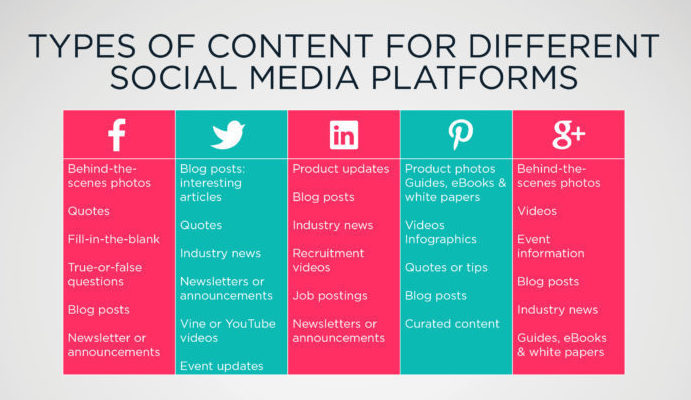
Your achievements on social media depend entirely on the success of the content that you post. Producing efficient, high-performing content, however, poses a number of challenges for small organisations. It is competitive, time consuming and should preferably add value to your customer experience. In order to help with overcoming these hurdles, content strategies frequently include a varied mix of content types.

Put together high-quality content

This seems like the most apparent point, and it is, however it is also forgotten too often. There are no shortcuts: shareable content is continually high-quality content. If you concentrate on superficial topics and do not invest sufficient time into research or content creation, you cannot anticipate your followers becoming interested as well as engaged. This is one of the reasons why long-form content is doing much better than ever.

Use smart structuring

Internet users read extremely quickly and nothing will turn them off more than a wall of text. Format your content intelligently by making use of numbered lists, bullet points as well as headers in order to easily highlight key information points.

Add value to users’ lives

Informative content is great, however if your readers and clients are not able to put your words into practice then they will not profit from what you publish. The main goal of content is to resolve users’ problems and show how to conquer them. This will not only build brand loyalty, it will keep them coming back for more. As long as the content you create is genuinely helpful, it is also certain to be passed around.

To make certain that your brand stands out among the rest, that you save time and that you improve your customer experience, take advantage of each and every social media platform’s features in order to weave these unique content types together.

Do not be scared to experiment and also be creative with your ideas. Over time, you will discover what types of content rings true with your unique audience. You will not know what works best until you try out the strategies.

DIGITAL SCHOOL OF MARKETING
info@digitalschoolofmarketing.co.za
www.digitalschoolofmarketing.co.za

Brands Need To Disrupt The Attention Convention

Brands Need To Disrupt The Attention Convention

M&C Saatchi Abel partners state that Covid-19 provided rocket fuel for our digital rocket. Forget captive audiences, the more interesting the world becomes, the less interested consumers are in brands. The time you will take to read this opening sentence is about how long a brand has to grab a consumer’s attention, which is why breaking the attention convention in a world evolving at breakneck speed is vital.

‘Brands must compete for a share of attention,’ said Cape Town-based Strategy Partner Keke Mahlelebe. ‘In the world of content, we need to cut through the clutter and actively compete for consumers’ time. We must be interesting and we must entertain – that has always been important, but even more so in a world with so many channels and so many choices. Eight seconds – that’s what we have to grab and hold attention.’

Brands are not just competing with other brands for consumers’ attention, he added, ‘They also need to compete with WhatsApp, Netflix, friends, pizza night, family and much more.’

M&C Saatchi Abel Digital partner Melody Maker, also based in Cape Town, agreed. ‘This may sound harsh, but brands – all of us in fact – need to stop drinking our own Kool-Aid. Brands must understand their consumers and find relevant ways to intersect with them.’

If the world is always on, why is people’s attention seemingly mostly off? How then do brands prevent themselves from being blue-ticked? 34 million people binge-watched Netflix’s Tiger King in the first 10 days, Jerusalema became the most Shazaamed song in the world and average screen time is the highest it has ever been. ‘A strategist in our group said it succinctly: ‘Instead of trying to create something people might be interested in, we need to become what people are interested in,’’ said Mahlelebe.

He argued that the traditional brief that starts with a brand and marketing objective is out of touch. ‘Brands should turn this on its head. Why don’t we break convention and ask: ‘What is interesting in the world of the consumer?’ This way we are not deciding what is interesting and making the consumer secondary, rather, we are being relevant to the consumer. It’s one of the oldest values – to put the customer first – but if you want to talk to your customer on their device you have no choice but to embody this value.’

Maker said this is exacerbated when brands embark on box-ticking exercises. She said: ‘It doesn’t matter what you think is trending. There’s no point communicating on a platform for the platform’s sake – you need to always ask: ‘Is this something I would engage with?”

Ironically, but perhaps inevitably, the more we have access to AI, machine learning, highly technical data and insight gathering tools, Mahlelebe and Maker said the best insights are right in front of you when you actually engage with the people you want to speak to.

Mahlelebe added that the most successful brands have a point of view. He referred to Volvo, which he said communicates one thing: safety. ‘That’s the safety of their cars, cars in general, people and the environment. They can have these broad conversations that people find interesting because they have a constant point of view and are driven by clarity of purpose. That makes them relevant.’

‘The opposite is where brands try and engage in important cultural discussions, but they simply cannot back it up with their brand’s point of view. It lacks authenticity and is irrelevant. If you’re irrelevant I’m not spending my attention on you,’ said Maker.

The two partners believe that if brands want to compete, they need to increase the size of the playing field. While this may seem like an impossible ask, one only has to look at the international Burger King campaign, where the fast-food giant got the best soccer players in the world to wear its branding by directing its thinking to what consumers find interesting.

‘It sponsored a fourth-tier football team called Stevenage and encouraged gamers on the popular game FIFA 2020 to ‘hire’ the world’s best players. Burger King went from selling burgers to sponsoring a football team. They broke the attention convention by being interesting, relevant and brave,’ said Mahlelebe. ‘Breaking the attention convention is how you compete and stay relevant in the new economy.’

M&C SAATCHI ABEL
www.mcsaatchiabel.co.za

Grey And WPP LIQUID Announce Autocorrect Advertising Campaign Award Win

Grey And WPP LIQUID Announce Autocorrect Advertising Campaign Award

Grey and WPP LIQUID won silver at the global 2021 Clio advertising awards. The Clio Awards is an annual award programme that recognises innovation and creative excellence in advertising, design and communication, as judged by an international panel of advertising professionals.

Language is a vital aspect of our culture. In South Africa, the dawn of democracy was marked by the new government giving 11 of South Africa’s languages recognition as official languages. Sadly, autocorrect is still stuck in a decidedly undemocratic mode, where it will correct any word it does not recognise into English. This means that an innocent ‘Bathong’ suddenly turns into ‘Bathing’. Savanna has found a workaround for this irritation and has done so in the brand’s customary dry and witty manner.

Grey Advertising Africa’s Chief Creative Officer, Fran Luckin, said, ‘It is so gratifying to see this piece being recognised by international judges on a global stage. Being awarded in the pioneering ‘Digital/Mobile – Emerging Technologies’ category is testament to our effectiveness in navigating the industry with game-changing campaigns and illustrates the value of sticking with a creative idea for as long as it takes to execute. Over two years in the making, ‘Decolonise Autocorrect’ has finally stepped into the limelight.’

GREY JHB
+27 11 706 3060
www.grey.co.za

Retailers Should Build A Unified Customer Engagement Strategy To Boost Brand Loyalty

Retailers Should Build A Unified Customer Engagement Strategy To Boost Brand Loyalty
Robbie Kearns, Senior Vice President at Salesforce.

According to data from Salesforce’s Q1 Shopping Index, the digital commerce market has grown globally at a rate of 58% in the last year. This is largely because of the effect of the Covid-19 pandemic on consumer behaviour. Robbie Kearns, Senior Vice President at Salesforce, sets out three ways in which retailers can begin to build a unified customer engagement strategy to boost brand loyalty.

As the Covid-19 pandemic has accelerated the shift to shopping online, retailers have had to re-imagine how they do business in a new digital world. Over recent months, leveraging technology to stabilise their business has shown us what it meant to be resilient in a crisis. It is clear that how and where we shop – along with customer expectations – are changing forever.

In a post-pandemic world, the relationships that retailers have with their customers and technology alike will continue to evolve. A strong e-commerce strategy means creating inspiring shopping journeys online, being available to customers 24/7, quickening the pace of business and minimising unnecessary costs. Retailers equipped with a single view of each customer also presents an opportunity to reimagine brick-and-mortar stores.

As the digital-first economy continues to evolve at hyperspeed, here are three ways in which retailers can begin to build a unified customer engagement strategy and boost brand loyalty.

1. Create inspiring shopping experiences online

When shopping online, customers want to be inspired. The more information available and the less clicks required to access this content, the better. Social platforms such as Instagram, Pinterest and TikTok exemplify the growing power of technology to drive sales. Rather than providing long lists of products and prices, searchable via filters, by leveraging popular social media and streaming platforms, retailers can digitally create the in-store sense of discoverability.

A seamless experience across all channels is essential to attracting and securing business. Whether customers are browsing on their desktop or mobile device, collecting data at every touch point will help retailers get to know their customers better and provide personalised experiences they expect in-store. Being able to share the right information and offers at the right time, based on previous interactions and tailored to customers’ needs, will keep them coming back for more.

2. Communicate directly with customers at anytime, from anywhere

As online sales continue to increase, the cost of e-commerce – picking, packing, delivery and returning items – should not be underestimated. Even while data continues to inform messaging and marketing strategies, online customers need just as much, if not more, personal consultation than they would receive in-store. Having the capability to communicate with customers directly, wherever they are, is revolutionising the customer experience and saving retailers time and costs associated with handling requests to return items.

In this context, both the strategic deployment of AI-powered chatbots and the continuous development of store associates is becoming increasingly important. Through communication tools like live chat and digital concierge services retailers can quickly address consumer queries, for instance, relating to product availability, shipping visibility and delivery updates. Continually revamping commerce webpages to provide comprehensive product descriptions and reviews, accurate fit guides and even videos, are key to instilling confidence in customers before they buy.

3. Transform customer service in-store

Just as the evolution of e-commerce is making online shopping more convenient, retailers can also deliver a safer, smarter and more unified customer experience in-store. Leveraging new channels like live streaming is helping retailers to drive customer engagement, showcase and sell products. Connecting physical and digital retail channels and creating a single source of truth for every customer is better equipping in-store associates to deliver a complete, personalised, and trusted service.

With an omnichannel strategy and ready insights, such as past customer purchases and access to digital inventory, retailers can promote, sell and ship products from anywhere in store, in real time. Altogether, this is making the store associate’s and customers’ experience more informed and convenient.

The need to invest, on and offline

Having an effective e-commerce strategy will be essential to meet changing shopping trends online and minimising requests to return items. Looking beyond this pandemic, continued investment in engaging and responsive customer service, both online and in-store, will be a key component of every retailer’s digital transformation journey.

Appearing online is one thing, digitising whole business models is another. In an all-digital world, only by connecting marketing, commerce, and service teams together can companies confidently deliver informed, inspired and personalised customer experiences.

Salesforce
www.salesforce.com

This is Modern Marketing