Home Blog Page 421

Fepe International Announces Creative Awards Judges For 2019

Fepe International Announces Creative Awards Judges For 2019

Fepe International has appointed the judges for the 2019 Creative, Lifetime Achievement, Leadership, Technical innovation and the industry’s Rising Star Awards.

Executive director John Ellery will chair the awards panel drawn from the Fepe board and executives, including new director Katrin Robertson from blowUP Media. They will be joined by Charmaine Moldrich, CEO of Australia’s Outdoor Media Association. 

Joining the awards panel for the Fepe Creative Awards is Dino Burbidge, latterly director of tech and innovation at London creative ad agency WCRS. Burbidge brings a wealth of advertising and technological expertise to the Creative Awards, which celebrate the best creative work in the medium through the year.

Classic and digital

Once again the panel of judges for the Creative Awards will make two awards: Classic, for traditional static posters, and Digital. Last year’s Classic winner was music streaming company Spotify for its US campaign featuring a number of alternative playlists, produced in-house. The winner in the Digital category was Japan National Tourism Organisation for a campaign from Enjin Tokyo, who worked with Clear Channel France to show the full potential of the digital Out-of-Home medium.

Awards chairman Ellery said, ‘The Fepe International Creative Awards have become the blue riband of Out-of-Home creative globally and we hope and expect that this year we will have more entries than ever.’

Very best creative work

Last year’s Classic and Digital winners and many of the other contenders were outstanding and the addition of Charmaine and Dino to the judging team will ensure the 2019 Awards reflect the very best creative work of the industry worldwide.

Closing date for nominations is 1 March 2019. Entries in all categories are free and may be submitted by Fepe members and OOH National Associations. All nominations should be sent to Richard Saturley: richard@fepe.com. 

FEPE www.fepe.com

Tractor Outdoor And UrbanSigns Form Urbantrac

Tractor Outdoor And UrbanSigns Form Urbantrac

Tractor Outdoor and UrbanSigns have announced ‘urbantrac’ – a partnership between the two companies to profoundly redefine their DOOH portfolio within Cape Town.

‘It is my pleasure to announce that UrbanSigns and Tractor Outdoor are now a fully formed partnership. We have together put in a tremendous amount of hard work and I am confident in Tractor’s expertise and knowledge of the OOH industry and I look forward to future developments,’ said Antony Urbaniak, owner of UrbanSigns. 

Ben Harris, Rights and Development Director at Tractor Outdoor said, ‘We are proud to join forces with Urban Signs. With DOOH growing rapidly in the OOH sector there is no doubt that we as media owners need to evolve and keep up with the latest trends within the industry. By collaborating we are merging our large-scale portfolios and expertise to allow our clients to target multiple key locations aimed at their target market and maximising their unique reach.’

An exclusive digital screen located along the M5 highway in Cape Town is one of the first DOOH additions to the ‘urbantrac’ trademark. With the addition of this screen, it now takes Tractor’s digital portfolio growth up to nine screens this year alone. 

TRACTOR OUTDOOR
www.tractoroutdoor.com

URBAN SIGNS
+27217947711
www.urbansigns.co.za

MOKOM Group Taking A ‘Quantum’ Leap Through Transit Advertising

MOKOM Group Taking A 'Quantum' Leap Into Commuters Through Transit Advertising
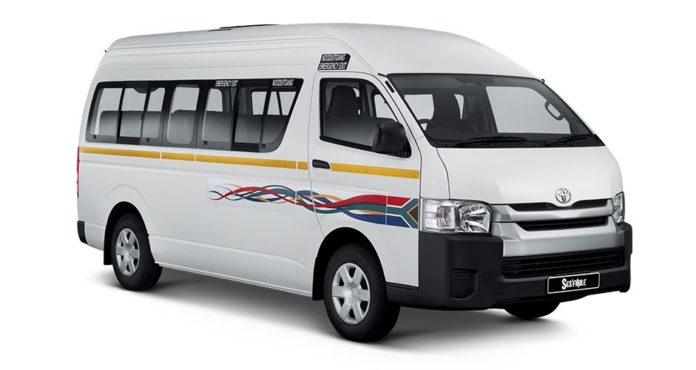
Image source: Imperial Toyota

Ordinary South Africans use taxis as a mode of transport daily to run errands. Almost 70% of working-class citizens use minibus taxis, also known as ‘Quantums’, to get to work and back.

These automobiles are also home to many of our South African household brands. It is believed to be a powerful brand carrier as it holds the highest brand recall when fully wrapped in a vinyl that provides 100% brand exclusivity.

We live in a very challenging economy that has birthed a staggeringly high unemployment rate, which has increased over the months following the VAT increase under a year ago. And recently, the country has plunged in and out of technical recession mode. This has resulted in a reduction on consumer spend more specifically from a township market perspective.

Triggering an emotional buying habit

The township market is believed to have higher consumer spend. Pulling a notable worthy economic investment of R100 billion, the MEC for economic development, agriculture and rural development Lebogang Maile bears testimony to this. If brands can position themselves around triggering an emotional buying habit, rather than pushing products down the customer’s throat, then they’ll benefit immensely from this local economic giant.

To remain relevant in advertising, more specifically in the Out-of-Home ads (transit ads), brands need to stop viewing the market as a place where demand and supply factors meet. The omnibus of campaigns with less brand experience and more ‘selling, selling, selling’ is, in fact, straining many of the company’s ad spend and, in some instances, the company’s bottom line.

The taxi branding trend has reduced significantly over the years with the advancement of technology. Billboards and many other mass reach formats seek a high level of creative design and an effective call to action.

Improvement needed

Over time, with the affordability of smartphones and growth of social media, people are constantly glued to their device’s screens, making it slightly difficult to grab their attention with ads that shout ‘Purchase’ all the time. But how are we going to make money, you might ask. Well, it is said that: people don’t care how much you know until they know how much you care. Gone are the days where brands would continuously use the same strategy for many years in different market segments.

The need to understand factors such as customer behavioural habits, emotional attachment towards product offerings, cultural differences, market trends and all these other factors is increasingly becoming imperative. This speaks to how campaigns should be modelled, the type of messaging involved and the process used to drive customers offline to online. The strategy used for minibus advertising is obsolete and needs to be improved.

A few of the required improvements:

1. Added-on experiences to campaigns
Fewer Minibus taxis are fitted with a mobile Wi-Fi hotspot and this is where brands can come on board to fill up the need. Use this platform to engage heavily with consumers, from data generation to newer product offerings.

2. Loyalty rewards
Who said loyalty rewards are restricted to shoppers? Commuters can be rewarded according to the loyalty they possess towards a certain product brand or how often they use a branded transport mode (factors such as climate issues encourage people to use taxis more often).

3. Competitions
Nothing beats the good old competitions. Brands need to craft competitions that evoke excitement, something around what the customer would really like to have. e.g. redeemable points for hampers etc. or something that sparks a conversation around the brand.

4. Reward drivers for good driving
Taxi drivers can be rewarded for good driving. This minimises risks such as brand reputation being tarnished by recklessness and irresponsibility by the brand ambassador.

MOKOM GROUP MokomAgencyFacebookPage

Hypervsn Introduces Solo L 3D Holographic Display System

Hypervsn Introduces Solo L 3D Holographic Display System

Hypervsn’s two new product offerings include the large format Solo L unit and Hypervsn 3D Studio. The announcement looks to target both individuals and big brands looking for new and innovative methods of reaching their audience.

The Solo L is a new, enlarged 75cm unit size that is over 33% bigger than the previous 56cm model. The additional size also allows for an image size that is 80% larger than the 56cm device. The displays are generated by a four-ray rotor lined with LEDs, projecting visuals up to 30 frames per second and creating mesmerising 3D images for audiences all around the world. The unit can be used to create unique digital displays at stores, events, and entertainment locations.

Hypervsn 3D Studio is an online service with the integrated 3D Content Marketplace that provides Hypervsn customers with a new and easy way of creating and customising 3D content for their Hypervsn.

Customers can take 2D images and convert them into 3D visuals within seconds, including a feature to add stunning animations and backgrounds to make them look even more impressive. 3D Studio is included in Solo M and Solo L packages, providing a new level of usability and content development, while dramatically reducing overall usage cost. The new Solo L will be available both in Cloud and Classic packages. Both offerings will be available globally and shipping will begin in late January.

Kiryl Chykeyuk, Founder of Hypervsn said, ‘Our new offerings highlight the team’s dedication to creating a fully immersive 3D holographic experience for both consumers and brands. The new Hypervsn 3D Studio will allow all consumers and brands to create amazing content and unparalleled disruption. 2019 will be the year that 3D holographic visuals become mainstream.’

HYPERVSN hypervsn.com

Fluxaxis Generates Awareness For Blood Cancer Through Wide Format 3D Printing

Fluxaxis Generates Awareness For Blood Cancer Through Wide Format 3D Printing

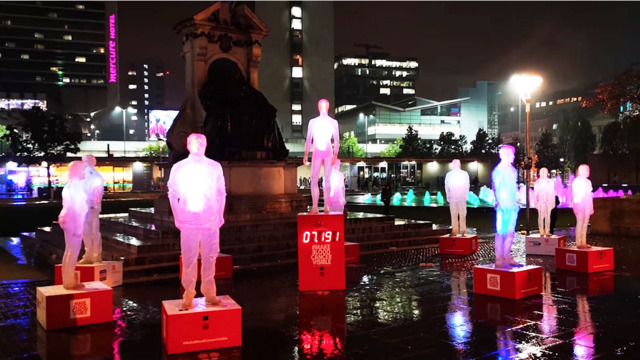
Fluxaxis, a UK based digital manufacturing service provider, has 3D printed two life-size master figures that were integral to a recent ‘Make Blood Cancer Visible’ campaign for pharmaceutical company, Janssen.

Fluxaxis produced the models on its Massivit 1800 3D Printer in less than eight hours each. This drastically reduced both the time and costs involved in creating the display compared to traditional production methods.

The figures were used by Fluxaxis’ customer Windsor Workshop to create moulds for a series of ten life-size human bodies designed to convey the invisible nature of blood cancer.

Designed to give blood cancer well-deserved priority and recognition within the UK, real-life recordings of people with the disease were emitted from the human figures to enhance the sensory impact. The campaign travelled to key locations across London, Cardiff, Manchester and Edinburgh and received widespread coverage across social media platforms.

MASSIVIT 3D www.massivit3d.com

FLUXAXIS www.fluxaxis.com

Kantar MillwardBrown Lists Five Principles To Drive Brand Growth

Kantar MillwardBrown Lists Five Principles To Drive Brands Growth

According to Kantar MillwardBrown, we live in a world of 24/7 data and the potential to make rapid and knowledgeable brand decisions has never been greater but most marketers aren’t using it to their advantage.

The truth is, the quantity and speed of data today is a double-edged sword. It’s hard to know which key measures to focus on. Making decisions based on short-term responses is likely to result in a focus on short-term sales, when the strongest effects often occur over the long term.

Over the past few years, Kantar Millward Brown has been rewriting the rules of tracking studies to provide what marketers need in a world that has gone from fast to even faster. Brands that focus their continuous tracking on the metrics that matter for success – the long-term indicators that move most quickly in the short term – will gain a competitive advantage.

The principles to driving brand growth are:

1. Act quickly to gain a competitive advantage: brands that have fast access to the right data are making real-time decisions to get ahead.
2. Be first to mind when it matters: salience has a strong relationship with volume share but it’s not the only thing that matters.
3. Identify what drives sales now and into the future: Brands that are both salient and meaningfully different grow bigger faster.
4. Be seen to be meaningfully different to drive profits: meaningfully different brands can command a price premium that leads to higher profits.
5. Know where and how to invest: Use solid data and insights to break the rules with confidence.

Download the booklet here

KANTAR MILLWARDBROWN www.millwardbrown.com

Agencies Should Focus On Offering More Integrated Services

Agencies Should Focus On Offering More Integrated Services
Chris Botha, Group Managing Director of Park Advertising

The future will be built by Wall Breakers, not Builders.

Our world seems to be filled with two types of people. Wall Builders and Wall Breakers – and opinions are stronger than ever before. The battle for ultimate segregation or integration is more fervent than ever. The communications industry is filled with people hell-bent on separating themselves, and others integrating themselves.

Looking at Wall Breakers

Wall Breakers in the communications industry are agencies integrating more and more services into their repertoire. Want an ad? We can do it. Want a website? We can do it. Want your shoelaces tied? We can do it. Need a frontal lobotomy? We know a guy. I really do believe the future agency will be modelled on this. A real one-stop shop for clients, as long as it doesn’t lose the speciality skill.

Wall Breakers have realised that to offer clients only a small portion of the services they are after is limiting. From a business perspective, you lose the opportunity to integrate your services, and let’s face it, to make more money. The big danger they face is to become a ‘Jack of all Trades and Master of None’. The Wall Breakers who get to keep excellent skills in specialist divisions will be the ones to win the big game.

Looking at Wall Builders

In some cases masquerading as ‘specialists’. I was recently told of a new media agency that only specialises in TV planning. Not strategy. Not buying. TV planning only. They’ve built a wall around themselves and only do one thing. Apparently really well, but only one thing. Why does their future need to be limited? These are Wall Builders of the ultimate kind, who I don’t believe will last long.

Then, of course, there are the Wall Builders who believe that the client should have no direct contact with the media owners. How ridiculous! Media owners know more about their media type than anyone else, and have a better understanding of their viewer/reader/listener than anyone else would. So why build the wall? Let’s break it down.

Digital and traditional media is, of course, another favourite. Whether you’re a client, copywriter, salesperson or media planner, you cannot afford to build a wall around yourself. Walls need to be broken down and we need to learn, ask, and expose ourselves to as much knowledge as possible.

There is something about Donald Trump that I admire. I don’t agree with some of his political views but what the man has done for social media and entertainment around the US Presidency, is well, unprecedented.

One of the promises he built his initial campaign on was the infamous ‘Wall’ between the USA and Mexico. Recently, the narrative around this topic has increased. I am not sure whether President Trump will ever get that wall built. I hope not. It doesn’t solve the ‘problem’ and it doesn’t advance his country. I hope in 2019 we all get our sledgehammers out and start knocking down those walls.

THE MEDIASHOP
www.mediashop.co.za

MegaVision Executes Jeyes Fluid Campaign

MegaVision Media Executes A Jeyes Fluid Campaign

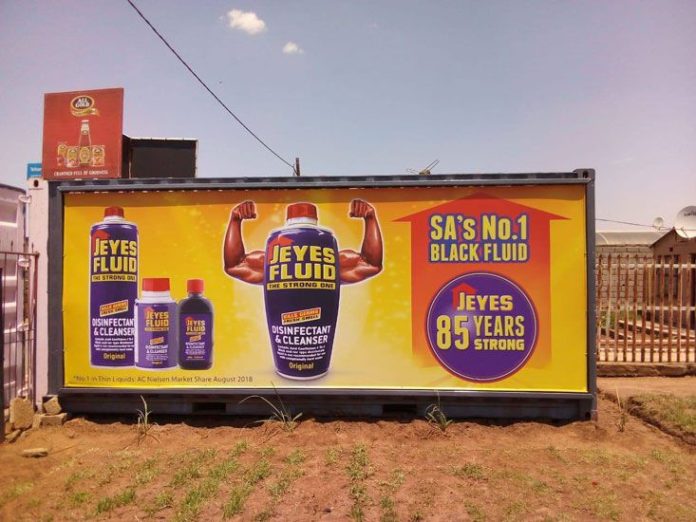
Tiger Brands commissioned MegaVision Media, which used their spaza shop footprint, to execute a Jeyes Fluid campaign.

The objective was to create brand awareness for their ever-popular household cleaning product, Jeyes Fluid, in the lower LSM markets. MegaVision Media used their spaza shop footprint in Gauteng and the Eastern Cape to execute the campaign.

They printed and installed the bold Pocket and Bar fixtures on stand-alone poles as well as mounted them onto shop walls. This resulted in a bright and vibrant campaign that really stood out and made a statement over the festive season.

MEGAVISION MEDIA
+27118038433
info@mvmedia.co.za
www.megavisionmedia.co.za

Nedbank Expanding Client Reach Through Effective And Targeted Digital Strategies

Joe Public Retains Nedbank Account

Nedbank has selected agencies to work on its through-the-line, sponsorship and digital marketing communication strategies.

Award-winning brand and communication group Joe Public has retained the bank’s through-the-line account, with Levergy managing the sponsorship account and Digitas Liquorice the digital creative account.

‘The diversity of these agencies will enable us to entrench the Nedbank narrative and expand our client reach through effective and targeted digital strategies, remaining mindful of the current competitive landscape in the financial sector,’ explained Khensani Nobanda, group executive for Nedbank Group Marketing and Corporate Affairs.

NEDBANK www.nedbank.co.za

JCDecaux Expands African Footprint With Nigerian Collaboration

JCDecaux Expands African Footprint With Nigerian Collaboration

JCDecaux Africa entered the Nigerian market in partnership with Grace Lake Partners (GLP), an indigenous investment and advisory firm based in Lagos, Nigeria, with a philosophy of creating shared value.

JCDecaux will operate in the outdoor advertising industry in Nigeria through an exclusive partnership and licensee agreement between JCDecaux and Horizon Outdoor Advertising Limited, a wholly Nigerian owned subsidiary of GLP. Horizon is Advertising Practitioners Council of Nigeria (APCON) certified and a member of the prestigious Outdoor Advertising Association of Nigeria (OAAN).

The partnership between JCDecaux and Grace Lake has commenced work with the installation of four city-wide public service programmes, all at no cost to the citizens of Lagos. The programmes cover the installation, operation and maintenance of:
• A Traffic Information System (LATIS): a network of 94sqm digital traffic arches designed by Marc Aurèle providing real-time traffic information to commuters at strategic driving decision points across Lagos.
• A high-quality advertising street furniture programme: a network of advertising bus shelters designed by Lord Norman Foster, which have solar-powered roof panels and are 100% energy self-sufficient.
• A self-cleaning automatic public toilets programme, designed by Patrick Jouin, located at the city’s busiest bus stations and which are free to use.
• A network of 92 sqm billboards for the stations under construction of the upcoming Lagos cable car system (LCCT), which will link the key hubs of the economic capital (Lagos Island, Mainland and Victoria Island).

This partnership gives JCDecaux a foothold in Nigeria, the most highly populated country in Africa, with 190 million people (a population which will double in the next 30 years). The partnership will also help maximise the economic potential of Lagos, Africa’s biggest city, and the economic capital of the country. With nearly 21 million people, it is a market with huge potential for advertisers and media agencies.

Considered as one of the most gridlocked cities in the world, Lagos is planning to install urban infrastructure that will provide a high-quality public service and accelerate its transformation into a smart city pioneer on the African continent.

With the LATIS project, the new JCDecaux Grace Lake partnership delivers a solution that gives drivers real-time information on traffic, through digital traffic arches at key junctions across the city and via a mobile app designed and built by Nigerians. This traffic information system, a first for the group, has been designed to meet Lagos’s needs and help ease traffic flow in the city by suggesting alternative routes and estimating times of arrival.

JCDecaux Grace Lake is also contributing to the modernisation of public transport and improvement of passenger services by installing a network of solar-powered bus shelters and automatic public toilets in the main bus terminals. These facilities will help meet environmental and social commitments by encouraging mobility, easing road traffic, developing solar power, promoting hygiene on the public highway, creating sustainable skilled jobs and encouraging the training of a local workforce.

Jean-Sébastien Decaux, CEO, Southern Europe, Belgium and Luxembourg, Africa and Israel, said, ‘In line with our unique model of organic development, we are delighted to be entering the Nigerian market and particularly Lagos, a thriving city in many respects. We will put our capacity for innovation, particularly digital, at the service of one of the most dynamic cities in sub-Saharan Africa. We have developed a unique service to bring Lagos the best of our expertise in street furniture and an unprecedented traffic information system, a first for Africa and for JCDecaux.’

JCDECAUX AFRICA
+27115141400 
wandile.setlhodi@jcdecaux.com
www.jcdecauxafrica.com