

Home Blog Page 415

The Effect Of Artificial Intelligence And Big Data On Marketing And Advertising

The Effect Artificial Intelligence And Big Data On Marketing And Advertising
Image source: www.microsoft.com

Artificial Intelligence (AI) is powered by data. Not just the data that we as marketers have traditionally been accustomed to using such as data for sales, market share, site visits, link clicks, engagement rates etc.

AI is now being used to tap into, and make sense of, a massive amount of unstructured ‘big data’. When we talk about AI in marketing, we’re talking about AI solutions that are able to process and interpret big data in ways humans cannot.

AI is therefore enabling marketers to make better-informed decisions by making it easier to derive insights from big data, helping them expand customer engagement, optimise operations, and improve offerings. As we accelerate into this new and exciting data-driven AI-enabled future, our marketing capabilities, our effectiveness, and our competitive advantage, all relies on the extent to which we can leverage and act upon all the data available to us.

AI can support a more customer-centric, personalised approach to marketing. As in the previous era of mass marketing, a marketer’s main goal was to determine how best to group audiences into similar segments, based on insights about their shared needs and characteristics. AI is now helping us go beyond mere segmentation, enabling us to create hyper-personalised campaigns, all in real time. In fact, 58 per cent of businesses are confronting their most demanding marketing problems with AI by prioritising personalised customer care.

As a result, consumers are not bombarded with information that is irrelevant to their interests or needs. Marketers will, on the other hand, increase their productivity and efficiency.

Core elements involved in AI-driven marketing strategy

Traditionally, marketers construct their strategy according to the Awareness, Interest, Desire, Action (AIDA) model; modern marketing takes this model a step further. In order to truly get the most of a modern marketing strategy, marketers need to take into account: data, talent, tools and partners.

For example, AI helps marketers leverage customer data using tools like machine learning to anticipate the customer’s next move and improve the customer journey. A tool like Microsoft Dynamics 365 AI for Market Insights allows marketers to gain insights into their brands, customers and competitors using AI. This means they can stay on top of market trends as they unfold in social conversations and web searches and respond to customers faster.

Then, they need the right talent to mine and interpret the data. Upskilling marketers to incorporate new technologies like AI will be very important as we head further towards the digital revolution.

Finally, it is imperative that marketers adopt the services of a trusted technology partner who can tailor solutions according to their needs. The tools are just a starting point. The technology partner should be able to match your needs to the tools they provide.

The use of AI to humanise a brand

Marketing, at its very core, remains a storytelling function. Although technology gives us the ability to automate processes and draw insights from big data, it still cannot create evocative, beautiful stories or generate authentic interactions with customers. Customers are still human, not machines, and years and years of marketing experience has taught us that humans crave authenticity from brands.

As modern marketers, we should leverage AI as an extension or augmentation of ourselves, while using the insights garnered from big data sets to give us both a quantitative and qualitative perspective, and then determine the right stories to tell to target the emotional quotient of our customers.

Ethical and moral considerations for marketers and advertisers

A consumer privacy study by TRUSTe/NCSA found that 92 per cent of online customers cite data security and privacy as a concern. While, according to a report published by the Chartered Institute of Marketing, 57 per cent of consumers don’t trust brands to use their data responsibly. It’s clear that in the age of AI, trust is the most important ethical and moral consideration for marketers to be cognisant of. Customers want to know that the companies they do business with have trust as their most important core value and guiding principle.

AI needs to be built and used in a way that earns trust, and that AI systems need to be designed with protections for fairness, reliability and safety, transparency and accountability, privacy and also be inclusive. The principles of verification, careful design and development practices, along with advances in AI, can take on these new challenges.

POPI/GDPR in marketing and advertising

GDPR and other data protection regulations like POPI are a great opportunity for marketers. Under GDPR for example, marketers need explicit consent to use a customer’s personal data. This allows marketers to gain insight into each individual’s interests and provide them with tailored information that they want to receive. GDPR also helps marketers maintain transparency. This is important because as mentioned above, many consumers cite security of their personal data as a concern.

Digital transformation: a threat or an opportunity for advertisers and marketers?

This is an opportunity, not a threat. AI definitely won’t replace the role of marketers. It will simply allow for marketers to adapt in order to work in tandem with these powerful AI tools. We believe that with AI, there’s a huge opportunity for machines to augment (not replace) people’s capabilities. Companies need to be committed to creating and expanding access to the skills needed to fulfil the promise of AI as well as design technology that complements rather than substitutes human labour. Working with machines, humans can drive better business outcomes.

The role of modern marketing in the digital transformation journey in the MEA region

The Middle East is a hotbed of technology and innovation. Africa is also ripe for opportunity, with a growing middle class and a huge increase in smartphone penetration. In fact, it’s expected that by 2020, half of all African adults will have a smartphone. The large youth population in the MEA region is also a fantastic opportunity for marketers because most of these youth frequently interact with brands through digital platforms.

A shift towards a human-focused and customer-centric marketing strategy

There is a need to refresh marketing strategies to make them more human focused and customer-centric. This transformation required an innovative, new marketing strategy because our traditional marketing methods could no longer compete. Based on data analysis and insights, we worked hard to reposition ourselves as a human brand, which we believe is key to the success of any marketing campaign.

This can be done by simplifying the structure of marketing efforts to being more outcome focused, relevant to all partners and scalable. Strategy should offer personalised content and customer experiences; introducing the company’s culture into the marketing culture; creating a more aligned and connected sales and marketing experience; telling a story and educating our customers on specific verticals or industries; tracking and analysing the entire purchase journey to improve ROI; and lastly taking care of our customers by forging life-long relationships.

MICROSOFT www.microsoft.com

Sports Sponsorship Can Drive Business Growth For Brands

Sports Sponsorship Can Drive Business Growth For Brands
Gareth Marshall, Senior Brand Manager at Shield, Unilever.

Sport is one of the few avenues that enables brands to interact with an already highly engaged audience. By tapping into this audience, brands are able to use sport as a platform that not only builds brand love and creates brand awareness, but that also functions as a mechanism to drive business growth – but only if implemented correctly.

We’re living in an increasingly hyper-connected world where content seems unlimited and brands are consistently fighting for airtime. Sport is one of the biggest platforms that not only has powerful content, but that retains the power to unite audiences simultaneously through a universal passion for real-life experiences and as third-party viewers through the media.

In South Africa, brands are struggling to leverage the power they have available to them. The majority of local sponsorships are based on an off-the-shelf sponsorship rights package or they believe that just slapping a logo on a shirt equals job done.

I believe that sports sponsorship is not just a marketing channel, but rather a brand communications platform that can be brought to life across a broad range of consumer touch points. In my opinion, well-activated sports sponsorships deliver a more significant return on investment for brands and a higher engagement with the intended target audience.

Brands contemplating sports sponsorship need to be clear on their business objectives. Starting with the consumer in mind and placing them at the heart of the campaign will set the benchmark for marketers to authentically activate a sponsorship opportunity and make a difference in society. A non–negotiable for me is to ask the question: are we bringing value to people’s lives?

I truly believe that we need less off-the-shelf sponsorship rights and more co-creation with our partners that will drive better value exchange and consumer engagement. In the end, both parties win.

In summary, here are my pointers for a successful sponsorship partnership:
• Avoid an off-the-shelf sponsorship package.
• Co-creation between brand and rights-holder is key to unlocking the magic.
• Brand and rights-owner need to have aligned business goals and objectives.
• Always put your consumer at the heart of the campaign.

Late last year, I was fortunate to be invited as a guest speaker and panellist at the inaugural CoNext Forum, where we tackled the topic of sports sponsorship head-on, spear-headed by Andrew Ross (MD Chaos Theory), OG Molefe (Sports journalist), Kelvin Watt (MD Nielsen sport) and Edward Connock (Head of Global Activation – Chelsea FC).

We need more conversations like this and I’m pleased to be kicking off, so to speak, with a series of articles tackling how to more effectively unlock the power of sports sponsorship so that marketers can win the hearts of their consumers.

UNLEASH ACADEMY unleashacademy.co.za

Fourways Mall Draws In Shoppers Through Street Network’s Advertising Platforms

Fourways Mall Draws In Shoppers Through Street Network’s Advertising Platforms

Fourways Mall tasked Street Network with executing a visually striking promotional campaign on bus shelters and taxi ranks to grab the attention of commuters in the area.

These locations are key, as their proximity to the mall greatly increases the chances of a mall visit directly after experiencing the visual elements of the campaign. One of the findings of Arbitron’s 2013 OOH Industry Report found that bus shelter advertising drives response, with as much as 26% of consumers of a campaign immediately visiting the business in question.

Howard Lonstein, Marketing Manager of Outdoor Network said, ‘Bus shelters are a high reach and frequency media, providing directional signage to visitors and residents of the Fourways area.’

The Fourways Mall creative is dominated by a bright pink background and features an animated ‘family’ riding a rollercoaster, with the invitation to mall visitors to ‘Play@4WM’ and promoting a family-friendly offering. Fully wrapped bus shelters are being used a means of attracting shoppers from surrounding areas to the Mall as new shops open. The creative will be updated as new stores open, keeping consumers engaged and up to speed on the latest retail developments within the mall.

Fourways Mall opened its doors over 30 years ago and has become a landmark shopping destination in the northern suburbs of Johannesburg, and specifically the greater Fourways area.

OUTDOOR NETWORK
+27 86 177 6826
info@on.co.za
www.outdoornetwork.co.za

Nfinity ‘Reveels’ Latest Player In Out-Of-Home Space

Nfinity Acquires Reveel
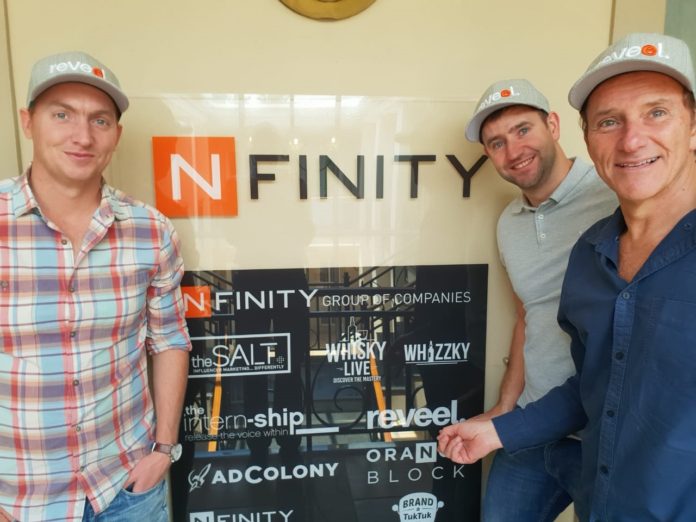
Tanner Rock and Tyron Martin, Reveel, with Ken Varejes, Nfinity.

Nfinity has announced Reveel as the latest business to join the fold. Reveel is an innovative Out-of-Home business with a specific focus on Digital Out of Home (DOOH), large format and non-traditional platforms.

Nfinity CEO, Ken Varejes said, ‘The Out-of-Home industry has always been a brilliant platform for innovation and a particular passion of mine. I’m so pleased to be introducing the latest player in this space and we’re confident that it’s going to be a great disruptor.’

The Reveel business will be headed by Tanner Rock, the Commercial Director who has vast experience in new site and product development. He will manage the day to day relationships of key landlord and supplier partners. Tyron Martin joins the management team in the capacity of Sales Director. He has a proven track record in this space as a top performer, with fantastic relationships at both client and agency level.

‘Reveel is underlined by an unwavering desire to create opportunities for our clients that are different and unique. Our management team is extremely passionate about this ever- changing OOH space, and with the many years of combined experience comes many solid relationships that are key to the growth of the business in the short term. The team is excited, highly motivated, and we are really looking forward to creating additional relationships that will be formed as we start this journey,’ said Rock.

Varejes added, ‘Rock and Martin are the perfect duo to take Reveel to incredible success. They have the backing and infrastructure of our entire Nfinity arsenal of businesses, management team and staff. What a great start to 2019.’

NFINITY 
www.nfinity.co.za

OOH Continues To Gain Audiences, Especially Within The Transit Environment

Five Ways To Help Keep Brands And Products On Top Of The Customers’ Minds

Shamy Naidu, Executive: Transit Ads, outlines the importance of implementing 360° advertising campaigns within the highly effective, high frequency and captive transit environment.

As in any other advertising environment, the need for a 360° campaign in the transit environment is vital to ensure maximum ROI and to keep brands and products top of mind. Over 12 million commuters use taxis on a weekly basis, while train and bus commuters combined makeup 4 million commuters on a weekly basis. Around 80% of this audience is the main purchaser in their household. This audience fits cleanly within the economically active LSM profile of 4 to 7, making them one of the most sought-after market of potential buyers and product purchase decision-makers. And we can tap into this audience when they are most open to brand messaging.

1. 86% of consumers agree that OOH makes brands visible

Research from Nielsen shows that 86% of people agree that Out-of-Home advertising (OOH) makes brands stand out. As the population grows, Out-of-Home becomes more powerful and more relevant. While other mediums are fragmenting and fighting for the consumer’s attention, OOH continues to gain audiences, especially within the transit environment.

The UK’s Outdoor Media Centre’s (OMC) research shows that OOH is the advertising medium most seen by shoppers in ‘the last window of influence’ before shopping. Only 13% of consumers stick to a pre-determined purchase list, while 72% can be swayed towards a product by recently viewed OOH advertising, making this type of exposure highly influential (www.oma.org.au).

2. Proximity to purchase

Research also shows that most commuters make a purchase within five minutes of getting off a taxi – providing clients with a perfect opportunity to expose their brand and product. Advertising within the transit environment offers an effective solution for targeting and communicating with the economically active emerging market.

There has been an increase over the years in the number of retail outlets and entrepreneurial retail opportunities, both in the taxi and train station environment, so too have the opportunities for brands. This said, brands need to be all the more attentive to their advertising strategy because there are many more competitors vying for attention than in previous years. This is where a 360 degree campaign comes into play.

3. Targeted Placement

Effective marketing is not about bombarding the consumer in numerous ways, but about understanding – with an ear to the ground approach – the landscape in which we find our client’s target market. Transit Ads does extensive and continuous research on the placement of platforms so that audiences are reached effectively.

This research directs the touchpoint placement in terms of geographic footprint and high dwell areas. This is particularly relevant in areas such as Johannesburg, where there is extensive media clutter, and in Cape Town, where there are tight media restrictions. Within these environments, placement ensures that the frequency of exposure is at its maximum at all high-traffic times.

At Transit Ads, we use a scientific approach known as Environment Media Mapping (EMM) which clearly defines the best times and locations at which to engage the consumer. This process ensures that all offerings – Transit.TV screens, taxi branding, train station branding, taxi branding, rank branding, BRT bus branding and activations – provide the best visibility, maximum impact and most effective engagement with the consumer for the client.

4. Maximised Exposure

In a transit environment, when consumers are standing in a queue or waiting for their train to arrive, they use this time to get information, whether they’re conscious of it or not. They check messages on their phone and look around. Because Transit Ads Platforms are strategically located to target consumers when they are in this frame of mind, they draw attention.

Why? Messaging and creative is large, highly visual and attracts attention. Transit TV screens flight information and news, interspersed with advertisements that are relevant to this audience, while activations offer another touchpoint to engage these consumers on their transit journey. This influences purchasing decision and impulse buying, especially because stops along the commuter journey are in close proximity to retail.

5. Excellence and consistency ensure effectiveness

The operational structure within Transit Ads ensures that the quality of exposure is always excellent. Strict quality control measures are fundamental in enabling Transit Ads to deliver a service that is measurable, effective and relevant. There is consistent and continuous measurement of all platforms to ensure consistent effectiveness and a high standard of product and exposure.

PROVANTAGE MEDIA GROUP
www.provantage.co.za

Primedia Outdoor Launches LED Billboard In Durban

Primedia Outdoor Launches LED Billboard In Durban

Primedia Outdoor launched a highway LED billboard along the M4 Southern Freeway in Durban, KwaZulu-Natal. This colossal digital network positions the company as a robust media partner in the OOH landscape.

Following the success of its Freeway Digital Network in Gauteng, Primedia Outdoor’s brand new 4.5m x 18m LED billboard delivers impressive audience impacts of 3,327,782 over 4 weeks (ROAD 15/16/17 SM, KZN Adults 15+). Audiences travelling from the southern suburbs towards the Durban CBD will be met with this powerful LED billboard, delivering dynamic, flexible, high-quality digital messaging 24 hours a day.

Jorja Wilkins, Marketing Services Executive of Primedia Outdoor said, ‘The addition of this superb new freeway LED marks a key step forward in our advancement with our DOOH growth strategy in South Africa and the rest of Africa. We are committed to deliver dynamic quality platforms for our clients and their brands. We are dedicated to offering advertising solutions that are impactful and engaging, allowing clients and agencies to develop significant DOOH campaigns that positively influence purchase behaviour.’

PRIMEDIA OUTDOOR
+27114751419 
jorja@primeoutdoor.co.za
www.primediaoutdoor.co.za

IndaHash Study Reveals Influencers’ Shopping Behaviours

IndaHash Study Reveals Influencers’ Shopping Behaviours
Image source: labs.indahash.com

In January 2019, over 1000 influencers participated in global influencer marketing platform indaHash’s Valentine’s Day study. 84% of influencers said that besides gifting their significant other, they spend money on friends, family, themselves, and their pets on Valentine’s Day.

The study further reveals their shopping behaviours alongside new and different ways to reach audiences by harnessing the power of influencers around this time. 72% of influencers said that they look to other influencers for gift inspiration over TV ads, magazines, and brand websites. This very much confirms the findings of indaHash’s holiday study, where 92% of influencers said their followers ask them for gift recommendations – proving that it’s not only followers looking to influencers, but also influencers looking to other influencers for spending inspiration.

The majority of influencers (91%) claimed that when they’re in relationships, they love celebrating Valentine’s Day but not all of their followers always feel the same. Alternative movements like the tongue-in-cheek ‘Singles Awareness Day’ (S.A.D.) and ‘Galentine’s Day’ are also widely celebrated, with only 9% of influencers choosing not to celebrate at all around this time.

While many celebrate the romantic love associated with Valentine’s Day, it can also be a painful reminder of love lost or loneliness. Others think it to be a day adopted by brands to push people to buy, buy, buy. Such conflicting sentiments create the perfect opportunity for brands to think outside the box and connect with their customers in new, meaningful ways.

60% of influencers prefer experiences over material gifts for Valentine’s Day. While everyone loves material presents, experiences are becoming a clear preference among Millennials.

40% of influencers treat themselves with gifts or experiences when single and spend the day with friends and family.  Another Millennial priority? Beloved pets! Millennials are crazy for their pets and with many having their own pet influencer Instagram accounts, they too are being treated with gifts – 12% of the survey group admitted they purchase Valentine’s Day gifts for their animal friends.

The indaHash study shows that 63% of influencers wait for Valentine’s Day deals before they buy, with 54% of influencers shopping for gifts online. Valentine’s Day is a great opportunity for brands to stand out and run engaging campaigns that speak to those in love, as well as to those who feel out of sorts around this time. For more on influencers’ Valentine’s Day shopping behaviours and data-informed ideas on how to reach audiences through influencer and brand collaborations, go to the report.

An international study gives insight into how influencers celebrate Valentine’s Day, their shopping habits and who they look to for inspiration. The study reveals that while 91% of influencers have celebrated Valentine’s Day at some point in their lives, days like Single Awareness Day or Galentine’s Day are increasingly popular. It’s also about more than just romantic love: 42% of influencers bought a gift for their friends, 38% for themselves, and 12% for their pet.

INDAHASH 
www.indahash.com

Market Your Business Even When Sales Are Good

Market Your Business Even When Sales Are Good
Image source: www.firejuice.co.za

If your business is doing well without any proactive marketing, you know you are onto something good. Clearly, there is a demand for what you are selling.

But what you should also know is that you are walking along the edge of a cliff, because it just takes a little wobbly in the market and you are left stranded. This is because you are not doing any marketing and simply relying on good fortune and rumour.

As difficult as it may be to incorporate marketing into your business, getting it right provides you with an offensive weapon even when times are tough. Now you are not just at the mercy of market forces, but attract customers even when there is a downturn or new competitors enter the market. This, of course is the power of a brand built over time through consistent marketing. A strongly built brand allows you to take some power into your own hands despite what is happening around you.

In my consulting work, I deal with many clients that have neglected marketing their businesses because sales were good without it. Tenders kept coming in. Competitors were few. International players stayed out. The markets they operate in were stable, if not growing. Good times! The biggest danger during such good times is that you never learn how to market your products.

The moment the market turns and headwinds pick up, you are left stranded without a brand, without marketing partners that understand your brand and without a clear marketing message. Now, you’re on the back foot, you are forced to fight the only way you know how – by dropping prices – which typically signals the start of a downward spiral.

You should use the good times to learn how to market your business and build brand recognition beyond the small group of loyal customers you have. A brand gives you some control over what happens outside of your business. It buys you time in bad times and gives you wiggle room when things get crowded. But you can’t switch on a brand overnight. It requires foresight to invest in marketing when you don’t feel you need it.

FIREJUICE
bernard@firejuice.co.za
www.firejuice.co.za

Vida e Caffè And Mall Ads Capture Clients With New Kiosk

Vida e caffè And Mall Ads Capture Clients With New Kiosk

Vida e caffè has opened a kiosk in Musgrave Centre in Durban, Kwazulu-Natal, facilitated by Mall Ads. The kiosk is located under an escalator in an area that is prominent, captive and experiences a high footfall.

Bonga Sibisi, Account Manager at Mall Ads said, ‘Coffee kiosks under escalators have popped up in malls all over the country as the location provides the ideal dimensions and liminal space conducive to a coffee pause, be it to enjoy a quick espresso on the go or to take a break and connect with friends over a tall latte.’

‘We had prime space available at Musgrave Centre and were searching for a vibrant, on-trend brand to fill it and our first choice was vida e caffè. They recently launched their new look and they add a fresh element to the tenant mix. From a business point of view, it makes perfect sense,’ continued Sibisi.

The functional purpose of the mall environment is no longer simply about making a purchase, explained Sibisi, but rather it is a multidimensional experience. ‘Malls are shifting to more experiential features that include activations, pop up stores and kiosks. also, socialising and entertainment form an important part of the shopping process. As such, Mall Ads is offering more experiences as well as marketing and business solutions that drive shoppers from prospect to purchase. The vida e caffè outlet at Musgrave Shopping Centre is a seamless business strategy where all stakeholders – landlord, tenant and shoppers – benefit.’

Hitesh Patel, vida e caffè Business Director, explained that setting up a kiosk at the bustling Musgrave Centre is part of a strategy to roll out more opportunely-located kiosks. ‘The expansion of the brand through the implementation of strategically located kiosks – in airports, corporate offices and malls – ensures that our commitment to consistently, and now conveniently, delivering the perfect Vida experience is upheld. The convenience and location of our kiosks has opened the way for new consumers to engage with the brand.’

MALL ADS
john@provantage.co.za
www.provantage.co.za


Everything In Business Is Marketing

Everything In Business Is Marketing
Image source: www.silverwindstudio.com

The biggest lie in marketing is almost certainly not what you’re expecting. If you ask the average business owner about marketing they will tell you: ‘I don’t have enough time for marketing.’

Whether these business owners know it or not, they are marketing their business all day, everyday. That’s because everything in business is marketing.

Here are 35 examples that support this

1. The eagerness you display, for helping your clients or customers.
2. The cleanliness and age of your company vehicles.
3. The quality of the coffee you offer people who visit you.
4. The way you speak: from the words you use to the warmth of your voice.
5. The experience you give your clients/customers, which they share with their friends.
6. The way you handle phone calls.
7. The causes that you or your business publicly support.
8. The way you motivate people to pay you on time.
9. The terms and conditions you set for working with you.
10. The brand and age of the technology you use.
11. The prices or fees you charge.
12. The type of offers you use to attract new clients.
13. The range of services you provide, especially in relation to how similar they are to what your competitors offer.
14. The confidence you inspire in others when you connect with them.
15. The way you respond to email enquiries, both in the speed and tone of your response.
16. The content you use on your website.
17. The places you choose to advertise.
18. The type of advertising messages you use.
19. The groups your business belongs to, plus those you don’t belong to.
20. The energy you have for your business.
21. The way you connect with people on social networks.
22. The time it takes you to make a decision.
23. The quality of the photos and other images you use.
24. The address you work from.
25. The type of clients or customers you choose to work with.
26. The type of clients or customers you choose not to work with.
27. The leadership you demonstrate.
28. The guarantees you offer.
29. The flexibility you show, when a client or customer has a unique challenge.
30. The professionalism of your marketing copy.
31. The working atmosphere you provide.
32. The way you communicate with your clients or customers.
33. The way you handle problems, both internally as well as external (client) problems.
34. The regularity with which you achieve deadlines.
35. The way you and your team dress.

It’s all marketing. Everything your business does (or fails to do) is marketing. That’s to say, it’s telling people a story about your business. It’s setting their expectations. It’s building confidence in your services or creating doubt. It’s telling them what your priorities are. It’s positioning your business as a sound investment or an unnecessary risk.

In short, if you run a business, you are already engaged in marketing. And you’re doing it all day, every day. So the question is never if you market your business or not. The question is whether you’re doing it correctly and intentionally or not.

This article was sourced from: jimsmarketingblog.com

This is Modern Marketing