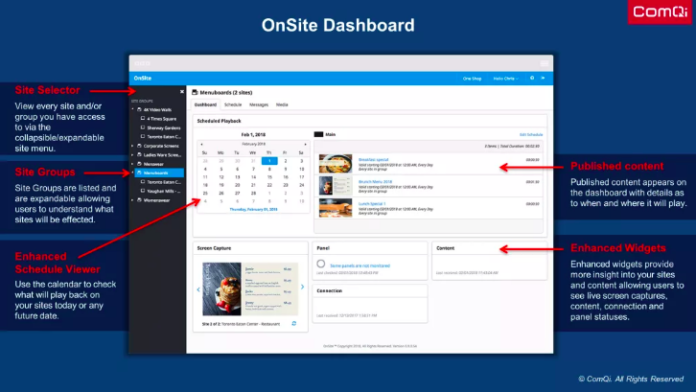
ComQi Inc has launched an OnSite toolset for its EnGage content management solution, which allows offices and shops to update content on digital signage and maintain centralised control on scheduling and content design.
Centre offices can assign and permit local managers and staff to update specific content pieces on chosen displays without the updates clashing with the design principles such as logo, colour and font choices.
The platform has an approval process that notifies managers of messages that need to be reviewed before being placed on the displays. ‘When we speak with brands about local messaging, whether that’s in retail, food services, health care or corporate, we hear how they all want to enable more messaging at the local level, without having to worry about things like brand continuity,’ said Josh Nagy, director of product management, ComQi.
‘We developed OnSite to specifically meet that need. Companies can get gorgeous templates designed that stay right on brand, control the frequency, timing and scheduling of content, and give local offices the ability to update them. When you have an approvals process in place, no one’s developing heartburn worrying about what’s getting on screens away from the main office.’
UK foodies love using Rooibos to add a burst of flavour and colour to their food and drink posts. Social media is turning tea into the beverage industry's sexiest new offering.
According to a recent Innova Market Insights consumer study, one in ten consumers in the US, Canada, Mexico, Spain, the Netherlands and Australia are influenced by social media in their food and beverage purchases. That number increases to a whopping one in five in China and India. In SA, the case is bound to be similar with more than 23 million users spending almost three hours on average a day on social media.
Every day, people all over the world post a gazillion snaps of the most beautifully styled dishes and drinks – created by either themselves or served to them with an aim to wow followers who are often left with a sense of envy and cravings for these foods and beverages.
It’s posts like these from celebrity chefs, Gordon Ramsey and Siba Mtongana, that’s catapulting our homegrown Rooibos to superstar status on social media.
‘It’s a phenomenon that is also having a big impact on tea consumption worldwide,’ said Adele du Toit, spokesperson for the SA Rooibos Council. ‘Before the social media boom, coffee was king, but these days tea is catching up to the popular brew. Aside from Facebook and Twitter, tea has been hash-tagged in over 29 million Instagram posts alone – arguably turning one of history’s oldest drinks into what may be the beverage industry’s sexiest new offering.’
She said that the tea-drinking demographic is also widening as influencers on social media encourage followers to live healthier lives, by becoming more mindful about their lifestyle choices and the impact it has on the environment.
One person’s suggestion to try Rooibos-citrus-and apple ice tea in the Netherlands (pictured), or Rooibos-vanilla in Spain, has helped to promote Rooibos to thousands of people across the shores in a single day.
‘Many consumers are looking to cut back on coffee and are leaning towards caffeine-free drinks with natural plant-base ingredients. This opens the door for botanical and herbal teas, such as Rooibos, offering health-boosting benefits.’
According to industry experts, consumers have maxed out on other beverages and enjoy the variety of flavour combinations that teas offer them. Beverage giants have responded by launching tea-infused waters, soft drinks and energy drinks. Ready-to-drink, tea-flavoured alcohol options are also proving popular.
‘So too, the increasing interest in ethnic cuisines is drawing food bloggers to unique flavours such as Matcha and Rooibos teas. Every time celebrity chefs, such as Gordon Ramsey or BBC’s Siba Mtongana posts a Rooibos recipe, it reaches millions of social media followers who share it with their followers.’
‘Popular platforms, such as Instagram and Facebook, have made our homegrown Rooibos accessible to the more than 3.48 billion users that are currently active on social media, which in turn is strengthening the demand for the tea globally,’ she added.
Andile Qokweni, Business Unit Manager at The MediaShop, says that most kids today are plugged into devices like TVs, tablets and smartphones well before they can even ride a bike. Most kids watch what they want across all these platforms when they want to, no longer by appointment. It’s all about options now! Ensuring your content is available on the platforms that kids consume is the key to success.
No better situation demonstrates the availability of content across the board than the amount of entertainment available to kids. I grew up in the ’90s with an MNET decoder and I felt I had an infinite amount of youth based entertainment options. For some of our younger colleagues, if you had an MNET decoder in the ’90s it meant you had access to three hours of entertainment per day between 3 and 5pm and this was bumped up to five hours on a Saturday and Sunday morning from 7am to 12pm.
Again for our younger colleagues, this segment on MNET, which at the time was a standalone channel for many years, was called KTV, short for Kids Television. KTV introduced us to characters such as Scooby Doo, Gummy Bears, Animaniacs etc. Even The hosts of the programming schedule have gone on to become local celebrities.
Multichoice has always been ahead of the content curve or trend locally as many years later our free to air public broadcasters joined the bandwagon with their own kiddies segments, namely YOTV on SABC, and etv brought us Craz-e.
The competitive advantage that Multichoice has over their direct rivals even back in the ’90s was access to up to date content. In our media landscape presentation a few weeks back we spoke about the relevance of content and relevance in this context was how up to date the content we consumed on KTV was – it was always first in class. If I think back to where my love for the Marvel Cinematic Universe comes from or began, it was access to the latest cartoon shows such as the X-Men, Spiderman and finally Iron Man.
Fast forward to the mid to late ’90s and the availability of Multichoice’s digital satellite service now commonly known as DSTV. This opened up a whole new world not only for the adults but for kids as well as suddenly there was access to 24 hours of content instead of the three hour segments on KTV or Craz-e or YoTV. Who can forget Dexter’s Lab, Edd Ed and Eddy, Courage the Cowardly Dog and many other global or international shows?
Fast forward even further: the children of the 1990s are now running their own households. Parents are looking for different ways to keep their kids entertained and occupied. What better way to do that than getting them occupied with relevant entertainment? The options are now limitless in terms of platforms to view and content to view. Multichoice are continuing to carry the baton for all South Africans as their various bouquets carry content from Cartoon Network, Nickelodeon, Boomerang, Disney Junior, Disney, Disney XD – and that’s just on TV. If we look outside of traditional or linear TV, the likes of YouTube has a dedicated kids section and so does Netflix.
It is no longer about rushing to get home at 3PM from school or setting a clock to wake up at 7AM on a Saturday or Sunday. The content must be compelling and relevant enough to stand out in an ever changing, dynamic and competitive environment.
Makgotso Sekete, Media Strategist at The MediaShop, discusses digital marketing in a third world country. According to Statista, South Africa has a population of 58 million people but due to the expensive cost of data, only 31.1 million South Africans have access to the internet with 28.9 million people accessing it using their mobiles. Digital marketing in South Africa has increased at a rate of 35% and certain trends have increased in popularity, which will have to be taken into account, like Black Twitter.
As a third world country, traditional media is our main method of communication with radio, television and OOH the highest consumed mediums across various markets in South Africa. But digital is growing at a rapid rate and is enabling huge brand integrations.
Makgotso Sekete, Media Strategist at The MediaShop.
The growth of digital advertising in South Africa exceeds the current global growth. In a study conducted by Adobe, at least 59% of customers in South Africa take greater interest in classified ads that are published in digital media than classified ads aired on TV or radio.
In comparison to first world countries that have internet penetration of 95%, SA’s is low. With this being said, television, radio and OOH touch points are consistent in delivering mass awareness objectives. These more traditional platforms are freely consumed because the high cost of data is a barrier, especially for citizens on the bottom of the pyramid (BOP).
With that said, not only are millions more people accessing the internet than ever before, but they are doing it in different ways. Online marketing is the way of the future and stats show that it can provide companies with superb advertising for lower prices and with even better, and proven, results. Businesses, both large and small, are taking the internet by storm and connecting the power that digital marketing has to offer for marketing, sales and customer engagement. With digital marketing skillsets, small businesses are finally able to level the playing field against larger corporates.
Infrastructure is of course a massive consideration to provide digital accessibility to the overall South African population. However, as an emerging economy, SA has covered a lot of technological ground lately. We should keep our eyes on those ahead of us, and be on the lookout for trends and developments of internet marketing strategies globally.
Marking posts with #ad, #advertisement, #sponsored or #gifted, adds another layer of authenticity and integrity to influencer content where followers will be able to distinguish between organic and branded content. Last year there were rumours that the Advertising Regulatory Board (ARB) would require influencers to mark all sponsored social media posts as such and it’s finally a reality.
Although quite a lot of local influencers are already doing this, the ARB is finally enforcing this code. This comes after an influencer failed to disclose a trade exchange with a big automobile brand. The decision is welcomed by both influencers and the rest of the industry, as it will provide full transparency to audiences.
Audiences don’t like being lied to, and in the past, they would get some sort of signal from influencers that they were either paid for the posts, or that they were sent products to post about, but some didn’t always do that. The new ARB Social Media Code is quite specific about not misleading consumers. Pretending that content is organic, when it’s not, is inauthentic, which is a big no-no as an influencer. This is seen in the same light as buying followers or engagement and can lead to reputational damage to these influencers and the brands associated with them.
The fact is that influencers with integrity and credibility who work with brands and products that already align with their own brands aren’t worried about marking their posts. Their audiences already like their content and are interested in products that can add value to their interests and therefore won’t affect their engagement rates.
It’s important to note that not all the responsibility rests on influencers’ shoulders. According to the ARB’s Social Media Code, brands must be clear of their expectations to influencers and ensure that they give them correct and clear information; and be satisfied that they understand it in order to avoid misleading consumers in their social media posts. The brand and influencers will be held equally responsible if this is the case. Brands are also required to have a written contract in place with all paid influencers and it must include: • Details of the brief. • Remuneration (cash or cash equivalent), details and conditions of payment. • The obligation to publish only own content or to clearly disclose or credit the content creator, if and when the content is not self-created. • Mandatory disclosures and industry specific marketing regulations required by the marketer’s industry
The move by the ARB is a step in the right direction to regulate the influencer industry and will start weeding out the charlatans. This is good news for influencers and brands alike. It will ensure more authentic partnerships and campaigns with the right influencers for brands, which will lead to better campaign results.
Handcrafted flowers by South African women using recycled plastic bottles, plastic cutlery and plastic hangers. 2-litre milk bottles, 5 and 1.5 litre water bottles.
AWoolworths botanical window display that incorporated milk bottles and plastic hangers received a prestigious global prize at the annual Creative Retail Awards in London.
The Creative Retail Awards recognise and reward innovation and excellence in retail design from around the world. The festive-season window featured 3D flower artworks, including striking, oversized models of iconic Proteas made from discarded plastic.
The flowers were handcrafted by South African women using recycled plastic bottles, plastic cutlery, plastic hangers, 2-litre milk bottles, 5 and 1.5-litre water bottles as well as many common single-use plastic items such as cutlery and hangers.
Woolworths’ marketing head, Charmaine Huet explained, ‘Our aim was to create a visual representation of Woolworths’ zero packaging to landfill journey over the 2018 holiday season.’
Shaune Jordaan, Founder and CEO of Hoorah Digital, says companies that suffer an aversion to using digital marketing tools are in substantial danger and that mobile is on the increase.
Digital transformation changes buying behaviours and the decisions of customers. People are spending more time on their mobile devices, such as smartphones, tablets or laptops, than ever.
The marketing landscape is turning its focus from the brand itself to placing the consumer at the heart of the strategy. Those that have embraced all things digital have vaulted ahead of competitors that are stuck in traditional marketing practices.
Shaune Jordaan, CEO of Hoorah Digital
What are the things that are preventing companies from diving into digital marketing?
A lack of basic understanding of digital platforms
One of the reasons many C-suite executives are opposed to digital marketing is that they don’t personally use social media, therefore making them sceptical of its effectiveness.
It is important not to get bogged down in the technical side of digital but to focus on data that translates to results they are familiar with, like conversion rate and cost-per-acquisition. By using metrics that are simpler to describe, a client will be better able to follow the overall effectiveness of their digital marketing.
Lack of experience
Digital marketing is in a perpetual state of change, challenging marketers to learn, research and adjust their strategies more frequently than ever before. Many businesses aren’t prepared to seek proper training for their marketing employees, ending in a huge waste of time and money.
The world of digital marketing is becoming more complex, making it almost impossible to do it half-heartedly. Companies should find a digital consultancy to perform a trial advert for their brand, allowing them to test the digital marketing waters without engaging in a binding contract. These small-scale tests are great at foretelling your company’s success or failure on any given digital platform, allowing you to find an objective point of departure for bigger campaigns.
The mistaken belief of a low return on investment
Many companies are hesitant to put a budget behind digital marketing because they believe it is difficult to prove the return on investment (ROI) of anything that is not traditional marketing. Yet, digital advertising’s return on investment (ROI) is far greater than that of traditional media such as television and radio. As reported by an analysis by Nielsen, digital advertising’s ROI takes the lead at R2.30 per rand spent, in comparison to R1.30 for television, and is three times more effective than radio.
Not only does digital have a proven higher ROI when compared with traditional media, but it is also more cost effective. With South African businesses being faced by increasingly tighter budgets, they have to demonstrate that the money they spend on marketing is worthwhile. For the cost of a TV advert, you can make six YouTube videos and target them at specific people, boosting engagement and sequentially sales revenue.
Do digital, or die
South Africa has 31.18 million active internet users and 28.99 million active mobile internet users. We have a 54% internet penetration (7% growth from 2017). South Africans spend an average of 8 hours and 32 minutes on the internet per day via any device. And they access the internet for personal reasons on any device: every day (65%), at least once per week (22%), at least once per month (8%) and less than once per month (4%).
It’s clear. Companies in the contemporary marketplace need digital marketing to compete. Online is where the consumers are. It’s where they prefer that you reach them. Online is where the modern buying process begins.
Game South Africa has appointed The Odd Number as its new brand agency, and Ogilvy South Africa as its retail agency. This comes after an extensive procurement process which saw four major agencies shortlisted for the main business.
According to Game, all four were exceptional but two stood out the strongest in brand work and retail work respectively. ‘We are excited to work with these two dynamic agencies to reposition Game in the hearts and minds of the South African consumer,’ said Katherine Madley, Game brand and customer director.
Submit your most impressive creation for the official Loeries T-shirt, in partnership with Barron, and you and a partner could be VIPs at Loeries Creative Week in August.The competition closes on 10 July.
How to enter:
Send your design of what you think the ideal Loeries T-shirt should be – there are no limits.
Post your creative design to Facebook or Instagram using the hashtag: #LoeriesBarronDesign.
Share your designs with the world and get your people liking and loving your posts.
The 20 most liked designs will be shortlisted and the Loeries committee will select the winning design, which will be used for the Official Loeries T-shirt at Creative Week. The winner receives two VIP tickets to Loeries Creative Week (19 to 25 August 2019) in Durban – travel and accommodation excluded.
Barron has been creating unique corporate and promotional products for over 25 years and is also the proud sponsor of the Media Innovation Category at the Loeries this year. It is a category focused specifically on new methods and approaches to advertising, on any media platform.
Loeries CEO Andrew Human explained that, ‘The Loeries Africa Middle East celebrates creativity and brilliance in the advertising and marketing space. It rewards brand communications that make us feel something, question the status quo and rethink our way of doing things. We’re delighted that Barron is sponsoring this competition, and we fully expect some unique and interesting design entries.’
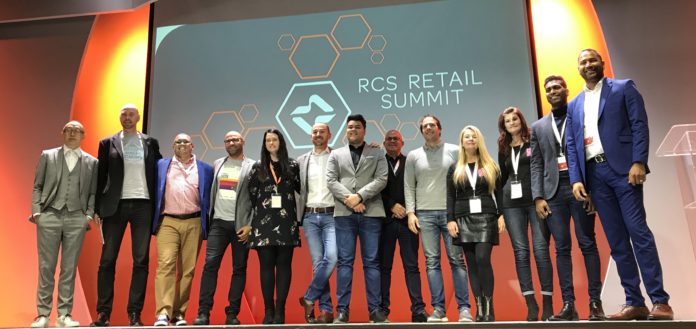
The RCS Group, in partnership with Echangeuar, hosted its third annual Retail Summit on 27 of June at The Venu in Melrose Arch in Johannesburg, under the theme, ‘Explore the evolution of retail’.Delegates got a glimpse of the future of retail from the speakers, who explored mega-trends that will shape the future of global and local marketing and retail in South Africa.
Nicolas Diacono, Technological Trends Expert at Echangeuar, discussed Chatbots, AI, Machine Learning, VR, AR and IoT retail. He decoded the key technological innovations in 2018-2019, as they applied to retail, and showed South African marketers how to recognise the biggest innovations to impact their business, discover new retail practices and to refine their sales strategies.
Dion Chang – Trend analyst and founder of Flux Trends, explored new and emerging urban tribes that are shifting the zeitgeist (and therefore the consumer mindset), globally as well as locally, such as Generation Z, Neo afro-culturist, African spiritualist and more. This follows the ground-breaking 2012 e-book, New Urban Tribes of South Africa. He touched on how diversity and inclusion are two of the commanding values driving Gen Z, and therefore, their interactions within society and commercial industries.
Warren Owen, Managing Director of 2Way Systems, discussed the future of workforce mobility: how employee mobility leads to better processes, improved productivity and 100% more satisfied employees.