Home Blog Page 366

Sanlam And King James Inspire Great Acts Of Change With Launch Of #NeverBeenABetterTime Campaign 

Sanlam collaborated with creative agency King James Group on its newly launched social initiative, #NeverBeenABetterTime, which aims to inspire South Africans to do good, and to see the good in others and our country.

Right now, according to Stats SA, there are more than 13,000 under-threes in South Africa named Enzokuhle. Around 6000 of these are girls and 7000 are boys. It was by far the country’s most popular first name in both 2017 and 2018. While naming trends are nothing new, the interesting part of this one is what it symbolises: Enzokuhle means ‘To Do Good’. According to Sanlam, the pervasive use of the name symbolises an underlying zeitgeist of positivity in South Africa and presents an opportunity to galvanise an ethos of doing good for others. 

Sanlam believes that actions can add even more meaning to our names. Enzokuhle is surrounded by many similarly positive names. There are many more examples of great men and women who have lived up to their names and made a positive difference in the world. Siyamthanda means ‘we love him’, Zenzile means ‘the one who can overcome life’s obstacles, and make a way for herself’, Mpilo means ‘the one who brings life’, Nadine means ‘the courage of the bear’, Trevor means ‘ambitious’, Pomeza means ‘chosen to fulfil’ and Thuso means ‘the one who will help’.

Sydney Mbhele, Chief Executive for Brand at Sanlam, said South Africans are reaching for positivity, for good and for hope for our nation’s future. ‘At Sanlam, we were so moved by the many acts of hope and humanity we have seen this year in South Africa, which is why we decided to create a community for good.’

The Sanlam Group has invested more than R530 million over the past 10 years, on a range of imperatives to uplift the lives of South Africans. ‘We believe in doing well by doing good. #NeverBeenABetterTime is evidence of our continued, passionate commitment to doing good for our nation,’ said Mbhele.

‘The more we document acts of kindness and positivity, the more we will all be inspired to act for the good of others and the country,’ Mbhele continued. ‘And what better way to start this conversation than with the powerful story behind the country’s most popular baby name?’

Jared Osmond, creative director at King James, commented, ‘The insight hit us between the eyes. It was individually decided, by thousands of parents living in a country that’s in a tumultuous time, to name their children with intention, and to make them the good of the future.’

Osmond said, given the fact that the meanings of so many names are incredibly special, Sanlam is challenging South Africans to analyse the meaning of their name and to commit to living up to this meaning. ‘It is clear that our parents had the very best intentions when naming us. So we are saying, let’s collectively live up to our names and do good.’

Sanlam is asking South Africans to visit its social channels and explain what their name means and how they’ll live up to it using #NeverBeenABetterTime. The prize on offer is R10,000 for the charity of the winner’s choice. T&Cs apply.  

There are many more wonderful initiatives planned for 2020 under the #NeverBeenABetterTime banner. Follow and join the conversation by visiting, neverbeenabettertime.co.za

KING JAMES GROUP
+27112150000
enquiries@kingjames.co.za
www.kingjames.co.za

Will The Division Between Marketing And IT Continue In 2020?

To meet customer expectations, IT needs to be included in the marketing department’s plans and aid in delivering the customer experience at every touchpoint along the customer journey. However, while there is much hype around the benefits of technology and marketing working together, there continues to be a great divide between these departments. And yet when marketing and technology come together to achieve a common goal, they can achieve great things and drive business success, states Paula Sartini, founder and CEO of BrandQuantum.

Business confidence across the country declined throughout 2019 on the back of the tough economic climate which is expected to continue in 2020. The need to win customers and gain their trust against increasing competition is a key challenge for most companies. As such, customer experience is growing in importance as a key differentiator for companies to attract and retain customers, particularly within a tough economy.

Customer experience melds marketing and technology

Customer experience has previously been the marketing department’s responsibility, however, new technologies such as automation and artificial intelligence can transform the delivery of customer experience. This creates the opportunity for the IT department and marketing department to work together to achieve a unified goal of delivering customer experiences that meet and exceed tech-savvy customer’s expectations.

Both departments offer a diverse range of strengths to organisations. Marketing departments bring a creative and customer focused approach, whilst IT provide both a technical and problem-solving perspective. At the same time, marketing is often seen to want to adopt the latest technologies while IT is focused on governance, security and enterprise architecture. Both of these are critical to the success of a company. As customers are starting to hold companies accountable for keeping their data secure, the role of IT and marketing need to align to meet customer expectations in terms of customer experience as well as in keeping their personal information secure from potential data breaches.

Surviving a recession with the help of technology

The role of technology continues to grow in importance across organisations of all sizes. However, while companies recognise the benefits that technology can bring to various departments, the organisation and the customer experience, in many instances, adoption of these technologies has been slow.

Yet, technology is a critical component to helping companies overcome several business challenges, including helping companies to overcome the impact of a recession. According to research findings published in Harvard Business Review, recessions can create performance gaps between companies, but investing in digital technology before a recession provides analytics and agile business practices to help companies better understand the threat they face and respond more quickly to market changes. Based on the findings, companies that invested in technology outperformed those that did not during a recession.

There are several factors attributed to the role technology plays in helping companies overcome the impact of a recession. Firstly, technology provides access to data that gives companies the ability to make decisions to meet their customer’s needs. The technology solutions also provide companies with the flexibility they need to adapt to the environment and respond to their customers with tailored solutions. Technology also aids in cost-cutting, which helps the company to save money when it matters the most.

Many of these benefits can spill over into marketing departments, for example, giving marketers access to the right data enables them to make decisions to meet their customer’s needs. They would also benefit from the flexibility that technology allows in adapting to the environment, helping them to develop or change campaigns according to the market.

However, in many instances, marketers have collected customer data for several years, but have not had access to the tools needed to extract and interpret this data. This is where marketing and IT should be working together more closely to improve marketing insights and close the loop on the customer experience.

Delivering the customer experience

The customer experience is a key focus for the marketing department. However, marketers are unable to deliver customer experiences in isolation. With tech-savvy customers, marketing departments are becoming more reliant on IT departments to develop technology solutions for customers to interact with the company at a time and on a platform that is convenient to them. This experience needs to align with the overall brand experience and requires insights from the marketing department to achieve this.

More broadly, marketers require the support of the entire organisation to meet customer expectations at every touchpoint across the customer journey. This means that the marketing department needs to implement technology solutions that help employees to deliver experiences aligned to the brand in every customer engagement.

According to a report from Forrester, businesses often deploy technologies that aren’t aligned to their business strategies and do not understand how these technologies affect customer journeys. Ultimately, the consumer experience strategy should be central to technology purchasing decisions. The marketing department needs to implement solutions that will help employees across the organisation to deliver consistent brand experiences in every customer interaction.

This will remove pressure on the marketing department to play the role of brand police, give marketers peace of mind that the correct information is being sent to customers and empower employees to meet customer expectations in every interaction. However, marketers also stand to benefit from implementing automation technologies to streamline their functions and help improve efficiencies.

Automating marketing functions

Marketers have a strategic role to play within organisations but are often chasing the next deadline or working on name tags and invitations for an upcoming event. These repetitive tasks can keep marketing departments bogged down in the finer detail and detract them focusing on the broader strategy of the department and the organisation.

In some instances, marketing departments have started implementing automation software that enables them to automate time-consuming repetitive tasks. By implementing these software marketing departments, which are usually made up of a small team of marketers, are freed up to focus on strategic elements of the business while delivering on the brand and marketing elements beautifully without investing a significant amount of time and effort on the delivery.

Marketers are already starting to recognise the value that automation software can bring to their department with the Digital Marketing Institute finding that 44% of marketing leaders believe that automation software will become more important in 2020.

While some strides have been made in terms of bridging the divide between the marketing and technology teams to meet customer’s expectations and deliver consistent customer experiences, in most cases locally marketing and IT continue to work in silos. However, globally technology and marketing departments are working together more closely and reaping the benefits of this relationship that has a direct impact of improving customer experiences and increasing company profits, helping them to adapt to a customer-centric environment and weather the storms of the tough economic climate.


BRANDQUANTUM
+27100450905
ignite@brandquantum.com
www.brandquantum.com

World Branding Awards Honours Amarula As 2019 Brand Of The Year

World Branding Awards named Amarula as 2019 Brand of the Year – National tier. It was the only brand in the Alcoholic Spirits – Cream Liqueur category from South Africa to be selected for the 2019 Awards. This is the third consecutive year that Amarula has been acknowledged with this accolade, solidifying its reputation as South Africa’s most awarded liqueur.

Global Brand Director Michael Lloyd said that the award speaks to the brand’s consistent commitment to retaining its authentic African roots while also expanding its global footprint. ‘Being honoured with this prestigious award once again cements Amarula’s status as a truly global brand. Amarula is Africa in a bottle, and its distinctive Marula taste inspires people to explore the unexpected cultural diversity and rich natural beauty of this continent.’

The World Branding Awards celebrates the very top brands that have become household names in terms of their work and achievements, both in their home countries and abroad. With over 4500 various brands competing from different sectors, only 316 winners were announced in their respective categories. Winners are judged on a unique three stream system – brand valuation, public online voting, and market research – which all contribute to a brand’s final evaluation score. 

Amarula has been widely acknowledged for its pledge to quality and has earned over 39 awards since its inception some three decades ago. This third win in the World Branding Awards joins other illustrious accolades, including the 2018 Michelangelo Double Gold Award, a silver at the 2018 San Francisco Spirits Competition, and a silver at the 2018 IWSC awards. 

The World Branding Award win also acknowledges Amarula’s ongoing commitment and efforts in safeguarding its African heritage by raising funds for the conservation of Africa’s natural wildlife via the Amarula Trust. The initiative ensures that animals such as the elephant, an animal synonymous with the Amarula brand, can continue to thrive under the Marula trees of the African wilderness. The Amarula Trust implements sustainable environmental and education projects to ensure the preservation of the precious African heritage in partnership with Wildlife Direct.

AMARULA
amarula.com

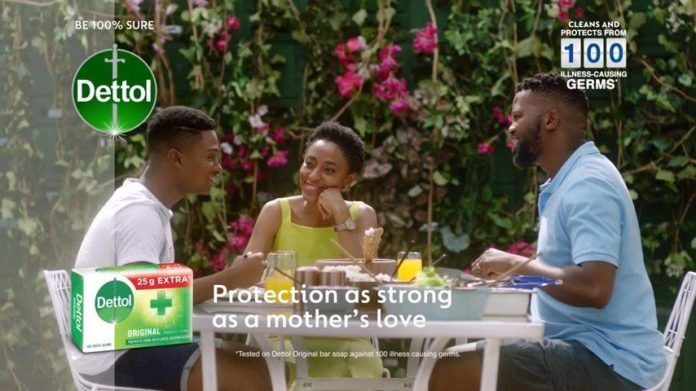
McCann1886 Illustrates The Strength Of Dettol’s Protection Via Ad Campaign

Using the insight that, no matter how old you are, you will always be your mother’s baby, the TVC developed by McCann1886’s creative team of Executive Creative Director Tumi Sethebe, Copywriter Zi Sithole and Art director Chan Ma, was directed by Egg Films’ Dani Hayes. 

Reckitt Benckiser’s 80-year-old brand Dettol is reinforcing its ‘protection as strong as a mother’s love’ positioning with a bar soap TVC from its advertising agency McCann1886.

‘I tasked the agency to evoke an emotional reaction from the Dettol soap bar’s target audience – mothers and other caregivers in South Africa,’ was how Marketing Director at Reckitt Benckiser, Kunal Sahgal, described the brief that inspired a TVC he’s very proud of. This TVC delivers on emotion and authenticity while still being able to communicate on the germ protection credentials of the brand. It does so with music and visuals that put the spotlight on a mother’s enduring love for her children and her desire to protect them. The transitions between a young and older mother and her pre-teen, and then grown-up son are exceptionally subtle and seamlessly done, and are incredibly entertaining to watch.’

MCCANN1886
+27115666000
mccann.co.za

How Long Can Google, Facebook And The Like Continue To Thrive, And What Is The Impact On Advertising?

Federico de Nardis, GroupM Sub Saharan Africa CEO, says ‘The Great Disruption’ is here and these are dangerous days for advertisers, at least those who have used television as the foundation of their communication strategy.

Google and Facebook on the one hand and Netflix on the other have structurally undermined a century-old economic model: the former two by advertising-led monetising of intent and social interaction in the absence of content, and the latter one by monetisation of content in the absence of advertising.

In the former instance, massive outflows of cash combined with a diversion of attention from print media eviscerated the legacy publishing model. In the latter, the creation of an appetite for ad-free video diverted time, attention and money from traditional ad-supported television.

As the third decade of the 21st century begins, the question is: How long can these companies continue to thrive? The position of these three companies in the West, at least, seemed impregnable only two years ago. Now they continue to grow in both volume and share, but at decelerating rates and with clear vulnerabilities that may impose significant change.

In GroupM’s top 15 markets as defined by total billings, Google and Facebook represent 19% of the total. This includes all of Facebook’s individual platforms and the Facebook Audience Network, as well as all Google search, display and video, including any revenue ultimately repatriated to publishers. Google is the largest supplier to our clients. Facebook is fourth. The pair is separated by The Walt Disney Company and Comcast. Had the merger activity of 2018 not taken place, Facebook would have been second, with a big gap to Google and a slim one to Comcast.

In the case of Google and Facebook, the data assets that laid the golden egg of targeted advertising are now questioned. Regulators have identified consumer harm, the enablement of criminality and the undermining of democracy as sufficient reason to demand radical change.

It’s not altogether surprising that many competitors, commentators and regulators are calling for some variation of a break on growth or a breakup of corporate entities. So far, regulators have been content to fine Google and Facebook. The sums are large in any normal corporate context, but little more than an inconvenience to these companies. It seems certain that the fines will rise and the calls for breakup will get louder in 2020.

Who or what threatens Google and Facebook?

Regulation is easily the biggest threat. A boycott by advertisers is no threat at all; advertisers go where the customers are. Of greater significance is what Facebook and Google might do to themselves. Facebook’s announcement of the consolidation of the data engines of WhatsApp, Messenger and Instagram in the name of end to end privacy should be seen alongside its energetic development of Instagram commerce and Libra. Messaging, storefronts, commerce and currency represent a radically evolved model for the company. These initiatives will be viewed by some politicians and regulators as aggressive moves, and may see a backlash as a result.

At Google, the threats are three-pronged. Regulators appear focused on their ownership of Android, the social consequences of YouTube and their market dominance in both search and the ad tech ecosystem.

Google’s grip on app revenue is also loosening, as a number of major developers are bypassing the Play Store – because they are able to and perhaps because they believe Google is in a less-strong position to enforce its gatekeeping position. Google realises that the cash cow of search is challenged by Amazon in product and by vertical players in travel and finance.

It’s possible that Google will hold station in search and shift the YouTube brand entirely to curated content and a virtual multichannel video programming distributor on a global basis in order to protect its ownership of Android and position in ad tech. In that configuration, Google can maintain its runway at a reduced level of controversy as it builds its credentials as a dominant player in ad-funded video and becomes the ‘anyone but Amazon’ partner to those with e-commerce aspirations. In turn, this may enable the longer-term bigger bets of both Google and Alphabet to play out successfully in cloud, autonomous vehicles, health care and other associated life science endeavours.

Smaller companies could also pose threats, if minor ones in the near term. In advertising specifically, Twitter and Snap are resurgent and valuable to advertisers, but, like Pinterest, they are still small. Elsewhere, TikTok has zoomed into public consciousness. However, there is a view that TikTok is susceptible to brand safety issues.

More broadly, all eyes are on Amazon and the multimillion (billion) dollar question: is purchase data the highest fidelity signal of all? If so, and if Amazon disrupts the ad tech status quo following its acquisition of the ad-serving assets of Sizmek, both Facebook and Google will find a new competitive threat. Advertisers great and small will have a new route to market.

Across all of these titans – Google, Facebook and Amazon – the bargain becomes ever more complex for the largest advertisers. Business performance is blending with ethical concerns, many channels to market are also competitors, and the information asymmetry between the platforms and their customers has never been greater. The walls of the walled gardens get ever higher.

GROUPM AFRICA 
www.groupm.com/africa

M&C Saatchi Delivers Joy With Takealot.com Jingle Kelz Christmas Ad

M&C Saatchi Abel kicked off the festive cheer with its Takealot.com Jingle Kelz Christmas advertisement that has a razor-sharp sense of humour and demonstrated that it is on the pulse of the social reality in the country.

Set in her upmarket Johannesburg home, the story involves Kelz speaking to the viewers in her signature style. The advert and set allude to a white Christmas and poke fun with highly nuanced South African jokes. One of the highlights is the Christmas jersey Kelz is wearing, and has proven to be a hit with viewers, along with a host of other clever devices throughout the advert.

This is the second time satirist, comedian and writer Lesego Tlhabi has featured in a Takealot.com advertisement, and Gordon Ray, Creative Partner of M&C Saatchi Abel said, ‘We worked with Tlhabi on a Takealot.com advert earlier this year, where her Coconut Kelz character took viewers on a tour of the Takealot.com warehouse. Kelz is a white Sandton woman trapped in a black woman’s body, perfect for appealing to South Africans. Her sharp wit and hilarious commentary on topical issues makes her a fresh choice for Takealot.com. Notorious for not liking to struggle, we felt Kelz was the perfect person to show viewers what convenience looks like in a funny, satirical jab at contemporary South Africa that appeals to a broad range of viewers.’

The Christmas holidays are very important in South Africa, and M&C Saatchi Abel’s brief was to create an advert that would stand out from the other festive season adverts on TV, something that ‘would cut through the noise,’ said Ray. ‘Shopping for gifts during Christmas time is known to be a schlep, having to deal with crowds, queues and lots of carrying. So, the idea was to show how Takealot.com removes the struggle of festive shopping by offering thousands of products that can be delivered straight to your door.’

Founding partner and CEO Mike Abel said, ‘At the end of the day, our job is to create value for our clients, and it certainly helps that we are able to have fun while doing it.’

M&C SAATCHI ABEL 
+27112686388 
jerry.mpufane@mcsaatchiabel.co.za
www.mcsaatchiabel.co.za

Using 2019 Marketing Techniques To Pace Your Business For 2020

Jainita Khatri, Managing Director, Prana Business Consulting.

Jainita Khatri, Managing Director, Prana Business Consulting, discusses six ways in which 2019’s marketing trends have prepared us for 2020.

1. ‘Effectiveness wins the battle over efficiency.’ – Sarah Vizard

They sound interchangeable but the definition of effectiveness is the degree to which something is successful in producing the desired result. The meaning of efficiency is the ratio of the useful work performed in a process to the total energy expended. In other words, brands prioritising long term success over a shorter sighted return on investment (ROI) looked strong in 2019. 

2. ‘Digital transformation can orchestrate and personalise the entire end-to-end customer experience, moment to moment, at scale, on any channel, in real time.’ –  CMO by Adobe

Artificial Intelligence (AI) is fittingly poised on the brink of a marketing landscape truly worthy of science fiction. These new technologies within AI and the Internet of Things (iOT) have pushed marketing into frontiers that are taking personalisation into the area of customer knowledge previously known to only family and friends.  

This means having, as Todd Dipaola wrote about, how an understanding of AI at broader and deeper levels delivers more personalised and contextually relevant advertising. Customer experience management (CXM) is top of mind for companies.

3.  ‘Mastering Marketing Mix Modelling (MMM) allows marketers to create magic moments.’ – Techcrunch

Marketing mix modelling is being more broadly used to enhance advertising offerings and promotions improving ROI. TechCrunch explains the effectiveness of using MMM to enhance the customer experience: the explosion of data and identity management, combined with technical advancements in real-time signal detection and machine learning, present new opportunities to respond to consumers, but mastering this ability enables marketers to create ‘magic moments’ – instances of hyper-relevant content, delivered at the perfect time and place.

4. Measure what matters – smart data over big data.

According to Marcel Deer, in 2020 we can expect to have 20 billion IoT devices collecting data for analysis and in large tech corporations business leaders are now synergising assistive technology to run more intelligent data analytics. So from 2019 onwards, prioritising how we quantify data will be make or break. It is no longer an option for marketers to rely on big data with no quality metrics as these continue to spew out key audience assumptions that may not be true. 

5. ‘Brand messages reached 561% further when shared by employees vs the same messages shared via official brand social channels.’ – MSL Group

The average survival rate of businesses is quite a sobering one, 79% last for one year, 50% for five and 33% over ten years. And if the stats from 2019 tell us anything about holistic marketing, it is to treat internal marketing as seriously as external marketing. While we are so caught up in technology and data management, we can’t lose sight of the fact that that much of customer experience is still in the hands of humans. Attracting and retaining the best people is still one of the key ways to win big points in the marketing battleground.

6.  ‘Eliminating the CMO position sets the brand free from the confines of marketing, reuniting it with the business.’ – Forrester

According to a report done by Forrester, Chief Marketing Officers (CMOs) are facing a final desperate fight for survival, and what we saw in 2019 seems to support this as McDonald’s, Uber and Johnson & Johnson no longer have CMOs. The trend in 2020 will be to have One designated C-suite leader who will be responsible for all that surrounds the customer, clarifying the role of marketing in a business environment obsessed with growth.

In closing, some stats to indicate just how extraordinary the years to follow 2019 will be:
· There are more than 7040 different marketing technology solutions available.
· By December 2019, $4,704,038,648 was pledged to Kickstarter projects and a total 175,086 of successfully funded projects.
· There are 700,000 podcasts and 29 million podcast episodes, up 27% from 2018.
· 70% of marketers say their companies expect marketing to be the primary source of business growth in 2020.

PRANA BUSINESS CONSULTING 
+27117941409
info@pranabusinessconsulting.com
pranabusinessconsulting.com

Six Best Holiday Ads Of 2019

Image source: www.adweek.com

Tribe Leader at One Lady And A Tribe, Sheila McGillivray, discusses six of the best 2019 holiday ads.

1. Tiny Budget

Hafod Hardware, a locally owned store in Rhayader, Wales, released a nostalgic Christmas commercial #BeAKidThisChristmas which made viewers cry. The two-year-old star of the advert is Arthur Jones. His father, Tom Jones (I know right!) runs the hardware store with his parents. The video was shot by a friend, Josh Holdaway, in one day for less than R1850 (£100).

These are some of the viewer comments on YouTube – ‘This is not an ad, this is art’ and ‘This is like the light at the end of the Black Friday tunnel – when the whole world is crazed’. Soundtrack is a make or break for an ad like this and the cover of 1980’s band Alphaville’s ‘Forever Young’ by singer Andrea von Kampen is perfection – little wonder the commercial went viral.

2. Celebrating Product

Quite a few of the Festive Season ads lack either the story or the product placement. Not so with Tesco’s time travelling van in #DeliveringChristmas. The ad has a ‘Back to the Future’ vibe with a food truck driver delivering to Victorian-era England and awing the crowds with ‘food from the future’. There are also deliveries to War World II, a ’90s rave, Buckingham Palace and more. The highlights are most certainly the array of Tesco products dropped off at each venue. Mouth watering – so five stars to Tesco for making their produce the star of the show.

3. Pepsi versus Coke

With over 6 million views on YouTube, Pepsi did something right with their Cardi B Gift it Forward ad. In keeping with their trend of using celebrities (here’s the Nicki Minaj one) Cardi B gets to be both naughty and nice. It’s a fresh ad, a touch crass but also cute, especially when she tells the twerking elf, ‘Try less hands and more hips’.

Coca-Cola’s ad is more around trying to unite the world with a message of inclusivity and the need to welcome Santa into your home. Santa in this case is, I guess, a metaphor for the ‘stranger’ or the ‘other’ or in 2019, sadly, the refugee. I like it and think Coke took a risk with this as it is weightier than their previous fizzy Festive Season ads.

4. Heart Strings

Apple gets it right with this Holiday ad. It’s authentic (give the kids a device to shut them up this holidays) touching and showcases Apple technology. It is interesting to see the emerging trend of using ‘real’ people compared with the previous year’s animated commercial. The current one is more like watching a beautifully crafted short film and, as they say, ‘Sometimes, the best gifts can come from the most unexpected places’.

5. Animals

There has to be one animal-centric advert on the list and Santa’s Little Helper (RSPCA) is my winner in 2019. The two minute commercial features Tiny Tink the rescue pony who has big dreams. As the RSPCA explains on YouTube, ‘She’s always wanted to be one of Santa’s herd helping other vulnerable animals, and find her very own forever home’. It touches the heart strings and the purse strings. Plus we’re seeing another 1980’s cover version being used to beautiful effect here as Lucy Ellie’s covers ‘Nothing’s Gonna Stop Us Now’. Is this a trend we’re going to see more of in 2020?

6. New store leader

Ikea’s Silence the Critics #WonderfulEveryday ad is fresh, funny and taps into the anxiety many people feel over the Festive Season when they’re entertaining. D Double E raps about the family’s well worn home and the ad cleverly shows what a difference some choice Ikea purchases can make. Sorry John Lewis, your Excitable Edgar ad didn’t quite make the grade, and neither did Sainsbury’s Nicholas the Sweep – maybe next time.

ONE LADY AND A TRIBE
+27112442160 
www.oneladyandatribe.com

Online Retail Trends For 2020

Image source: https://tcfcr.com

According to Derek Cikes, Commercial Director at payment fintech Payflex, consumer demands for a frictionless, personalised experience that caters for their lifestyle needs are set to drive online retail trends in 2020. The result is a focus on creating a customised experience that supports and enhances shopping in the virtual environment, facilitating the buying journey.
 

1. Omnichannel retailing

As shoppers expand their touchpoints with a brand, the online and bricks-and-mortar channels will increasingly merge into a seamless omnichannel experience within the brand ecosystem. In order to facilitate this, merchants need to provide shoppers with an integrated shopping experience across all channels that allow shoppers to browse, shop and return items across in-store and online channels.

2. Pop-up shops

2020 will see pop-up shops expanding beyond brand awareness to provide shoppers with a curated shopping experience. Leveraging the scarcity and exclusivity principles associated with these temporary storefronts, shoppers will have access to novel or limited brand items. Brands, in turn, will have the opportunity to engage one-on-one with their customers while collecting shopper data.

This intimate connection will also enable pop-up stores to take on a new position of facilitating brand experiences rather than only focusing on the commercial aspect of a retail pop-up store. By providing a compelling pop-up experience, brands are able to differentiate themselves and establish a unique relationship with their target market.

3. User experience

User experience will be optimised by levering online channels. Simplicity is the key, enabling the user to effortlessly navigate the website and find and acquire the desired items. This includes reducing the number of steps to complete a payment transaction such as the seamless single click checkout process, which can dramatically increase sales conversions. Our experience has shown that the Payflex 1-click checkout process can reduce cart abandonment by a whopping 40% –  a huge benefit for ecommerce merchants.

4. Online security

Concerns about online security and privacy are one of the key challenges to growing online sales in South Africa. To provide comfort to shoppers, 2020 will see a focus on creating a secure online infrastructure and being transparent about the use of data, so that shoppers feel comfortable sharing their financial information. 

5. The customer journey

The year ahead will see online stores optimising the customer journey through each touchpoint with the brand. This will translate into establishing a strong online communications infrastructure, supporting customers through a variety of online and social media platforms throughout their purchasing journey. This optimises the shopper’s online experience, allowing the next steps to follow naturally – increasing conversions, customer retention and eventually brand advocacy.

6. Payment choices

Consumers are increasingly wary of incurring debt to purchase lifestyle goods, which has opened the door to alternative non-credit pay later solutions, such as Payflex.  
Customers want more control of their spending, encouraging the online retail industry to incorporate payment experiences that meet their needs.

7. Online ubiquity

The increase in social media retailing demands a pervasive online brand presence where shoppers can engage in a seamless experience with the brand and buy products directly from social media channels in a contained, accessible environment such as Instagram. 

8. Machine learning

The year ahead will leverage the capabilities of artificial intelligence and machine learning to provide more personalised shopping experiences. By using data and search history, merchants can curate products and services specific to the shopper’s needs and likes.

This results in being able to customise each shopping experience such as with sites like Amazon, where automatic suggestions are made in addition to the purchase or music sites such as Spotify or Deeza, which leverage machine learning to provide a personal playlist based on a user’s data and online search and listening history.

The inter-relatedness of consumer demands and technological innovations creates one of the central themes of online retail in 2020 – a symbiotic relationship between shopper and technology. This will play out in new avenues of innovation that meet consumer demands while leveraging technology to create a meaningful online experience, moving shoppers further along the customer journey to facilitate successful conversions.

PAYFLEX
+27104440004
support@payflex.co.za
payflex.co.za

Digital Marketing Megatrends For 2020

Ashleigh Wainstein, Director of Social Places.

According to Ashleigh Wainstein, director of martech firm, Social Places, new tech tools take hold and consumer behaviour moves ever faster towards instant communication and results. She discusses seven key trends that will define digital marketing in 2020.

1. Data visualisation will become even more important, particularly the consolidation of all marketing and operational touchpoints into a single dashboard that offers quick visual insights into a business, its performance and relationship with its customers. Data doesn’t mean much without the tools used to visualise and analyse it. All business channels – online and offline – have to be integrated into this single view and this can be a challenge, but the rewards are great. 

2. Artificial Intelligence (AI)-powered insights are possible once data has been collected and formatted. AI tools are able to look at much larger datasets than humans and can draw correlations across business events quickly, flagging insights and anomalies. The software picks the trends and then people can unpack these, analyse them and make more informed business decisions. For example, AI can take 50 marketing channels – billboards, local messaging, Facebook and so on, and can tell you what marketing channels achieve the most with whom and when – the detail is incredible. It interrogates the metrics and can make suggestions and recommend marketing opportunities. These are based on data rather than human assumptions or biases.

3. Local messaging is becoming increasingly significant because local content trumps brand messaging when talking to consumers. It comes down to authenticity and relevance – and technology lets businesses talk to consumers, via many channels, one-to-one. Global brands have long since steered away from big generic messaging. We can see how their messaging varies between countries and even within territories. Brands are now identifying that this needs to be taken further, with different branches tailoring their messaging on a community (suburban) level, to suit their individual clients’ needs, because every store’s customers are different. When it comes to messaging, don’t waste your budget – one size does not fit all and brands get three times the customer engagement using local, customised content then they do with blanket messaging.

4. Expectations around reviews is growing among consumers and this is reflected in the growth of near-me searches and review stats – proximity stats have jumped 500 percent in the last two years and show no signs of slowing. Consumers prefer to interact with a brand digitally instead of through call centres and more than 80 percent trust online reviews as much as a personal recommendation. They do expect quick responses to any review they give – positive or negative – and companies need to be prepared for this.

5. Growth of Loyalty Clubs will accelerate in 2020 as more brands go this route because the data they produce is valuable. Organisations are better able to understand their customers using the data they acquire from their loyalty programmes. It’s a win-win situation – brands give customers rewards, and as they know more about their customers, they are able to communicate through the most relevant channel and this in turn results in increased loyalty.

6. Marketing Automation with Personalisation simplifies communication with consumers based on their preferences. Historically, multiple teams were required to create and send targeted messaging. Increasingly sophisticated tools are now able to identify consumers’ preferences, as well as which channels they prefer to receive communications on, and send intelligent, useful and relevant marketing messages to them.

7. Brands will place less emphasis on ‘influencers’ with a large number of followers – there will be more relevant content being produced by smaller, on-the-ground nano-influencers who are in touch with their immediate community. This ties in with brands moving towards local messaging, which is more relevant and authentic for consumers.

SOCIAL PLACES
+27215513170
letschat@socialplaces.co.za
www.socialplaces.co.za
This is Modern Marketing