Home Blog Page 331

Sign Africa Live Presenting Free CorelDRAW Power Half Hour

Sign Africa LIVE and CorelDRAW Master Mo Jogie will present a free CorelDRAW Graphics Suite Power Half Hour online filled with bonus content on Thursday, 6 August at 11am.

From Creation to Completion, break down creative barriers with CorelDRAW® Graphics Suite 2020. Find all the professional vector illustration, layout, photo editing and typography tools customers need to create and complete important design projects, from virtually any device.

Register online for free, there is limited space.

SIGN AFRICA LIVE
+27114501650
www.signafrica.com/live

Prismaflex Launches LED Screens

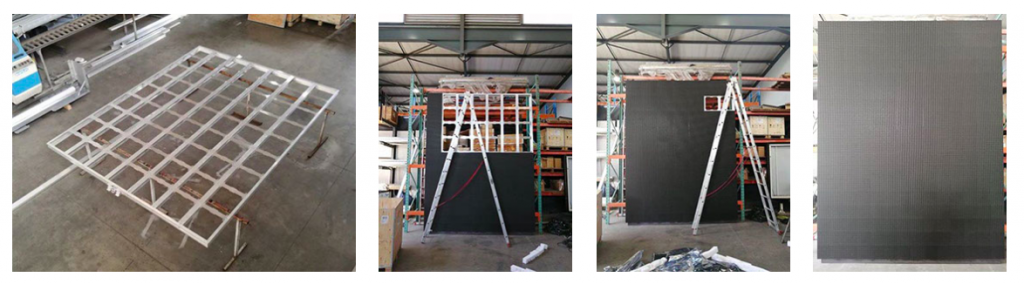
Prismaflex’s Prismatronic LED screens have been redeveloped and re-launched as Prismatronic BBM2. The company’s Billboard Monitoring System has been redesigned as a simpler and easier to use BBM2 LED control system together with a matching new, better, thinner, lighter and simpler fibre optic connected module.

It features the following benefits:

  • BBM2 has a simpler, easier to use management interface.
  • Modules are thinner and lighter.
  • New module size that enables the ability to build an exact 3m x 6m billboard.
  • Lower power usage.
  • Better IP resistance.
  • Modules connect using dual fibre optic cables that carry signals faster, don’t rust and have redundancy in the event of signal loss in one cable.
  • Early warning system that sends notifications about the screen, modules, power, control, cabling, etc. 
  • Complete remote reporting, right down to pixel level.
  • Monitored both locally and via Prismaflex’s 24-hour monitoring and control centre in France.
  • World-leading Prismatronic modules are imported and the screens are now assembled in South Africa for a faster, better and more cost-effective solution.
  • Local backup and global support via centres of excellence in France, China and USA.
  • BBM2 module features independent and separate power box and receiving cards for easier maintenance and less complication. The result is a lower heat, low power, higher quality, easier to use LED module that remains robust and long lasting.


PRISMAFLEX 
+27118235008
martin.nel@prismaflex.co.za
prismaflex.co.za

Effective Adoption Of Digital Media Technologies Will Unlock Value

According to Accenture, local content alone will not be enough to stimulate more growth in the South African media market. The local media industry needs to evolve at a similar pace to the global industry, investing in digital capabilities and infrastructure, or risk being left behind.

Additionally, significant network and infrastructure improvements are required to address the challenges local media players face in terms of reaching audiences. The effective adoption of digital media technologies to unlock value will require a collaborative effort by all the stakeholders within the media industry, specifically, policymakers, industry bodies and business.

Three digital opportunities for South African media:

1. Hyper-personalisation and contextualisation

Having great content is no longer enough to stand out amid the overload of information that consumers face. Improved user engagement is now also an imperative for the media industry. Traditional methods of advertising fail to engage consumers – irrelevant adverts disrupt user experiences and promote the use of ad-blocking software. ‘Enhanced-pull’ personalised advertising helps to convey a brand’s value proposition to a more receptive audience.

Hyper-personalised user experiences, which could add R42 billion in value, are driven by advanced algorithms that use contextual information — such as content previously consumed, online behaviour, social media activity and connections, and location — to present users with the most contextually relevant personalised advertising and content recommendations.

2. Content fragmentation across platforms

Content is being distributed across a growing number of platforms, devices and mediums. The increasing amount of time spent by customers online, particularly on mobile devices, has amplified the demand for Over-The-Top (OTT) media platforms. Increased use of OTT services and the growing popularity of short-form content and second-screen services is changing broadcasting, presenting broadcasters with new advertising platforms by offering integrated services for both the first and second screen.

Advertisers can broadcast content to users on instant messaging and social platforms. These online platforms allow for the delivery of free and paid content and allow service providers to engage with consumers and monetise their customers’ activities. Netflix, for example, is an effective subscription-based OTT service that distinguishes itself by providing data-driven hyper-personalised recommendations to consumers for content consumption across multiple devices and by using analytics to determine what content to commission or licence.

3. Partnerships and convergence

Technology is enabling enterprises to partner with their audiences, using online platforms to fund or co-create innovative content, and deliver more engaging and interactive experiences.

Advanced analytics and collection of data from social media and online platforms enable content creators to incorporate the ideas of audiences when creating new content. This fosters additional consumer loyalty and engagement. Such digital additions to the industry (e.g., user-generated content) have the potential to generate an estimated value of R10 billion. Media companies will need to invest in digital analytics and platform capabilities to realise this value.

For more insight into the opportunity for value creation that digital technologies offer stakeholders in the South African media sector, and the steps they need to take to realise that value, click here.

ACCENTURE SOUTH AFRICA
accenture.com/za-en

Modern Marketing Digital TrendCamp: Tips For Building An In-House Agency

Our Modern Marketing Digital TrendCamp video features Shaune Jordaan, CEO of Hoorah Digital, who discusses how the advertising industry has changed, especially the movement of going in-house. 

The video is live on our YouTube channel – don’t forget to subscribe to the channel for more videos on advertising/branding/marketing trends and topics.

Send a 3-4 minute audible video of yourself at home. The video should be about a general advertising/branding/marketing trend/topic (not a product or company promotion).

To submit your video and for more information, please contact thapy@practicalpublishing.co.za

HOORAH DIGITAL
www.hoorahdigital.com

Reshaping Messaging To Engage Different Coronavirus Consumer Groups

Kantar states that governments around the world are slowly reopening societies and economies, but in South Africa we are still facing the eye of the Covid-19 storm.

Although shops, restaurants and cinemas are re-opening, many of us are reluctant to get back to our old way of life. While 50% of us are keen to get back to work in the next month or go to the hairdresser, more than half of us want to delay sending our children back to school, visiting a restaurant or travelling, because of concerns about our own or our loved ones’ safety. Instead, like people all over the world, we are taking an alternate route, preferring to forgo the liveliness of restaurants, cinemas and gyms and stick to the safety of homemade meals, streamed movies and living room workouts for the moment.

Understanding the six distinct consumer tribes can help marketers to reshape their messaging, consumer experiences and even their innovation plans to drive recovery. Wave six of Kantar’s Covid-19 Barometer, which has interviewed more than 150,000 consumers in over 60 markets worldwide across six waves, finds that only 25% of South Africans are keen to bounce back to our old way of life as soon as possible, and 2/3 of us remain concerned about social distancing and avoiding busy places.

The basic Maslowian needs around safety and security remain unmet and until people are ready to climb the pyramid to the next level, economic recovery may stagnate. But brands can play a positive role with the right knowledge — providing the signals of hygiene and safety that encourage people back into the marketplace.

Pandemic tribal affiliations

People are tribal. Different things bring people together: kinship, ethnicity, culture, politics or ideology. For example, in South Africa, we have the growing Curly Girls South Africa movement, dedicated to nurturing natural hair for the best possible version of those natural waves, curls, kinks and coils. We are also home to Harley Davidson Riders in SA, dedicated to riders who relish that twin-motor growl and sharing rally news. While these two groups possibly represent opposite ends of the population spectrum – though there is certainly some overlap – the tribally affiliated individuals within them are apt to share common beliefs and behaviour, and this is key.

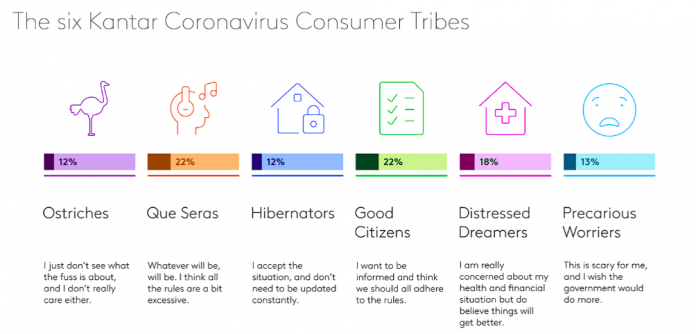
Kantar research has identified six distinct coronavirus tribes defined by the levels of worry that they are experiencing, their information consumption about the virus, how conscientiously they adhere to the rules and their trust in government. The segmentation helps brands better plan, communicate, engage and innovate in ways that will encourage people with empathic understanding, and entice them to interact with brands in ways that will shorten the path to economic recovery.

This segmentation informs a perspective of how each tribe responds differently to stress and adversity, empowering businesses to better navigate the consumer environment in the near and longer term. The tribes have been created in 18 key markets around the world including South Africa, Kenya and Nigeria.

Not only are the six Kantar coronavirus consumer tribes different according to how they respond to the pandemic, they also differ in their attitude to travel, how and where they shop, their financial attitudes and behaviours and their tendency to make big plans. While Ostriches are keen to get back to their old way of life as soon as possible, including travelling, going to the cinema and attending large events; Precarious worriers are much more cautious – they are very conscious about continued social distancing, avoid busy places, and will delay engaging in most of their old behaviours.

Tribes are transitional to growth

As lockdowns loosen globally, it is important that marketers meet people ‘where they’re at’, along their personal journeys towards resuming life. Like the distinction between focusing on what you take out of the product box to treat your tresses as a Curly Girl to letting your mane fly behind you on that Harley, Kantar’s research mirrors the polarising differences observed in modern societies in the opposing sentiments of the Precarious worriers and the Ostriches.

But taking the middle road for marketing will not work to bridge the divide between these two groups. Rather, acknowledging and working with people’s differences in beliefs, attitudes and behaviour is essential to effective marketing, particularly when many are feeling stressed and disconnected, while others are not. With this understanding, businesses can work to effectively encourage re-engagement and foster the return to economic growth.

KANTAR 
kantar.com

Home-Based Working Can Be Tricky For Creatives

John Davenport, Chief Creative Officer at Havas Southern Africa.

Havas Southern Africa Chief Creative Officer, John Davenport, discusses ways that creatives can survive Working From Home (WFH).

Although the nature of work and productivity is an area into which there has been a huge amount of research (because it is a lucrative area for academics to study) there has been very little research into home-based working. 

Probably because until now only about 2% of people worked from home, making it a decidedly not so lucrative area in which to do research. But that has changed just a tiny bit this year. The numbers are hard to find, but it seems like more than half of professionals are now WFH. And it seems to be working better for some than for others.

Generally, it is easier for people who are older, because older people tend to have more space, meaning that they are not working 8 hours a day in their bedroom with their computer balanced on a pile of books. In fact, one study claimed that 30% of young people had essentially spent the last five months working in or on their bed, meaning they have been in bed since March, which can’t be especially psychologically healthy.

WFH also seems to work better for people who are more organised, and people who don’t suffer from ADHD. People who don’t rely on social interactions as much, and people who don’t need much new sensory input. All of which means that this new way of working is particularly tricky for one group of people: creatives.

The act of creating a new idea is a funny one. Psychologists still don’t fully understand it. But it seems to be related to the ability to make unexpected connections between things. This creative ‘leap’ seems to be helped by many of the things that are currently unavailable in the WFH space – conversations with co-workers, seeing new things, and brief and fun distractions from the task at hand before returning to it. All of this seems hard to achieve when one is working from home. But we need to figure out how to do this, because social distancing is one of the very few tools we have to fight this pandemic. So how do we do it?

Technology 

We really are terrifically lucky to have digital tech that has made group video chats so simple and accessible. Can you imagine if this had happened 30 years ago when a telephone was the only tech available? However, we need to make sure our Zoom-ness is not only used for meetings. Meetings, as we know, are the opposite of creativity, so we need to make sure that these group calls are not just used for information-heavy discussions about work-flow etc. We need to make sure that they are used for casual brainstorms, conversations and talking nonsense – because this is where a lot of creativity happens.

Make the most of this change 

A change in environment or way of working can often be a great way of getting your mind to look at things in a new way. And WFH certainly entails this. We need to embrace it. Things are different now, and that can be good for ideas, we just need to dive into it and not fight it. In the good old days, you could chat to a colleague to take a break, now you can go for a run. Before you had people to bounce ideas off, but now you have all your personal books to draw on. The important thing is to make sure we actually do this, and don’t slide into the grey creative abyss that is composed purely of work and then Netflix.

Kill the boredom before it kills you 

Nothing crushes creativity more than boredom. Things like having a mean or dim-witted boss don’t even come close. Trust me, I’ve looked into it. During this lockdown period, boredom stalks us like a hungry predator. The only way to fight it, is to fight the work/Netflix rut and its warm, sticky embrace.

– Invent a card game.
– Write an article nobody will ever read.
– Have a picnic on the roof.
– Play strip poker.
– Call someone you would not normally call on a Tuesday.
– Dance, even if you are bad at it.
–
Light a bonfire.
–
Paint the bathroom.
– Do 200 push-ups.
– Dress up for breakfast.
– Invent a cocktail with a glorious name, made out of the 10ml of leftover gin and that cheap bottle of sherry you keep under the sink.
– Learn to sing.

Being organised

We need to be patient with creative people while helping them be organised. Sadly, apart from a few super-humans (no, you are not one of them) who can do both, people tend to be either efficient and organised or creative. The physical workplace helps the creative mind stay on-task and helps it manage the on/off distraction/creativity cycle where ideas tend to be formed. This means that we as creatives need to try and practice more self-discipline, and also means that managers need to find ways to oversee and check-in just as regularly as they would in a physical office space without micro-managing. It will take us all a while to learn these skills. In the meantime, we need to be patient with each other.

Getting out of the house/your bedroom 

So while we can’t exactly go to a museum/art exhibition/bar to jerk the creative mind into action, there are other things we can do. Even if it is a totally safe drive out of the city where you never leave your car, it is vital to change your environment a bit when the blank page looks very blank and new ideas resolutely refuse to appear.

Managing the return to work 

The truth is that creatives probably need to be the first people to return to a physical work space of some kind. But when this happens (and that is currently unclear) it will need to be done carefully. However, if only a proportion of employees are returning, it should be relatively easy for them to observe strict distancing and sensible Covid-19 protocols. Fortunately, creative people don’t need to spend 24/7 working together to fuel the creative process – getting together for short periods of time should be enough to start the process and help pull your mind out of the ruts that bog down creative thought.

Don’t imagine that creatives will want to/be able to work from home when this is over 

One reads with interest that some companies seem to be embracing the idea of staff working from home with an enthusiasm exclusively reserved for ideas that save them money. This is a bit like the speed with which hotels embraced the idea that not all their towels should be washed daily – which was quite funny because we know they would happily sell the sun to Satan for a 2% increase in profitability.

But the point is that this will not work for businesses that employ creative people,  unless you want to lose all the good ones. A start-up in London that I know of recently said to their staff that they could save $200,000 a month on rent if they moved to a permanent WFH system and offered to pay half of that to their 60 staff as a salary increase. Almost 100% of the staff said that they thought this was a terrible idea, proving how highly the creative mind values the need for other people and human interaction.

When all is said and done, the creative mind is a problem-solving machine

Wherever it is, it will find ways to come up with ideas. I have had some of my best ideas simply appear in my head unannounced while I was doing something completely unrelated. And have had others while sitting down and staring at a computer screen until my cerebral cortex felt ready to explode. Either way, ideas won’t be stopped, we just need to help them make their way into the work as easily as possible. 

HAVAS SOUTH AFRICA
+27115493600
info@havas.co.za
www.za.havas.com

Industry Interview: Loeries Chairperson On Using Virtual Platforms To Get More Reach

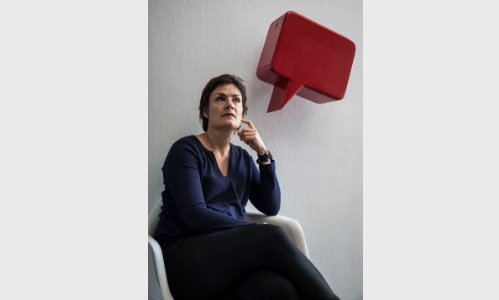
Fran Luckin, Chief Creative Officer at Grey Africa and new Loeries chairperson. Image credit: The Loeries.

As part of its exclusive industry interview series, Modern Marketing spoke to the newly appointed chairperson of the 20/21 Loeries board – Fran Luckin – who is also the Chief Creative Officer (CCO) at Grey Africa and has been in the industry for over 22 years.

What do your responsibilities as a chairperson of the Loeries board entail?

You are asked to bring your particular passion and cause to the party. The Loeries board comprises a lot of creative people and your purpose is to represent creative leaders while emphasising on your own cause or passion.

Former chairperson Suhana Gordhan’s cause was around women in advertising, while Tseliso Rangaka’s cause was around transformation in advertising. Being a chairperson is about being a flag barrier for what we want the Loeries to stand for and believe in.

I do not want to re-invent something but I want to build on what people who came before me had started. Gordhan did great work with Open Chair, which emphasised encompassing female leaders. I come into this role at an interesting time – during a pandemic. It is terrifying but it has also created new opportunities that we can use to perhaps broaden the reach of the Loeries.

Now that we are moving to more virtual platforms, that could be a way of bringing more people into the industry, such as women and people from different backgrounds that we might have been missing. There is so much talent out there that doesn’t just live within five kilometres of Sandton. Through virtual platforms, we can extend our inclusiveness, use this opportunity to increase our reach and bring in a wider range of people.

How does The Loeries make a difference in the branding/advertising industry? 

Award shows are important because they highlight excellence in a field in a way that inspires younger people. When I was very young in advertising, going to the Loeries and seeing all the amazing work showed me what was possible and helped me learn what great work was and who was behind that work. Award shows illustrate what can be done when you break the rules, and they show people new possibilities. 

What kind of campaigns do you think matter most for this year’s awards?

It will be quite interesting because you have to weigh out worthiness with great craft. There will be a lot of work about the pandemic that is worthy in that it has a noble end, but we have to think about the craft and originality – that is what the Loeries awards are about. Work that will be noticed is the kind that acknowledges the situation we are in but does it in a fresh way and delivers a tried and tested message that breaks through to audiences. I see some brands have taken a humourous approach – which is refreshing and nice.

To learn about what important industry-related changes Luckin has observed, her favourite advertising campaign, as well as her interests and more, watch the interview below. For the latest industry content, visit our YouTube channel.


One of Luckin’s favourite advertising campaigns:

LOERIES 
www.loeries.com

Consumer Pulse Research Shows Increase In Online Shopping

According to new Consumer Pulse research from Growth from Knowledge (GfK) South Africa the behaviours and sentiment of online consumers during the Level 3 lockdown have increased.

South African consumers look set to accelerate their journey towards online shopping beyond the pandemic as they stay in to enjoy the investments they have made in their homes during the lockdown.

The survey reveals that consumers are preparing themselves for a prolonged period of being cocooned, with 59% of consumers expecting the pandemic to last more than another 12 months, and 34% predicting that it will continue for another 18 months or more. Only 2% reported that they have booked a holiday for the summer and 71% agreed that they will travel closer to home in the future. 

This reality is catalysing changes in consumer behaviour that are likely to outlast the pandemic. Some 3% of consumers reported that they had made an online purchase in the week preceding the survey, up from 19% in the level 5 lockdown. Meanwhile, 26% said they would definitely increase their usage of home delivery even after the pandemic. 

Some 16% agreed that they would definitely try to avoid the malls and shops and almost half (48%) said working from home would definitely continue to be a reality for many companies after Covid-19. These figures reflect consumers’ growing fears about the virus as infection numbers soar – 70% said that they are ‘extremely worried’ about the coronavirus in lockdown level 3, up from 66% in lockdown level 4. 

‘The pandemic and the national lockdown have forced South Africans to change how they connect with the things they care about and how they experience life,’ said Rachel Thompson, Insights Director at GfK South Africa. ‘Consumers are seemingly ready to stay in beyond the end of the pandemic to enjoy the investments they have made in DIY, home appliances, and consumer electronics for home entertainment.’

Most categories of online shopping set to grow

The research shows that consumer preference for online shopping has grown dramatically in most product categories during the lockdown. Across product segments, an even higher proportion of consumers said that online shopping would be their post-Covid channel of choice. The survey results indicate that growth in adoption of online shopping in groceries, consumer electronics, DIY and mobile phones will be robust post-pandemic. A significant portion of consumers who claimed they used online as their preferred channel for fashion and IT shopping during the pandemic said they would go back to traditional channels after Covid-19, but not enough to bring this number down to pre-Covid levels. 

Online channel choice now and in the future by product category (claimed current and future purchase channel choice).

Category

Pre-Covid

Covid-19 lockdown

Post-Covid

Consumer electronics

17%

21%

24%

Groceries

3%

4%

6%

IT

17%

31%

26%

Beauty and hygiene

5%

11%

13%

Small appliances

10%

20%

22%

Fashion

11%

21%

17%

Mobile phones

14%

17%

20%

DIY

8%

12%

15%

When it comes to shipping and delivery options, consumers want them to be free, fast and flexible. Two thirds (66%) said they expect free delivery, 64% demanded fast delivery, and 55% wanted click-and-collect options. Hygiene was also on their minds, with 56% insisting delivery staff must wear masks and 52% saying staff must not touch products with their bare hands.

Make it human

Even as they move towards digital channels, South Africa’s online consumers are still looking for human contact. More than half (52%) expect to be able to speak to a person on the phone for support, 44% expect to speak to someone via video chat and 35% expect home installation. Most (65%) are also seeking reassurance about the security of their personal information when using a mobile payment app.

‘With 44% of consumers reporting that they will decrease spending after the pandemic, leading brands are thinking about how they can position themselves for growth in a difficult market,’ said Thompson. ‘The key to succeeding with online shopping at a time that people are feeling vulnerable is to offer wraparound value and to build and reinforce trust through more human brand experience. Established retail brands have an advantage since consumers find it easier to shop online with brands they already know and trust in uncertain times.’ 

According to Thompson, some of the steps that brands can take to provide reassurance to consumers as they transition from offline to online include:

  • Making the product tangible through virtual product tours, virtual shopping, unboxing videos and other techniques where the human touch is visible.
  • Using testimonials and peer reviews to build confidence in the brand.
  • Offering transparency on product availability.
  • Letting consumers choose the payment app or brand they trust to pay.
  • Ensuring there is no friction or extra cost involved in order collections and deliveries.
  • Communicating hygiene measures to consumers and enforcing them with logistics partners.
GFK 
gfk.com/home

Reinventing Brands To Be More Purpose-Led

Arisha Saroop, Managing Director at The MediaShop Durban.

According to Arisha Saroop, Managing Director of The MediaShop Durban, the Covid-19 crisis has left its mark on virtually every single industry around the world and on all levels from a social, health and economic perspective.

As some economies ground to a halt and others are still recovering from imposed lockdowns, brands, like individuals, are being forced to re-examine every aspect of their daily operations, find new ways to survive, adapt, offer purposeful existence and maintain relevance within our new reality.

Kantar’s Covid Barometer research shows that South Africans want brands to be purpose-led and practical, using their resources to help and inform during the global pandemic we find ourselves in. 

The majority of clothing and accessories stores were initially considered non-essential, and employment in this already struggling sector fell by 58.9% from February to April this year as per Business Insider research – it is no wonder then that this sector had to take the leap of adaptability during these unprecedented times.

With no social gatherings fighting for RSVP’s, couture wardrobe and designer accessories have taken space at the back of the cupboard. Given the increased need for personal protective items, international and local design houses have evolved their offerings to stay relevant, purposeful and to deliver a supportable service.

Internationally, Tommy Hilfiger has donated 10,000 T-shirts to Covid-19 front line healthcare workers – in an effort to provide a change of clothes for those between shifts or just to freshen up from their daily PPE wear. In addition to this, they have launched a special capsule collection, with 100% of sale proceeds going towards pandemic relief efforts.

Renowned French luxury conglomerate LVMH, known for their handbags and champers, swopped their leather and bubbles by converting three of their perfume manufacturing facilities, usually reserved for Christian Dior, Givenchy and Guerlain fragrances, into hand sanitiser production factories. These were given at no charge to the largest hospital system in Europe and to French authorities. Keeping staff employed and responding to public interest is what has kept this luxury brand purposeful and relevant.

It didn’t just stop at production though as one might have assumed. British brand Burberry has vouched to use its global supply chain network to deliver over 100,000 surgical masks to the NHS, and additionally, Burberry is also funding research into a single-dose vaccine developed by the University of Oxford.

Closer to home, Polo South Africa’s shirt factory in Atlantis Cape Town, recently pledged to provide 250,000 reusable and washable cotton face masks to essential service providers and at-risk commuters. Even though the masks are not medical grade, these indispensable items provide safety in reducing the virus spread. L’Oréal SA recently introduced a new range of hand sanitisers under its natural brand Garnier that will be donated to the South African Covid-19 Solidarity Fund to assist front line workers. Iconic couture designer Gavin Rajah under his NPO White Light Movement trains victims of gender-based violence to make fabric face masks. The profits from the sales of these items assist them and the families they support.

Each of these brands has shown purpose in their adaption, either by using their resources for alternate production or supporting a just cause towards the fight against the invisible pandemic – this has no doubt been for the greater good of the consumers and the brand.

This proactive reaction has kept the lights on for businesses in many aspects: by keeping their staff employed, supporting the local economy, producing essential items, staying relevant and most importantly, adding to their existence and purpose.

For consumers, such adaptions and purpose-driven production translates to brands that care. A renewed brand purpose is reassuring during times of crisis, as consumers may not be buying today. However when they do return to ‘business as usual’, they will remember and reward brands that offered meaningful sustainable support.

THE MEDIASHOP
www.mediashop.co.za

Loeries And Tractor Outdoor Partnership To Raise Standard Of Creativity In OOH Category

Tractor Outdoor is the new Loeries partner of the Out-of-Home (OOH) Category. The partnership will showcase the power of OOH and digital Out-of-Home media (DOOH) in Africa and the Middle East.

Tractor Outdoor CEO Simon Wall said, ‘We jumped at the opportunity to partner with the Loeries in the Out-of-Home category as we want to shine a light on one of the most exciting and creative mediums currently available, and in doing so inspire and invigorate more and more creatives to make use of the technological and creative advancements in DOOH and OOH. The Loeries #CreateChange for 2020 suited our partnership as it fits the innovation and creativity impact that Tractor takes prides in providing its clients. More importantly, the global shift to DOOH is fast gaining momentum as ‘dynamic’ screens, varying in size, respond in real time to consumers, at the likes of roadsides, garage forecourts, in malls, airports and buses. Marketers from Paris to New York and Dubai to Cape Town are harnessing the powerful trend that has digital screens responding in real time to factors like traffic flows, weather, sales or store footfalls.’ 

Loeries board member, Tseliso Rangaka said, ‘Outdoor is a huge part of the African and Middle Eastern media landscape. Despite the large footprint, Innovative creative execution in this space is still a rarity, more so when it comes to digital outdoor. For this reason, I am excited to see the Loeries partner with Tractor on a mission to help raise the standard of creativity in this category.’

Wall continued, ‘Gone are the days when a commuter rides past the same billboard twice a day over several months. Now a creative concept developed at 10AM can be executed immediately. The beauty of DOOH is the technology and inbuilt software with sensors that can change an ad in keeping with real-time data inputs. For example, if the pollen count in the vicinity of a screen rises, a pharmaceutical ad could switch from a beauty product to a nasal spray. A food franchise screen could differ at breakfast and lunchtimes or a screen can offer immediacy with news or sports results.’ 

‘In short, we have entered an era of real-time responses through a bounce back medium. And, as many clients relaunch products, DOOH challenges the ubiquitous pop-up online ads that consumers increasingly block. Our intention is to enthuse and empower creatives to harness and leverage the immediacy of the format. Eighteen months ago, the rate card value in South Africa was R1,2 billion, just imagine the growth as creatives are unleashed into the new space,’ said Wall.

Loeries CEO Preetesh Sewraj said, ‘Our partnership with Tractor will add real value to our forthcoming Creative Week and to our commitment to being a source of innovative ideas for the brand communication industry. Ultimately, I look forward to seeing this partnership support creativity that creates a positive impact for consumers and brands.’

LOERIES 
www.loeries.com
This is Modern Marketing