Global research company RECMA, which evaluates the performance of media agencies around the world, has identified The MediaShop as number nine on its Top 16 Standalone agencies that are part of groups.
The study also confirmed The MediaShop’s market share at 14.6% of the South African market, a higher share than any other international agency listed in this Top 16. The Debrief, released on the 16th July is a specific analysis separate to its annual performance ranking of 900 media agencies around 50 countries. The MediaShop, while partly owned by the IPG Group, is a mostly locally owned and a standalone agency.
‘As a majority locally-owned media agency, The MediaShop is a proudly South African business that is well known for pioneering and innovating thinking,’ said shareholder and board chairman Bonang Mohale of RECMA. ‘In a market as unique as South Africa, it’s imperative that any media agency is able to make autonomous, quick and decisive decisions for clients based on its local current climate at any given point. This is just one factor that sets The MediaShop apart. As a collective, we’d like to congratulate The MediaShop team for once again placing the agency firmly on the world map of media agency excellence.’
Edward Herridge, Finishing Artist at Grey Advertising.
Edward Herridge, Finishing Artist at Grey Advertising, states that design must attract attention in order to expand the legend (brand) of an agency’s clients. Now is the time of the emerging new normal, new patterns and increased chaos.Now is the time to allow the designer to expand.
This is important since the product of their labour is what creative agencies sell, and free-range design will improve that product in surprising and probably lucrative ways.To predict the future, I believe that it is important to have a solid grasp on the past.The Industrial Revolution, which occurred in the mid-to-late 18th century, gave rise to the 9-to-5 office.
Before this period in time, the 9-to-5 office as we know it did not exist. There were no factories that workers needed to be close to and no offices required for the administrators of those factories. After the industrial revolution, things changed drastically as the world began to gravitate towards industry.
It was in this cauldron of creativity that the age of the atom and analogue communication was born. First came the telegraph, then the telephone, followed by television. This heralded in an era of unrivalled communication that acted as the catalyst for exponential technological growth in the years to follow.
The digital revolution
Communication and computation bring us neatly to the present day. Interestingly, before this current Covid-19 global crisis, the trend of change in the way we live and work, due to our stage of technological development, had seemed to have stalled somewhat, regardless of the exponential growth of modern technology and the sciences over the past 70 years or so.
Where industrialisation forced centralisation, modern technology in the guise of the internet and automation should have led to expansion since it clearly enables up to 40% of workers in modern economies to no longer be geographically bound to their source of income. So, why did it have to take a pandemic to force the world to adapt to a future that should have occurred in the past already?
Unlike the industrial revolution, the digital revolution experienced almost no resistance. In fact, it was embraced by both private and governmental interests. It happened much quicker than any other revolution that had come before it. As little as two generations ago, an individual would go through their lives without experiencing any drastic change. In today’s world, new technologies manifest on a daily basis to subtly change and shape the immediate future.
The corporate contract(ion)
Pre-Covid-19, creative agencies used to operate on what I like to call the battery-farm principle. They wanted bums on seats arranged in neat rows. I can only chalk this up to the security of habit and routine ingrained into corporate culture and demanded by skittish shareholders. Set hours seemed far more important than results. Companies would prefer staff to rather sit at their desks and peck mindlessly at their keyboards instead of allowing them the freedom that Covid-19 ironically exposed the world’s workers to by putting them into lockdown.
I do believe that the world would have naturally gravitated to the off-site working model, but Covid-19 expedited matters rather drastically. Now, we are beginning to wonder why we sat in traffic for so many hours. We also wonder why we rushed about for meetings that could have been done on Teams or Zoom.
Interestingly, off-site working is not a new concept. It is one that companies like Grey Advertising has been gravitating towards. It is partly because of this emerging agile structure that our agency is weathering the Covid-19 pandemic without having to make too many uncomfortable concessions.
The emerging new normal
The future of traditional and digital design is this: offices will transform into places where designers are motivated to want to be, not where they have to be. Offices will transform into hubs of social and professional gathering where networking, meetings and brainstorming will be staged. It will no longer be a place of work. Work will be done where these masters of creation feel most comfortable.
The way designers work will also change over time. In the next ten or so years, professional designers will find themselves working on contract for more than one agency and experience a diversification of their function far beyond the parameters of old school agency work. The tools designers use will also change drastically as technology begins to automate the drudge work and grows far more intuitive and intelligent. In this future, the designer won’t be using their tools as much as they will be collaborating with them.
Now is the time to allow the designer to expand. This is important since the product of their labour is what creative agencies sell, and free-range design will improve that product in surprising and probably lucrative ways.
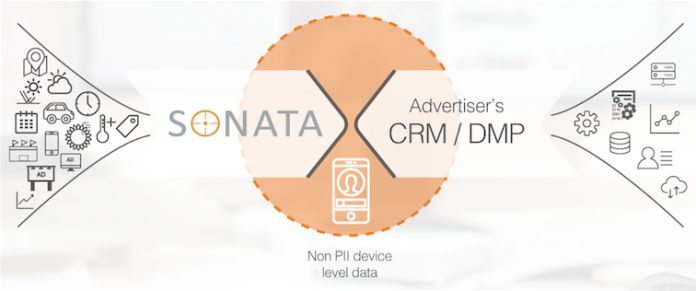
As consumers are thrust into a more digital lifestyle by the restrictions put in place to curb the pandemic, TAPTAP Digital announced its Sonata Audiences technology to provide brands with critical insights about new patterns of behaviour continuing to emerge.
To implement an effective, value-added communication strategy that keeps up with the evolving needs of consumers amidst the pandemic, fresh insights are a must for any advertiser. Sonata Audiences draw on multiple dimensions of online and offline data, bound together by geospatial intelligence, to create a granular picture of the user journey.
Measures taken to reduce the effects of Covid-19 have generated a behavioural shift: e-commerce activity has grown by 200%, indicating that a significant proportion of new digital transactions were previously made offline.
As we have heard from widespread consumer studies that now is not the time to stop communicating, brands need to find ways to engage with different groups of audiences – many of whom are migrating from offline to online shopping. The level of accuracy of the extensive 1st and 3rd party dataset in Sonata gives brands the ability to build custom affinity profiles that can be activated in any context in the digital ecosystem.
‘A key part of our understanding of the user is based on the frequency and recurrence of their offline visits to points of interest (often to points of sale). When we cross-reference this dynamic information with the user’s online activity, we get a much better picture of the user and where they are on the path to conversion,’ said Andrew Gillet, Commercial Director of Africa Media Alliance (TAPTAP’s South African partner).
TAPTAP audience profiles are based on six dimensions:
●Demographics. ●Digital and Device Profiles. ●Real-Time and Historical Location. ●Campaign Affinity. ●Intent Signals. ●Custom Data.
TAPTAP targets these audiences with strategic media activations on behalf of brands to shift them from historically physical customers to e-commerce customers. ‘We also factor in dynamic moments and offer these online audiences multiple Tap2Action ad units. These can include Tap2Web, Tap2Shop or Tap2Download to deliver an online discount or offer. For clients who have reopened retail operations or those who are always-on (like Consumer-Packaged Goods), our Tap2Map continues to be a resource that drives footfall,’ added Gillet.
Calvin van Rensburg, Head of Programmatic at Dentsu Aegis Media commented, ‘We briefed the team at TAPTAP to build a custom audience segment for a beauty client who had historically sold a high proportion of their product through a large retailer. With the onset of Covid-19, we had to connect with these users and redirect them to the e-commerce offering whilst stores were still closed. Using historical and fresh data, we built custom audiences who had been in this and other beauty retailers and who showed intent through their online and app activity. As a result, we were able to shift their purchase behaviour from offline to online.’
Kristen McCormick, Content Marketing Manager at WordStream, states that you could be offering the best new product or service around, but if you don’t promote it properly, you are likely to miss out on opportunities or even end up losing money down the line.
The best way to digitally promote your new product or service will depend on what channels your audience frequents and what their online behaviours are. Regardless, you should use multiple channels and cross-promote. The truth is, there are many low-cost ways to promote your business.
Make use of Google My Business
There are several ways you can promote your new product or service using your Google Business Profile, provided you have a Google My Business account. The first is via Google My Business posts.
If you are just announcing the new product or service, you may want to go with a ‘What’s new’ post. Just remember that Google My Business posts expire every seven days, so you’ll need to repost. On the other hand, if you are running a special introductory deal, an ‘Offer’ post would be best, as you can set a timeframe. Regardless of which post type you use, be sure to include a picture and a call to action.
You can also promote your new product or service by uploading photos of it to your Business Profile via the Photos tab of your GMB dashboard, as well as adding it as a new item via your Products/Services tab.
Post on social media
If you are using any of the tactics mentioned above to promote your new product or service, make sure to spread the word of your deals and offerings via your social media accounts. This is an easy way to reach your audience, and your followers can easily share your post to their own profiles. Another benefit is that customers/prospects can ask questions about the product in the comments section.
If you have a niche audience or loyal following, you may also want to use a custom hashtag in your promotion post. This will not only expand the reach of your campaigns but may also inspire customers to share posts and pictures to their accounts, using the custom hashtag. And you know what that means: user-generated content that can then be used to get even more people to try out your new service or product.
Run a social media contest
Social media contests are a fun, easy way of connecting with customers and bringing in more fans/followers and prospects for your business. Facebook contests garner an average of 34% new customers per campaign, which is a great way to combat the platform’s low organic reach.
As far as positioning is concerned, the winner(s) of your Facebook or Instagram giveaway should gain the opportunity to be the first to get their hands on your new offering and get it for free or at a discounted rate.
Be sure to announce the content across all of your marketing channels and not just the social platform you are using to run the main campaign. This includes your other social media channels, your website, email newsletters and even paid ads.
In addition to generating more excitement and buyers for your new offering, the increased engagement with your social media account will likely drive more traffic to your website, put your business in front of new customers, and create a fun means of connecting with your audience.
Spread the word via email
Did you know that 82% of consumers open emails from businesses, and that 76% of email subscribers have made purchases from an email marketing message? Email is a fantastic channel for getting the word out about your new product/service. Plus, it makes a great incentive to get subscriber signups in the first place.
You can run an email campaign specifically about this new offering — perhaps even as a series of emails building up to the day of launch. Or you may want to announce it as the focus piece of your next email newsletter. This email could go out to your general audience, or, in support of method number 2, it could be a subscriber or customer-exclusive offer.
Write a blog post
When promoting your new product or service, you may not have a landing page for customers or subscribers to go to. After all, your new offering could just be an upgrade on an existing platform or account. In this case, your goal may not be to get more customers but to get your existing customers engaging, or to re-engage dormant customers.
Having a blog post written on the newly launched item is a great way to go into depth on all of the details, features and benefits you would otherwise include on a landing page, and you can share the link to the blog post via your emails or social media channels. Even if you do have a landing page, a blog post is still a great channel for getting the word out about your new offering and provides ample opportunities for you to link to the landing page.
Host a virtual event
During the pandemic, virtual events still serve as an effective promotion tool. You might:
Host a Facebook Live session demonstrating the product and highlighting its features.
Run a live or recorded Q&A on the product itself.
Centre the event around an influencer who has expertise around your new product or service, with the promise to unveil the new offering at the end.
Share customer reviews
One of the best ways to promote a new product or service is to let your customers promote it for you. If you take advantage of some of the ideas previously mentioned (like offering an upgrade or free trial), you can then ask them to write an online review of the new service or provide material for a testimonial.
Reviews and testimonials will be invaluable when rolling the product out to your more general audience. After all, 84% of consumers trust online reviews as much as personal recommendations.
Run Facebook ads
With 1 billion daily active users, Facebook advertising is a window to a large base of people who will be interested in your new product or service. Facebook ads are particularly useful because the personalised data voluntarily provided through users’ profiles makes for unbelievably specific audience targeting. You can factor in gender, age, location, interests, marital status, profession, and more, ensuring you’ll get the most bang for your buck. There are also several options for ad type, budget and duration of the campaign, so you can accommodate your goals within your means.
HelloFCB+ and City of Cape Town’s campaign, My Covid-19 Dairy, showcases Vuyokazi Nqayi, a 35-year-old mother of two from Langa, Cape Town. Every day, she films a short video in which she shares her feelings, symptoms, fears and how she appreciates the support and kindness she is receiving from the online community. Heart FM has also joined the campaign, doing daily interviews with Nqayi.
The campaign was devised to build empathy for those who have contracted Covid-19 and encourage the communities in which they live and work to stop stigmatising them.The key insight informing the campaign is that, as Covid-19 cases increase at a rapid rate, it is easy to forget that behind the numbers, statistics and graphs, are family members, friends, colleagues and loved ones – all of whom need care and support over this time.
HelloFCB+’s creative team, Zodwa Gunuza and Chane Keyser said, ‘Stigmas are the discrimination of a group of people or a place, arising due to a lack of knowledge and awareness. As humans become ‘Covid-19 cases’, many patients and their family members are being ostracised by society.’
‘We felt that by letting the residents of Cape Town build closeness to someone suffering from the virus, understanding their daily struggles and learning more about Covid-19 through them, it would build empathy that would lead to less stigmatisation. These daily diary updates are proving that it is far easier to stigmatise when those infected appear as statistics, but far harder when you form an emotional connection with someone suffering from the virus,’ said Gunuza.
Director of Communications for the City of Cape Town, Priya Reddy, added that the project is both challenging and unpredictable. ‘We had many a conversation with Nqayi to ensure she was up to it. She, like us, wants to build awareness and education around the virus and the effects of stigmatisation, reminding our residents that the Covid-19 statistics are actually human beings who deserve compassion and kindness,’ Reddy said.
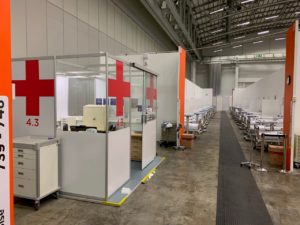
South African exhibition, events and display company, Scan Display, was commissioned by the Western Cape Department of Health to transform four exhibition halls at the Cape Town International Convention Centre (CTICC) into four separate recovery wards for the temporary Covid-19 hospital.
Although building a temporary hospital was not something the Scan Display team had done before, the company has always valued the importance of design, and its integration into innovative working solutions. The company’s team of architects, interior designers, quantity surveyors and project managers took on the challenge of creating solutions for the hospital’s infrastructure, plumbing and electrical requirements.
The project’s brief included the following specifications:
1600 running metres of hardwood walling to partition 863 beds.
Oxygen, electricity, internet, nurse calling and plumbing for each patient.
Wired internet connection to create a paperless facility.
Over 50 plumbed basins with medical-grade taps.
30 custom-made shower units for staff, in a location requiring the wastewater to be pumped up to the nearest run-off, one floor above the location of the showers.
Nurses stations, a physiotherapy unit, treatment rooms, pharmacies, donning and doffing areas and macerator rooms.
Extra patient toilets and showers in the marshalling yard, with multiple marquees and covered walkways.
Signage, patient notice boards, directional signage, and other graphics.
Working on the project during lockdown Level 4 was not an easy task. Online (rather than on-site) project meetings, with sometimes 50 participants, added to the project’s challenges. Scan Display’s Creative Director, Paul Hugo, was responsible for collating the requirements from the different departments during the meetings and then generating a design that would meet the requirements.
With only a two-day notification before the start of the build, Scan Display brought suppliers out of lockdown and set about planning the project, with council submissions being made and Fire Chief approval being given during the build. The company’s production team faced its own set of challenges: wearing hard hats, Perspex visors and masks, and maintaining social distancing made the build more difficult.
The project was a real collaborative effort with Scan Display’s multidisciplinary team working closely with the Western Cape Department of Health’s Chief Architect: Infrastructure Planning, Duncan Rendall, and the Project Manager appointed by the Western Cape Department of Health, Mark Munro. It was through this combined effort that the team was able to design, manufacture and install a working hospital in just over two weeks.
The exhibition and events industries require thorough planning and creative problem solving when things do not go to plan, as they have tight deadlines that cannot be moved. Scan Display was able to put the skills learnt in the exhibition industry over more than two decades to good use creating this healthcare facility, Hospital of Hope.
Scan Display’s Cape Town Sales Manager, Jane Steel, concluded, ‘The project offered Scan Display an opportunity to showcase the depth of talent in our company, which enabled us to move seamlessly from exhibition design and infrastructure into building a temporary Covid-19 hospital. Scan Display has always championed a can-do attitude, and this certainly came to the fore.’
According to Liesl Simpson, MD at Evolution PR, for any corporate, stakeholder support is crucial. However, in order to achieve this, the organisation needs the assistance of various communication channels, especially a PR agency that understands the company’s industry.
The importance of creating a favourable impression is hard to overstate in all walks of life, and in business, it is vital to achieve strategic goals. These were the words of Cees B.M. van Riel, a Professor of Corporate Communications at Erasmus University in the Netherlands. In his book, The Alignment Factor, he talks about leveraging the power of total stakeholder support.
But does it really matter if the agency is a small, medium or micro enterprise or a large multi-national? In addition, how does the organisation know if the PR agency is the right fit for the business?
I’m big and you’re small
The general mindset, when it comes to choosing PR agencies, can be based on a quote from Roald Dahl in his book Matilda – ‘I’m right and you’re wrong, I’m big and you’re small, and there’s nothing you can do about it.’ This is because just like in any industry, one assumes that smaller companies are not as effective as larger ones.
Are all agencies defined by size?
When embarking on the journey of finding a PR agency, many businesses start by Googling to get an idea of which agency ‘pops-up’ first on the screen. As a result, the selection process is based on the promotional material they have out there, the size of business or its footprint – national and global. So, organisations looking for a PR agency often gravitate to those that are quickly found on online platforms and that look larger than the rest.
This might sound critical of what a PR agency actually does for its clients, and this is by no means a ‘do as I say but not as I do’ attitude. Promotion is how we gain visibility and in turn, creates sales prospects. However, it is also important to dig a bit deeper and get an idea of the results the agency has achieved for the promotion and reputation of their clients.
Organisations therefore need to take the time to read customer testimonials, obtain an idea of the frequency of client turnover and speak to existing clients. In a nutshell, does the agency actually deliver on its promises?
Deliverables are everything
The goal of the PR agency is to obtain positive exposure for its clients in the media through a number of tactics and activities such as media interviews, thought leadership pieces or press releases. Yet if these activities are not generated and executed, this means no coverage. Even if activities are generated and executed, yet the coverage is not obtained, what is the point? PR agencies often bill according to hours spent on a campaign, using timesheets to prove that they have worked on the account. In spite of this, it does not necessarily mean that deliverables are being met i.e. exposure obtained in the media.
Retainers based on time or deliverables?
It is therefore always best to question the outcome of the hours billed for. In addition, it is also good to bear in mind that perhaps it is preferable to have an agency that bills for deliverables rather than time, as it ensures that the ultimate goal of PR is achieved – positive exposure that reinforces and creates awareness of the brand, highlights the company’s value it delivers and enhances its reputation.
You need to do your research
Whether the PR agency is large or small, organisations need to ensure that when choosing a PR service provider that they do their due diligence. They need to look out for an agency that is concerned about the end result. This means looking at the type of coverage the organisation can expect and if their share of voice in the industry can be increased.
Word of mouth is one of the most credible forms of marketing. Conversely, it means that the agency’s reputation is not based on the Google ads they pay for or the size of the organisation and its global reach. Smaller, local agencies should not be overlooked as they offer great value through a personalised, tailored service that is geared towards results and outcomes.
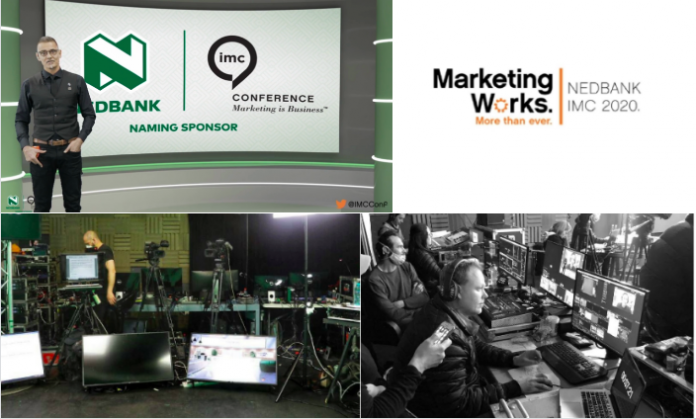
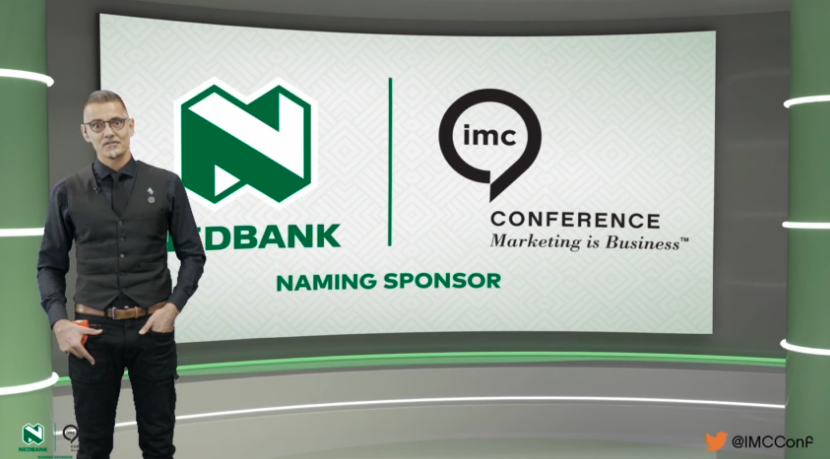
Nedbank IMC media partner, Modern Marketing, virtually attended the 2020 Nedbank IMC Conference, which took place on 24 July 2020 under the theme #MarketingWorks.
Pepe Marais, co-founder and Group COO of Joe Public United, was the Master of Ceremonies. Marais said that industry players should focus on what they can control, such as: creative product, quality, excellence, delivery and turnaround times to clients.
‘The more I focused on what I could control, the more I worked with my partners in business, with our teams, and together with our clients to deliver on their demands to the best of our ability. The more our company only focused on that and worried less about the by-product, which is money, or the sales, the more I find it easier to manage this time. That is going to be a huge insight for me going forward: to focus on what I can control and on creative excellence. The rest must just fall.’
Pepe Marais, co-founder and Group COO of Joe Public United.
Speaker highlights:
Andy Rice: strategist, writer and speaker
He shared his effective brand strategy model, comprising of four quadrants that represent a component of every successful, sustainable and change-resistant brand:
Profitable – marketing is a commercial enterprise.
Fulfilment – the ease of working a supply chain should be as strong a determinant of the brand’s success as the promise of the brand itself.
Unmet – there is no such thing as a commodity market, only a commodity mindset.
Needs – find a true need in the consumer’s lives, rather than in their category of behaviours.
Alistair King: co-founder and CCO of the King James Group
He suggested that 10% of what the advertising industry creates across all mediums and channels is good to excellent (compelling and persuasive). A further 20% of what the industry does is solid-to-good (functional, effective and conveys useful information to the consumer but is not necessarily inspiring). The remaining 70% is rubbish.
Most of the work produced is not because of the absence of bravery but rather the presence of a myriad of other forces that get in the way. He described the different types of advertisers using blankets called ‘king comforters: the no hanky-panky blankies’.
The ultimate blankie that can save marketers and advertisers is the uber blankie: it does not looking comforting and offers no protection, no security and there is nowhere to hide, but that is the whole point. Innovative thinking and ideas that have no precedent are not comfortable and leave you feeling exposed – that is what leaps of faith feel like.
Acts of intuition and trust will always come at a degree of exposure and risk. When you do make tough calls that lead to magnificent advertising, everyone can see you and you are the one that is credited. And is that not what you really want? He said advertisers attend conferences and celebrate great work but then go back to their offices and shrink back into their comfort zones. You can decide today which path you want to take.
He closed off with a quote that read, ‘I would rather lose my job in an ambitious blaze of glory than spend my life in that cold, soul destroying place called obscurity.’
Andrea Quaye: Jury President IAB Bookmark Awards and marketer at large
Quaye mentioned that brands need to pay attention and particular care to the user experience they create from the moment the consumer browses to the moment they receive and unbox your product.
Regarding the future of marketing, she said the power has been shifting to retailers through e-marketing and that the pandemic has greatly accelerated this shift. South Africa is significantly behind the US and China, but there has been a huge growth figure in traffic and basket size.
History continues to move faster than ever and moments will continue to change faster than ever. The more moments change, the more the fundamentals of marketing become super important. These include:
Meet real needs: understand the role of your brand and the role it plays in people’s lives, this can be functional or emotional, but ideally have a functional role with an emotional connection. Analyse the brand memory structure and how it is expressed in the new context. When the crisis hit, your brand needed to be able to tap into its true ethos. This is something that brands should be building over the years.
Always build: build your brand at every moment, if you are not, you are just postponing an inevitable unhappy ending. Sometimes the adversity comes in the form of massive disruption but more often it comes as steady shifts in the market (economic or consumer preferences).
Stay true: whether it be your brand purpose or ethos – whatever name you give to what your brand stands for, you must stay true to it, before, during and after the crisis. Brands that are clear about what they stand for get stronger when a crisis hits.
Nthabiseng Matshekga, Executive Head: Group Marketing, Nedbank
Matshekga addressed using your purpose as a brand to communicate meaningfully in times of uncertainty, and using purpose-led marketing to define what you do as a brand beyond just making money.
She highlighted how a brand, such as Nedbank, lives their purpose to deepen their relationship with customers by putting out the kind of marketing that people cannot watch without mirroring themselves. This was done by having consumers interrogating their relationships with money, and start talking about money, which is one of the hardest things to talk about.
Purpose-led campaigns should: – Link to clear insight. – Be intrinsically linked to the brand purpose. – Use first party-data for a targeted approach and to build much more relevant solutions and benefits for customers.
Zumi Njongwe, Consumer Communication and Marketing Excellence Director, Nestlé
Njongwe said businesses are perceived to be prospering at the expense of their communities and other issues. Businesses’ role in corporate responsibility has not yielded much gain, perhaps this is because their view of creating value is outdated and grounded in optimising their gains. ‘As Marketers we can no longer stand on the sidelines, we have roles that are connected to the societies in which we live, the communities in which we exist and the environment in which we operate.’
We must look at how we lead and are shaping the future. Marketing is important because it plays a critical role in shaping culture. Today more that ever, we must reconstruct our world. We are living in a lot of pandemics: gender-base violence, Black Lives Matter, The Trump effect, Covid-19 and a recession.
Stop looking at shareholder value and drive a new framework by moving ourself into shared-value:
– Reconceive brands and portfolios. – Redefine productivity in the value chain. – Build a supportive industry in agencies.
All three are relevant to marketers because the story they tell about their brands are not just that of communication, but the end-to-end story that comes from where the brands are sourced and where they go. However shared value shows up it, need to shape and create the world we live in.
Lee Naik, CEO TransUnion Africa
Naik said that technology and data used to be a driving force. Now he thinks less of those and more of the difference that the company wants to make. The Covid-19 pandemic has accelerated the future ‘new-normal’ to the current way of working. If you thought that omnichannel was something in the future and mobile devices were just a part of your strategy – it is now the only strategy.
Marketing has shifted, and how customers work and behave has changed, so we need to think omni-choice: get rid of the predetermined journeys that are set-up for consumers. You do not own the customer, as we live in a world that shares the economy and we all own different stages of the value chain. Look for a way that allows customers to consume your product better.
– Get to know your customer and know that they are human. – Look at outcomes that matter by trying to solve the actual problems that your customers have. – Embrace data by figuring out who these customers are and use data to answer the right questions.
Nandus du Plessis, Founder, Crazy Ginger Consulting
Consumers live in a world where they do not know where they are getting communication from, but they are exposed to it. Channels are just a way of consuming content, and it is important that we change our systems and processes to deliver on this.
Evolve consumer segmentation: make the consumer a co-creator of the brand instead of a spectator through day-to-day optimisation of consumer segmentation. For example, Codec enables you to update your consumer segmentation on a daily basis – looking at your traditional target segmentation and then adding Behaviours and Values, Symbols and Social organisations to fundamentally change the way that you look and target the consumer.
Get a great tech-stack: social, email, web, mobile, print, video, voice, point of sale and face to face. Keep in mind that relevancy and personalisation can create about 10% of additional revenue. The consumer is complex and more demanding than ever before, therefore you need an omnichannel structure. So make sure that you optimise every part of the customer journey to deliver the most amazing experience.
Lee den Hond, CEO Blue Platinum Events and third South African woman to summit Mount Everest
Challenge your passion: Den Hond cited an anonymous quote stating, ‘If the same thing excites you today, is what excited you five years ago, then you are in serious trouble.’
360 degrees: there are a lot of resources at our fingertips, whether you are an entrepreneur in your first year or 20th year, there is so much out there.
True currency: Pay attention, this is true currency. As Buddha says: ‘The trouble is, you think you have time.’ But there is no more time. Make a decision and make it today.
Verusha Maharaj: advertising and marketing lead at Deloitte Consulting South Africa
Focus on three things that stand out when it comes to consumer engagement:
1. Communication is key: 65% of consumers indicated that their likelihood of purchasing would be based on how well the brand responds to the crisis.
2. Brands as advisors: consumers continue to have faith in the brands and the companies that stand behind them.
3. Strike the right tone: it is important to realise that your existing creative might strike the wrong tone and push customers away.
Mzamo Masito: CMO of Google Africa
Masito said we only have one brand on the ‘Most admired brands in Africa’ list that is by and for Africans. We need to make sure that marketing works to the point where the top five of the brands on that list are from Africa.
Things that stand in the way of marketing to work
1. The financial business model of agencies is messed up – the margins are declining year on year and no one wants to talk about it. You cannot do great work if you are broke. 2. There are four Cs in the marketing industry that is being spent on more than anything else: Cocaine, Cannabis, Coffee and Cocktails. 3. Procurement cycle – it is about saving, saving, saving and that stands in the way of marketing to work.
Masito also said the marketing and advertising industry is a pre-dominantly filled with white males with a sprinkle of white females and that is not helping with marketing that works.
Fahmeeda Cassim-Surtee: CEO – DStv Media Sales
The smart TV market is booming and top platforms like Netflix and Showmax are becoming the norm. PayTV broadcast platforms are now offering connected TV services, like Catch Up or transactional TV and demand services like Box Office. There are some consumers who do not want to pay for content. From these streaming sites to new advertising models, it is an industry that is constantly in a state of flux, where change is happening at a faster rate than at any other time in history.
For marketers, television has always been the best platform to build their brands, but in this new, connected world they are adding digital engagement to the biggest screen in the home. Now everyone is confused about uniformity in video metrics, for example, when a piece of video is viewed on a laptop versus when it is viewed on a mobile phone or when it is viewed on a television. How do you measure that? Globally there is no solution yet for an essential metric. So media agencies are trying to adopt a video stacking solution and adding screen measurements separately in order to get to what they call a total video audience.
Fernando Machado, Global CMO for Burger King
Creativity is a source of competitive advantage. As a CMO, you will most probably not survive for more than six months if you are doing good stuff but not driving results. Whatever you do, you need to drive extra results.
Creativity matters and it can be a source of competitive advantage based on the type of approach you take and the emotion you evoke in your customer that makes them lean towards considering or even buying your product. Note that everything that stands out will get criticised – rather have critics than no one noticing or caring about what you do.
Link the creativity with data in order to identify the opportunity of advertising based on potential consumer’s habits based on the brand’s carriers and triggers. That way creative can produce a stronger output.
Key learnings about creativity:
– Creativity has the power to bend reality. – If it looks like an ad, sounds like an ad and smells like an ad, then it is probably not a good ad. – No money, no problem: creativity helps you figure out how to advertise without breaking the budget. – Stretch and learn – use data and tech to do this. – First or nothing – strive to do things first.
Amanda Cromhout: CEO at Truth and Emerce Commerce
Marketing work and loyalty works. 72% of South Africans use loyalty programmes. Loyalty does influence behaviour – the programmes can change where one shops, what they buy in the store, where they bank, where they buy fuel and so on. If you can get a loyalty programme right – it can really work.
To get it right you can use these points as a guide: 73% females (6.3 programmes on average) use loyalty programmes and 71% males (4.8 programmes on average) use them. Monetary related benefits remain king, providing customers with instant gratification and savings.
The distinct difference between men and women: women prefer: discount vouchers, double points, free gifts/samples, birthday offers and instant discounts. Men prefer: airtime and data, airport lounge access, ability to move up tiers, priority boarding and ability to share points.
Always inoculate your customers against the inevitable seduction of your competitor. ‘Retention is the new growth: to win in today’s world, every business has to transform themselves to become manically focused on the customer experience,’ – Shantung Narayen, Adobe CEO.
Loyalty points encourage moving from a purely transactional interaction to an emotional relationship with the customer. Loyalty cannot be bought or created, it is earned as a result of loving, understanding and engaging with your customers on a level far deeper than your greatest discount.
Suhana Gordhan: Executive Creative Director at FCB Joburg
Gordhan said that the marketers, CMOs and CFOs listening to her presentation are breaking her heart as they have forgotten how to be human and how to really feel. She feels like she is about to break up with them because: – They want to tick boxes, instead of moving people’s minds and hearts. – They do not want her opinion but neatly packaged toolkits and campaigns. – They would rather listen to Nielsen, than her well-tuned instinct and gut. – They want everything now, raw and soft boiled, instead of letting her cook-up a strong idea for them. – Their procurement people want Egyptian cotton for the price of polyester. – They want to speak to real South Africans, but their boardrooms are not inclusive enough. Marketers treat advertising as a branch of logistics.
Patrick Collister: author and speaker
He touched on the new seven rules for making marketing work:
– Be Purposeful: do stuff, do not make gestures. Donate money, partner with people that stand for something and help take care of the health workers. – Be Branded: brands spend less on branded advertising – everything is short and measurable. – Be Data-minded: a new creative construct – gather insights that lead to an idea and can be innovative. You can use data to inform and amend your campaigns as they are live. – Be Personal: Advertising is not a one-size-fits-all.97% of ads do not have targeted creative for each audience segment (that is why people hate online ads). Personalisation is using pragmatic advertising to talk to the right people at the right time and, crucially, in the right way.
– Be Social: just be a human being. Apply human characteristics to objects. Listen to the consumer and respond. Allow customers to advertise on your social media in an effort to help alleviate costs during Covid-19.
– Be Involving: packaging is the most untapped frontier, it is the medium you own and there are few marketers who are actually doing anything with it. Add things to your product and services that people can easily access through technology, like QR codes that reveal your brand information on the back of the product.
– Be Innovative: look at what is happening out there and innovate with your product, it is expected of you. be a brand that understands your customer’s generation and learn to do cool things.
Mpume Ngobese: Managing Director Joe Public Connect
Brands can break through the clutter and reach to Generation-Z through ‘Transmedia storytelling’ – using a variety of touch-points to tell a bigger story that appeals to the multimedia, multiscreen fluidity of today’s youth.
Catch snippets of all the speaker’s topics in the video below. For the latest industry content, visit and subscribe to our YouTube channel.
Five lucky Modern Marketing Instagram followers won virtual tickets to attend the event. One of the ticket winners, Nicholas Curle from Whaam Concepts, said, ‘I would like to thank this team for the opportunity to attend the Nedbank IMC. I truly appreciate it.’
The Sun Circle Group states that the technical production and live events industry in South Africa has been one of the hardest hit under the current Disaster Management Act, enacted by the government on 15 March 2020.
Stakeholders in the industry, such as SACIA, TPSA and the SA Events Council, have been trying to engage with the government since the start of the lockdown, but few gains have been made.
These industry statistics are desperately required to present to government:
– The event industry’s contribution to the GDP.
– The number of people employed by the sector.
– Job losses and business distress.
– Lack of workable Business Relief Funding.
To contribute to these statistics and take the Events Industry Business Survey, click here. All individual company information is private and confidential and is only used to build statistics to be presented as a collective report. No individual company’s information will be disclosed in any reports or to any party other than the researcher from Sun Circle Publishers and the auditor from Contador Accountants.
The Modern Marketing expo, co-located with Sign Africa, FESPA Africa and Africa Print expos, and scheduled for 9-11 September 2020 at Gallagher Convention Centre in South Africa, will be postponed to 2021.
This decision was taken due to the current pandemic, restrictions on international travel, and the event industry being closed at the moment in South Africa with no clear indication if it will reopen before the planned dates.
‘The planning for these events involves a significant amount of time for both organisers and exhibitors, who in some cases import equipment to showcase and have representatives from their manufacturers on their stand,’ said Dyelan Copeland, expo organiser. The decision has been made to cancel this year’s expo and reschedule a new date in 2021 to ensure the event will have the due planning from all sides to make it a success. Copeland added that, ‘The number of online registrations we have had for 2020 indicate that the industry is looking forward to the next event.’
‘We are working on other opportunities to host interactive, dedicated audience sessions for companies later this year. Once we have approval on these ideas from the necessary authorities, we will launch them. Right now, whilst we wait for approvals and the event industry to open up, we have a great digital media platform to give fantastic exposure to our readers and audience and promote your services and products to our extensive databases in sub-Saharan Africa.’