Home Blog Page 298

Watch The Webinar On Building A Culture Of Wellbeing In The Workplace

Watch The Webinar On Building A Culture Of Wellbeing In The Workplace

Printing SA, in partnership with Health Squared and Agility, hosted a free and informative webinar that addressed how to prioritise overall health and wellbeing in the printing, signage, packaging and visual communications sectors.

Panellists included:

– Marcia le Roux, Sales Executive for Agility Channel.
– Hannele Steyn, Founder and CEO behind The Passion 4 Wholeness range of healthy food.
– Jermaine Naicker, Printing SA KwaZulu-Natal Regional Chamber Manager.
– Dr. Jacques Snyman, Medical Director of Agility Health.
– Juan Royffe, Traumatologist.

How do you build a culture of wellbeing and resilient employees who can deal with stress?

‘A key aspect to this is creating an environment that promotes a positive and a productive workplace,’ said le Roux, ‘This can include access to services and experts who can assist employees with aspects they are currently faced with, such as health, psychological, financial and legal matters that all add to major stress.’

‘As part of a duty of care perspective from an employer’s side, the employer can also assess the current healthcare cover that employees may or may not have, and the employer can then have a partner such as Agility and Health Squared to assess and provide an integrated solution that will be financially viable to all of the LSM groups at the company, and also then particularly focus on that individual’s healthcare needs,’ added le Roux.

With many uncertainties around the rollout of Covid-19 vaccines, especially how this affects businesses – can South African employers require their employees to undergo mandatory vaccination for Covid-19 as a pre-requisite to employment?

Naicker outlined the following:

‘The government has made clear on a number of occasions that whilst the uptake of vaccines was to be encouraged, it would not required/be obligatory on South African citizens to become vaccinated. It may accordingly be safely assumed that the government will not seek to legislate compulsory Covid-19 vaccinations. This is consistent with the reluctance by governments to require vaccinations for other contagions such as polio, measles, mumps, and rubella (MMR).

The government aims to vaccinate up to 70% of the country’s citizens over 16 years of age in order to reach herd immunity (the condition under which the spread of a contagious disease is contained) by the end of 2021. Given the impact of Covid-19 on employers and employees in the private sphere, the prospect of early vaccination is particularly attractive. The subject of compulsory vaccinations has, however, become increasingly contentious and there are significant legal and moral facets that must be considered.

In the President’s address to the nation towards the latter parts of January 2021, when he delivered the much anticipated news of the first batch of vaccines coming into the country, he mentioned that ‘no person’ will be forced to take the vaccine – it would be based purely on a voluntary basis. Even with this, there is no specific legislation that speaks to this, but rather a reliance on existing legislation that addresses the aspect of vaccinations.

Given the lack of any legislation requiring vaccinations, employers will need to assess whether it would be permissible or desirable to require their employees to be vaccinated. In our view, there would be considerable legal risk attendant upon employers adopting workplace policies that require their employees to be vaccinated in order to prevent them from contracting or spreading Covid-19.

Any mandatory vaccination policy could, depending on the circumstances, violate section 12 of South Africa’s Constitution, which guarantees everyone the right to bodily integrity. Section 187(1)(f) of the Labour Relations Act of 1995 (the LRA) prohibits dismissals that discriminate against employees based, inter alia, on their religion, conscience, belief, political opinion or culture. The Employment Equity Act of 1998 (the EEA) offers similar protection against discriminatory conduct that falls short of a dismissal.

Section 5(2)((c)(iv) of the LRA prohibits employers from prejudicing an employee (or person seeking employment) for refusing to do something that the employer is not lawfully entitled to require them to do. Therefore, these are three pieces of legislation that impact the decision to make the vaccination a mandatory requirement for employees.’

Can you explain the importance of nutrition and a healthy diet to maintain mental and physical wellbeing?

‘As an ex-professional sports person, I realised the importance of nutrition to keep your physical body strong and healthy and that is very important as your body is basically your business,’ said Steyn. ‘I always say that science is your base and logic is your lead. So if we look at science, all the research shows how important it is to have a healthy body to be able to perform better. Logically it then make sense that it affects your mental health in a big way. The stronger the mind, the better you can perform physically and mentally, which are essential for exercise and work.’

Steyn believes the pandemic has created an opportunity for people to have a healthier lifestyle, because now instead of having to choose foods at cafeterias and kiosks, or taking something to work that is just convenient to eat, they can make healthier foods at home with better nutritional value.

‘For me – not only as a sports person but also as an older individual now – health is most probably one of the biggest blessings in life. Health is not expensive, sick is. I would love employers to advise their employees to look at healthier meal options. My passion and what my company does, is to develop foods that are well balanced, good for your health and where every ingredient has a reason behind it.’

Steyn is currently on the Health Squared Optimum plan. ‘If you invest in a retirement annuity, why not invest in a medical aid that will also take care of you? The difference being that the medical aid will pay at the time you need it.’

How can employers support employees during the Covid-19 pandemic?

‘We experience a lot of anxiety, and one of the anxieties among many staff members is job security,’ said Royffe, ‘so companies should be transparent about this. We always think we are trying to protect people by not telling them bad news, but even bad news is better than not knowing – not knowing creates more anxiety.’

‘So it is really important for companies to be transparent regarding, for example, sick leave: what is going to happen if an employee has Covid-19? Are they going to have a job when they come back and be able to extend their sick leave? How are they going to be accommodated etc.? Answering these questions will reduce so much stress, which of course will then allow staff members to function a lot better.’

Can you please expand on Agility Health’s offerings to promote health and wellness in the workplace?

‘With an employer wellness programme, you need to link that into your medical scheme, but you must also look at staff members that cannot afford those medical schemes. Therefore, you need to look at your primary healthcare for those as well,’ said Dr. Snyman.

‘The whole suite of Agility Health’s healthcare products are well integrated to support all the members or all the beneficiaries within the workplace environment. Not everyone earns the same amount, and therefore you need to cater for all the different levels of earning within that environment. If you leave out a portion of staff from health cover, then that is often the burden you bring back to your company. That is also the burden that has no access to support for psychosocial trauma, or physical diseases that could be contagious,’ added Dr. Snyman.

With that in mind, Dr. Snyman said that it is important that employers make sure that staff are looked after from the very lowest level. ‘Make sure that your wellness programmes integrate well into your staff care, and integrate well with your medical scheme in order to cater for all employees in any organisation.’

For further health and wellness tips, watch the full webinar below:

PRINTING SA
+27112871160
info@printingsa.org
http://www.printingsa.org

HEALTH SQUARED
+27219186210
http://www.healthsquared.co.za / http://www.agilitydistribution.co.za

The Human Element Enhances Communication Between Brands And Audiences

The Human Element Enhances Communication Between Brands And Audiences
Zubeida  Goolam, Chief Creative Officer at Valiant.

According to Zubeida Goolam, Chief Creative Officer at Valiant, the adoption of new technologies should only eliminate communication barriers between the brand and its audience, not worsen the experience. The human element is always key to transformation.

Transformation in digital marketing must begin internally to leverage external opportunities. It is up to the organisation to create an environment where their team can combine their skills and culture with the power of digital technologies.

Humans create ideas and technology helps us share them. Finding a team that can marry the two will give any brand a competitive edge. The human behind the tech always has to ensure that their ideas are culturally relevant to the audience and that the tech used is accessible to their market. An organisation with a team of diverse people is always at an advantage. They can formulate strategies from a point of empathy, which is always relatable. 

South Africa is a unique example of how diversity is necessary in order to speak to a broad audience. A country that is so rich in language, culture, religion and ideologies. A country that speaks 11 official languages yet one united language at the same time. We know what we want to say, but sometimes we are unsure of how to express it. 

We come from different backgrounds, but this is what makes our creative DNA that much stronger. Think about it: for one creative idea there could be multiple perspectives and concepts that can touch a larger range of different audiences. It makes for great conversation and often hilarious outcomes. South Africans are growing in creative leaps and bounds – we constantly challenge each other, asking questions to better understand one another and are eager to learn more about our Rainbow Nation. 

The question is: How do we get there?

The answer is actually quite simple. We need to have conversations – i-ringas, a chin-wag and a lekker kuier. It might take some courage, a lot of understanding and a generous dose of good old South African humour to push us out of comfort zones at first and sometimes we will fail along the way. But that is because humans are not machines, we come with the hurt of past transgressions. We come with flaws and egos. In essence, we come with factory faults. But the good news is that we also come with big ideas and unwavering passion, and those are things that technology simply cannot replace. 

We strive to have the right conversations; we crave an increase in awareness of unconscious bias. We yearn for the organisations that we back to be more inclusive, diverse and equitable places. So why do these conversations feel uncomfortable? And more importantly, why does it feel so intimidating to take the first steps? Firstly, we strive for perfection, which is the first pitfall. 

Humans are imperfect

Stumbling along the way is ultimately how we grow and learn. It is what makes us so interesting and multi-faceted. When we let perfection become the enemy, we cannot express ourselves fully in a creative way. We become afraid of asking the wrong questions and certainly do not want to offend anyone. Think about art and literature and how these can be open to interpretation – the same applies to our ideas and conversations. The good news is that we can change that and we cannot allow fear of failure to hold us back.

Secondly, we need to speak to our audience authentically. The only way to get that right is to be authentic ourselves and let the voice of our company be the voice of millions of South Africans. 

Some South African brands are already doing this really well 

It is so exciting to see that more and more people want to make a difference with their ideas and creativity and that the human connection in the world of digital communication is the key to unlocking strong messaging. 

With the onset of the Covid-19 outbreak, we were catapulted into the digital space so suddenly that some people struggled to adapt. Digital meetings, online schooling and virtual coffee dates became the norm and the fact is simply that you either plug in or miss out.

The need to be present digitally is now not just nice to have, but an absolute necessity. It is a fast-paced digital world and the appetite to get into the game is greater than ever. People now have the opportunity to harness their creativity in a way that can transcend the barriers of the past. As the digital industry in South Africa continues to grow, the need to have more creatives join this space is never-ending. Their voices can be heard and their artistry imagined. 

VALIANT
+27 10 001 2531
hello@valiantagency.com
www.valiantagency.com

The Future Of Publishers And Advertisers In A Third-Party Cookieless World

The Future Of Publishers And Advertisers In A Cookieless World
Colleen Rose, Consulting Director at Acceleration.

Colleen Rose, Consulting Director at Acceleration, a Wunderman Thompson company, states that while welcomed by privacy advocates, the looming demise of the third-party cookie has caused some anxiety among publishers and advertisers.

For the last 20 years, third-party cookies have been a foundational part of digital advertising, allowing user behaviour to be tracked across websites and turned into preference information that is used for targeted advertising.

But what does it mean in real terms? To come to grips with the implications, it is important to first analyse what is actually changing. We are not, as it is sometimes framed, moving to a ‘cookieless world’.

The move away from third-party cookies is gathering momentum as tech companies respond to growing consumer and regulatory concerns around personal data. Apple already ended support for third-party cookies in Safari in 2018, and Google plans to do so in its Chrome browser within the next two years.

This represents a tipping point since the two browsers have an 80% share of the market. A recent class-action lawsuit in the Netherlands also highlighted the risks that businesses face with Oracle and Salesforce being sued by Dutch citizens who claim their personal data was used without their consent.

First-party versus third party-cookies 

The reality is that the browsers will only disallow third-party cookies — those that are set by domains other than the one the user is currently visiting. These cookies are used for purposes like ad retargeting, programmatic ad buying, cross-site tracking, sharing of data between third parties, social share buttons, customer service pop-ups and measuring cross channel campaign performance.

First-party cookies — those set by or on behalf of the website that the user is visiting — will still be allowed. Websites use these cookies to enable a convenient and seamless user experience – for example, to keep you logged in to websites and applications, track which products you have added to shopping carts, and store your website settings such as the language you selected and the values you entered in forms. 

Independent Advertising Board (IAB) Senior Vice-President Jordan Mitchell said, ’Without third-party cookies, we are only left with per-domain identifiers using first-party cookies, and it becomes impossible for third parties to set or recognise any form of shared or universal ID across domains, for any purpose.’ There are dissenting views but the impact on cross-domain tracking will be significant and will require publishers to come up with creative solutions. Certainly, consent management will become increasingly important and close management of this will be key to a future response 

The impact for publishers, demand side platforms and consumers

The move away from third-party cookies affects a wide range of stakeholders in the digital ecosystem. For publishers, the concern is a potential loss of revenue. Many have already seen significant drops in programmatic ad revenue because of Safari’s anti-tracking updates and fear there is more to come when Google stops third-party cookies on its browser.

There will certainly be a significant impact in programmatic, though the exact consequences are still hard to envision. Recent studies show that when advertising is made less relevant by removing cookies, funding for publishers falls by 52% on average. This means they are less willing or able to share free content and could ultimately mean that there is less high-quality content available outside of paywalls.

Demand-side platforms (DSPs) and other platforms that rely on third-party cookie syncs to identify individuals across sites will also be deeply affected. We will see a return to the time before cookie-based behavioural data-powered advertising, when marketers depended on personally identifiable information (PII) or much more explicit consent from users to extend their reach and consumer knowledge. 

For consumers, less intrusive advertising and tighter control over the use of user data by third parties might sound like a net positive. However, the move away from third-party cookies could increase the market power of already formidable companies like Facebook, Amazon and Google. They have amassed huge amounts of personal data in their walled gardens and will use this control of user preferences and user behaviours to further dominate the market.

How businesses are responding

Industry responses to the threat of cookieless marketing can be grouped into six broad categories:

1. Rearchitect the business 1 model of the internet

The idea here is that consumers should own and be in control of the use of their identity and any related data. There would be an identifier that is encrypted so that it cannot be reverse engineered to identify the person. How this would play out in practice is not well defined, but it could mean that targeting decisions and ad-serving would happen on a consumer’s device. Brands and publishers would then have to offer auditable assurances that third-party vendors cannot track consumers without their explicit consent. An example of this is the IAB’s Project REARC.

2. Privacy sandbox

Google is proposing a secure environment for personalisation that protects user privacy. The user data shared with websites and advertisers would be minimised by anonymously aggregating user information and keeping Personally Identifiable Information (PII) on the user’s device only. Google will do the conversion measurement (determining whether someone who saw an ad went on to take a desired action). 

3. Fingerprinting

Developers have found ways to use tiny bits of information that vary between users, such as which device they have or what fonts they have installed, to generate a unique identifier that can be used to match a user across websites. Unlike cookies, users cannot clear their fingerprint and therefore cannot control how their information is collected. Privacy regulations such as GDPR require informed consent by consumers. Since no such consent is obtained by fingerprinting companies they are sure to move to restrict fingerprinting.

4. Grouping in an anonymous way

Users are added to a group (a cluster or a flock) that allows advertisers to target them without knowing who they specifically are. A group of different nodes, such as browsers or smartphones, could build machine learning models and upload parameters to a master model without sharing user-level data. Each browser captures data on users’ behaviour: the websites they visit, the content of those websites and their actions. That data is used to build a model with parameters shared with a master model on a trusted server. In this way, each browser can be put into a cluster based on its user’s browsing behaviour. This type of grouping is also known as federated learning and it means that browser manufacturers would become more significant players in the adtech ecosystem. This is more good news for Google but will be an interesting test of ambition for Apple and Microsoft.

5. Contextual targeting

This refers to an ability to target users based on what they are doing on a website rather than on who they are. There have been some attempts to develop ‘programmatic’ type of auction engines that allow publishers to sell the fact that a consumer is on their site looking at a product right now. The browser watches what users do and stores the data locally, but neither the advertiser nor the publisher learns much about them. A German publisher, for example, has developed a system that sends a signal to advertisers to invite them to bid to display an advert when a user visits a page. Instead of targeting a certain type of customer, advertisers will target customers reading a certain type of article or watching a video in a particular genre or topic. 

6. ID resolution

This uses ID matching as a way of connecting various sources of consumer data to create a single profile. A consumer’s ID across various systems (Facebook, Twitter, CRM, LinkedIn etc.) is linked to a common code. This would allow advertisers to target users based on their own first-party data or to partner with publishers in a regulation-compliant way to extend their access to data. Businesses will need improved identity management to scale audiences in a post-cookie world. Brands will need to update their tech stacks and strategic data partnerships to build and feature their own independent PII-based identity solutions.

To sum up, the future of marketing could be one of three scenarios:

  • Consumers are fully anonymous – relying wholly on a few dominant players who control the whole user data market. The IAB says Google’s move to block third party cookies means the ‘default future state of digital media will be 100% anonymous, non-addressable to third-party vendors that support advertising-funded media and services today’.
  • Consumers are fully known – relying on the collection and use of first-party known data.
  • The way of interacting with consumers depends on the results of massive upheaval in the business model where data is owned by individuals.

What should we be thinking about?

As brands and advertisers, we can prepare for the future in a few ways: 

  • Gathering first-party data: advertisers will need to collect more pseudo-anonymous and personal data. They will face a choice of getting more data partners or relying on market research, paying a premium and wasting a lot of impressions. It seems inevitable that larger publishers and walled gardens with large data sets will be the big winners. Brands should think about incentives they can offer to entice users and customers to share their data.
  • Manage consent: to sustain their revenue streams and control their own destiny, publishers are looking at strategies to develop and activate their own audiences. Brands will have to look at how they make use of data sets that they have in their control to offer targeted content or advertising to their users, remembering that provable consent will be required.
  • Think about the value exchange: how can brands make it attractive to users to share their information? What do they get in return for their consent? How do we attach a value to first-party data to ensure that the cost of acquiring it does not outweigh the benefits of having it?
  • Be known as a brand that is responsible with data. This will mean that consumers would be more willing to share data with you in whatever future scenario marketing finds itself in.

ACCELERATION
+27 11 267 0700
acceleration.biz


UpBeet Digital Partners With HelloTARS To Offer Conversion Rate Optimisation Tool In SA

UpBeet Digital Partners With HelloTARS To Revolutionize Conversion Rate Optimisation In SA

UpBeet Digital is now an authorised South African partner for HelloTARS and can offer a revolutionary conversion rate optimisation tool to South Africa, in the form of TARS.

TARS is not a chatbot in the traditional sense, but rather a sophisticated piece of artificial intelligence with the sole purpose of lead returns, with an emphasis of improving productivity while minimising wastage. 

Forms and static landing pages are the current status quo in lead-generating and enquiry game, but are they the most effective strategy? The inevitable hit-and-miss nature of leaving the bulk of the work in the hands of your valued customer is a relatively short-sighted way of going about generating quality site leads. Customers find filling out time-consuming forms a deterrent when approaching a potential product or service online, so what is the solution?

Having already proven its efficacy in influential global markets, TARS can improve businesses lead generation and enquiry rate by between 25-200% with the use of conversational landing pages. The benefit of the conversational model is that numerous exchanges of information happen in a fraction of the time it may take for a prospective customer to fill out a form. This, in turn, provides a more natural interaction, leaving all visitors to the site with a more positive experience of the product or service. 

The TARS technology allows users to have an intelligent bot answer potential questions and generate leads 24 hours a day, seven days a week. These bots allow teams to create pre-determined, targeted messages and preferred responses to questions too, always ensuring a clear and consistent message from your business while also providing current and potential clients with real-time information. The information gathered from these conversations can also be stored, creating a database from which the chatbot can learn, thereby improving further interactions with customers. View the applications that TARS is useful for.

UPBEET DIGITAL
+27(0)828538616
digital@upbeetdigital.com
upbeetdigital.com

Combining Traditional And Digital Media To Serve More Market Segments

Shifting From Traditional To Digital Media To Better Track Campaign Performance

According to Sikota Suuya Bones, media director at Dentsu Zambia, the general assumption is that the appetite for digital media has grown exponentially. Are clients ready to shift their budget from traditional media to new media that allows them to make real-time changes and track campaign performance with various KPIs?

Consumers and clients are going to adapt to, adopt and combine new and old media to ride the wave of change, but clients must first fully understand their core business and marketing objectives.

Setting goals 

It is a given that the pandemic has disrupted every aspect of our normal life. However, in the case of digital, it has not been necessarily disrupted, but accelerated. As a business, we had always planned to build out digital as a service, but the pandemic resulted in a huge shift in marketing budgets – almost overnight. Digital budgets went from contributing less than 2% to overall marketing budgets to now taking up more than 20% of the pie. 

Anticipating challenges 

The biggest hurdle for a third-world market like Zambia is finding the right skill set. In 2020, marketing consultant Alberte Touani shared a quote below by Mike Berry (2013, Digital Marketing Conference 2.0: Deploying Digital Marketing for Competitive Advantage) in which he outlined the lack of understanding of the benefits of digital marketing in both small and large markets: 

‘Digital marketing is still a mystery to many companies in Africa. Some think it is only about creating a website – that is just the start. Some turn to their agency for help, only to find the same old answers: print, outdoor and TV (if the budget is big enough). Others take it a step further to add a social media presence on Twitter and Facebook or even building brand awareness via banner ads and lead generation via Google AdWords. The digital-marketing picture in Africa is very fragmented at the moment, but that is completely normal at this stage of development of digital marketing in any country.’ 

Touani added that there is a lack of help or guidance offered to clients by local digital agencies.

Combining old and new

It is important to understand that very few African countries went into hard lockdown. As a result, only the middle-income earners and upwards made meaningful changes to the way they live – that is, working from home and shopping online. Conversely, the lower-income earners could not afford to stop trading or move their business to an e-commerce platform.

We need to remember that the lady selling vegetables on the side of the road and the farmworker are still desirable customers with purchasing power; they only lack the surplus income, meaning they cannot make changes to the way they live or work. Hence they will most likely continue with their old way of life in what is the ‘new normal’ for others.

Therefore, our task as communicators is to adapt to, adopt and combine the new media and old media. We are in a position where the digital divide has widened in Africa as the upper and middle-income earners have zoomed into 2021 – working flexible hours and, therefore, demanding more convenience. This is contrast to the lower-earning demographic who commute to their destinations and wait for their favourite television programme because they do not have access to streaming services, and who are still stuck in 2019. As marketers, our challenge is servicing both segments, providing solutions relevant to where they are right now.

DENTSU AEGIS NETWORK 
+27214425600 
HelloSSA@dentsuaegis.com
www.dentsuaegisnetwork.co.za

Trend Forward Launches Interactive Virtual Retail Showrooms

Trend Forward Releases Interactive Virtual Retail Showrooms
Cobra virtual showroom by Trend Forward.

Trend Forward has created realistic 3D environments that can be viewed on any device and even by using VR goggles. These environments are fully interactive as clients journey their way through a world that can take on any look and feel. This enables clients to have no design restrictions such as those that they would potentially experience with the creation of a physical store or showroom.

The viewer is greeted with different music in specific areas as well as video content, PDF’s and whatever else is required to make the journey memorable, resulting in the user returning time and time again as the content is updated and changed.

The pandemic affected every single business in one way or another but, amidst this hardship, opportunities arose for those who were able to look at things differently and innovate. One such company did exactly that and has just produced one of the world’s largest virtual retail showrooms.

The entire experience was a visual feast and, although it resembled a real exhibition, it was all created in 2D. During the process it became evident that more and more people were becoming comfortable with doing business on the internet as well as actually purchasing items and, of course, even attending events and conferences.

Through the process of research, creating and learning, the company realised that although brick and mortar retail will never die, the dynamics are changing. Retail stores are getting smaller and online retail is generally boring.

The demo platform struck a lot of interest. Cobra jumped at the opportunity and decided to go as big as they possibly could and to align the new technology with their re-brand. The result is one of the biggest virtual showrooms – in fact, it is a series of showrooms.

These showrooms include one that has been designed primarily for consumers with the aim of not only highlighting products, but being an inspiration for homeowners by having the latest bathroom trends on show. There is a shower experience, which combines beautiful environments with leading-edge designer shower heads and mixers.

There is also a technical showroom designed for the trade, packed with information and training videos, and highlighting installation techniques as well as technical data in the form of downloadable PDF’s.

The professional showroom is aimed at architects and interior designers and shows Cobra products in environments that include public bathrooms, a hospital, a school, a hotel room and even a jail. All 3D models are available as downloads in a variety of formats, making specification a breeze. This is a real game-changer for the retail industry and another level of immersive digital experience.

TREND FORWARD
+27826520976
Info@trendforward.co.za
trendforward.co.za

Meeting The Needs Of An Evolving Audience 

Meeting The Needs Of An Evolving Audience 
Kirsten van Rooyen, Head of Digital at Simply Black Media.

According to Kirsten van Rooyen, Head of Digital at Simply Black Media, at the onset of the pandemic, many businesses were not digitally-savvy and were initially unsure how to go about reshaping their communications to meet the needs of an evolving audience.

The events of 2020 reshaped the world in ways we never thought possible. Nowhere was this seismic shift more apparent than in the digital media space, as marketers sought out new and innovative ways to reach consumers all-but-confined to their homes. Nobody could have predicted the impact it would have on the role of advertising. Suddenly consumers were no longer commuting, leaving billboards unseen and radio shows unheard.

Print media fell out of favour fast as buyers gravitated to less tactile forms of consumption. As everyday life migrated rapidly into the digital sphere, the value of online platforms quickly became apparent, opening the floodgates for a period characterised by unprecedented creativity and innovation. Necessity is the mother of invention after all. 

However, as the year progressed, new and exciting opportunities began to emerge. As television and radio stations moved into the online space, digital inventory expanded across the continent, offering advertisers access to new markets and methods of communication, while existing platforms like WhatsApp proved to be incredibly versatile in terms of their capacity to drive both engagement and sales.

Online shopping

One of the inevitable outcomes of the first wave of lockdowns was a boom in online shopping, as customers flocked to the digital space to avoid exposure to public places. Major players in the e-commerce space were quick to capitalise, forcing smaller enterprises to adapt in order to survive.

Where once this sphere was all but owned by the likes of Takealot, it quickly began to diversify, as smaller speciality stores started using platforms like Facebook and WhatsApp to promote their own click and collect offerings, in turn opening up the market and enabling users to recreate the traditional retail experience from the comfort of their homes.

Building brand affinity

Certain sectors like tourism, alcohol and events were especially hard hit by the pandemic, which essentially obliterated their earnings for a significant portion of the year. But while some chose to shut up shop temporarily, others used the unique circumstances to build brand loyalty and engage consumers like never before.

The Comrades Marathon for instance was reimagined in virtual form, with runners taking part in an individual capacity via an online portal. This enabled sponsors to entrench ties with consumers, fostering unity and encouraging interaction that would not have otherwise been possible.

Rough and resonant

2020 was characterised by the emergence of less polished content as brands scrambled to communicate and keep up with the ongoing changes. The result was a compelling narrative fuelled by authenticity, with world-class production value replaced by rougher, more resonant content.

Brands were forced to be brave and experimental, ultimately enabling them to connect with consumers in a far more authentic way. From at-home workouts to live cook-offs to TikTok challenges, brands embraced change like never before, paving the way for a new era of added-value content less adherent to brand guidelines and more attentive to the real needs of consumers. 

Social gets serious

Possibly the biggest paradigm shift of 2020 was the way in which brands finally embraced social channels with newfound seriousness, recognising the true potential and scope of the tools at their fingertips. Seemingly overnight, social media was promoted from ‘nice-to-have’ to ‘must-have’, and as such, brands began to push the envelope – measuring, adapting and ultimately leveraging the potential of each channel.

Gone are the days of social media merely serving as a supplementary messaging house for above-the-line campaigns. Today’s consumer expects more, and it is up to marketers to deliver the goods. 

2021 and beyond

Where do we go from here? Unpredictability continues to be the order of the day, and as more and more brands become digitally-savvy, an increasingly agile and creative approach will be required to cut through the clutter. As prices increase in light of growing competition, real value is likely to be the key to success, and marketers willing to take risks are those most likely to be rewarded.

SIMPLY BLACK MEDIA
+27101250127
info@simplyblackmedia.com
simplyblackmedia.com

Engaging Customers Who Are Easily Agitated By Digital Ads

Engaging Customers Who Are Easily Agitated By Digital Ads

Rob Anderson, CEO of Brand Hubb, says leading brands need to rethink their digital marketing strategies as customers become increasingly agitated by digital ads. Brand supporters are fed up with unsolicited digital marketing advances, and the brands who fail to respond to their irritation risk alienating them forever.

Customers are sick and tired of hanging onto their smart TV remotes to hit the ‘skip ad’ button and miffed at having digital adverts stuffed down their throats dozens of times during each Facebook or YouTube session.

Internet and social media users have long been complaining that the digital ads that flood their screens are irrelevant, repetitive and far too frequent. The millions of mainstream pay television viewers have even more to complain about. DStv subscribers receive advertising content despite paying high monthly subscription fees. DStv has taken a hit since Netflix launched; but has tweaked its reporting methodology to claim 19,5 million Africa-wide subscribers to its DStv Premium and DStv Compact Plus services by 31 March 2020.

Social media account holders on Facebook and Instagram are subject to countless unwanted ads and cannot opt out of the data-sharing arrangements that drive this content. Services such as Spotify and YouTube, meanwhile, infuriate their ‘free’ users by interrupting music and video feeds with adverts that frequently feature the same brand.

More and more websites are favouring ‘in copy’ ads that disrupt the user experience. This explains why more than 763 million computers and smartphones use ad-blocking measures worldwide, according to the 2020 Page Fair Ad-block Report.

Targeted advertising without consideration

Brands are spending a staggering amount on targeted advertising without giving a second thought to the reaction their customers might have. You have to consider the negative impact of this invasiveness.

Why do brands insist on ploughing ad-spend into Facebook, Google and YouTube instead of rewarding their loyal customers? These customers are, after all, the real engine room of brand awareness and market share growth.

The resentment of digital ads is coupled with growing awareness among tech-savvy consumers that their ‘free’ social media accounts come with strings attached. Customers who sign up with the likes of Facebook, Google, Instagram, Twitter and YouTube have to agree to wordy terms and conditions that give these internet giants carte blanche to leverage their personal data and serve them with targeted advertising content, among other activities.

But a recent study by Sprout Social found that advertisers were unable to convert the personal data collected on social media platforms into compelling digital marketing campaigns. Instead, customers are forced to interact with ads that have uninteresting content or are irrelevant. Fewer customers than ever are finding reasons to interact with these ads. The unhappiness with digital marketing practices coincides with a significant increase in expenditure via digital channels.

The Internet Advertising Revenue Report, a comprehensive survey conducted by PwC and sponsored by IAB SA, observes that Covid-19 has had a significant impact on the internet advertising industry. A summary of the survey findings notes that advertisers are containing costs and moving from offline into digital channels. It also reveals a spike in the consumption of both television and digital content during the lockdown.

The PwC Entertainment and Media Outlook 2019-2023, meanwhile, forecasts that R7.3 billion will be spent on Internet advertising in South Africa this year, with a huge chunk of this money going to paid search on Facebook, Google and other social media properties.

The CMO Survey: Special Covid-19 Edition, published June 2020, reveals that spending on mobile and social media marketing spiked by more than 70% in the first months of pandemic, with these channels absorbing almost a quarter of total marketing budgets.

The survey also found that investments in social media were positively correlated with company performance and that this medium would receive greater relative budget allocations in coming years. Despite this, digital marketers often fail in their quest to acquire and retain customers because they are unable to convert personal data into compelling value propositions.

There are real concerns that the misdirection of brands’ social media budgets will alienate loyal customers and dissuade potential customers from making a meaningful connection. Brands need to find innovative ways to differentiate their digital marketing campaigns to stand apart from the unsolicited ads that clog their customers’ online platforms or risk losing their trust.

How can this be done?

There are some clues in the CMO Survey, which observes that customers respond to superior product quality, excellent service and trusting relationships. Customers are more likely to interact with content if it meets the aforementioned needs, offers a unique customer experience and comes from a brand they trust. Another important consideration is that the bulk of the South African consumer market consumes digital content over smartphones. The IAB SA Digital Landscape Survey notes that 82% of respondents owned a personal mobile phone versus only 9% who claim to own a smart TV.

A change in digital advertising

We are nearing a step-change in digital marketing that will centre on marketing product directly to consumers via their preferred channel and with their informed consent. Your brand needs to operate at an innovative e-commerce platform that influences how customers interact with leading brands and has experienced a 728% growth in revenue and 19 times surge in user registrations in 2020 compared to 2019, despite the economic fallout caused by the pandemic and lockdown.

Find a platform that offers a brand reward solution that allows brands to redirect part of their digital advertising budget to the end-customer, creating unrivalled brand loyalty and allowing customers to engage with the brand on their own terms. The ability to offer more than a product, by way of enhanced customer engagements, will prove invaluable to brands over the longer term. Brands need to rethink their digital marketing strategies with a view to achieve meaningful customer interactions.

One of the great reveals in the Sprout Social study was that consumers were more interested in seeing ads from brands than from influencers, with a key emphasis on transparency and authenticity. An article titled ‘27% of social media users view ads more negatively’ and published on marketingdive.com observes that ‘consumers who make personal connections with a brand are more likely to be loyal customers’. Brands should differentiate themselves from competitor brands by offering the ultimate user experience to loyal and connected customers.

BRAND HUBB
+27100208600
marketing@brandhubb.com
brandhubb.com

Understanding A Customer Helps To Deliver Tailor-Made Customer Experiences

Understanding A Customer Helps To Deliver Tailor-Made Customer Experiences
Candice Lee Reeves, Senior Digital Copywriter at Everlytic.

Candice Lee Reeves, senior digital copywriter at Everlytic, states that unless you understand who your customers are and what they really want, you will have a difficult time knowing how to give them an experience that brings them joy. Start by creating client personas for the types of clients you work with. You can also run surveys to collect targeted and detailed customer data – adding depth to your personas.

Your business is not really in retail, finance, technology, etc. Surprised? That is part of what you sell, but the most successful brands realise that their business hinges largely on the customer experience. In fact, in 2021, the customer experience is forecast to be the key brand differentiator – overtaking price and product. 

Think Disney, Amazon, Google and Apple – even our own Takealot and Netflorist. All these organisations do more than just sell you a product or service – they give you an experience.

But knowing the success of your business depends largely on the customer experience and making the kind of changes that will revolutionise the experience are two different things. Sometimes incremental changes are not enough when your entire industry can be disrupted by companies like Uber and Airbnb.

This does not always mean you need to overhaul your entire business, but it does mean losing sight of your customer experience can be fatal. A customer experience strategy can help you prevent this.

Tools for a better customer experience

Support your employees

This may sound strange for a customer experience, but it is critical for its success. Take McKinsey’s example of an airport, where staff avoided interacting with travellers because they did not know the answers to their questions (a lack of training) and they were not given a space away from customers to take a break. This frustrated everyone – including travellers.

Further, if your employees do not feel cared for, why would they be interested in making your customers feel cared for? The culture of care and commitment to a positive experience is something to be invested in at every level. This means involving staff in decisions around this and uniting them with a common goal or mission. At Disney, for example, their common purpose is to ‘create happiness’.

Once you have collectively settled on the customer experience goal, keep meeting with staff on the matter. McKinsey’s airport in their example was still having weekly meetings with more than 50 staff members to consistently reinforce their aspiration. It is not something you can do once and leave – it has to be an ongoing commitment, or motivation will wane.

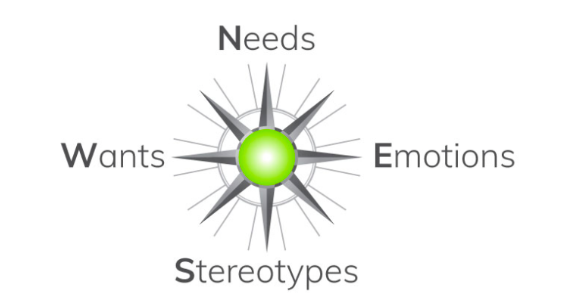
The compass model

Walt Disney has always been anchored in the customer experience. Something they have used to guide their customer experience for decades is what is known as the Disney Compass.

Understanding The Customer Helps Deliver Tailor-made CX 1
The Compass Model of marketing.

Here is how it works:

  • North (N) – Needs

This is about meeting the minimum requirements that a customer needs when visiting your business.

  • West (W) – Wants

This goes above the bare minimum, aiming to provide the customer with the things they want too. When you provide this, you amplify the customer experience.

  • South (S) – Stereotypes

This is about addressing the beliefs a customer may have of your business due to your business stereotype. For instance, doctor’s rooms are notorious for being late and keeping you waiting. To address this, you can work to reduce waiting time.

  • East (E) – Emotions

The way a customer feels about your business is often more important than logic when it comes to buying decisions. It is so important to address their emotions, provide an experience that brings them joy, and build that into your systems so it is always in mind.

Additionally, Harvard Business Review said that ‘fully connected customers are 52% more valuable, on average, than those who are just highly satisfied’. Connecting to your customers on an emotional level in your marketing and client nurturing is what separates the whales from the small fry.

Understand your clients

Another level to this is understanding where your clients come from. How do they link to your site in the first place? Use a UTM creator like UTM.io to track where your website traffic comes from via Google Analytics. This way, you can master your presence on these channels and double down on the experience in those places.

Once you know more about who they are, start collecting this data and using it to hyper-personalise their journeys. For instance, if you know that certain customers are there for one product and the others are there for something else, you can segment your database and only send messages that are relevant to their needs. You can even customise the experience by level of engagement, sending special deals to more engaged clients.

Map the client journey

Much like when you create a content strategy, when creating a customer experience strategy, it helps to understand the client’s journey when interacting with your business. This helps you to get an idea of their experience at every touchpoint.

Understanding The Customer Helps Deliver Tailor-made CX 2

Know the competition

What is the customer experience norm in your industry? Are you meeting it? Can you improve on it? Understanding what kind of customer experience your competitors are providing will help you make these decisions.

According to Quicksprout, tools you can use for this include:

  • SpyFu: gives you a view of the organic and paid clicks that your competitors are getting, what their top keywords are and where their backlinks are coming from. This can help you replicate and improve on their strategy.
  • Talkwater: social listening tools like this can keep your ear to the ground about what is being said about any brand in the media. Track your brand and your competitors to monitor brand sentiment and to understand the common complaints and praises.

Additionally, you can research them a little. Go onto their website and see what interacting with it is like as a customer. Follow them on social media to see what kind of content they are sharing and what kind of questions they get asked. The more you know about them and their clients, the better you will be able to support your own clients.

Get smart communication tools

Many touchpoints on your customer experience will be a million times easier to implement and maintain if you have the tools available to automate it. With a communication platform like Everlytic, you can:

  • Connect with customers on multiple channels, all in one place.
  • Improve customer engagement with hyper-personalised communications that are relevant to their demographics and responsive to their behaviour.
  • Collect customer behavioural data and adapt their customer experience accordingly.
  • Track and analyse which communications work best, so you can tweak for the best results.

These days, a great customer experience can separate you from the competition. Do not let it be what gets you left out of the running.

EVERLYTIC
everlytic.co.za

Tips On Creating Video Content That Spreads Brand Awareness

Tips On Creating Video Content That Spreads Brand Awareness
Calvin Fisher, owner of Pandabomb.

Calvin Fisher, owner of Pandabomb, shares how to create engaging footage and gives tips on how to shoot quality video content that spreads brand awareness.

In an age of technology where most people carry smartphones or tablets, video marketing has risen in popularity to become one of the most efficient methods of delivering marketing messages. Video content can spread brand awareness and build your business by establishing a connection between your company and its audience. However, this is less easier said than done.

In this overcrowded digital world, capturing someone’s attention is not the easiest thing to do. You need to find a way to stand out from the competition and connect with your audience. Here are some tips:

Have an idea of the desired outcome

The first thing you need to do is have a clear understanding of what your business offering is. You then need to identify who your audience is and why your product or service can be of value to them. Finally, you need to identify the goals you want to achieve with the video content you are producing, how you will present the information and whether that is the best approach for your audience.

Prepare everything you need

As soon as you have all the information you need for your video, write a script and get everyone involved to know it off by heart. This makes shooting the video a lot less time-consuming and it allows everyone involved to know where all the video footage will be shot. Having everything in place and in order also makes post-production much easier to work through. Struggling to remember your lines? A compelling voice-over on top of some B-roll footage can save you time in the editing process.

Use your best camera settings

This might seem like the obvious thing to do, but so many people miss this simple step. The higher the quality of video you put into your edit, the better the video will come out. The only setting you should avoid maxing out on is your frame rate. Try and set your camera to record at 25-seconds-per-frame as this would be closer to what you see in a Hollywood movie. If shooting on a modern smartphone and there is no 25 frames per second (fps) insight, opt for 30fps.

Get your lighting right

This is probably one of the most important steps you need to perfect. Too much light and your picture can come out overexposed if not blurry. Too little light and your shot won’t be clear enough to see. Worse still, it will be super grainy and unattractive as a result. Try and get your own artificial light to help out with your shots.

One light diagonally in front of you plus a practical light behind you that you don’t mind having in your shot – such as a lamp – is a good two-light set-up. If you are using natural light, just remember that sudden cloud cover could mess with your continuity.

Music

You might be tempted to add your favourite Kendrick Lemar or Justin Bieber track as background music, but it will be blocked in certain countries due to the music rights not being allowed there. There are plenty of legal royalty-free sites you can try for audio. Alternatively, YouTube has its own legal library of music you can use. Bonus tip: try and edit your video to the beat of the music to add a really cool look and feel to it.

Edit everything

As soon as you have recorded all the footage you would like to add to the video, it is time to get down to the hard work: editing. As tempting as it can be to just read a script and shoot a video in one take, the best of them need a little more work. All the prolonged pauses need to be trimmed, along with all the excessive ‘um’ usage. Shooting multiple takes of each scene will allow you to gather all the best parts in the video, so be sure to take your time with it.

Ready, set, upload

Once you have done all the editing and you are happy with the final version of the video, go ahead and upload it to the web. Don’t forget to track its performance by checking the number of views, click-throughs and social media engagements it gets.

PANDABOMB
+27781923112
calvin@calvinfisher.co.za
pandabomb.co.za
This is Modern Marketing