

Home Blog Page 9

Publicis Groupe Africa Announces New Head Of Influential

Publicis Groupe Africa Appoints Jarred Trembath To Lead Influential
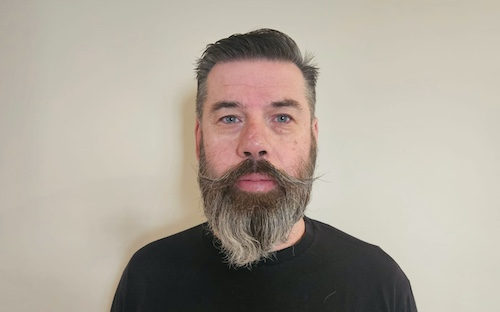
Jarred Trembath, Publicis Groupe Africa.

Influencer marketing is now one of the fastest-growing media channels globally. As marketing investment faces greater scrutiny, brands need influencer marketing to deliver measurable business outcomes, not just content and engagement. Publicis Groupe Africa has appointed Jarred Trembath as Head of Influential, Sub-Saharan Africa, to lead the growth and evolution of the group’s integrated creator marketing capability across the region.

Trembath brings 15 years of EMEA experience in paid media, performance marketing, creator marketing and leadership and continues to lead the group’s Performance B2B and Affiliate Marketing capabilities.

The industry is shifting from creators, followers, reach and organic campaigns toward audience intelligence, AI-powered planning, paid media integration, commerce and measurable business outcomes.

Influential is a capability within Publicis Groupe Africa’s broader Connected Media proposition, combining AI-powered audience intelligence, ConnectedID deterministic identity, first-party data and cross-channel measurement. The real differentiator is how creator marketing connects to AI, audience intelligence, identity, data, media and measurement within the Publicis ecosystem. Publicis starts with audience identity and data, identifying the communities that shape behaviour, then the creators who authentically influence them.

Ashish Williams, Senior Vice President Media said, ‘Creator marketing is evolving from a standalone communications channel into a measurable growth driver powered by data, technology and intelligence. At Publicis Groupe Africa, we are focused on integrating creator capabilities within our broader Connected Media ecosystem, enabling brands to connect creativity, audience intelligence, commerce and measurement in a way that delivers meaningful business outcomes. Jarred’s appointment reflects our commitment to building future-fit capabilities that help our clients navigate this evolving landscape with greater precision and impact.’

Jarred Trembath, Head of Influential SSA said, ‘The creator economy has matured beyond a content-led discipline. We are entering an era where influencer marketing is becoming one of the most accountable and intelligent media channels in the marketing mix.’

‘At Publicis Groupe Africa, we are redefining how brands connect with people by combining AI, audience intelligence, data and tech and creator expertise within a single integrated ecosystem. This enables us to identify the creators who genuinely influence culture and connect those relationships to measurable business outcomes. The future of influencer marketing will be defined by who can connect intelligence, media and creativity to drive real business growth.’

PUBLICIS GROUPE AFRICA
https://publicisgroupeafrica.com/

Nostalgia Gives Memory A Present-Day Role

Nostalgia Is A Powerful Commerce Lever
Bonita Christie, Digitas.

Bonita Christi, Business Unit Director at Digitas writes that the most interesting thing about nostalgia in marketing right now is how quickly the past is being turned into something people can book, buy, wear, watch, collect and share.

Hannah Montana returns not as a rerun, but as merchandise, content, collaborations and fan experiences. Clinique brings back Chubby Sticks and turns a familiar beauty product into a fresh moment of colour and play. None of this is accidental. And none of it is really about the past. This is how brands are using familiarity to reduce the distance between attention and action.

Nostalgia has typically been treated as emotion, a warm layer applied to a campaign to make people feel something familiar. That framing undersells what is actually happening. Nostalgia is increasingly functioning as a trust shortcut, reducing the friction people feel before they engage and buy. In a market shaped by economic anxiety, algorithmic fatigue, cultural fragmentation and constant change, familiarity is commercially useful.

This is why nostalgia is no longer limited to people remembering their own past. Adults are buying back childhood products. Gen Z is romanticising eras it never lived through. Retro aesthetics are resurfacing across fashion, beauty, entertainment, packaging and social media, often reinterpreted rather than reproduced. In each case, the familiar cue is doing real work in the decision-making process. It helps a brand feel recognisable before it has to explain itself.

At its strongest, nostalgia offers a fixed point in a market that will not stop moving. Brands that can provide that fixed point are finding that it changes how people engage with them and how quickly they move from interest to purchase.

From Feeling To Transaction

For most of its history, nostalgia lived in brand-building. A well-made ad could take people back to a moment and leave them with a warm feeling. What has changed is that consumers no longer want only to remember a moment. Increasingly, they want to step back inside it. Once a brand can offer that, nostalgia stops sitting quietly in brand perception and starts actively shaping the purchase journey. It reduces hesitation at the point where people are deciding whether to engage.

That is where it becomes commercially interesting. The most effective nostalgia today does not simply remind people of something they once loved. It gives that memory a present-day role: something to book, buy, wear, watch, collect, share or experience.

When Brands Get It Right

The clearest signal that nostalgia has moved from sentiment to strategy is not a single campaign. It is a pattern. Brands across categories identifying what their audience once loved, translating that emotional territory into something participatory and building a clear commercial path around it. The memory becomes the entry point. The experience, the product, the collaboration or the event becomes the reason to act.

What these activations share is architecture. Recognition is the hook, but it is never the whole offer. The most effective work makes nostalgia immersive and transactional, something people can step inside, buy into and share rather than leaving it as a passive feeling that fades once the campaign ends.

The Trap

Many brands experimenting with nostalgia make the same mistake. They bring back the look, the old logo, the familiar packaging, the retro colour palette, the jingle people remember. They do not build the commercial architecture around it. There is no urgency or participation. No clear path from the emotional hook to checkout. The result is content that is liked, shared and forgotten.

The brands seeing real returns treat nostalgia as a designed system. They identify what people loved in the first place, translate that feeling into something relevant now and make it easy for consumers to act on it.

The Asset In The Archive

For any brand with real history, nostalgia is one of the most underused assets available. It is already sitting in the archive in the form of old products, packaging, campaigns, characters, rituals, slogans, sounds and design codes. The opportunity is to reinterpret the past.

Consumers can tell the difference between a revival that simply repeats what came before and one that understands why it mattered. The most effective nostalgia revives the values that made people care in the first place, then gives those values new relevance.

It is also a trust play. In a landscape crowded with newness, speed and short-lived trends, familiar brands and stories offer reassurance. They feel known and easier to choose.

The Opportunity

The question for any brand sitting on heritage and history is not whether nostalgia has commercial value, but whether the right architecture exists to release it. The connected experiences, the participation mechanics, the routes from emotional recognition to transaction that turn a nostalgic asset into a genuine growth lever.

The archive is not a vault of old ideas. It is a live commercial asset. Nostalgia is not just a moment of recognition; it is a catalyst for relevance, connection and growth.

DIGITAS LIQUORICE
https://liquorice.co.za

Bookmark Awards’ Marketer Of The Year Sets A Benchmark For The Wider Industry

Happy Friday M
Andrea Quaye, HEINEKEN Beverages.

Andrea Quaye from HEINEKEN Beverages was recently named Marketer of the Year at this year’s Bookmark Awards. The win recognises here leadership and her contribution to advancing marketing excellence, innovation and industry growth across Africa.

Quaye has spent her career championing digital-first marketing, from Carling Black Label’s ‘Be the Coach’ to more recent work including HEINEKEN’s ‘Social Screens’ and Savanna’s ‘Try January.’

After serving as Global Vice President for the Coffee Category at Coca-Cola in Ireland, she returned home to join HEINEKEN Beverages as CMO in late 2024, tasked with aligning the business post the Distell acquisition and driving digital transformation across the group’s marketing delivery. Her insistence that every plan pair creativity with a digital-first focus has given agency partners a clear mandate: digitally integrated, creatively effective work.

That approach shows up across the portfolio, from a data-reactive billboard mirroring Max Verstappen’s race-day speed at the Dakar rally, to a Returnable Star Bottle initiative using QR codes and WhatsApp to reward consumers, driving the return of more than four million bottles. It also underpins campaigns for Windhoek, Bernini, Amstel, J.C. Le Roux and Savanna, each built on digitally led ecosystems that turn ideas into participation at scale.

Koo Govender, CEO of Publicis Groupe Africa, credits Andrea’s partnership with agency LePub as a driving force behind this integrated work, ‘It’s her ability to drive a digital-first marketing approach with clarity and courage that aligns stakeholders and creates the conditions for brand and agency partners to deliver breakthrough, integrated work. Andrea raises the standard of how modern marketing should be done in South Africa.’

Luca Gallerelli, Group CEO of TBWA\Hunt\Lascaris, echoes the sentiment, ‘Andrea leads in a way that makes digital transformation practical and scalable. She is rigorous on strategy, but equally committed to the craft of digital ideas. That leadership elevates the client-agency relationship, accelerates the digital agenda, and sets a benchmark for the wider industry.’

Her impact reaches beyond her own brands. Andrea has championed emerging talent through HEINEKEN’s sponsorship of the Cannes Young Lions Digital category over the past two years and her team’s digital work helped HEINEKEN Beverages secure a strong share of honours at the Loeries 2025, where she ranked as the festival’s second-best marketer in her first year in the role. Coenie Grebe, ECD at Brand Halo, points to Klipdrift’s ‘Legends’ work as further proof of the digital-first thinking now spreading across the wider HEINEKEN Beverages portfolio.

Quaye embodies a marketer who not only champions a digital mindset in her own role, but actively drives that ethos industry-wide and this recognition celebrates the impact she has delivered in a remarkably short space of time.

PUBLICIS GROUPE AFRICA
https://publicisgroupeafrica.com/

Moving From Fear And Anxiety To Positive Action When Communicating Climate Change

Communicating Climate Change- Moving From Fear And Anxiety To Positive Action
Willem Steenkamp, Flow Communications.

Willem Steenkamp, senior writer and editor at Flow Communications writes that  for too long, the dominant narrative about climate change has been one of apocalypse: collapsing ice shelves, parched earth, species extinctions, bleached coral, catastrophic storms and even the current northern hemisphere heatwaves, conjure up fears of irreversible environmental calamity.

While climate change science justifies the urgency, we are indeed hurtling headlong towards disastrous changes to the Earth’s climate, communicating the science has brought us to a psychological tipping point. Instead of galvanising us into action, relentless alarmism triggers climate anxiety, a chronic fear of environmental doom that leads to paralysis rather than participation.

As communicators, we must recognise that fear only motivates people up to a point. In the face of a threat as enormous (and abstract) as global warming, our natural response to fear is often to freeze as a way of self-protection; to give in to our feelings of powerlessness. When the problem feels insurmountable, individual actions, such as recycling or saving water, appear trivial and pointless.

Instead, to inspire meaningful change in the greater public, we must move beyond this doom-and-gloom approach and make the connection between urgency (the need to act) and agency (the ability to act).

To be sure, we must be straightforward about the realities of climate change; there is no denying or sugar-coating it. But we must pair this honesty with practical, hopeful choices. People will not change their behaviour because they are frightened, but they most likely will if they believe their actions matter.

This requires a shift from global abstractions to local realities. For example, for a resident of Cape Town, the threat of ‘day zero’ water shortages is far more motivating to be water-wise than the melting of distant glaciers. By focusing on local solutions, such as water resilience or urban greening, we make addressing the climate crisis tangible and relevant.

In South Africa, we have powerful stories to replace the narrative of catastrophe. Community-led carbon capture and storage initiatives in the Eastern Cape, for example, are not only addressing global warming, they are creating jobs and restoring ecosystems. In the Northern Cape, dozens of solar photovoltaic and concentrated solar power installations feed green electricity into our national grid, stimulating local employment and driving clean energy uptake by industrial users such as mines and factories throughout South Africa.

When we highlight successes such as these, we demonstrate that a sustainable future is not just necessary, it is desirable and possible.

As communicators, we also have to ditch technical jargon, which creates a barrier between experts and the public. Terms such as ‘anthropogenic’, ‘carbon sequestration’ or ‘mitigation strategies’ sound smart but probably mean little to many people. Rather, we should use more accessible language that is easy to grasp and culturally relevant to the audience. Use words like ‘we’ and ‘our’, emphasising our sense of collective responsibility.

In a similar vein, we must move away from a one-size-fits-all approach to how we say things to various audiences: a small-scale farmer’s concerns about crop failure are inherently different from a business executive’s focus on ESG compliance, for instance. This is Communications 101, effective messaging always considers the audience first, and tailors the ‘ask’ to what is achievable for that audience.

Ultimately, our role is not to make the public more afraid, rather, it is to ensure that each of us feels like a protagonist in the story of environmental restoration, not a helpless witness to its collapse. Pairing credible information with local success stories and clear, actionable steps allows us to turn climate anxiety into climate action.

And when people believe that they can make a difference, they usually do.

FLOW COMMUNICATIONS
www.flowsa.com

Effie Awards South Africa 2026 Grand Jury Revealed

Effie Awards South Africa 2026 Grand Jury Revealed

The Effie Awards remain the globally recognised benchmark for marketing effectiveness. Effie Awards South Africa has announced the senior panel of industry leaders who will serve on the 2026 Grand Jury, tasked with adjudicating the programme’s highest honour, the coveted Grand Effie.

The Grand Effie recognises the campaign that best demonstrates effectiveness at its highest level, where clear strategic thinking, powerful creative work and measurable results come together. The Grand Effie is not guaranteed each year and is awarded only when a case meets the exceptional standard required.

The 2026 Grand Jury will meet in person on Thursday, 10 September 2026, to review qualifying Gold-winning cases and determine whether any campaign stands above the rest as the year’s most effective work.

‘The Grand Jury represents one of the most senior and considered moments in the Effie process,’ said Gillian Rightford, ACA Executive Director for Effie South Africa. ‘This panel is drawn from the highest levels of client and agency leadership, bringing together deep experience across marketing, strategy, creativity, media and business. Their role is to look beyond the award level already achieved and determine whether a case truly represents effectiveness at its peak. That requires judgement, rigour and a clear understanding of how marketing creates measurable value.’

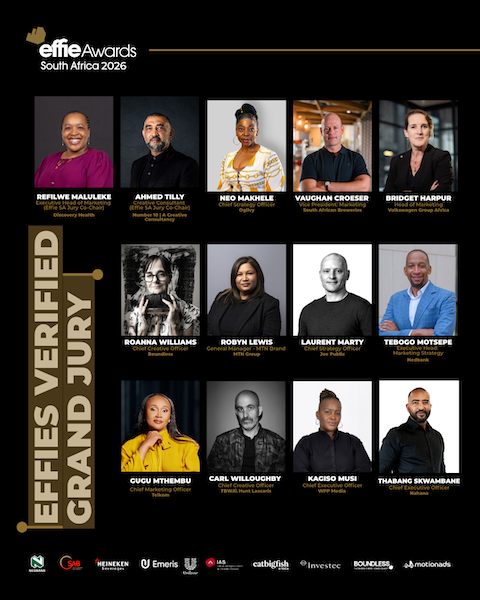
The 2026 Grand Jury will be co-chaired by Refilwe Maluleke, Executive Head of Marketing at Discovery Health, and Ahmed Tilly, Creative Consultant at Number 10 | A Creative Consultancy.

The 2026 Effie South Africa Grand Jury:

– Refilwe Maluleke, Executive Head of Marketing, Discovery Health
– Ahmed Tilly, Creative Consultant, Number 10 | A Creative Consultancy
– Bridget Harpur, Head of Marketing, Volkswagen Group Africa
– Carl Willoughby, Chief Creative Officer, TBWA\Hunt Lascaris
– Gugu Mthembu, Chief Marketing Officer, Telkom
– Kagiso Musi, Chief Executive Officer, WPP Media
– Laurent Marty, Chief Strategy Officer, Joe Public
– Neo Makhele, Chief Strategy Officer, Ogilvy
– Roanna Williams, Chief Creative Officer, Boundless
– Robyn Lewis, General Manager: MTN Brand, MTN Group
– Tebogo Motsepe, Executive Head: Marketing Strategy, Nedbank
– Thabang Skwambane, Chief Executive Officer, Nahana
– Vaughan Croeser, Vice President: Marketing, South African Breweries

Winners of the 2026 Effie Awards South Africa programme, including the Grand Effie should one be awarded, will be announced at the Effie Awards South Africa Gala on Tuesday, 20 October 2026.

Effie Awards South Africa is hosted by the Association for Communication and Advertising (ACA) and sponsored by Nedbank, South African Breweries (AB InBev), Unilever, Heineken Beverages, Emeris, IAS, Eat Big Fish, Investec, Boundless and Motion Ads.

EFFIE AWARDS
www.effieawards.co.za

Nedbank IMC Announces Musical Collaboration

Nedbank IMC Announces Musical Collaboration
Siya Metane, SlikourOnLife.

Rather than simply talking about music’s role in marketing, SlikourOnLife will demonstrate it. The Nedbank IMC has announced a new collaboration with Siya Metane, widely known as Slikour, Group CEO and Founder of SlikourOnLife, for its 2026 conference taking place on Thursday, 17 September 2026 at Mosaïek Teatro in Johannesburg or online.

Throughout rehearsal day on 16 September and the conference itself on 17 September, the SlikourOnLife team will capture vox pops, soundbites and voices from speakers and delegates and use them to build an original conference track in real time.

The project is designed as a live test of a broader marketing idea that music can operate not only as entertainment, but as media, culture and a commercially meaningful platform for brands. The track will be developed from a studio space inside the main auditorium during the day, with MC Donovan Goliath introducing the experiment in his opening and checking in with Metane as it develops.

The completed song will then be revealed live as the final moment of the conference, with Metane joining Goliath on stage for The Conference Song: Revealed Live.

The collaboration reflects SlikourOnLife’s broader proposition around music, culture and commercial value. The platform has built its business around helping brands and creators connect more credibly with audiences through African music, content, distribution and cultural participation.

For the Nedbank IMC, the experiment also puts Marketing is Business® into practice, testing what happens when content born inside a major marketing platform is turned into a piece of music and distributed beyond the conference itself.

‘Siya and SlikourOnLife are not coming to tell marketers that music can create cultural and commercial value. They are going to demonstrate it, live,’ said Dale Hefer, CEO of the Nedbank IMC.

Metane has built a career across music, media and entrepreneurship. Best known initially through his work in South African hip-hop, he went on to build SlikourOnLife into a media and cultural platform connecting artists, audiences and brands.

His role at the Nedbank IMC will extend beyond the live song creation, with SlikourOnLife also creating content from the day and engaging with selected speakers, marketers and delegates.

The finished track will be shared across all major music distribution platforms, including Spotify, YouTube and Apple Music, as well as the SlikourOnLife and Nedbank IMC platforms after the conference. This will extend the experiment beyond the event itself, allowing its performance to be measured through streams, shares, saves, reach and other audience engagement.

The collaboration forms part of the Nedbank IMC 2026 theme, Shift Happens™. Are You Ready?, and its broader focus on how marketing is changing across technology, culture, creativity and business.

The Nedbank IMC 2026 takes place on Thursday, 17 September 2026 at Mosaïek Teatro in Johannesburg or online.

Tickets are available here.

Nedbank IMC
www.imcconference.com

Visit The Modern Marketing Expo For The Latest Trends In Advertising, Media, Promotional Products And More

Visit The Modern Marketing Expo For The Latest Trends In Advertising, Media, Promotional Products And More

Experience the latest trends in advertising, media, promotional products, branded apparel, AI design and content technologies, marketing technology, at the Modern Marketing Expo 2026, where brands build momentum. The event is taking place 8-10 September at the Gallagher Convention Centre, Johannesburg.

This is Africa’s focused marketing expo for marketing professionals, who can also see the latest developments and innovations in: signage, displays, visual communication, print and production technologies, digital experience and engagement, as well as retail and shopper marketing

Supercharge Your Marketing At The Modern Marketing Power Hour

Industry leaders will share their expertise and insights in the ever-evolving field of marketing at the free-to-attend Modern Marketing Power Hour, taking place in Hall 3 at Gallagher Convention Centre.

Please register online for free attendance to the Modern Marketing Expo, taking place 8-10 September, 9am-5pm at Gallagher Convention Centre. The event is co-located with: Sign Africa, FESPA Africa, Africa Print and Graphics, Print and Sign expos.

MODERN MARKETING EXPO
+27 11 568 1894
https://modernmarketingexpo.co.za

Patience And Persistence Are Key To Success

Patience And Persistence Are Key To Success
Barry Venter, Nashua

Barry Venter, CEO of Nashua discusses how to keep a legacy brand relevant in a fast-changing market. As technology, customer behaviour and market conditions change, businesses need to keep up. In some cases, that might mean making wide and deep changes to the business model to ensure that the company remains relevant. The challenge for a well-established business lies in innovating and evolving, while retaining its brand equity and customer relationships.

At Nashua, we have gone through a significant business transformation over the past decade, from office automation specialist to a major player in the ICT industry. Before that, we evolved from a specialist in the sale and service of liquid toner copiers into an office automation leader.

Here are some of the lessons that our over 50-years history offers for other businesses that are reinventing their legacy brands for the digital age:

Innovate Within Your Offering

Evolution starts with rethinking what you already provide and looking at how you can leverage existing infrastructure and customer relationships to grow. You don’t need to build something completely new or abandon existing businesses to remain relevant. Our approach was to expand into areas that were adjacent to our existing business to meet new customer requirements.

Invest In The Skills Your Industry Needs

Investing in new skills is expensive and it takes time, but it is essential. Building the right team is as important as building the right product. There is a balancing act between ensuring the continuity of the core business, while investing in the revenue streams of the future.

With our move beyond print into ICT, we had to invest in new skills, including presales, implementation, and after-sales specialists, to support our expanded solutions.

Bring Existing Partners With You On The Journey

As a business changes and evolves, the support of its existing business partners is as important as building new vendor relationships. Customers are more likely to trust you with new solutions if you build on established relationships. A strong partner ecosystem also helps smaller companies to compete more effectively by pooling knowledge, resources, and reach.

Respect Heritage Clients, But Focus On New Ones

A successful reinvention is one where you don’t leave your existing customers behind. We still support many customers that depend on legacy print solutions and who are not yet ready to invest in digital solutions. We continue to serve this market, while prioritising the next generation of SMEs with needs in connectivity, cybersecurity, and green energy. Balancing the old and the new helps maintain credibility with long-time clients, while showing newer ones that you are forward-looking and relevant to their needs.

A Solutions Mindset Pays Off

Business reinventions pay off when they are oriented towards solving your customers’ problems. Over the past 10 to 15 years, we’ve moved away from the ‘box drop”’mentality of selling equipment, towards providing turnkey solutions that help customers achieve their goals and future-proof their operations. One element of this is building industry-specific solutions for each sector, from agriculture to education and beyond.

It’s A Journey, Not A Flick Of A Switch

Perhaps the biggest lesson is that reinvention takes time. Our evolution spanned decades, not months. Patience and persistence are the key to success, especially when bringing new offerings to market. Reinvention is not about one big launch, but about steady, deliberate steps to change the business. Each improvement lays the groundwork for the next. Over time, these incremental changes build trust and position your brand as a long-term partner to its customers.

NASHUA
https://www.nashua.co.za

Rethinking Retail Spaces And Retail Marketing

Rethinking Retail Spaces And Retail Marketing
Camagu Sam, Mall Ads.

As foot traffic patterns shift and e-commerce continues to place pressure on physical retail, malls are having to reinvent their value proposition.

In this practical session, which will be held during the free-to-attend Modern Marketing Power Hour, Camagu Sam, Senior Sales Manager, Mall Ads will explore how treating physical retail space as a structured media network, rather than simply a leasing asset, is reshaping the economics of shopping centres, with implications for retail marketing, and shopper engagement.

Topic: Rethinking Retail Spaces and Retail Marketing
Wednesday 9 September 12:30-13:30

Book your free slot here.

The event is taking place at the Modern Marketing Expo. The sessions will be held on the Balcony in Hall 3 at Gallagher Convention Centre.

Please register online for free attendance to the Modern Marketing Expo, taking place 8-10 September, 9am-5pm at Gallagher Convention Centre. The event is co-located with: Sign Africa, FESPA Africa, Africa Print and Graphics, Print and Sign expos.

MODERN MARKETING EXPO
+27 11 568 1894
https://modernmarketingexpo.co.za

The Copyright Lessons Behind A Recent Celebrity Dispute

The Copyright Lessons Behind A Recent Celebrity Dispute
Amani Patel, Spoor & Fisher.

Amani Patel, with oversight by Marco van der Merwe (Partner) at Spoor & Fisher, writes that a recent copyright dispute involving media personality Ntando Rambani (née Duma) and photographic agency Pixel Kollective has highlighted a common misconception about photographs and copyright.

The dispute arose after a photograph, in respect of which Pixel Kollective owned the copyright, was allegedly used in a commercial advertising campaign without Pixel’s permission. Although Pixel was credited when the image was originally shared on social media, the subsequent commercial use of the photograph ultimately resulted in a damages award for copyright infringement.

The case raises an important question: who owns the rights to a photograph – the person depicted in it, the photographer who captured it, the person who employs the photographer or the person who commissioned the taking of the photograph? The answer is not always straightforward.

With social media making photographs instantly accessible and easy to share, it is common for individuals and businesses to assume that a photograph may be freely reused provided the photographer is acknowledged. However, while attribution may be courteous and, in some circumstances, contractually required, it does not authorise the reproduction or commercial use of a copyrighted work.

In South Africa, copyright in original photographs is governed by the Copyright Act 98 of 1978. A photograph is an artistic work for purposes of this Act, and the ‘author’ of a photograph is the person responsible for its composition. Importantly, authorship and ownership are not necessarily the same. While copyright generally vests in the author, until it is assigned, the Copyright Act provides circumstances in which ownership may initially vest in another person.

In the context of photography, the person who takes the photograph will generally be the person responsible for its composition and, therefore, its author. However, this is a question of fact. The person appearing in the photograph is not its author simply because they contributed to the scene. In the Ntando Rambani matter, the Court considered whether Rambani’s attire, appearance, make-up, hair, pose and input regarding the location made her responsible for the composition of the photograph. It concluded that these contributions did not make her the author of the photograph.

Ownership of copyright in a photograph may nevertheless vest in someone other than the author. Where the photograph is authored in the course of a contract of employment, service or apprenticeship with a newspaper, magazine or similar periodical (i.e. a media business), and is made for this purpose then the media business is the owner of the copyright in the photograph in so far as it relates to publication of the photograph in the newspaper, magazine or similar periodical, but in all other respects the author is the owner of the copyright.

Where a person commissions the taking of a photograph, pays or agrees to pay for it, and the photograph is made pursuant to that commission, the commissioning party is the owner of the copyright. Importantly, however, this statutory ownership rule applies subject to any agreement excluding its operation. The parties can therefore agree to exclude the default ownership rule.

This distinction was particularly relevant in the Rambani dispute. Pixel Kollective had been commissioned by Homecoming Events to photograph the event and was paid for its services. This arrangement would have vested ownership of the copyright in Homecoming Events. However, in this case, the evidence showed that Pixel’s standard terms provided that copyright remained with Pixel unless otherwise agreed. In other words, the parties agreed to exclude the statutory ownership rule. The Court accordingly found that Pixel had retained ownership of the copyright despite having been commissioned by Homecoming Events to take the photographs.

Importantly, the position is unaffected simply by who appears in the image. The subject of a photograph may have separate rights relating to privacy, personality or contractual arrangements, but those rights are distinct from copyright ownership. Being depicted in a photograph does not, by itself, give a person ownership of the copyright in the photograph.

This distinction has become increasingly relevant as brands, influencers and content creators regularly reuse photographs across social media platforms and marketing campaigns. A photograph may have been posted publicly, shared by the individual featured, or credited to the photographer, but none of these factors necessarily entitles a third party to reproduce or use it for commercial purposes without the copyright owner’s permission.

Before using a photograph in advertising, promotional material or sponsored content, businesses should therefore ensure that they have obtained the necessary permission from the copyright owner. Equally, influencers and public figures should be aware that their ability to use images of themselves may be subject to consent from the copyright owner, particularly where the images are used for commercial purposes rather than merely shared as part of ordinary personal social media activity.

The recent dispute serves as a timely reminder that copyright protects the original expression embodied in a photograph, including the skill, judgment and creative input involved in its composition. It also demonstrates why it is important to distinguish between the person depicted in the photo, the author of a photograph and the person who owns the copyright in it.

The lesson is a simple one: crediting the photographer may acknowledge their work, but it is not a substitute for obtaining permission to use it.

SPOOR & FISHER
www.spoor.com