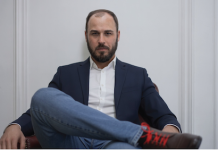


South Africa’s new Entrepreneur of the Year, Taryn Hunter Sharman, explains that when she started Faith & Fear more than a decade ago, she thought the name was about choosing faith over fear.
I know better now. The most important part of the name has always been the ‘&’. Because entrepreneurship rarely asks you to choose between confidence and doubt, ambition and exhaustion, courage and fear. Most of the time, you carry both. That small space between the two is where most of my entrepreneurial journey has happened.
I did not start a business because I had some perfectly mapped-out vision of becoming an entrepreneur. I knew marketing. I knew how to build relationships. I knew I could work hard. I had instinct, ambition and probably a healthy amount of naivety. What I did not have was certainty. That may be one of the first things entrepreneurship taught me: certainty is not a prerequisite for action.
There have been plenty of moments over the years where, from the outside, things looked successful. The clients got bigger, the business grew, we won awards and built an incredible network around us. But confidence does not rise neatly alongside turnover.
I have walked into important meetings wondering whether I really belonged there. I have presented ideas while simultaneously questioning them in my own head. I have made decisions that affected other people’s livelihoods while quietly wondering whether I was making the right call. That tension never completely disappears. What changes is your relationship with it. You learn that self-doubt does not always mean stop. Sometimes it simply means you care.
Entrepreneurship is often sold as freedom. Build your own thing. Be your own boss. Create the life you want. All of that can be true, but there is another side to it. Building something asks a lot of you.
I have built a business while also being a wife, a mother, a daughter, a friend and a human being who occasionally needs to stop functioning like a machine. There have been seasons where the business needed almost everything I had, and there have also been seasons where life made it very clear that business could not have everything.
That has probably been one of my biggest lessons. Every important yes contains a no. Saying yes to growth might mean saying no to time. Saying yes to a client might mean saying no to capacity. Saying yes to an opportunity might mean saying no to something your ego desperately wants. Success is not just learning what to pursue. It is learning what to protect.
I believe deeply in grit. A huge part of entrepreneurship is simply doing the things other people stop doing. Following up. Pitching again. Making another call. Fixing the problem. Finding the money. Showing up when you are disappointed. Doing the work nobody applauds. But somewhere along the journey I realised grit has a shadow side. You can become so proud of your ability to push through that you stop asking whether you should.
There is courage in perseverance, but there is also courage in changing your mind. There is courage in admitting something is not working. There is courage in asking for help. And there is enormous courage in letting go.
For founders, that last one can be particularly difficult. In the beginning, your willingness to do everything is often the reason the business survives. Eventually, it becomes the thing that stops it growing.
You have to move from asking,’Can I do this?’ to asking, ‘Can I build something that does not require me to do all of this?’
That shift requires trust. In people, in partnerships, in your team and, perhaps most importantly, in the idea that someone else’s way of doing something does not have to look exactly like yours to be good.
I also think entrepreneurs need to be less apologetic about wanting to make money. Profit matters. Cash flow matters. Commercial success matters. Money creates jobs. It gives businesses oxygen. It gives founders choices. It allows you to invest, take risks and build something that lasts.
But at some point in my own journey, another question began to become equally important: what is this all for? That question eventually helped shape The Brave Collective, our community focused on women’s self-worth, net worth and networks. It has influenced my speaking, my writing and the work I want to do beyond the agency itself.
The business became the engine. But meaning became part of the destination. And perhaps that is another evolution nobody really prepares you for. At first you are trying to build the business. Then, one day, you realise the business has also been building you.
I do not think successful entrepreneurship is about becoming fearless. I still experience fear. I still get things wrong. I still have moments where I wonder what on earth I am doing. But I trust myself differently now. Not because I believe everything will work out exactly as planned, but because I know that when it does not, I will figure out what comes next.
If I could distil the journey into a few lessons, they would be simple ones. Start before you feel completely ready. Learn to sell. Protect your reputation fiercely. Understand your numbers. Choose your people carefully. Do not confuse every opportunity with the right opportunity. Let the business evolve. Let yourself evolve too. And remember that fear is not always a warning to retreat. Sometimes it is simply evidence that you have reached the edge of what you already know. For me, that is where entrepreneurship has always lived.
Not in faith, not in fear, but in the ‘&’.
C1W Initiative
Change 1 Woman (C1W) aims to empower women in the branding, print and signage industries. As part of this initiative, Modern Marketing would like to spotlight women-focused content like this piece. If you have any trend/business articles related to the signage, branding and printing industries, please email content to: info@c1w.co.za. Follow C1W on Facebook, LinkedIn and Instagram for more updates.
TARYN HUNTER SHARMAN
https://tarynhuntersharman.com