Home Blog Page 82

How Marketers Can Strike The Right Balance Between Creative Freedom And Brand Limitations

How Marketers Can Strike The Right Balance Between Creative Freedom And Brand Limitations
Thato Moatlhodi and Fredine Swigelaar, Matte BLK.

With South Africa recently commemorating the 31st anniversary of its democracy, and celebrating its collective freedom, it might be the right time to reflect on the ideals of freedom and what they mean in business. It’s no secret that marketers generally wish to have more creative freedom when impacting brands.

This is because to limitations like brand guidelines and defined boundaries set by clients to operate within to safeguard their brand image, briefs that could be clearer, quick turnarounds and bottleneck. These factors can stifle creative freedom and the potential for maximum impact on brands, which would benefit the overall profitability for all involved.

However, the question is how can marketers identify strategies, or best practices, to balance efficiency and impact amid brand guidelines, and retain their client base? The collaboration between the creative and client service teams is vital. On one hand, the creative team thrives on originality, creative innovation, and pushing boundaries. On the other hand, client service teams are the guardians of brand integrity, ensuring that all campaigns stay within the guidelines set by the client. Striking the right balance between creative freedom and brand limitations requires mutual understanding, deliberate strategy, and clear communication.

Unpacking this dynamic further, Matte BLK’s Senior Art Director, Thato Moatlhodi and Group Account Director, Fredine Swigelaar both emphasise that marketers must be strategic to achieve this goal. The two seasoned campaigners listed the following tips for marketers looking to unlock more freedom for themselves while working within the ambit brand guidelines:

Seek the ‘Why’ Behind Limitations

Clients have internal rules and guidelines that eventually determine how they want their brand image to be published, and these trickle down to how agencies are expected to operate. It’s part of the agency’s responsibility to find out the ‘why’, according to Swigelaar.

‘Sometimes, brand guidelines may feel restrictive, but it’s essential to understand the rationale behind them. Client service teams should dig deeper into the client’s reasoning and communicate it effectively to the creative team. This understanding often opens new creative opportunities to work within those boundaries,’ she added.

Understand The Client And The Brand

The creative team must immerse themselves in the brand’s identity, voice, and values. The client service team, on the other hand, must support this by managing the relationship with the client, understanding how the client prefers to function and how to traffic the creative work between the two organisations seamlessly.

Client service teams play a crucial role here by acting as translators between the brand guidelines and the creative expression, helping creatives find innovative ways to interpret the rules without overstepping boundaries. ‘The foundation is a strong relationship with the client. It’s key to achieving creative freedom. Client service teams should nurture trust by consistently delivering value and demonstrating an understanding of the brand. Once trust is established, clients are often more willing to loosen strict limitations and allow more creative exploration,’ said Swigelaar.

Technology Integration

Technological advancements can support the management of client relationship, through managing the production, communication and logistics process. Tools like Adobe Analytics, Improvado and HubSpot offer solutions for predictive analytics and tracking systems to manage delivery timelines effectively, minimising delays and errors.

Be Responsible With ‘Rules’ – They Exist For A Reason

Moatlhodi implored marketing firms to be responsible when navigating through brand limitations to solve problems because ‘rules are the for a reason. They guard the brand’s integrity. To the client it’s not about creative freedom vs brand limitations, but it’s about protecting their equity. ‘The limitations set by clients guide creatives when looking for the best ways to impact brands. The solutions offered by creatives should help the clients protect their brands, as much as amplifying their objectives. The clients are busy and contract marketing agencies for solutions; clients don’t have the time to find the solutions with them.’

Be Solution Minded

Moatlhodi urged creatives to search for solutions for the ‘need for more creative freedom’ puzzle on their side first. ‘The solutions are normally on our side of the fence. It takes a careful understanding of the client’s brand to fit the missing pieces to the puzzle when it feels like client limitations, like CI specs for example, limit creative freedom.’

Another common quick fix is a more collaborative approach between clients and marketers, if there is room, so that the marketers can create the necessary freedom for themselves.

MATTEBLK
http://www.matteblk.africa/

Brands Must Architect Behaviour To Build Loyalty

Brands Must Architect Behaviour To Build Loyalty
Melanie Campbell, RAPT Creative.

Melanie Campbell, Partner, Group Strategy at RAPT Creative, says consumers don’t wake up feeling loyal. Loyalty is the cumulative result of smart brand design: showing up in the right moments, creating emotional significance and making repeat buying feel frictionless. When done right, loyalty becomes less of a conscious choice and more of an automatic response.

Here’s how to build brand loyalty that lasts, even when your customer is just one swipe away from a better offer.

1. Easy To Mind: Be The First Brand They Think Of

If consumers don’t think of your brand in the moment of need, nothing else matters. Loyalty begins with memory.

What To Do:

– Codify distinctive brand assets: Logos, colours, packaging, sounds. Think Netflix’s ‘tudum’ or McDonald’s golden arches.
– Own key category moments: Gatorade doesn’t just sell sports drinks — it owns post-exercise hydration. Identify and embed your brand into those trigger moments.
– Relentlessly repeat: The brands we remember are the ones we see often and everywhere. Consistency breeds familiarity — and familiarity breeds trust.
– Default brands aren’t always better. They’re just more available in memory.

2. Easy to bind – Through Ritual And Relevance

Loyalty is sustained not just by recognition, but by relevance. People return to brands that feel personally meaningful.

What To Do:

– Create rituals, not just transactions: Nespresso didn’t just sell coffee – it created a morning moment. What emotional role can your brand play in consumers’ lives?
– Tap into identity: Brands become part of who people are. Harley-Davidson isn’t a bike, it’s rebellion. Oatly isn’t milk — it’s moral positioning.
– Design emotional rewards: Whether it’s joy, pride, nostalgia or confidence, give people a reason to feel something when they choose you.
– Emotion makes a brand memorable. Repetition alone doesn’t.

3. Easy To Try / Buy Through Reduced Friction

If your product is harder to buy, harder to find, or harder to understand than the alternative, loyalty will evaporate.

What To Do:

– Simplify the path to purchase: Think Amazon’s one-click reorder. Or Uber’s invisible payment experience.
– Embed yourself in routines: Auto-reorders, app-based subscriptions, reminders. Loyalty thrives when convenience removes decision-making.
– Lower the barrier to first trial: Free trials, starter packs, easy returns—remove friction at the entry point to lock in future purchase behaviour.
– The easier you are to buy, the harder you are to stop buying.

4. Hard To Leave Behind – Make Switching Feel Risky

People fear losses more than they crave gains. Loyalty often isn’t about love; it’s about aversion to change.

What To Do:

– Reward longevity, not just spend: The more effort someone puts into a brand – playlist curation, loyalty points, personalisation – the harder it becomes to leave.
– Create product ecosystems: Apple locks you in with seamless integration across devices. Once you’re in, leaving means starting from scratch.
– Reframe the switch: Insurance brands have mastered this — ‘What happens if something goes wrong with your new provider?’ Loss framing increases stickiness.
– Consumers don’t always stay for what they’ll gain. They stay to avoid what they might lose.

5. Easy To Align – Use The Crowd To Your Advantage

Social validation is one of the strongest forces in behaviour. People trust what they see others doing, especially when the choice feels low-stakes but high-risk (like trying a new product).

What To Do:

– Highlight what’s trending: Netflix’s ‘Top 10’ signals safety in numbers.
– Make brand use visible: Starbucks cups, branded sneakers, shareable unboxing moments, these are subtle signals of belonging.
– Empower influencers to validate, not just advertise: People trust real people more than polished ads. Especially when the product feels personal.
– Loyalty can be reinforced by herd behaviour – if everyone’s in, I must be too.

6. Turn One-Time Buyers Into Repeat Customers

The best form of loyalty is habitual. Once a consumer buys you without thinking, you’ve won.

What To Do:

– Nudge the next action immediately: After a purchase, guide them to the next one. ‘Reorder in one tap” or “Only 2 more purchases to reach VIP status.’
– Gamify progress: Streaks, levels, badges. Duolingo made quitting feel like losing. You can too.
– Make repeat use feel rewarding: Spotify Wrapped isn’t just a playlist—it’s a celebration of your time spent with the brand.
– Design for recurrence. Loyalty lives in the repeat.

The New Loyalty Playbook

To build loyalty in a disloyal world, brands must do more than earn affection; they must architect behaviour.

Here’s The Formula:

– Be mentally available when the consumer needs you.
– Be emotionally rewarding to use and easy to choose.
– Be different enough to matter and familiar enough to trust.
– And finally, be so seamlessly integrated into life that switching doesn’t feel worth it.
Loyalty doesn’t live in sentiment. It lives in systems.

RAPT CREATIVE
www.raptcreative.com

YOU FM Announces New Managing Director

You FM Announces New Managing Director
Tebogo Mashego, YOU FM.

The appointment of Tebogo Mashego as Managing Director is a strategic move aimed at driving growth, diversification, and financial stability in the competitive business space. With his extensive experience in market intelligence, Mashego brings the right skills to propel YOU FM’s market share and revenue growth.

With over a decade of experience in the media industry, Mashego brings a wealth of knowledge and expertise to drive growth, diversification, and financial stability.

‘I’m thrilled to join YOU FM as the new Managing Director, with a clear mandate to drive growth, diversification, and profitability. Our key objective is to attract a more diverse audience, expanding our reach and increasing our market share. By leveraging my expertise in market intelligence, we’ll inform strategic decisions that drive business growth and ensure sustained profitability. I’m excited to work with the team to unlock new opportunities and take YOU FM to new heights,’ said Mashego.

Mashego’s broad experience and skills make him an ideal candidate for this role. His ability to analyse market trends, identify opportunities, and develop effective strategies will drive YOU FM’s growth and success.

Tebogo holds a National Diploma in Marketing from the Vaal University of Technology, as well as a Bachelor of Arts degree in Sociology and International Relations from the University of the Witwatersrand (Wits). He furthered his studies with a Bachelor of Arts Honours degree in Political Studies from North West University and a Bachelor of Laws (LLB) degree from Wits.

With a career spanning over a decade, Mashego has worked in various senior roles within the media industry, including Senior Media Analyst at eMedia, Senior Media Strategist at MSG Afrika, Senior Audience Specialist at Multichoice, and Head of Sales and Insights at YOU FM.

YOU FM
https://www.youfm.co.za/

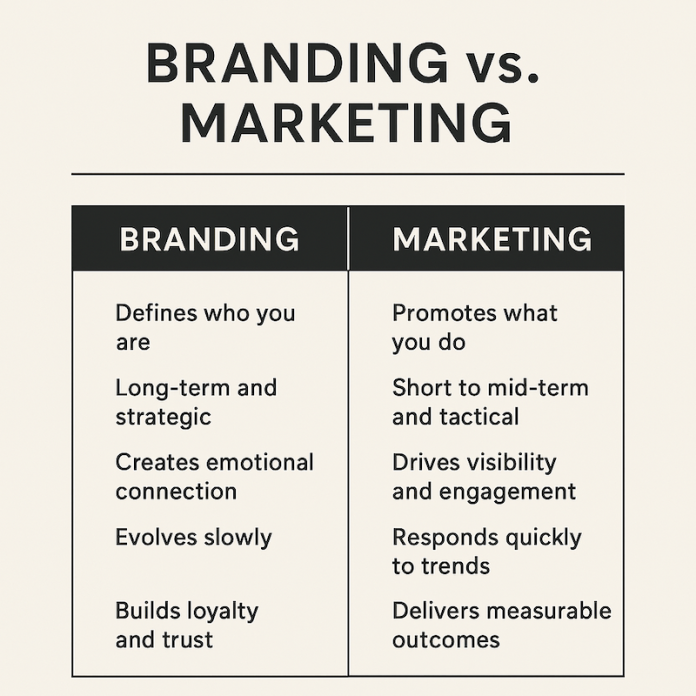
Don’t Confuse Branding With Marketing

In a world where attention spans are short and digital content is everywhere, businesses are under increasing pressure to communicate clearly and connect meaningfully. Yet one of the most common misunderstandings among growing organisations and purpose-led enterprises lies in confusing branding with marketing.

According to Get Published, one of the most common misunderstandings among growing organisations and purpose-led enterprises lies in confusing branding with marketing. This confusion can lead to short-term wins but long-term challenges. Understanding the distinction between branding and marketing and how they work together is vital for building not just visibility, but credibility and loyalty.

Branding: The Foundation Of Trust And Identity

Branding goes beyond design, logos, or slogans. It’s the perception people have of your organisation shaped by what you stand for, how you communicate, and the emotional connections you create over time. It’s a long-term, strategic process that defines who you are and why you matter.

‘Your brand is your promise to your audience,’ said Nadia Hearn, founder of Get Published. ‘It’s what people say about you when you’re not in the room. If you want to build something meaningful that lasts, branding is where it starts.’

While branding can often feel intangible, its role is deeply practical. A strong brand provides internal clarity and external consistency. It helps teams make decisions aligned with values, and it enables audiences to form emotional ties that go far beyond products or services.

Marketing: Driving Awareness And Action

Marketing, on the other hand, is the execution — how an organisation promotes its offerings and engages with its audience in real time. Whether through digital campaigns, email newsletters, press coverage or paid media, marketing’s role is to generate interest, drive conversions, and keep the business visible and relevant.

‘Marketing is where you show up,’ said Hearn. ‘It’s responsive and ever-changing. It helps you meet your audience where they are, but without a strong brand behind it, the message can become diluted or forgettable.’

Marketing strategies often shift based on trends, campaign goals or platform algorithms. Branding, by contrast, is slower to change — anchored in the long-term purpose and personality of the organisation.

When Strategy Meets Storytelling

The most successful organisations understand that branding and marketing are not opposing forces they’re complementary. Marketing might drive someone to click on your ad, but branding is the reason they stick around. Branding inspires word-of-mouth, repeat engagement, and lasting advocacy.

This is especially true for organisations working to make a positive impact. Purpose-driven enterprises are held to a higher standard they must demonstrate integrity, authenticity and clarity. Consistent branding helps meet those expectations, while thoughtful marketing ensures the message is heard.

This strategic balance should be at the core of every campaign. ‘Our work starts with purpose,’ said Hearn. ‘If we understand the values behind a brand, we can help them communicate with impact—whether through media relations, digital content or community engagement.’

The Takeaway

For business owners and key management who want more than quick wins, understanding the difference between branding and marketing isn’t just helpful – it’s essential. Marketing gets your message out. Branding ensures that message is meaningful, memorable and aligned with your values.

As audiences become more discerning, authenticity becomes your most valuable asset. Investing in both branding and marketing – thoughtfully and strategically is what separates noise from resonance, and followers from advocates.

GET PUBLISHED
https://www.get-published.co.za

Brands That Embrace Storytelling With Authenticity Will Build Loyalty

According to Flow Communications, storytelling is fundamental to human nature. It’s theorised that humans first acquired language 20 000-odd years ago and it’s almost certain that since then stories have been told. Storytelling is as primal as our fascination with flame.

There’s science that demonstrates the effect stories have on us. When you hear or see a story, your brain’s neurons activate in the same way as the storyteller’s – a phenomenon called neural coupling.

Also, stories engage more areas of the brain than facts. When a compelling story resonates with us, it triggers the release of oxytocin, a hormone that enhances feelings of trust, empathy and generosity.

If you want brand loyalty in your customers, a good brand story that creates an emotional bond between them and your brand is vital.

Let’s be clear: the story must be about the brand, not its products or services. Things like logos and colours are indicators of your brand, while the brand is the feelings invoked by brand symbols. A brand is something company executives and marketers do not have direct control over. Yup. Sorry, but it’s true.

You do, however, have control of your company ethos – decide what it is, and defend it because over time your products and services emanate from your ethos, as does your staff’s behaviour, even if the kicker for your company to start was, initially, a product or service. You need to live that ethos – and your living it and others experiencing your living it develops your brand. In motorcycles, think Harley-Davidson vs Honda.

Storytelling In The Digital Age

Because humans are storytellers, the best way to convey the ethos of your brand is to show people by telling a story – creating a myth around your brand. A myth is not a lie, but a story that expresses a deeper truth that resonates with your audience.

The best brand stories are used like a golden thread, throughout every one of a brand’s marketing efforts. It’s mythmaking at its best. When you create a myth or legend for your brand, you craft a symbolic and cultural framework for the brand, based on shared values, beliefs and aspirations.

A great South African example of this is Castle Lager. Like all good legends, Castle’s origin story has elements of truth. There was a man named Charles Glass who came to Johannesburg in the late 1800s, during the gold rush, and used his beer-brewing knowledge to quench miners’ thirst.

For a long time, however, his story was all but forgotten until marketers adopted Glass as the brand’s figurehead and the legend was born. The bedrock of the Castle story is the values of what the beer’s brand director, Wendy Bedforth, has described as ‘resilience in the face of challenges, a strong sense of community and what we believe is better defined as ‘courageous optimism’’.

The brand has used these bedrock values as a golden thread wound through its advertisements, but how these values have been conveyed has changed, reflecting social changes within South African society.

This brand story has delivered some of South Africa’s best-loved advertisements, such as the 1998 ad featuring the renowned track Africa by Toto, delivered as many South Africans returned to the country after the end of apartheid as a legislated system in 1994. The advert received awards and critical acclaim from around the world.

How To Craft A Brand Narrative

To craft brand narratives that command audience attention and inspire a deep connection with the brand, you need to decide what you stand for and the values that underpin your brand, and stick by these. The stronger the stand, the stronger the brand. You have to be brave.

Here’s why. When people can readily see what you believe because it shines through every action, they recognise that your brand is authentic. Audiences are increasingly canny about marketing ploys and easy catchphrases – you and all your colleagues must live and breathe the brand.

The Nelson Mandela Foundation promotes the values for which Madiba himself was famous – democracy, equality, social justice and more, with its key objective being finding sustainable solutions to problems that face humanity.

This thread runs through everything the foundation does, from social media posts to the Nelson Mandela Annual Lecture. A strong example of how the foundation takes definite stands on controversial topics is its stance on Israel’s actions in the Occupied Palestinian Territories, especially since Hamas’s 7 October 2023 attack on Israel.

An Instagram post from the Nelson Mandela Foundation on a roundtable discussion the foundation hosted with Palestinian National Initiative leader Dr Mustafa Barghouti. The foundation has taken a strong stance against what it terms genocide perpetrated by Israel against Palestinians in the Occupied Palestinian Territories.

One way to show what your brand stands for is to use real-life examples or employee stories to illustrate the brand’s commitment to its values.

So, ensure that your brand narrative comprises stories that evoke emotions such as joy or excitement, and inspire empathy. The best way to do this is to use vivid images and compelling personal anecdotes. Personalised storytelling can enhance audience engagement by making the narrative more relatable and relevant to individual experiences.

The Good Work Foundation is a non-governmental organisation focused on ensuring that people in rural areas have access to quality, future-focused education. This mission is on show in all of its public-facing communications, and it uses personal anecdotes and compelling images to good effect.

This Instagram post from the Good Work Foundation uses vivid images and compelling personal anecdotes to make its narrative more relatable and relevant to members of the public.

When your brand story is emphasised repeatedly, you create a brand narrative that can significantly increase brand loyalty and engagement because emotions play a crucial role in our decision-making processes.

It goes without saying that the ubiquity of social media platforms has changed how stories are consumed. There are so many ways to spread your brand story, from social media posts to podcasts, and from opinion pieces to your website.

What’s vital is consistency: tell the same story across all the marketing channels you decide to use. In these times, when life is increasingly politicised, even the platforms you pick say something about your brand. As the song goes, ‘Everything counts in large amounts.’

Be Brave

In an age where attention spans are short and competition is fierce, storytelling remains the most powerful tool for brands to grab attention and build a connection with an audience. A well-crafted brand story isn’t just marketing – it’s the heartbeat of your brand, the golden thread that connects your values to your audience’s emotions.

Brands that embrace storytelling with authenticity and consistency will cut through the noise, building trust and loyalty. Be brave, be bold, be true and make every story count.

FLOW COMMUNICATIONS
https://www.flowsa.com/

SA Businesses Should Pay Attention To Commerce Media

Commerce media is advertising that lets retailers build a media business out of their first party data by connecting consumers with their products and services at every step of the shopping journey. Think: sponsored listings on e-commerce sites, personalised offers in your banking app, or shoppable links on your favourite social media platforms. It’s a fast-evolving space, and South Africa is only just beginning to tap into its potential.

‘Retailers may have lit the spark,’ said Daniel Levy, Co-Founder and Co-CEO of Flow, ‘but the most exciting growth is now happening beyond the realms of retail. That’s because commerce media isn’t limited to retail and e-commerce platforms. Banks, insurers, telcos, publishers, even marketplaces – anyone with first-party data – can get in the game.’

Why Now – And Why South Africa?

Globally, commerce media is on a tear, with mobile advertising spend expected to hit $1.3 trillion by 2030 and the global social commerce market projected to reach $8.5 trillion by 2030, according to GlobeNewsWire. Here’s the kicker: non-retail sectors in the US are now growing their commerce media spend at more than double the rate of retail – 34.1% versus 16.2%.

This shift signals something big: commerce media has moved into a new phase – one where any platform with rich first-party data can play, and win. With South Africa’s e-commerce market projected to reach approximately $7.32 billion by 2025, and digital retail expanding rapidly, the time is now.

‘What many businesses don’t realise is they’re already sitting on this first-party data – and with the right tech and strategy, they can monetise it in ways that drive real business results,’ said Levy. ‘Retailers and e-commerce players in South Africa are especially well-positioned to lead this charge – but they need to act fast to capture their share of the opportunity.”

Commerce Media 2.0: It’s Bigger Than Retail

Originally, commerce media lived mostly on retailer and e-commerce websites – sponsored product ads, brand placements, in-platform deals. But Commerce Media 2.0 goes much further, because:

It’s not just for big retailers: Any business can monetise its transactional or behavioural first party data.

It’s off-site: Ads can now appear beyond your own site – on apps, content platforms, social media, or across the open web.

It’s non-endemic: This means you don’t have to sell your product on a commerce platform to reach its audience. Non-endemic advertising lets brands promote products or services that aren’t sold by the platform but are still relevant to the shopper’s journey – like a bank advertising home loans on a property site. This unlocks new revenue for data-rich platforms and helps brands tap into high-intent audiences.

Precision targeting: Targeting is audience-optimised, not only optimised for placement.

Full-funnel measurement: Because commerce media uses first-party data, you can see the full customer journey, from the first ad view to the final purchase. This end-to-end gives you a closed loop measurement so you can really see how your digital marketing performs.

Many of these off-site ads are delivered through programmatic environments – digital spaces where ads are bought and placed automatically using data and technology. This allows brands to reach specific audiences in real time, across a wide range of websites and platforms, with content that’s more relevant and more likely to convert.

In other words, you don’t have to be a retailer to benefit. You just need to understand your audience, have first-party data, and activate it in a way that connects brands to buyers wherever they are.

5 Quick-Fire Facts Every SA business Should Know

Commerce media isn’t retail media. Retail media is a subset. Commerce media is the bigger ecosystem – covering all the ways ads can drive transactions across platforms and industries.

First-party data is your superpower. If you’re a publisher, a financial service provider, or even a telco – you already have the key ingredient: first-party data. Commerce media turns that into a revenue-generating engine.

It works across the funnel. Unlike old-school display ads, commerce media connects with people wherever they are in the buying cycle. That means better targeting, higher ROI, and clear attribution.

It’s growing fast. With reliance on third-party cookies disappearing and data privacy tightening, brands are hungry for high-intent, privacy-compliant audiences. Commerce media answers that call. And South African businesses are already doing it.

Ready to unlock your first-party data’s potential?

If you’ve got first-party data, you’ve got gold. And commerce media helps you turn that value into measurable business impact – whether that’s new revenue streams, better customer experience, or simply better use of your own data.

‘Commerce media is no longer something to watch – it’s something to build,’ said Levy. ‘And the most successful businesses in the next five years will be those that learn to monetise attention, not just content.’

South Africa doesn’t have to play catch-up. In fact, with our mobile-first economy, data-rich platforms, and rising demand for better ROI, we could leapfrog into the next phase of digital advertising.

The Takeaway

Commerce media isn’t just for retailers. It’s for any business with a user base and valuable data. And in South Africa, that includes banks, insurers, telcos, publishers, and platforms of all shapes and sizes. The opportunity is massive – and it’s just getting started.

FLOW
https://flowplatform.com

Informal Drinking Venues Offer Underestimated Route To Market For Drinks Brands

Informal Drinking Venues Offer Untapped Potential For drinks Brands, New Data Shows.

CGA by NIQ EMEA Client Solutions Manager, Abhi Seghal, said taverns and shebeens are often located in the heart of townships and communities and have long influenced consumer behaviour outside of the formal economy. But succeeding in this space requires a nuanced understanding of its distinct culture and dynamics.

‘Informal taverns may not have the penetration of some channels, but there is rich potential for brands to drive trial and loyalty here. Understanding what drives these consumers is essential if suppliers want to unlock sustainable growth,’ he cautioned.

More than half of South Africans who visit taverns and shebeens do so on a weekly basis, positioning these informal venues not just as nightlife staples but as central pillars of everyday social life. With around 14% of South Africans frequenting these establishments, they represent a significant and often underestimated route to market for drinks brands. These findings stem from the latest On Premise User Survey (OPUS) conducted by CGA by NIQ. The research, based on insights from hundreds of South African consumers, sheds light on evolving behaviours and preferences in pubs, bars, and restaurants across the country.

Value Is King, But Premium Has Pull

To achieve this, it’s vital to understand the nuances of these more informal tavern and shebeen outlets. For example, the OPUS research reveals that spending averages R175 per head – R23 below the broader On Premise average. However, while the spend may be lower, consumers are willing to pay for products and experiences they perceive as offering value. According to Sehgal, ‘Value doesn’t mean cheap. It means offering something worth the price – something people are happy to come back for.’

These consumers are also thirsty for new flavours with two-thirds of shebeen-goers (67%) reporting being more likely to try new drinks in these venues, and 68% are open to paying more for a better-quality option. This appetite for experimentation and premiumisation underscores a major opportunity for brands that are willing to innovate.

Afternoon Is The New Primetime

Patterns of foot traffic also differ from traditional bars. Thirty-one percent of visitors frequenting these establishments between 2pm and 5pm, a notably higher proportion than in other restaurant and bar settings. This mid-afternoon window presents a strategic opportunity for brands to engage with consumers or roll out targeted promotions.

The decision-making process in these venues is also fluid. While 54% of visitors arrive with a specific brand in mind, 36% only know what type of drink they want, and 10% remain fully open to suggestion. This highlights the importance of strong in-venue visibility, effective menu design, and staff engagement at the point of purchase.

Operator influence remains strong, with 24% of patrons saying staff recommendations affect their drink choices. In community-based venues where relationships between staff and regulars are common, a trusted endorsement can have more impact than a national ad campaign. These findings all send a clear message: brands that continue to overlook South Africa’s informal drinking venues do so at their own risk. ‘With high-frequency foot traffic, influential staff, and consumers hungry for new and premium experiences, taverns and shebeens are not fringe markets – they’re frontlines. For any drinks brand serious about long-term growth and cultural relevance, understanding and investing in this space is no longer optional, it’s essential,’ stressed Seghal.

CGA BY NIQ
https://nielseniq.com/global/en/

Capitec Challenges Banking Industry Norms With New Campaign

Capitec’s new jingle makes banking fees as easy as 1, 2, 3, 6, 10

Capitec is challenging banking industry norms with its newly launched SimpleFees campaign. The initiative is built around an unforgettable ‘1, 2, 3, 6, 10’ fee structure and a heartwarming jingle sung by the children of Capitec employees, making banking fees transparent and easy enough for anyone, even a child, to understand and sing about.

Francois Viviers, Group Executive: Marketing and Communications at Capitec, said the campaign responds directly to South African Reserve Bank Research, which highlights that while bank account ownership is high at 91%, a concerning 33% of account holders use their accounts merely as ‘mailboxes,’ withdrawing all funds immediately upon deposit.

‘Our client feedback reveals that for too long, high banking costs and complex fee structures have acted as a hidden tax on financial participation. This issue extends beyond fees to essential services like insurance, data, and airtime, eroding South Africans’ trust in these various sectors. When South Africans cannot easily understand or predict the cost of a transaction, they often don’t fully grasp the value they are receiving either.’

In response to the country’s need for clarity and reaffirming its founding principles, Capitec consolidated over 30 distinct transaction fees into straightforward price points. The bank launched a nationwide campaign on 14 April across television and radio platforms to bring this message of simplicity and clarity to life.

At the heart of the campaign is a catchy and heartwarming jingle performed by an unexpected choir – the children of Capitec employees. This unique and joyful approach transforms a typically dry financial subject into something memorable, relatable, and deeply human, powerfully underscoring the core message that Capitec’s fees are now so simple that even a child can understand and sing about them.

‘We are driven by the purpose of making a meaningful difference, and we wanted to strip banking back to its essentials so our clients know what they pay for. This campaign reinforces the fundamentals of simplicity, transparency, and affordability that Capitec is known for. By casting our own employees’ children, we deliver the message effectively and celebrate our Capitec community, their families, and the trust they place in our brand,’ added Viviers.

Viviers said Capitec believes that genuine financial inclusion extends beyond mere account ownership to encompass meaningful participation and active usage. ‘By making banking fees easier to understand and predict, we hope to encourage South Africans to engage more confidently with financial tools, fostering better financial health and contributing to broader economic resilience.’

Viviers concluded, ‘This initiative underscores Capitec’s position as a bank focused on empowering South Africans through understandable, affordable banking solutions. The ‘1, 2, 3, 6, 10’ fee structure and the accompanying campaign signal Capitec’s continued commitment to being the bank for all, making managing money clearer and more accessible. Capitec’s approach challenges various sectors to adopt similar transparency, fostering competition that ultimately delivers better value for all South Africans.’

CAPITEC
www.capitecbank.co.za

One Club Announces African Finalists In ADC 104th Annual Awards

One Club Announces African Finalists In ADC 104th Annual Awards

The One Club for Creativity announced the global finalists in the ADC 104th Annual Awards, including 13 from Middle East and Africa. Founded in 1920, the ADC Annual Awards is the world’s longest continuously running awards program recognizing global excellence in craft and innovation in all forms of advertising and design.

Finalists:

South Africa

BCKRDS Johannesburg has one finalist, for 54 Collective ’54 Collective Rebrand’. Pola Maneli from Port Elizabeth is a finalist for ‘Narrating Slavery’s Wake’ on behalf of The Smithsonian Institute.

Egypt

One finalist each went to Bahia Shehab Cairo for NUART Aberdeen ‘Bear Witness’, and Islam Hassan Cairo for Odoriko ‘Odoriko Logo’.

Saudi Arabia

BigTime Creative Shop Riyadh picked up the country’s three finalists, all for the ring magazine ‘4th Judge’.

Turkey

Both ADC 104th Annual Awards finalists from Turkey went to Sadi Akbudak İstanbul for ‘TUGFO 24’ on behalf of The Turkish National Youth Philharmonic Orchestra.

United Arab Emirates

Publicis Middle East Dubai has all of the finalists from UAE with four, all for Babyshop ‘ColourCheck’.

Globally, Klick Health Toronto has the most finalists with 39, including 18 for Café Joyeux ’47’, and 11 for KVI Brave Fund ‘Voice 2 Diabetes’.

Other top finalists are FCB New York 36, Serviceplan Germany Munich with 29, Apple Cupertino with 22, Rethink Canada with 17, and The New York Times Magazine with 15.

A total of 772 finalists from 40 countries were selected by this year’s esteemed ADC 104th Annual Awards jury. All finalists will win a Gold, Silver or Bronze Cube or Merit, to be announced on May 14, 2025. ADC Gold and special award winners will be celebrated that evening at the gala awards ceremony at Gotham Hall during Creative Week in New York.

Now in its 15th year, Creative Week (May 12-16, 2025) is a premier annual gathering for the advertising and design industries to come together and celebrate the creative excellence showcased in four of the club’s leading global awards shows, and discuss the latest creative trends and issues.

ADC AWARDS
https://adcawards.org/

SA’s Winning Teams To Compete In Cannes Young Lions Global Competition

South Africa’s Brightest Young Creative Talent Announced as Winners of the Cannes Young Lions 2025 Competition
Louise Laas And Khanyisile Modiba, Metropolitan Republic.

Ster-Kinekor, in partnership with Heineken® South Africa, is proud to announce the two winning teams who will represent South Africa at the prestigious Cannes Lions International Festival of Creativity 2025. This year marks the first time South Africa has competed in both the Film and Digital categories, reflecting the country’s growth in driving creativity. 

With only 48 hours to respond to a real-world brief, both teams demonstrated bold thinking, cultural relevance, and world-class storytelling. These exceptional young creatives have earned the opportunity to compete against the best talent from around the world in the highly competitive Young Lions Competition taking place in Cannes, France, from 16 June 2025.

Khomotso Lwazi Makoto And Paula Stephanie Andropoulos – TBWA Hunt Lascaris

Their 60-second commercial brought the power of Ster-Kinekor’s Vision Mission to life with a heartfelt narrative that inspired belief in the power of sight. The judges were impressed by the team’s ability to combine empathy, craft, and cinematic clarity in such a short timeframe.

Louise Laas And Khanyisile Modiba – Metropolitan Republic

The winning digital campaign presented a bold and innovative idea for Heineken® 0.0 and Arrive Alive, addressing the issue of drinking and driving through a positive and digitally driven behaviour change solution. Their 5-slide presentation stood out for its creativity, insight, and potential for real-world impact.

‘The level of talent in this year’s competition was truly world-class,’ said Andrea Quaye, Marketing Director at HEINEKEN Beverages. ‘This marks the beginning of what we see as a long-term investment in creative excellence. We are committed to nurturing this partnership and supporting young talent in the years to come.’

‘The Young Lions Competition continues to be a platform for identifying tomorrow’s creative leaders,’ added Lynne Wylie, Chief Marketing Officer at Ster-Kinekor. ‘We are incredibly proud of these young teams and can’t wait to see them compete on the global stage.’

The winning teams will now embark on a once-in-a-lifetime journey to Cannes, where they’ll join an international community of creative innovators, attend world-class talks, and compete for the coveted Young Lions title.

STER-KINEKOR
www.sterkinekor.com

HEINEKEN
www.heinekenbeverages.co.za

This is Modern Marketing