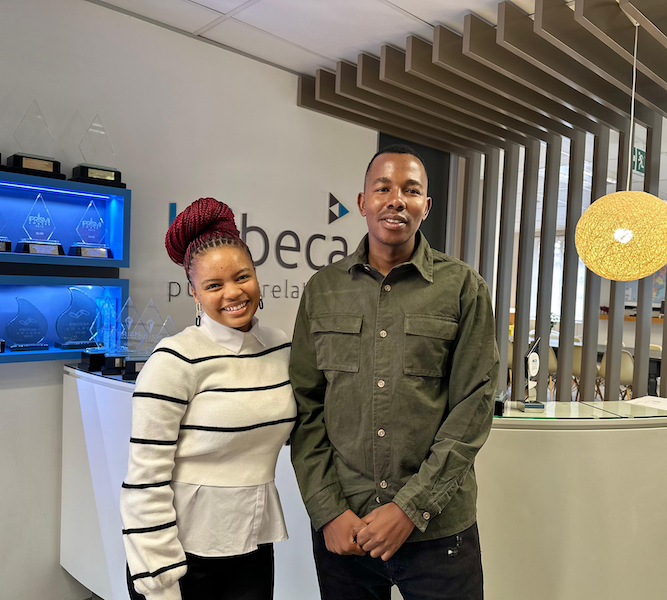
In the spirit of Youth Month and Tribeca’s ongoing commitment to growing the next generation of communications professionals, the agency has welcomed two new interns, Khutso Uoane and Ofentse Motau, to its team.
Uoane and Motau joined Tribeca’s internship programme and bring fresh energy, a love for storytelling and a keen curiosity that is bound to set their careers off to a great start.
‘I’ve always believed that great PR professionals are grown, not born and that starts with creating spaces for young talent to learn and thrive,’ said Kelly Mossop, business unit director at Tribeca. ‘Both Uoane and Motau bring unique perspectives, passion and loads of potential to the team, and we’re thrilled to play a role in their career journeys.’
For Uoane, it was a chance encounter with a PR textbook that changed the course of her studies. ‘I was meant to be studying HR, but something wasn’t clicking. When I stumbled across a textbook titled ‘Public Relations’, I saw a table full of microphones on the cover and something just lit up inside me,’ she said. ‘PR didn’t just find me. It chose me.’
Motau’s path to PR started with a curiosity about how brands exist and grow. Along with his side hustle as a promoter, this led to unexpected lessons in marketing and human connection. ‘Being a mascot at the Mall of Africa taught me how much joy you can bring to others even when people don’t know who’s behind the mask. I knew then that I wanted to be part of something bigger.’
Tribeca’s internship programme is an ongoing commitment to bringing fresh talent into the public relations industry and giving graduates a real chance to learn by doing.
‘Interns at Tribeca don’t just observe from the sidelines. They’re immersed in client work, mentored by experienced teams and are given space to develop their skills in a supportive yet fast-paced environment,’ said Mossop.
Nedbank won the award for Marketing Organisation of the Year.
Endorsed by the Marketing Association of South Africa (MASA), the MAAs stand alone in recognising marketing’s pivotal role in driving business growth, powering the economy, and shaping culture. The winners of the 2025 Marketing Achievement Awards (MAAs) were announced on 29 May at the prestigious Marketing Professionals’ Ball, held at the Sandton Convention Centre Ballroom.
This year’s awards marked a new era for the MAAs, with Primedia Broadcasting joining as Presenting Partner, Brand South Africa as Strategic Partner, and support from Kantar, Old Mutual, Telkom, African Bank, Google, Reveel, and Fresh Advertising and Marketing. Gearhouse came on board as Technical Partner.
The evening itself was a success with South Africa’s marketing elite coming out in their droves to celebrate the winners who included some of the most innovative and game-changing leaders in the profession. For the first time, the category Lifetime Achievement was introduced to honour a person who has made a significant and lasting contribution to the industry throughout their career.
2025 Leadership Awards Winners
Marketer of the Year: Khensani Nobanda
The Marketer of the Year Award recognises an outstanding South African marketer who has delivered innovative marketing, impacted business results, and used their influence to drive the industry forward. This year’s selection committee were particularly impressed with the high calibre of all the finalists.
In recognising Nobanda as the 2025 Marketer of the Year, judges highlighted her unique ability to blend data-driven insight, digital transformation, and purpose-led marketing. Her innovative approach to structuring an agile marketing function and her consistent delivery of tangible results for Nedbank, coupled with her commitment to industry-wide transformation and talent nurturing, set her apart from her peers.
Nobanda’s win was complemented by Nedbank’s award for Marketing Organisation of the Year, recognising their commitment to disruptive thinking, remarkable agility, and efficiency, with impressive metrics demonstrating how marketing directly drives their business success and positions them for continued future wins.
Rising Star of the Year: Jody Ashworth
Ashworth, a Senior Marketing Manager at Discovery, was named the 2025 Marketing Achievement Awards Rising Star of the Year. This accolade is a testament to her strategic foresight, innovative execution, and leadership qualities while managing a strategic portfolio for Discovery Bank. Definitely a young marketer to keep an eye on in the future.
Lifetime Achievement Award: Jeremy Sampson
This year, the MAA was honoured to present the inaugural Lifetime Achievement Award to Sampson — a true icon in the world of marketing and branding. With an illustrious career spanning nearly five decades, Sampson has left an indelible mark on the industry. His exceptional talent, visionary leadership, and unwavering dedication have shaped brands and inspired generations of professionals across South Africa. The Lifetime Achievement Award celebrates Sampson’s extraordinary legacy and the enduring impact he has made on the South African marketing landscape — a fitting tribute to a remarkable career.
This year’s MAA entries, spanning 16 different award categories, were judged by more than 50 industry experts against strict criteria, including the impact of the marketing initiatives on business objectives and bottom-line results. Each written submission was evaluated against specified criteria; the merits of each top-scoring entry were assessed in peer quorums; and in the case of some leadership categories, online interviews were conducted with nominees and their colleagues to understand the finalists and their work.
While other awards often focus on elements of marketing such as communication, the MAAs remain the only programme that recognises and celebrates the entire marketing value chain and its contribution to business success. This is why they remain the benchmark for marketing excellence in South Africa.
Ivan Moroke, Chairperson of the Marketing Achievement Awards, said: ‘In my role as Chairperson, I’m consistently reminded of the remarkable influence marketing wields in South Africa. Our winners and finalists this year truly exemplify how marketing transcends commercial objectives, driving business results, fostering economic growth, and profoundly shaping our society. They stand as a testament to the fact that marketing in South Africa is not only globally competitive but also a vital force for nation-building and positive change.’
The 2025 Marketing Achievement Award Winners
CATEGORY
AWARDED
FOR
AGENCY PARTNER
AWARD SPONSORED BY
Excellence in Purpose Led Marketing Award
SASKO
SASKO Siyasizana: Better Play for Better Tomorrows
MullenLowe
Old Mutual
Excellence in Strategic Sponsorship Marketing Award
Telkom
Telkom, Stand Tall
Levergy
Excellence in Brand Positioning Award
Nedbank
Bank Your Time
Kantar
Excellence in Marketing Innovation Award
Audi South Africa
Audi Curated Collection
Ogilvy
Excellence in New Product or Service Launch Award
ShopriteX
Xtra Savings Plus
99C
Gearhouse
Excellence in Brand Marketing B2B Award
Unilever Professional
Better Clean Better Business – Food Safe Launch
Attic House
African Bank
Excellence in South African Resonance Marketing Award
NikNaks
OwnYourNak
Accenture Song
Brand South Africa
Excellence in Resourceful Marketing Award
Marmite
Election Smear Campaign
Accenture Song
Telkom
Excellence in Reputation Management Award
No trophy awarded *
Excellence in Integrated Marketing Award
Telkom
Telkom, Stand Tall
Levergy
Reveel
Excellence in Internal Marketing Award
Absa
Let’s Write This Story Together
Avatar
Excellence in Digital Brand Marketing Award
Sea HarvestaHar
Fish Friday – Everyone’s Favourite Day
CRT Create
Google
Excellence in Brand Launch Strategy Award
Discovery Vitality
Vitality HealthyFood Relaunch
LEADERSHIP AWARDS
The Marketing Achievement Awards Rising Star of the Year Award
Jody Ashworth
Senior Marketing Manager – Discovery Limited
The Marketing Achievement Awards – Lifetime Achievement Award
Jeremy Sampson
The Marketing Achievement Awards Marketing Person of the Year Award
Khensani Nobanda
Group Executive: Marketing and Corporate Affairs at Nedbank
The Marketing Achievement Awards Marketing Organisation of the Year Award
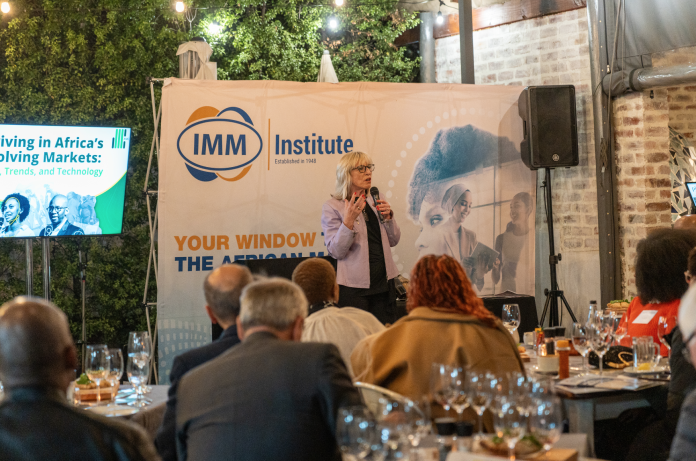
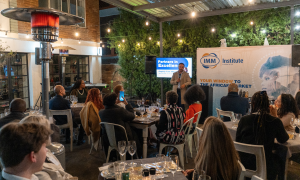
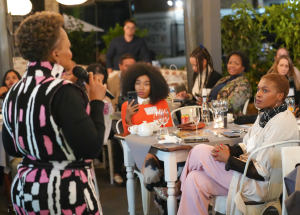
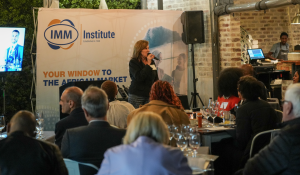
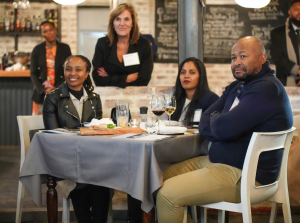
Ahead of the IMM Marketing Excellence Awards, the IMM Institute hosted a Partners in Excellence Event, which is an excellent opportunity for all marketers to mingle with those in the industry who have made significant contributions to the industries of marketing and supply chain management. Modern Marketing is a proud media partner of the IMM Institute.
The event is also a forerunner to the annual African Marketing Confederation (AMC) and Technology Information Confederation Africa (TICON Africa) will be hosting their annual conferences in the tranquil setting of Ghana’s Labadi Beach Hotel.
These Conferences offer marketing and ICT specialists from across Africa the opportunity to engage with other professionals while also providing them with insight to key trends for both disciplines – elevating their knowledge. Sponsorship slots are still available.
As global streaming subscription growth slows, Africa is emerging as a key growth market. Elouise Kelly, Country Manager at Viu South Africa, says in South Africa alone, over 8.4 million people now have access to paid or subscription-based on-demand streaming services, according to the latest MAPS™ dataset (July 2023 to June 2024).
Separately, industry projections estimate that the local streaming market could grow at a compound annual growth rate of around 8% by 2028 – underscoring the strong growth potential of the sector.
But platforms that rely on global playbooks risk missing the mark. Africa needs a different approach – one built on access, adaptability and deep local relevance.
The first and most critical point: Africa is not a single market. Each country comes with its own infrastructure challenges, linguistic diversity, cultural dynamics and economic realities. In South Africa specifically, users toggle between Wi-Fi and mobile data, prefer short-term subscriptions and expect content in their home languages. A one-size-fits-all strategy simply doesn’t work.
It is important to tailor every part of the experience – from content and pricing to language and partnerships – to the rhythms of real life. On a continent where the average consumer is young, price-sensitive and digitally savvy, streaming services must be flexible, affordable and relevant.
Affordability And Access Shape User Behaviour
In many African markets, affordability remains a key barrier. Consumers here are practical and value-conscious. They’re not just looking for entertainment – they’re weighing every rand. Hybrid models that combine free, ad-supported content with the option to pay for added benefits are striking the right balance.
Free platforms often serve as the first point of entry, especially in lower-income or unbanked segments. But retention hinges on value: users expect content depth, a seamless experience, and payment flexibility like daily or weekly subscriptions. This flexibility mirrors how streaming fits into people’s lives. Users dip in and out based on affordability, content preference or life circumstances. There’s no guaranteed stickiness – and that’s okay. The challenge is keeping the door open and the value clear.
Data costs are another major factor. Even in relatively mature markets like South Africa, data is expensive. This is where telco partnerships matter. Bundled offers, data-inclusive streaming and zero-rated content can make the difference between reaching new users – or not.
Partnering with local mobile networks to offer data-inclusive bundles and low-cost daily subscriptions helps reduce the friction of streaming for price-sensitive users. For many, access depends on affordability.
Ad-Supported Streaming Is More Than A Model – It’s A Growth Engine
Ad-supported video on demand (AVOD) isn’t a fallback. It’s a smart, scalable model for growth in Africa. It opens the door to new users while creating opportunities for advertisers to connect with a highly engaged, mobile-first audience. And as advertisers look to connect more meaningfully, innovative ad formats – like interactive or mobile-first placements – are gaining traction, helping brands deliver richer, more engaging experiences in these markets.
What’s often overlooked is how brand-conscious and aspirational these audiences are. While they may not fall into high-income brackets, they’re deliberate in their choices and responsive to messaging that reflects their values. This isn’t a passive viewer base – it’s one that responds to local languages, cultural cues and real relevance.
Advertisers, too, need to shift their thinking. These audiences aren’t a downgrade from higher-income subscribers. They’re the future: young, digitally native, fast-growing and smart in their ability to stretch their rands far. Platforms that offer them compelling content and frictionless access will win, and so will the brands that show up meaningfully within those spaces.
We’ve seen across emerging markets that AVOD – particularly when paired with subscriber video on demand (SVOD) as part of a hybrid model – works, if it’s supported by content people care about, flexible pricing and intuitive, mobile-first experiences. It’s not about retrofitting premium SVOD strategies for budget-conscious markets. It’s about building smarter, more inclusive ones from the ground up.
Africa’s Stories, Africa’s Pace, Africa’s Rules
Africa’s streaming audience is ready. Infrastructure is improving, smartphone penetration is high, and cultural pride is growing. What’s missing is more investment in African stories – told by African voices, in African languages, across genres that reflect everyday life.
With artists like Wizkid (Nigeria), Angélique Kidjo (Benin) and Tyla (South Africa) gaining global recognition, music has shown that Africa’s creative industries can travel. Video is next. But we need more than one-off productions. We need ecosystem commitment: writers, editors, dubbing artists, translators, marketers. This isn’t just content – it’s jobs, growth and influence.
Africa isn’t ‘catching up.’ It’s following a streaming blueprint shown to resonate in emerging markets: mobile-first, culturally grounded and powered by flexibility.
Tractor Media Holdings (TMH) has rebranded to the Glynt Group. More than a name change, the rebrand marks a strategic shift, positioning the group as a unified, future-facing media and innovation hub designed to shape the next era of brand engagement.
TMH was established in 2023 through a partnership with investment firm Hlayisani Capital, bringing together high-growth ventures like Tractor Outdoor, Polygon, Billboard Management Technologies (BMT), Mischief Media and Innovocean.
Conceived to scale and streamline this growing portfolio, TMH served as the holding structure for a collection of businesses already reshaping South Africa’s media landscape. But as the business evolved beyond its media roots, the need for a cohesive identity became clear.
‘This rebrand marks the natural evolution of our business,’ said Simon Wall, Group CEO at Glynt. ‘We’re no longer just a collective of successful media companies – we’re a connected ecosystem built on innovation, intelligence and creativity. Glynt gives us the identity and cohesion to reflect that.’
The name Glynt – a play on ‘glint’, meaning a flash of insight or clarity – was chosen to reflect the company’s role as a sharp, bright spark in a fragmented media landscape. As the group deepens its focus on data, tech and innovation, the rebrand signals a broader mission: to partner with brands seeking more meaningful, measurable engagement, said Wall.
The shift from TMH to Glynt also reflects the group’s internal transformation – from a collection of standalone companies into a synchronised ecosystem. While Tractor Outdoor remains a key pillar, the Glynt brand now extends across all operations, offering clients a seamless experience underpinned by a single mission, vision and set of values.
‘With Glynt, we have a name and identity that integrate our group across disciplines, said Wall. ‘It’s more than a new look – it’s a mindset shift.’
This ethos is captured in Glynt’s new positioning: ‘From many to one’. Whether clients engage through outdoor campaigns, programmatic buying or tech-led strategy, the experience is unified and anchored in quality, creativity and intelligence.
Glynt’s strategy is centred on the integration of marketing, intelligence and influence – a proposition built for scale, speed and agility. The brand’s visual identity reinforces this: crisp logomarks, a bold contemporary palette, and a confident, human tone of voice.
Designing the Glynt brand system was about more than aesthetics – it was about creating clarity. From internal documents and pitch decks to its redesigned website and social channels, the brand expresses momentum and transformation. The creative identity also helps Glynt stand apart in a cluttered media landscape.
‘This rebrand is about unlocking new potential, Wall concluded. ‘With Glynt, we’ve created a brand that better reflects who we are, what we do, and where we’re headed. We’re now in a strong position to drive growth and impact across our portfolio – supported by a group identity that brings our values to life.’
Kneo Mokgopa and Willem Steenkamp from Flow Communications state that ever since humans have been capable of language, misinformation (the unintentional spreading of untruths) and disinformation (the intentional practice of doing so) have existed. There has never been a time before falsehood.
The inventions of the printing press and mass media exponentially amplified the reach of publications, which would sometimes carry untrue statements and opinions presented as fact, as well as propaganda.
With the rise of the internet and social media in the past 30 years, many scholars have argued that our very understanding of knowledge itself has shifted. Our relationship with the ‘truth’ has become increasingly interwoven with identity, culture and politics.
The distinction between producers of information (journalists, academics or documentarians, for instance) and consumers has more or less fallen away as everybody has been given the opportunity to produce content and information for mass consumption, while algorithms have incentivised the production of sometimes egregiously sensationalist content.
We now exist in an environment that, arguably, encourages misinformation and disinformation, which are often motivated by political or economic gain, popularity or even vendettas.
At Flow Communications, these thoughts are always top of mind. We are paid to produce original work that fulfils our clients’ marketing and communication objectives, and at all times we must be ethical, embrace truthfulness and, perhaps most importantly, never cause harm.
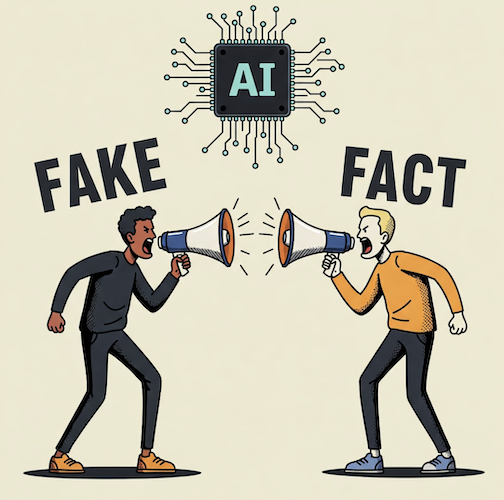
Most recently, the rise of artificial intelligence (AI) has supercharged our capacity to produce untruths. Information reliability analyst NewsGuard has identified at least 1254 ‘news’ sites that regularly publish misleading, AI-generated content that is convincingly presented as fact. Simply put, AI has given us the ability to easily produce falsehood at scale and distribute it en masse.
Thinking about the ‘truth’ we are now in an age of myth. Reading or consuming content feels more and more like poring over ancient maps, where unexplored territories are marked with illustrations of dragons. And as AI becomes more and more advanced, it has become increasingly challenging to discern fact from fiction. It seems like nothing is indisputable.
Even institutions whose currency depends heavily on truthfulness are not immune. Take a startling recent matter in the Pietermaritzburg High Court, Mavundla v MEC Department of Co-operative Governance and Traditional Affairs and Others, where a candidate attorney in the plaintiff’s legal team used AI to produce a list of nine legal citations.
Problem is, seven of the nine citations were entirely fictitious (including case numbers and non-existent judges). That the legal team did not cross-check the citations is problematic, as attorneys have a duty of candour to the court (i.e. they must speak truth) and courts habitually take them at their word.
The Mavundla matter is a classic example of misinformation: the candidate attorney’s intention had not been to mislead the court, and she had believed (somewhat carelessly) that the citations were true.
Now to disinformation. We decided to see for ourselves if we could prompt AI to produce intentionally false information for us. For it to be ‘proper’ disinformation, we set these criteria: it should contain a hint of truth (to be believable), have a local connection and be current, and be difficult to fact-check.
So we picked the topical issue of US President Donald Trump (and others) declaring – falsely – that white Afrikaner farmers face genocide in South Africa and are deserving of asylum in his country. On the first go, we got right-wing content; so we asked for more bias, and we hit paydirt.
‘The global left continues to turn a blind eye to the systematic persecution of white Afrikaners in South Africa. But thankfully, the Trump administration has had the courage to speak out against the genocide being carried out against South Africa’s white population, particularly its farmers,’ it began.
This met all of our criteria. It is false, but contains a modicum of truth. It has a local connection and is current, and it is difficult to pin down facts – the SAPS stopped reporting specifically on farm murders in 2007.
So what can we humans do to not be fooled, whether by inadvertent or deliberate lies? There are several practical things to consider:
– AI easily parrots human lies or invents ‘facts’: always do your own research, and check everything.
– AI may sound like it, but it is not a journalist: beware, though – 28% of journalists worldwide use generative AI to produce their copy.
– AI has a ‘fingerprint’: generative AIs produce content in their own way – and it’s easy to spot.
– Visuals can be giveaways: always view imagery and video with a jaundiced eye.
– Attribution: this is a must-do, but few AIs actually report their sources.
You don’t need to be a dragon-slayer to navigate our world of uncertain information. But you do need to keep your wits about you, be sceptical of everything you see and hear, and canvass a wide range of sources to arrive at something approximating ‘truth’.
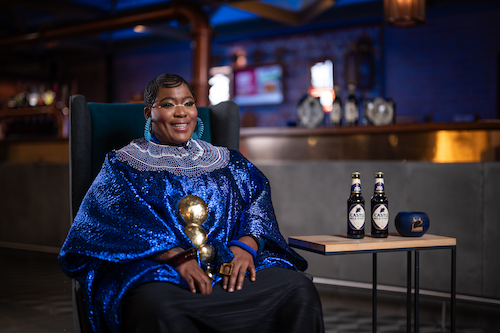
Castle Milk Stout, in partnership with renowned musician and cultural voice Thandiswa Mazwai, has reaffirmed its long-standing commitment to ancestral heritage following the observance of Ancestors Day earlier in May. While the official date of Ancestors Day was marked on 8 May, the brand’s campaign continued throughout the month as part of its broader purpose to preserve African traditions and foster national pride in cultural identity.
The 2025 campaign strategy focused on storytelling through digital platforms as a way of ensuring that the current generation preserves the knowledge passed down by Ancestors and ‘don’t let their stories disappear’, with a central role played by Mazwai. The artist, who has long used her music as a medium for cultural reflection, partnered with the brand to engage audiences on the meaning of memory, legacy, and the power of traditions in shaping self-identity.
The 2024 Sankofa tour, supported by Castle Milk Stout, not only marked the 20th anniversary of Mazwai’s landmark debut album Zabalaza, but also set a precedent for the brand’s long-term commitment to cultural preservation — using storytelling and music to honour the past while engaging contemporary audiences.
‘I lost my mother when I was very young and much of my life has been about this loss and what home has meant without her, what my own story means without a mother,’ said Mazwai. ‘So of course, much of my life’s journey has been around preserving her memory and her story. Ordinary people have such important and interesting lives and families should always pass down their stories for posterity.’
The campaign, housed under the creative platform Don’t Let Their Stories Disappear, invited South Africans to publicly share memories, praise songs, family names, and ancestral rituals. These shared stories were curated across social platforms in an effort to build a living archive of African memory — accessible, decentralised, and rooted in community.
For Castle Milk Stout, this campaign is not a once-off communication exercise, but part of a long-term mission to embed ancestral knowledge in the national consciousness. It is built on the recognition that African spirituality has often been excluded or marginalised in formal settings, and that culturally-specific rituals remain underrepresented on the country’s calendar of national observances.
‘By staying connected to their stories, their teachings and what gifts they leave behind in the bloodline and in the world,’ said Mazwai, when asked how she personally honours her ancestors.
Reflecting on her work, Mazwai shared: ‘Over time I have also realized that my work has done the work of bringing joy and healing to those who engage it deeply. I use my work to celebrate African languages, heritage and knowledge systems. Through the use of traditional instruments, I attempt to bring the ancient into the contemporary as a way of visualising future worlds.’
‘Our support of Ancestors Day is about more than awareness — it’s about affirmation,’ said Hetisani Makhubela, Brand Manager for Castle Milk Stout. ‘In a country where many South Africans still feel the need to defend or explain their cultural practices, Castle Milk Stout continues to create platforms that recognise ancestral knowledge as a legitimate, dignified, and powerful part of our identity. Our collaboration with Mazwai is a testament to the role artists play in reflecting truth, translating history, and sparking dialogue.’
Makhubela added that while policy discussions to formally recognise Ancestors Day as a public holiday remain ongoing, the cultural impact is already evident. ‘We’ve seen real shifts in how people engage. We’ve seen individuals pour One For The Ancestors on the 8th of May not because they were told to — but because it matters to them. That’s progress.’
In addition to storytelling, the campaign also sought to educate younger audiences about the significance of rituals that are often passed down without explanation — including the role of clan praises (izithakazelo), spiritual initiation (ukuthwasa), and the symbolism of ancestral calling in dreams and daily life. These practices are not only spiritual anchors; they are repositories of indigenous knowledge that Castle Milk Stout believes must be protected.
‘As we reflect on Africa Month, we must remember that pan-Africanism doesn’t only mean continental unity — it also means remembering where we come from,’ said Mazwai. ‘This campaign invites us to take that memory seriously. To speak the names. To ask the questions. To remember.’
For years, digital advertising has followed the same pattern: run a campaign, target an audience, track performance, report on ROI, then rinse and repeat. So, what’s wrong with that? According to Theo Visser, Head of Sales at Flow, it’s a lost opportunity.
‘The truth is, performance often improves the longer you engage your audience. You gain more insight. Meta and Google’s algorithms get smarter. Your messaging gets sharper. Your spend becomes more efficient.’
Yet, most advertisers start from scratch with every campaign. And when a campaign ends, the insights often disappear with it. Brands are left back at square one, guessing how to reach their ideal customer.
‘This short-term approach doesn’t just waste time and budget,’ said Visser, ‘it wastes a far more valuable opportunity: the chance to build out a long-term audience strategy and grow your retargeting pool.’
Why Always-On Audience Targeting Matters
The good news? There’s a far more sustainable, scalable approach: always-on targeting through high-intent, first party data audience segments. These are dynamic audiences you can plug into your campaigns at any time – not just during peak seasons or for particular campaigns – to help build a robust audience targeting and retargeting strategy.
So, Where Do You Find These Audiences?
You can start with your own first-party data, tap into data from other businesses through a data marketplace, or – most effectively – combine the two. Layering audiences in this way creates a powerful and precise targeting strategy.
For example, many brands can use a specific marketplace to try different audiences from different sectors, depending on their campaign objectives. ‘This gives them plug-and-play access to a range of first-party audience segments based on real behaviours and signals of intent – not guesswork. It’s all about flexibility and control, while tapping into targeting that actually works.’
And this kind of targeting does work, with commerce media pulling spend away from the traditional giants, and retailers and platforms increasingly using their own first-party data to offer advertisers precision access to consumers. ‘Brands are simply realising that their budget goes further when their targeting is sharper.’
From Rented Reach To Recurring Results
Rayhaan Williams, eComplete.
To truly shift from short-term campaign mode to raising your Customer Lifetime (LTV) metrics in the long run, brands need more than just tools – they need a mindset change.
Rayhaan Williams, Head of Digital Marketing at eComplete, said the first step is classifying campaigns by objective. ‘You need to separate evergreen activity from tactical promotions, and understand how each campaign contributes to your overall audience pool.’ Williams recommends tagging audiences and campaign categories consistently and tracking user journeys across the funnel – not just when they convert.
This isn’t just another round of targeting based on age, gender, or broad demographics. It’s precision targeting, driven by real user intent. In fact, it isn’t about just targeting – but also learning.
‘When you build an audience strategy that evolves over time, you start to uncover powerful insights: what channels drive the most valuable customers, how long it takes new leads to convert, and where your biggest drop-offs happen.’
Ideally, what brands need is continuous access to fresh, relevant audiences, so whether they are running a brand awareness push, a new product launch or a conversion campaign, they’ll have a relevant, high-intent audience, as well as the ability to learn and refine as they go.
What Brands Can Do Now
Stop thinking short term. Using custom audiences isn’t one-and-done. Consistent engagement and iteration pays off.
Map your campaign categories. Different campaigns need different strategies, and should all feed into a bigger audience picture. Align your different campaign types to specific audiences.
Tap into data marketplaces. Platforms can give you access to robust, high-intent audiences that you can slice, dice and layer to create fully-customised segments that align with your exact targeting goals.
Glean from every campaign. Consider measurables like churn, return rates, and time to purchase to better understand the consumers you most want to reach.
Invest in a robust retargeting pool. When you run campaigns like this, you start to build a very valuable retargeting audience based on real insights and results. Leverage this knowledge to make your next strategic move.
Looking Ahead: A Smarter, More Agile Future
So where does digital advertising go next? According to Visser, we’re entering a more dynamic and decentralised era: ‘AI is already changing how people search and navigate online. Big platforms like Meta and Google know this – they’re adapting fast to stay relevant. But at the same time, commerce media is rising, offering brands better ROI and more precise targeting.’
In this changing landscape, it’s never been more important – or more possible – to deliver a user experience that’s truly relevant and personalised. And how do you do that? By meeting your customer at the right time and place, with a message that’s meaningful to them.
The best first step? Know your ideal audience, said Visser.
‘The future of targeting lies not just in using first-party data audiences for once-off campaigns, but in building long-term, first-party data audience strategies. Brands that want to stay competitive need to start experimenting now.’
Ryan Nofal, Co-Managing Director of Penquin, says Generation Alpha, a digitally native generation born from 2010 onwards, is already shaping household purchasing decisions and redefining what it means to be brand-loyal.While many brands are still trying to figure out how to authentically engage with Millennials and Gen Z, marketers are urged to shift their attention to the next wave of consumers: Generation Alpha.
‘Generation Alpha may still be in school, but don’t underestimate their power,’ said Nofal. ‘They are the most tech-immersed generation we’ve seen. Their exposure to content, trends, and information is unprecedented – and that means their influence is real, even at a young age.’
With access to devices from early childhood, Gen Alpha has grown up interacting with brands on YouTube, TikTok, and gaming platforms like Roblox and Fortnite. This means their expectations for content are high – and their tolerance for inauthenticity is low.
‘Brands that want to stay relevant in the next five to ten years need to understand how to speak Gen Alpha’s language now,’ Nofal added. ‘They crave experiences, they value creativity, and they’re incredibly brand-aware – often more than we give them credit for.’
Engaging with Gen Alpha requires a future-focused approach: investing in immersive storytelling, interactive platforms, and authentic brand values that reflect their worldview.
‘They’ve grown up watching their older siblings challenge the status quo and advocate for social issues. so Gen Alpha comes pre-programmed with a voice – and they’re not afraid to use it,’ Nofal continued. ‘If brands don’t start paying attention, they risk losing a generation before the race has even begun.’
However, with this awareness comes an important responsibility: marketing to children must be handled with care. Brands should avoid exploitative tactics and instead focus on ethical, age-appropriate communication.
‘Just because you can reach a young audience doesn’t mean you should do it without intention and integrity,’ Nofal cautioned. ‘We have a responsibility as marketers to protect young minds while also engaging them. That means transparency, honesty, and respecting their developmental stage.’
We encourage brands to take a values-led approach, prioritising education, empowerment, and positive messaging when engaging with Gen Alpha audiences. ‘This generation is growing up fast, but that doesn’t mean they’re ready for adult messaging,’ Nofal continued. ‘Responsible marketing isn’t just good ethics — it builds long-term brand trust with both the kids and their parents.’
We also encourage brands to think beyond traditional advertising and start crafting strategies that include co-creation, gamification, and digital-first content tailored for this savvy, socially-conscious audience.
‘Generation Alpha isn’t just the future – they’re the now,’ Nofal concluded. ‘Smart marketers won’t wait for them to grow up. They’ll start building relationships today.’
Janette Hartman, Microsoft Advertising South Africa, InMobi Advertising.
As consumer expectations evolve and generative AI reshapes the digital landscape, marketers must rethink strategies, embrace innovation, and stay ahead of the curve. Microsoft Advertising and InMobi Advertising explore the key trends redefining how brands connect, engage, and grow.
South Africa’s digital advertising market is set to hit $816 million by 2026 (Statista), creating a powerful growth opportunity for marketers. Microsoft alone saw a 95% increase in clicks in the country in 2024 compared to 2023. With consumers now firmly rooted in digital ecosystems, brands must rethink how they connect – with seamless, consistent, and personalised experiences across platforms and devices.
‘Today’s consumers move smoothly across channels, and they expect their experiences to be just as smooth and consistent, especially when they engage with brands,’ said Janette Hardman, Country Head – Microsoft Advertising South Africa, InMobi Advertising. ‘For marketers, this is the moment to tap into emerging technologies and trends to reach, engage, and convert more effectively.’
AI-Powered Hyper-Personalisation: The New Era Of Consumer Connection
Today’s consumers demand experiences that are not just relevant, but hyper-personalised. With AI tools, marketers can now deliver deeply curated journeys that feel more like conversations than marketing communication. Innovations make it possible to engage audiences in real time, with content and experiences that resonate.
‘Personalisation has always been a priority. But now, with real-time insights and intelligent targeting, we can deliver on that promise at scale,’ said Mike Luscombe, Director – Partner Sales, EMEA and LATAM, Microsoft Advertising. ‘In a market as diverse as South Africa, that level of relevance becomes a real competitive edge.’
Mike Luscombe, EMEA & LATAM Microsoft Advertising.
Advanced AI and analytics enable brands to go far beyond demographic targeting, tapping into user behaviour, preferences, and context to drive engagement.
‘The shift is clear. Personalisation starts with the consumer. Brands must embed themselves in that journey,’ said Jacob Joseph, Head of Business – Middle East, Turkey and Africa, Microsoft Advertising at InMobi Advertising. ‘We’re seeing a powerful transformation, where marketers can finally forge true, one-to-one connections.’
Jacob Joseph, InMobi Advertising.
As AI becomes more powerful and accessible, the battle for consumer attention will be won by brands that prioritise authentic, data-driven experiences.
Omnichannel Connections
Today’s consumers shift between gaming, email, apps, social media, and search seamlessly and often within minutes across multiple devices. This behaviour is dissolving traditional channel silos and accelerating the need for true omnichannel strategies.
‘Omnichannel ensures advertisers can meet customers wherever they are, across devices and platforms,’ said Luscombe. ‘Smart marketers are building strategies that stay consistent while adapting to each channel’s unique context.’
The Power Of First-Party Data
‘We’re seeing a shift toward permission-based marketing that goes beyond compliance. It builds trust and long-term relationships,’ said Joseph. ‘Technologies that enable precision targeting in a privacy-compliant manner are now indispensable.’
Additionally, traditional ad formats are being replaced by engaging and interactive experiences. From playable ads and AR to video, immersive content is proving far more effective at capturing consumer attention. For instance, video ads are likely to get 6x higher engagement than traditional static ads.
‘Static mobile ads still have their place, but nothing beats advertising that entertains and involves the audience,’ added Hardman. ‘Brands that embrace immersive formats see significantly higher engagement and recall.’
For forward-looking marketers, the future lies in combining trusted data with rich, dynamic formats to deliver campaigns that don’t just reach — they resonate.
What This Means For South African Marketers
South Africa’s digital ad landscape is evolving rapidly, driven by hyper-personalisation, immersive formats, omnichannel reach, and a growing emphasis on privacy-first strategies. For marketers ready to take the next step, here is how to translate these shifts into action:
1. Start With Smarter Data Strategies
First-party data is the foundation of effective targeting. South African brands should double down on building their own data ecosystems by turning to privacy-compliant sources and local insights to deliver contextualised, personalised campaigns.
‘It’s not just about reaching audiences. It’s about understanding them deeply and respectfully,’ said Joseph.
2. Experiment With Immersive Ad Formats
Interactive experiences are redefining engagement. Test new formats early and often. They outperform traditional banners and help brands connect in more memorable ways.
‘Entertainment and utility are the new attention-grabbers,’ added Hardman.
3. Think Omnichannel, Act Contextually
Consumers in South Africa, like everywhere, are multitasking across platforms. ‘The right message, at the right time, in the right environment: that’s the formula,’ said Luscombe.