Home Blog Page 41

Your Communication Needs To Be Authentic And Relatable

Your Communication Needs To Be Authentic And Relatable

According to Sue Blaine, Flow Communications senior writer and editor, does it feel as though the only way to get your message across these days is to grab people’s attention by ‘hopping on a trend’ or producing something fast and flashy? Not so fast.

You need to follow up on that attention-grabbing gambit with some substance or you risk viewers simply moving onto the next message that is demanding their attention. To convert interest into partnership you need to work to build trust and, as in life, solid relationships are what we want in business.

Customer loyalty is the gift that keeps on giving, through repeat business, referrals and enhanced brand reputation and credibility. Building a relationship helps you understand customer needs, which leads to improved products and services, ultimately leading to a stronger competitive advantage.

Business-to-business (B2B) brands’ communication requirements are even more exacting and technology can help you get your message in front of the people you want to reach. But to craft messages that help you build a solid relationship with your chosen audience, you need to ensure your communication is authentic and relatable.

For example, working with Flow Communications, the Oppenheimer Memorial Trust (OMT) more than doubled its LinkedIn following organically in 2025, gaining more than 2 000 new followers. The philanthropic grantmaker has gained high engagement with its posts, many of which are long, with many others reposting them.

Flow’s work with the OMT is based on a careful strategy that pinpointed LinkedIn as the optimal social media platform for the organisation to communicate with its desired audiences.

And that illustrates an important point: when plotting a strategic communications strategy for an entity, the first step is to think carefully about who you want to reach, why reaching them matters and what action you want your audience to take. Pick your platform (not just social media!) according to these three parameters. Communication that delivers real results isn’t a magic trick, it’s an honest conversation.

While technology helps you get your foot in the door, it is the commitment to delivering authentic value and addressing audience pain points that converts clicks into lasting partnerships. In a noisy digital world, we have found that authenticity is the only currency that buys true customer loyalty.


FLOW COMMUNICATIONS
www.flowsa.com


Why Being Relentless Is So Critical In Business

Why Being Relentless Is So Critical In Business
John Tschohl, Service Quality Institute

John Tschohl of the Service Quality Institute writes why being relentless in serving customers will increase income stream and forge a path to success. If you are going to be relentless in serving your customers, you must first understand the meaning of that word.

Relentless is an obsession with providing exceptional service to your customers. It’s a propulsive, self-directed passion to continue to learn, to improve, and to consistently exceed expectations in everything you do, and it never stops.

I have two rules for being relentless. The first is to serve the customer. The second is, when in doubt, see rule number one. Serving your customers must be a belief and commitment that is shared by everyone in your organisation, from the front line to the board room. It’s about making extraordinary customer service a central strategy for your company.

Why is being relentless so critical? Because it builds an organisation’s bottom line and its long-term growth prospects. It’s your path to success, and it should be a way of life for your organisation going forward. It can’t be an add-on; it has to be part of your organisation’s culture.

Let me give you an example of relentless customer service. A man left his chequebook on the desk of a customer service representative at Metro Bank London. When that employee noticed it, he called the customer, who said he would stop in the following morning to pick it up. The employee said he would deliver it to the customer, even though it was then 8pm.

The customer said he was at a nearby pub with 10 friends. The employee delivered the chequebook, and the customer sent him an email the following morning saying that his friends were so impressed with the bank’s service that they were all going to open accounts at the bank. This a perfect example of how being relentless not only keeps your current customers but also attracts new customers, and their money.

Service recovery is a key element in being relentless. When a customer has a complaint, you should do everything possible to quickly solve the problem and keep that customer coming back to you. You can’t do that unless you empower your employees by giving them the authority to make decisions in favour of your customers. You must train all of your employees and trust them to do what’s necessary to keep those customers. That includes compensating customers for any problems they have with your products or services.

All too often, managers and executives fear their employees will ‘give away the store’, if they’re empowered to make decisions when customers have complaints. An empowered employee might give a disgruntled customer a small rebate. That’s a small investment when you consider that that satisfied customer will spend hundreds, if not thousands, of dollars with you in the future.

Another important key to being relentless is to use technology at every level to smooth the point of entry for the customer and to quickly connect them with the products or services they need. Amazon is a prime example of combining technology with personal contact to keep and attract customers. Do everything you can to make it easy for customers to do business with you. Remember this: The best way to sell is to make it convenient to buy.

Everything you do must revolve around the conviction that customers rule. You must put their needs at the forefront of everything you do.

SERVICE QUALITY INSTITUTE
https://johntschohl.com/

Airport Ads Illustrate Lucrative Advertising Opportunities At Lanseria

Airport Ads Illustrate Lucrative Advertising Opportunities At Lanseria

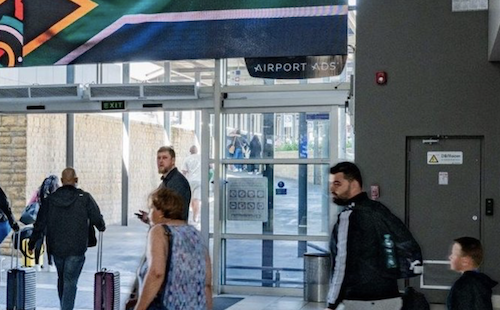
Johannesburg’s Lanseria International Airport (Lanseria) is on an upward trajectory. Passenger movements reached 135,732 in July last year alone, up 5% on the previous month, with steady growth projected as infrastructure expands, making it a location where brands can secure visibility in an uncluttered, premium environment.

Its catchment is already one of the most valuable in the country, from business executives from Sandton and Bryanston, upwardly mobile families from Gauteng’s north, and increasingly, premium leisure travellers planning getaways.

Unlike sprawling mega-hubs, Lanseria offers a contained footprint where advertising formats are impossible to miss. Airport Ads, the sole media partner at Lanseria, brands can secure visibility in an uncluttered, premium environment that is growing in both passenger volume and profile.

The Passenger Journey

Mzukisi Deliwe, head of Airport Ads, said this is the moment for brands to establish themselves at Lanseria.

‘As traffic grows, the brands that secure space now will enjoy first-mover advantage in a high-demand, tightly controlled environment. With exclusivity, there is no clutter, only targeted, impactful visibility.’

The media offering is built around the passenger journey. Digital billboards deliver instant impact at arrivals and departures; large-format billboards dominate key areas with high dwell time, ensuring standout moments of brand recall; and Airport.TV, broadcasting news, weather, sports and travel tips, creates a rhythm of repeated engagement across waiting areas, lounges and gates.

Deliwe explained, ‘Passengers don’t just see a brand once. They encounter it multiple times along their journey. That continuity builds recognition and intent and because we can measure impressions, dwell time and frequency, CMOs know exactly what value their campaigns deliver.’

Travel Rebound

Global travel is surging. The International Air Transport Association (IATA) reports that worldwide traffic has already exceeded pre-pandemic levels, growing more than 4% year-on-year.

In South Africa, ACSA recorded an 11% increase in July 2025, with international volumes up 14%.

Lanseria mirrors this rebound while carving out a unique growth path. Massive investments, from a R250 million multi-storey parkade to the coming Taxiway Alpha, enabling larger jets, are transforming its infrastructure and extending its reach.

The planned Lanseria Smart City will amplify demand further with housing, hotels, retail and commercial precincts feeding into the airport ecosystem.

Evolution Of Airport Advertising

Airport advertising has evolved beyond broad visibility. With advanced audience tools, campaigns at Lanseria can now be tracked in detail: reach, frequency and dwell time are all measurable, providing the kind of accountability marketers expect from digital platforms.

‘Airports are structured to create natural windows of attention. Queuing, waiting at gates, and collecting baggage, these pauses are powerful touchpoints. At Lanseria, we’ve designed the estate to capitalise on every one of them,’ explained Deliwe.

AIRPORT ADS
https://airport-ads.com

Major Shifts That Will Impact Marketers In 2026 And Beyond

Major Shifts That Will Impact Marketers In 2026 And Beyond

2026 will see a move toward an agent-to-agent economy where autonomous systems assist in negotiating value. And, while customers remain human, their purchasing decisions will increasingly be guided, filtered, or executed by a digital proxy. To stay competitive, marketing will require a strategic restructure.

‘We stand at the threshold of the ‘Agentic Turn’, a shift as significant as the dawn of the Internet. Unlike previous eras that digitised business to serve human needs, this phase asks us to bridge human intent with machine execution,’ said Jacques van Niekerk, Group CEO, Incubeta.

Incubeta has published its 2026 Marketing Outlook, identifying six trends driven by AI advancements. The playbook, titled ‘Tomorrow’s World,’ analyses major shifts in consumer behaviour, measurement, and technology infrastructure that impact marketers in 2026 and beyond.

Trend 1 – AI Is Collapsing The Consumer Journey

AI-driven discovery is compressing the traditional multi-step consumer journey into faster decision flows, with consumers expecting immediate, tailored answers across platforms. However, Incubeta doesn’t see this as a total collapse of the funnel or a replacement for search. The company points out that the shift is early and incremental, with Google still processing nearly 16.4 billion daily searches, while ChatGPT handles a fraction of that volume.

That said, specialists at the group say CMOs need to prepare by strengthening experience quality across every channel, ensuring clean and structured data, reinforcing authority signals that AI systems trust, and tightening conversion paths across search, ads, and emerging AI-driven surfaces.

Trend 2 – Measuring What Matters

Most brands are still chasing perfect attribution in a world where signals move faster than current systems can interpret. Meanwhile, AI-driven business intelligence will rewrite the entire philosophy of marketing measurement, establishing a new standard that moves beyond tracking clicks and channels to understanding true incremental impact and business outcomes.

Incubeta specialists say the future of measurement isn’t tracking users. Rather, success will be found in modelling outcomes with a combination of advanced methodologies like Marketing Mix Modelling (MMM) to draw a straight line from investment to bottom-line growth.

Trend 3 – Intelligent Creative As A Differentiator

Nearly 49% of advertisers are already increasing their use of AI to evaluate and optimise creative content. Incubeta specialists warn that the challenge is no longer about creative production capacity to keep up with media requirements, but rather about breaking through a sea of infinite noise. They advise that brands shouldn’t use AI to simply make more creative, but rather to start using it for more intelligent creative, using AI to build agile, data-driven creative systems that evolve in real time and drive measurable outcomes.

Trend 4 – Prompts Over Clicks

Consumers are continuing to move to more instant, AI-powered prompt interactions, where they get direct answers and solutions without needing to click through to websites. Company specialists believe success in the prompt economy will come from understanding how AI interprets intent. Successful brands will stay agile and user-focused, creating content that delivers real value and is clear, trustworthy, and instantly interpretable by LLMs, ensuring their brand becomes the answer.

Trend 5 – Rise Of AI-driven Shopping Agents

In 2026, AI-powered shopping agents will increasingly become the gateway to commerce. These agents will act as personal shoppers, filtering options, comparing prices, and finalising transactions in seconds. This means the customer experience won’t always be human-to-brand but will increasingly be brand-agent to consumer-agent. Success will depend on whether a brand’s data, product information, and content are structured to be understood, ranked, and recommended by intelligent systems. The company encourages investing in structured product data and AI-ready content, cautioning that preparing data is now a revenue imperative.

Trend 6 – Build Systems That Own The Future

In the year ahead Incubeta says static roadmaps will yield to agentic marketing systems that adapt in real time to rapid changes in privacy, AI, and platforms. The company recommends brands assess AI maturity across their organisation (from siloed tools to unified infrastructure like shared knowledge bases) and align the C-suite on scalable outputs. This builds proprietary moats, enabling resilience through custom agents and interoperable workflows.

‘Marketing can no longer be managed solely as a variable operating expense for quarterly efficiency. In a landscape where digital discoverability relies on deep integration, marketing must be restructured as a capital asset, an investment in proprietary data architecture and brand equity that compounds in value over time,’ advised Van Niekerk, adding: ‘The future belongs to those who integrate efficiency with empathy – viewing growth not as a cost to manage, but as an asset to nurture.’

CMOs and marketing professionals can access the full playbook for further insights as well as recommendations on how to plan for the coming Agentic Turn.


INCUBETA
www.incubeta.com


Epson Collaborates With Shakira On Latest Campaign

Epson Collaborates With Shakira On Latest Campaign
Shakira, International superstar and UNICEF Goodwill Ambassador.

Epson has launched its Back-to-School campaign in South Africa, aimed at supporting creativity and learning for students in local communities. International superstar and UNICEF Goodwill Ambassador, Shakira, joins the initiative, encouraging South African children to explore their imaginations and develop confidence through hands-on activities.

The campaign offers South African families access to a range of after-school programmes, both in-person and online, when purchasing selected Epson EcoTank printers. As part of the offer, parents can enjoy one-on-one online tutoring with a dedicated tutor in Maths, English, Science and more subjects through JustTutors. By purchasing a qualifying EcoTank printer from any participating retailer during the promotion period, families can claim up to four free afterschool classes, giving children the opportunity to be educated, entertained, and energised in a supportive learning environment.

In addition to online tutoring, children can take part in sport, coding workshops and other educational activities designed to spark creativity and build essential skills. Programmes are hosted in partnership with local organisations to ensure relevance for South African learners.

Research commissioned by NASA showed that children’s creativity can decline as they progress through formal schooling, with 98% of children aged four to five in the study displaying creative genius, which dropped to just 2% in adulthood. Epson’s Back-to-School campaign aims to counter this by providing engaging learning experiences outside the classroom, helping students gain confidence, develop skills, and express themselves freely.

Gareth Jay, Regional Sales Director for Epson Africa, said that nurturing the unbridled creativity inherent in children is key to building crucial life and professional skills later on. ‘Creativity is key to preparing students for the future, and while academic success is often seen as the primary goal when it comes to a child’s development, our goal is to help students build curiosity, confidence and problem-solving skills. The activities and online resources that are available are designed to complement classroom learning and empower children to thrive.’

Shakira’s collaboration highlights her shared commitment to youth education and creative development. As an international artist and advocate for children’s learning, she embodies the campaign’s vision of inspiring imagination, innovation, and self-expression among South African students.

Epson’s campaign reflects the company’s long-standing commitment to empowering classrooms and students with interactive tools and solutions that promote both academic learning and creative exploration. The campaign is applicable on select Epson EcoTank printer models only and will run from January across South Africa.


TRIBECA
www.tribecapr.co.za


Strategies To Leverage TikTok For Business Success

Strategies To Leverage TikTok For Business Success
Thulani Tsamela, Tik Tok Content Creator.

When Thulani Tsamela, an accomplished visual artist who was born in Sebokeng and grew up in Vereeniging, first encountered TikTok, he didn’t realise art could be a full-time career. It took exposure to other successful artists during the 2020 lockdown for him to recognise his art could be a hobby and a viable business. Just four years later, Thulani is fully booked for months in advance, unable to take urgent commissions, proving that consistency, awareness and the strategic use of tools like TikTok are the canvas upon which his creative success is built.

Through a combination of interviews, conversations, and rapid-fire questions, the recently launched African All Stars – Brand Edition by TikTok provides authentic, first-hand accounts of how businesses have leveraged the platform to reach millions and achieve tangible success. In a recent episode hosted by digital leader and media maven Lebo Lion, they offer a step-by-step guide to applying Thulani’s principles for artists.

One: Embrace Consistency Over Virality By Finding Your Sustainable Pace

The biggest mindset challenge for artists is the pressure to go viral, often believing they need thousands of views to be relevant or make a sale. Thulani rejects the idea of a ‘200 view jail’ mentality, stressing that success is found in steady, sustained effort.

You need to shift your focus from chasing viral fame to committing to a sustainable routine. Consistency is paramount, but it looks different for everyone. As Thulani advised, ‘Be consistent, you don’t have to push yourself too much in a way where you’re draining yourself’. If you can only post twice a week, make those two times consistent. This intentional approach prevents burnout and ensures your presence is reliable. By focusing on consistency, you manage your energy while ensuring your work is constantly exposed to new audiences, because you never know who’s watching’.

Two: Use The Process To Promote A Purpose

To capture and retain an audience, artists must offer more than just a final product. Thulani encourages artists to use their content to invite viewers into a deeper conversation around their work’s meaning and process.

To genuinely engage viewers, focus on the ‘process of creating the art’ rather than just the final result. Showing the canvas transform is exciting and allows the audience to immerse themselves in your craft and to some degree, be fascinated. Beyond the technical process, ensure your art is authentic to you and rooted in a personal message. Thulani uses his work to promote the ‘softer side of masculinity’, drawing inspiration from his grandmother’s strength and his personal experience with Gender-Based Violence (GBV). This depth humanises the artist and gives the audience a ‘why’ to invest in. Use your art to portray the message you need, and the right people will come.

Three: Don’t Be Shy About Business

Many artists struggle with the commercial aspect, believing sales should only happen organically. Thulani demonstrates that successful growth requires embracing marketing and strategic pricing.

You must treat your art as a business with no shame in promotion. If a piece performs well organically, don’t hesitate to ‘promote it again’ through paid ads. This turns successful content into a direct business driver. Furthermore, tackle the difficult aspects of running a business, namely, pricing and targeting.

To maximise sales, artists must consider employing a dual pricing and targeting strategy: broaden accessibility by offering smaller, more accessible items, ensuring your art is available to a wider consumer base while concurrently, implementing targeting your higher-priced original pieces by strategically focusing promotional efforts toward audiences with a higher disposable income, typically targeting users who are 25 and older. Views are valuable, but converting them into paying customers is the ultimate goal.

Four: Create Your Own Social Proof

For content to truly resonate and convert, it needs to inspire an emotional reaction. Thulani’s most successful posts focus on the relationship between his art and the client.

Move beyond simply showcasing static images of your finished pieces. A powerful strategy is creating a ‘video of a reaction of a client getting an artwork’. This type of content is exciting because people enjoy ‘seeing other people engage with art’. It provides social proof, excitement and a glimpse of the emotional value your art delivers, motivating prospective buyers to commission their own pieces. This emotional storytelling is key to converting interest into sales.


IRVINE PARTNERS
www.irvinepartners.co.za


WARC Report Illustrates Most Current Trends In Advertising Spend

WARC Report Illustrates Most Current Trends In Advertising Spend

WARC has released The Future of Media 2026, highlighting trends in media planning, advertising investments and the media ecosystem. WARC’s latest forecasts show that global advertising spend is forecast to grow 9.1% in 2026 to $1.30 trillion, doubling in size since the pandemic and equivalent to R2470 ($150) spent on every person.

The incremental growth is mostly being captured by digital platforms, not traditional channels. Almost 80% of ad spend now flows into retail media, paid search, and social platforms. The remaining 20% is shared across the whole of the rest of the media industry. These changes in the media landscape are forcing a rethink of traditional planning approaches.

Paul Stringer, Managing Editor, Research & Insights, WARC, said, ‘The established model for media planning and buying is breaking apart, and nobody knows exactly what comes next. The groundwork for a new model is just beginning.

T’his year’s Future of Media report maps the contours of this emerging model. First, by looking at how structural changes inside client organisations and across the media landscape are giving rise to a new model for planning, inspired by systems-thinking. Second, by examining how AI is rewriting the rules of search and simultaneously creating a secondary audience for marketing: machines. And finally, how growing investment in user-generated content and creator marketing represents a new form of brand-building that, at this stage, most marketers seem underprepared for.’

The Future of Media 2026 report explores these three key trends set to shape the media landscape this year, to help marketers navigate these challenges, adapt, and find opportunities for growth.

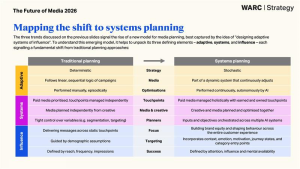
The Shift To ‘Systems Planning’

Traditional planning approaches, based on static plans, rigid personas and stable channel definitions are being disrupted by structural and technological shifts in media and marketing making them no longer fit for purpose. They must evolve to meet the demands of an increasingly complex, AI-driven marketing and media landscape.

‘Systems planning’ describes a new approach that focuses on ‘designing adaptive systems of influence‘, argued Dan Gilbert, CEO of Brainlabs, that build equity and shape decisions across the entire brand experience, recognising how touchpoint influence varies by context, category and consumer. This requires new mental models, frameworks, and planning tools that are only just beginning to emerge.

‘Systems planning’ puts an emphasis on developing talent with connective capabilities across data, commerce and creativity, skills that are essential for steering AI-enabled marketing platforms effectively and deliver better outcomes.

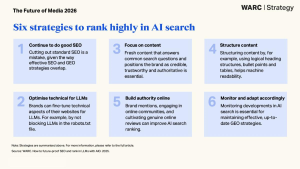
Visibility In The Era Of AI search

AI-driven search is reshaping how people find information and make decisions, and is beginning to impact consumer search behaviours. Buyers are using AI-powered search engines for longer, more complex queries and to satisfy a broader range of intents, discoverability and information, which vary significantly by category and context.

Optimising content for AI search requires new skills. Generative engine optimisation (GEO) marks a departure from traditional search engine optimisation (SEO) with a focus on producing structured, credible and authoritative content, aligned around different category entry points. Content which is optimised for both humans and machines such as large language models (LLMs) and AI agents. A greater focus on owned and earned media is also a key driver of GEO success.

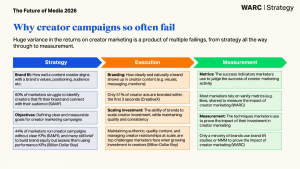
Cutting Through With Creators

The creator economy is maturing quickly, with revenues expected to more than double to $376.6 billion by 2030 per WPP Media, but a large portion of this investment is currently wasted. Problems range from creator marketing’s lack of clear definitions, to poor brand fit and weak measurement.

To stabilise ROI, marketers need to work with creators who align with their brand, set clear and measurable goals, and use robust measurements to gauge true business impact. Creative quality and choosing the right brand assets are essential to creator marketing success but requires a nuanced approach. Commitment to a structured learning agenda is also essential by looking at what worked while testing new hypotheses and strategies for growth.

The Future of Media 2026 draws on a combination of WARC insights and external research to provide marketers and strategists with key actionable takeaways. The report is part of WARC’s Evolution of Marketing programme helping marketers address major industry shifts to drive effective marketing. The report follows the recent publication of WARC’s Voice of the Marketer 2026, The Marketer’s Toolkit 2026, and The GEISTE report.

WARC members can read the full report.

WARC
https://www.warc.com

How AI Models Have Evolved

How AI Models Have Evolved

Flow Communications’ Richard Frank has outlined the traction gained by AI in a relatively short space of time. It’s been just over three years since ChatGPT launched, but it feels like a lifetime. The tech has exploded, not just with new models and capabilities, but with entirely new ways of working, creating and thinking.

The Pace Of Change Has Been Staggering

In September 2022, Queen Elizabeth had just died, the war in Ukraine was escalating and the Johnny Depp vs Amber Heard trial dominated headlines. But generative AI, something that now feels so normal, had not even officially launched yet. That would only happen on 30 November 2022.

If someone had shown you a tool on your laptop back then that could instantly draft documents, answer complex questions, generate images and even write code, would you have believed it?

The AI models of 2026 can do things we only dreamed about three years ago. But to understand how these models have evolved, I like to look at the AI benchmarks, the standardised tests used to compare the performance of AI models across capabilities such as reasoning, language understanding and coding.

In 2022, ChatGPT was famously bad at maths. Today, the model and others, such as Claude, Gemini and Grok 4, are acing graduate-level problems and even producing high-quality visual code outputs such as vector illustrations.

One particularly tough benchmark is called ‘Humanity’s Last Exam’ a set of 2 500 of the world’s hardest questions. When the models were first tested, they barely scraped 5% accuracy. Today, however, the current top model, Grok 4, is hitting 25%. It may not yet be a passing grade, but it is a major leap forward for such challenging material.

What’s In The Modern AI Toolkit?

It is no longer a case of choosing one tool and sticking with it. Different models have different strengths and at Flow Communications we use a mix, depending on what we are trying to achieve:

-ChatGPT and Gemini: our go-to generalists for fast answers, idea generation and content support.
-Claude: currently my favourite for writing and reviewing code. It is brilliant at software development tasks.
-ElevenLabs: the best I have seen for generating natural, lifelike voice-overs for audio content.
-Gemini (image and video): leading the pack when it comes to producing high-quality, realistic visuals.
-DeepSeek: an impressive open-source option that’s competing and quickly closing the gap with the top proprietary models.

Key Trends In Generative AI

Here are five AI trends to watch:

1. Improved reasoning

Early AI models competed with each other in terms of brute force (more computer power and more data). Now, it is about how the model thinks. The best tools can break problems down into steps, reason through them and even run small programs to get results.

2. Built-in tools

Whether it is browsing the web, writing code or simulating actions, modern AI models have to use other tools on your computer, like an assistant that does not just know things, but can do things.

3. Multimodal capabilities are now mainstream

We have gone from feeding AI plain text to giving it images, audio and video. We now expect an AI platform to respond across formats and generate content in multiple forms. You expect to be able to upload a photo or ask for a video, and get it instantly.

4. Efficiency has exploded

The models that once required a data centre to run now work on personal laptops. AI is now going to show up everywhere: on your phone, in your fridge and in your car. The lower the power requirement, the more embedded AI will become in everyday life.

5. Open source will catch up

What used to be the playground of a few big tech companies is now open to all. Open-source AI models from China and elsewhere are rivalling, and in some cases surpassing, their proprietary counterparts. Innovation is accelerating because more people can contribute to it.

Looking Ahead To 2026

If 2025 was the year of AI integration and experimentation, I believe 2026 will be the year of agentic AI. These are AI systems that act on your behalf, helping you buy groceries and run errands online, or even handling your admin or banking.

More people will build their own software using natural language prompts without having to know coding. And because the tech is so much more efficient, AI will soon be part of every connected device in your home.

The most valuable skill is knowing how and when to use AI tools. That’s what we focus on when hiring, and it’s what I encourage our clients to think about, too.

FLOW COMMUNICATIONS
www.flowsa.com

Understanding The Difference Between European And African Consumer Behaviour

Understanding The Difference Between European And African Consumer Behaviour
Ray Langa, Leagas Delaney South Africa

According to Ray Langa, Group Chief Executive of Leagas Delaney South Africa, luxury is often spoken about as if it were universal. As though taste travels cleanly across borders. As though restraint is inherently refined, and visibility inherently naïve.

Yet when we look closely at how consumers express success across Europe and Africa, it becomes clear that luxury is not simply about preference. It is about context, history, and what success must do in different societies.

In many European markets, understated luxury dominates. Logos are discreet, craftsmanship is coded, and recognition is reserved for those already fluent in the language of belonging. Across large parts of Africa, however, luxury is often worn visibly. Designer brands are more prominent, more expressive, more public. To some global observers, this contrast is dismissed as flashy or unsophisticated. That reading is not only inaccurate, it is intellectually lazy.

Status Signalling Is Not About Taste, It Is About Stability

Decades of consumer psychology research show that the way people signal status shifts depending on their social and economic environment. Studies on brand prominence and inconspicuous consumption consistently find that subtle luxury signals emerge most strongly in societies where wealth is entrenched, class structures are relatively stable, and social position is rarely questioned.

In these contexts, discretion becomes valuable precisely because belonging is assumed.

Across much of Europe, wealth has accumulated over generations. Status, while not immune to change, is often inherited rather than newly earned. In this environment, quiet luxury functions as an insider language. It does not announce success, it confirms it to those already inside the room.

This is not a higher form of taste. It is a by-product of historical stability.

Visibility In Africa Is Not Insecurity, It Is Legibility

Across many African markets, visible luxury plays a fundamentally different role. Research on status signalling shows that in societies characterised by higher inequality and real but contested social mobility, consumers are more likely to invest in visible markers of success. This behaviour is not driven by vanity, but rather by function.

Where progress is hard-won, success must be legible. It must withstand scrutiny. It must be recognised not only privately, but publicly.

For many first-generation professionals and entrepreneurs across the continent, luxury is not an indulgence. It is a statement of arrival. It signals that the odds were navigated, that barriers were crossed, and that new possibilities now exist, not just for the individual, but often for the family and community that stand behind them.

A luxury watch in Zurich whispers, ‘I belong’. The same watch in Lagos, Johannesburg or Accra often says, ‘We made it’. That distinction matters.

The Unspoken Hierarchy Of ‘Good Taste’

What global luxury discourse rarely interrogates is who gets to define what good taste looks like.

European restraint is frequently framed as timeless, effortless and refined. African expressiveness is more readily described as loud, excessive or aspirational. Yet cultural sociology has long argued that taste is not neutral. It is a form of power, a mechanism through which dominant groups normalise their preferences as universal standards.

When African consumers adopt European codes of restraint, it is often praised as sophistication. When they do not, it is treated as a developmental phase to outgrow.

Research does not support this hierarchy. It shows that signalling adapts rationally to context. Loud and quiet luxury are not moral opposites. They are tools optimised for different social terrains.

Post-Colonial Consumption As Self-Definition

In post-colonial societies, consumption carries additional symbolic weight. Scholars of globalisation and identity have shown that in contexts shaped by historical exclusion, modern consumption becomes a site of self-definition rather than mere acquisition.

Luxury brands in African markets do not simply represent wealth. They represent access, agency and participation in global modernity on one’s own terms. Visibility, in this sense, is not mimicry of the West. It is a reassertion of self in a world that long denied African consumers both visibility and authorship.

To read this behaviour as insecurity is to misunderstand its historical depth.

A Continent In Motion, Not A Stereotype

It would be equally reductive to suggest that Africa expresses luxury in a single way. As wealth deepens and elite circles mature across African capitals, forms of understated consumption are increasingly visible. Quiet luxury is emerging not as imitation, but as counter-signal, a natural evolution as visibility becomes widespread.

This matters. It reframes Africa not as behind Europe, but as moving through its own trajectory of expression. Luxury evolves as context evolves. Sophistication is not imported. It is earned through experience.

Perspective Earned From Inside The Luxury Ecosystem

These distinctions are not theoretical. They are patterns observed repeatedly from within the luxury ecosystem itself.

At Leagas Delaney, our work has placed us inside some of the most established luxury systems across Europe and the Americas, while increasingly engaging with African markets where luxury is still actively negotiating its meaning. That vantage point offers a rare perspective: the ability to see how the same brand codes behave differently depending on history, maturity and social structure.

What becomes immediately clear is that there is no single, transferable luxury playbook. Strategies that resonate in Paris or Milan can misfire when applied uncritically in Johannesburg or Lagos. Equally, expressions that carry deep cultural resonance in African markets are often misunderstood when judged through a European lens.

The most enduring luxury brands we encounter are those that understand why consumers signal status, not just how they do it. They resist imposing taste hierarchies. They listen before translating. And they recognise that luxury’s role is not to educate markets into conformity, but to express aspiration in ways that feel locally authentic and globally coherent.

What This Means For Brands And For Those Who Build Them

For global luxury brands, the implication is clear. Cultural fluency is no longer optional. African markets cannot be approached as extensions of European ones, nor can visible expression be dismissed as a transitional phase on the way to maturity.

The brands that will define the next era of luxury growth are those willing to hold multiple truths at once: that discretion and expression are not opposites but responses, that taste is shaped by history as much as preference; and that luxury, at its best, adapts without losing its essence.

From a position inside luxury ecosystems across Europe, the Americas and Africa, one thing is certain. The future of luxury will not be defined by a single aesthetic or behavioural code. It will be defined by those who understand context deeply enough to let luxury speak differently without losing its soul.

The Real Insight

The difference between European and African consumer behaviour is not about loud versus quiet. It is about what success must prove in different parts of the world.

In places where status is secure, it can afford to whisper. In places where it has been historically denied, it often needs to speak. Neither is superior. Both are rational. And both deserve to be understood on their own terms.

LEAGAS DELANEY
https://www.leagasdelaney.co.za

Is Your Outdoor Advertising Legal?

Is Your Outdoor Advertising Legal?
Photo credit: Newsday

What makes outdoor advertising illegal, and what steps can interested parties take to ensure compliance? An article sourced from Newsday outlined the elements that need to be taken into consideration.

The City of Johannesburg has launched an operation to address the growing prominence of illegal outdoor advertising across the city.

Musah Makhunga, the CEO of the Johannesburg Property Company (JPC), said that unlawful structures are a big problem in the city. He explained that these unlawful structures compromise public safety, disrupt infrastructure, and deprive the City of much-needed revenue.

‘This operation reflects a firm stance against non-compliance and a renewed commitment to enforcing by-laws without fear or favour,’ he said.

Johannesburg’s Executive Mayor, Dada Morero, added that the companies behind the illegal billboards violate advertising by-laws and engineering certification standards. He explained that the operation, which involves reclaiming public spaces and restoring order, is related to illegal outdoor advertising in Johannesburg.

Earlier this week, Makhunga and his team took the operation to Winnie Mandela Drive, where they uncovered many illegal structures, ‘We are dealing with ten sites where the city of Johannesburg is not receiving any revenue from the outdoor advertising,’ he said.

He showed one billboard which generates between R100,000 and R150,000 per month, where the city is not paid any money.

‘We will be on the ground visiting different regions and different streets to enforce the City of Johannesburg’s by-laws’, he said, ‘If people do not want to comply with the by-laws, we will take down the signs until they come forward and engage with the city.’

He explained that the outdoor advertising providers must get approval for the sites and have a lease agreement with the city. Makhunga added that the operation, which was launched in December 2025, will continue until all outdoor advertisers are compliant.

The Acting Chief of Police, Eldred Fortein, joined City Manager Floyd Brink and Makhunga, assisting in the removal of illegal outdoor signage.

‘The City is sending a clear message: unauthorised structures that bypass engineering safety and steal from municipal revenue will not be tolerated,’ he said, ‘We are leaving no stone unturned in our mission to clear uncertified structures.’

This article was sourced from Newsday.

This is Modern Marketing