According to Michael Gullan, co-founder and Managing Director of G&G Digital, customer relationship marketing (CRM) is an important tool to help turn your marketing campaigns into a success. With this tool, repetitive tasks are automated, freeing up time for teams to engage with tasks that are more demanding to meet business objectives.
Customer relationship marketing also empowers businesses to learn more about who their consumers are and what they want, making it much easier to communicate with them in a more personal and direct manner.
This is vital as consumers continue to embrace digital trends and new technologies. Consumers are very decisive and selective when it comes to the content they consume and the purchases they make online.
Michael Gullan, co-founder and Managing Director of G&G Digital.
Why you should make CRM an important part of your marketing strategy:
1. Target the right user at the right time Personalised, rich and useful content will not only improve customer experience but also assist in turning the user into a paying customer, which is good for business. A happy and satisfied customer is more likely to continue to trust you and recommend you to others.
2. Retain customers Use the information customers provide and their behaviour to predict their next interaction with your brand. CRM can do this, and when applied correctly, encourages customer loyalty and builds long-term relationships.
3. Use data to your advantage CRM is data-rich and using that data, marketing professionals and their agencies can understand how customers and potential customers interact. These reports indicate what works efficiently and what elements need improvement. Knowing this and making the necessary optimisations will make the customer experience with your rand more enjoyable.
4. Use education and information to your advantage CRM and online learning programmes are an excellent tool for B2B and B2B2C brands to inform, convince and create strong advocates for you.
With so much content to engage with, make CRM work for you by ensuring your customers and potential customers value their experience when interacting with your brand. By offering them valued experiences, they will be happy and satisfied, returning often to engage with your brand, making purchases and increasing your business revenue.
Nfinity’s OrangeBlock was awarded full event management of Whisky & Gin Live’s new look. This includes three Celebration events in Cape Town, Pretoria and Durban as well as the annual Festival, to be held at the Sandton Convention Centre in November this year.
Michelle Kirby, Managing Director of OrangeBlock said, ’Whisky lovers that have been attending this popular event over the last few years will have started to notice a change. On being awarded this contract, we introduced a change to the Celebration events to introduce a new look and a special focus on gin and live music. We realised that the Celebrations taking place in Cape Town, Pretoria and Durban required an offering that would appeal not only to the whisky connoisseur and emerging whisky drinker but to the gin lover too.’
The perception that the whisky market is dominated by an older profile is no longer accurate and the emergence of craft liquors, especially gin, is a trend that deserves attention. With two Celebration events under the belt, these changes have already been well received by both exhibitors and visitors alike. Guests enjoyed the expanded range and ambiance at Whisky & Gin Live, while exhibitors relished a broader range of consumers visiting the event – many for the first time.
Running an event of this magnitude is no small task but when it comes to executing tasks in triplicate, it’s no cut and paste solution. The events all ran back to back over a seven-week period with extremely tight deadlines and timelines.
Managing individual Celebrations across three different provinces comes with its own set of challenges. ‘The different municipalities and applications for each event is totally different and they have their own unique rules, regulations and time frames,’ said Kirby. ‘Every event has to comply with various rules in terms of health and safety applications which can be very time-consuming.’
Amazon has become the world’s most valuable brand, according to the 2019 BrandZ Top 100 Most Valuable Global Brands ranking released by WPP and Kantar at the New York Stock Exchange.
Amazon’s smart acquisitions, that have led to new revenue streams, excellent customer service provision and its ability to stay ahead of its competitors by offering a diverse eco-system of products and services, have allowed the company to continuously accelerate its brand value growth.
Technology companies have led BrandZ’s Top 100 ever since its first global brand value ranking in 2006, when Microsoft took the top spot. Rising in brand value by an impressive 52% year-on-year to $315.5 billion, Amazon moves ahead of Apple (no.2, $309.5 billion) and Google (no.3, $309. billion) which both rose by a modest +3% and +2% respectively, to end the technology giants’ 12-year dominance.
In the Top 10, Facebook remained at no.6 while, for the first time, Alibaba overtook Tencent and became the most valuable Chinese brand, moving up two places to no.7 and growing +16% to $131.2 billion. Tencent dropped three places to no.8, declining by 27% to $130.9 billion year-on-year, in what BrandZ ascribes to a more volatile world; one in which brands must continually anticipate evolving consumer needs and expectations.
As other social media platforms face challenges in terms of trust and desirability, Instagram (no.44, $28.2 billion), now with over 1 billion users worldwide, emerged as this year’s fastest riser, climbing 47 places with a massive +95% growth in brand value. Lululemon, the yoga-inspired, athletic apparel company was the second fastest riser, stretching to +77% growth year-on-year to $6.92 billion.
Other top risers, such as Netflix (+65%, no. 34, $34.3 billion), Amazon (+52%, $315.5 billion) and Uber (+51%, no.53, $24.2 billion) reflect the rapidly changing, technology-driven world in which consumers are placing more value on richer brand experiences.
David Roth, CEO of The Store WPP EMEA and Asia and Chairman of BrandZ said, ‘The growth in value of this year’s top 100 brands to an all-time high proves the power of investing in brands to deliver superior shareholder value. Behind this headline growth figure lies the success coming from a new phenomenon of ecosystem brand building. We’re seeing a move from individual product and service brands to a new era of highly-disruptive ecosystems. Brands need to understand the value this type of model can create and should embrace its approach to be successful in the future.’
The BrandZ Top 10 Most Valuable Global Brands 2019
Rank 2019
Brand
Category
Brand value 2019 ($BN)
Brand value change
Rank 2018
1
Amazon
Retail
315.505
52%
3
2
Apple
Technology
309.527
3%
2
3
Google
Technology
309.000
2%
1
4
Microsoft
Technology
251.244
25%
4
5
Visa
Payments
177.918
22%
7
6
Facebook
Technology
158.968
-2%
6
7
Alibaba
Retail
131.246
16%
9
8
Tencent
Technology
130.862
-27%
5
9
McDonald’s
Fast Food
130.368
3%
8
10
AT&T
Telecom Providers
108.375
2%
10
Despite the economic uncertainty surrounding the US and China trade tariffs, almost a third of a trillion dollars ($328 billion) of value was added to the BrandZ Top 100 Global ranking over the last year, giving it a combined brand value of $4.7 trillion – roughly the combined GDP of Spain, Korea and Russia.
Much of this value is derived from consumer technology brands appearing in the ranking, which combined are now worth in excess of $1 trillion. Examples include newcomers Xiaomi (no.74, $19.8 billion), a Chinese mobile handset brand that also uses the Internet of Things (IoT) to connect smart devices and is experiencing rapidly growing demand in countries such as Russia, India and Malaysia. Another Chinese brand, Meituan (no.78, $18.8 billion) is seen as a category-disrupting consumer technology platform offering everything from food delivery, room bookings and ride-hailing to bike rentals. Meanwhile, Uber is leveraging the ecosystem model and expanding into food and other delivery services, while Haier (no.89, $16.3 billion), the world’s largest home appliances and IoT platform, is committed to co-creating an open ecosystem brand in the IoT era with its customers and partners.
Doreen Wang, Kantar’s Global Head of BrandZ commented, ‘Amazon’s phenomenal brand value growth of almost $108 billion in the last year demonstrates how brands are now less anchored to individual categories and regions. The boundaries are blurring as technology fluency allow brands, such as Amazon, Google and Alibaba, to offer a range of services across multiple consumer touchpoints. Using their consumer experience and expertise, these brands are crossing over into the business services sector, creating new opportunities for brand growth. Disruptive ecosystem models are flourishing in regions such as Asia, where consumers are more technology-enabled and where brands are integrating themselves into every aspect of people’s daily lives.’
Key trends highlighted in this year’s BrandZ Global Top 100 study include:
• Luxury is the fastest growing category (+29%) followed by Retail (+25%), fuelled by the shifting preferences to digital channels from GenY and GenZ consumers. • Technology, Finance and Retail categories dominate, accounting for more than two-thirds of the total value of brands. • Nine newcomers appear in the Top 100, predominantly driven by Chinese and US technology brands with disruptive business models including Dell Technologies, Xbox, Haier, Meituan and Xiaomi. • Asian brands increased their presence with 15 Chinese, three Indian and one Indonesian brand making the ranking among a total of 23 from the region, including LIC and Tata Consultancy Services. • A new generation of brands emerged – GenZ brands (created after 1996) are miles ahead in growth rate as they add more value to the ranking per year of existence – almost four times more than brands created in the millennial era of 1977 to 1995. A total of 23 GenZ brands appear in the Top 100 with an average age of 16 years compared to 18 millennial brands averaging 33 years. • Sustainable brands – brand owners are demonstrating the importance of improving and reinforcing consumer perceptions that they are ‘responsible’ through social, environmental and corporate initiatives. • China and US trade wars affected the growth of the Top 100 ranking, which slowed to +7% over the last 12 months. Consumer confidence was hit as the trade tariffs impacted several brand categories with Cars, Logistics and Banks suffering most.
According to Paula Sartini, founder and CEO of BrandQuantum, Artificial Intelligence (AI) can bring great benefits to businesses across various industries. Already companies such as Google and Microsoft have invested significantly in this technology and are benefitting from it.
However, companies that don’t have AI solutions in place yet don’t need to rush off too quickly to implement it in an effort to catch up. However, they should start planning for AI as to not fall too far behind the curve.
Marketing departments in particular stand to gain vast benefit from using AI, most notably in their ability to deliver consistent experiences and exceed customer expectations. However, many marketers are cautious in adopting new technologies, and as AI can be a massive task to implement, marketers stand to benefit from easing into the process of AI adoption by following the steps below.
Start with automation
Automation software enables marketers to automate repetitive tasks such as applying the correct branding to company documents. Whilst these are important tasks, they can impact on productivity and detract employees from focusing on more pressing matters within the business. This is supported by research conducted by McKinsey, which found that 45 percent of work activities can be automated by implementing technology solutions. With automation, companies will benefit from cost savings, improved productivity and improved reliability.
Before implementing brand automation, marketers need to conduct a brand audit to determine how the brand compares to its competition, what the brand strengths are, how customers interact with the brand and where the key customer touchpoints are. It is important to look broadly beyond a specific department and include the ‘messy and complex’ things too as this is often the stuff that no-one wants to do but that will provide the most valuable insights. For example, marketers may suggest that email signatures are the responsibility of the IT department, however, customers don’t discriminate between the internal departments within a company, they expect their needs to be met and view the organisation as a whole regardless of who they engage with. As such every element of the brand should be audited.
Once you have conducted a brand audit, the next step is to determine which functions can be automated. These are the functions that require a time investment from staff but deliver minimal return on the investment. For example, complex customer requests should be handled by employees but if a customer is calling for a statement, this process could be automated to free up employees to handle the more challenging customer issues. The most important thing to remember when automating tasks is that customers are often looking for human interaction, particularly when dealing with sensitive or complex issues.
In the case of the customer experience, companies need to get the balance right between what can be automated and what should be handled by employees. Ultimately the best approach is to remove human intervention from the repetitive and menial tasks in order to free them up to handle the more important and complex functions that make the real difference to customers and ultimately build the brand. Once these functions have been identified the next step is to identify patterns within customer engagement by analysing the data.
Move beyond automation
For many years marketers have been collecting customer data but haven’t been able to use it effectively until now. With a mountain of data, combined with established parameters, technology is able to move beyond mere automation to bring marketers intelligent and intuitive offerings. For example, in the case of email, employees could select predeveloped content to drop into emails they send to customers. Initially this would require these employees to make decisions in terms of which content to select. However, over time the technology would become intelligent and intuitive and combining the data with usage patterns, it would simplify the process even further for users by automatically inserting the correct content for the recipient.
However, marketers should also pay attention to unstructured data as this is where the real magic lies. By identifying patterns in unstructured data, you’ll be able to find opportunities to innovate and identify real behaviours rather than rely on what people say they are doing. With greater insight into who your customers are, and a clearer understanding of their needs, it is easier for employees to engage with them using relevant, personalised information, sent at the right time and improving the overall customer experience.
Introduce AI tools
Once marketers have become comfortable using these technologies, the next step would be to assess their business needs to determine which AI applications are the best suited to meet their specific needs. There are several AI solutions available and marketers should be cautious not to implement AI for AI’s sake but rather determine which solutions are best suited to help them achieve their business objectives. It is also important that you consider the legacy systems within the organisation as this can often be a stumbling block to implementing new technologies. Marketers need to clearly articulate their requirements and collaborate with the IT department to implement solutions that meet the business’s needs.
The most imminent AI solutions available for marketers include anticipating future customer purchases and presenting offers accordingly, improving media buying, monitoring social media comments to determine brand affinity and tailoring promotions. However, this is only the tip of the iceberg in terms of what AI can bring to the marketing table. With the correct data combined with the right AI solutions, marketers can gain greater insight into customer sentiment and behaviour to more proactively plan and target campaigns that deliver the best results and enhance the customer experience across every customer touchpoint.
Get started now
There is no doubt that AI brings about some uncertainty with the promise of great things for marketers and business. While still in its infancy, this is the time for marketers to slowly start implementing technologies that lay the foundation for AI at a later stage. Marketers should start getting familiar with automation technology and determine exactly what they expect from AI technology before making the leap and introducing AI solutions into the organisation.
While it can be tempting to jump in head first, by adopting a slow and steady approach to AI implementation, they will be setting themselves up for success in the long-term. But the time to start is now.
In commemoration of popular culture icon SpongeBob Squarepants’ 20th Anniversary, two colours have been created through the collaborative efforts of the Pantone Color Institute and Nickelodeon: SpongeBob Yellow and Patrick Star Pink.
Nickelodeon is celebrating 20 years of SpongeBob SquarePants with the ‘Best Year Ever’— a tribute to the number-one kids’ animated series on TV that has generated a universe of beloved characters, pop culture catchphrases and memes, theatrical releases, consumer products, a Tony award-winning Broadway musical and a global fan base.
‘For two decades, SpongeBob SquarePants has inspired millions of people,’ said Charlotte Castillo, senior vice president, Franchise Planning, Viacom Nickelodeon Consumer Products. ‘From our partnership with the Pantone Color Institute to our collaborations with artists around the world – we’re commemorating SpongeBob’s 20th anniversary by celebrating his optimism, imagination and creativity.’
‘We were very honored to partner with Nickelodeon on the creation of colours for these two globally iconic characters. Inspired by SpongeBob’s enthusiasm, playfulness and fun-loving nature, the new SpongeBob Yellow we created is a luminous golden hue that reflects the energy of the sun, radiating joy and happiness, and sparking imagination,’ expressed Laurie Pressman, vice-president Pantone Color Institute. ‘Patrick Star Pink, a warm and inviting coral pink is the perfect companion colour to SpongeBob Yellow. Spirited and affable, a light hearted pink hue is ideally suited to the fun and laughter of being with your best friend.’
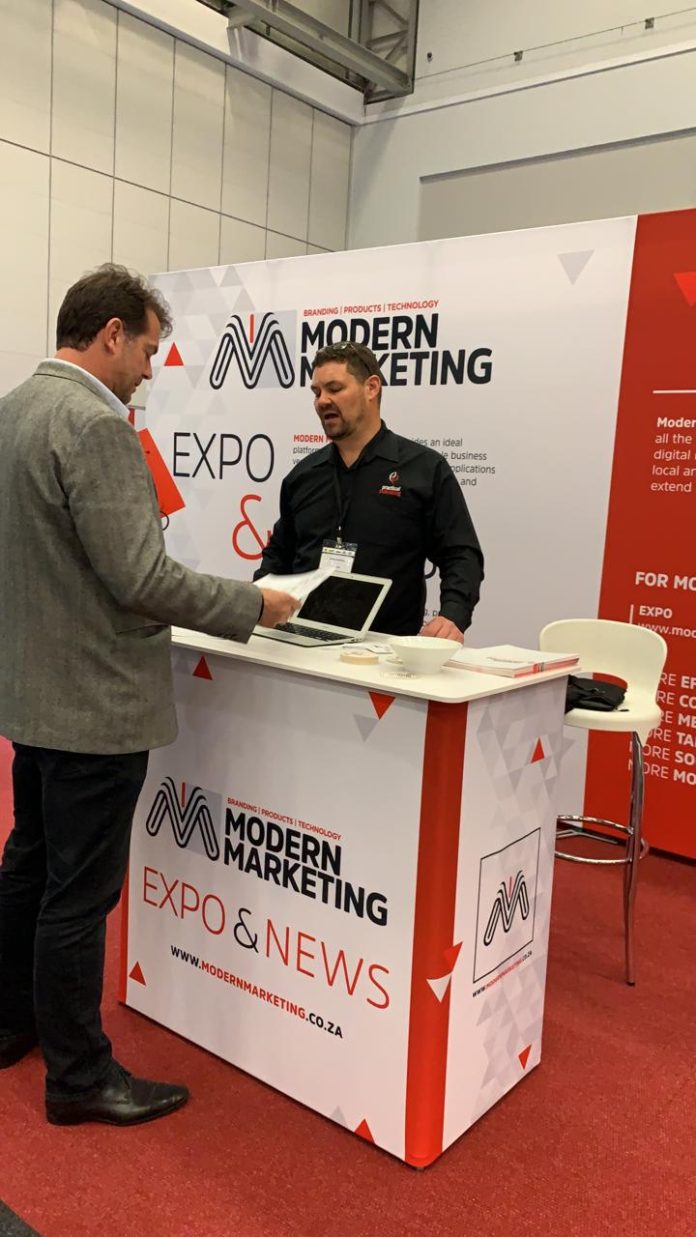
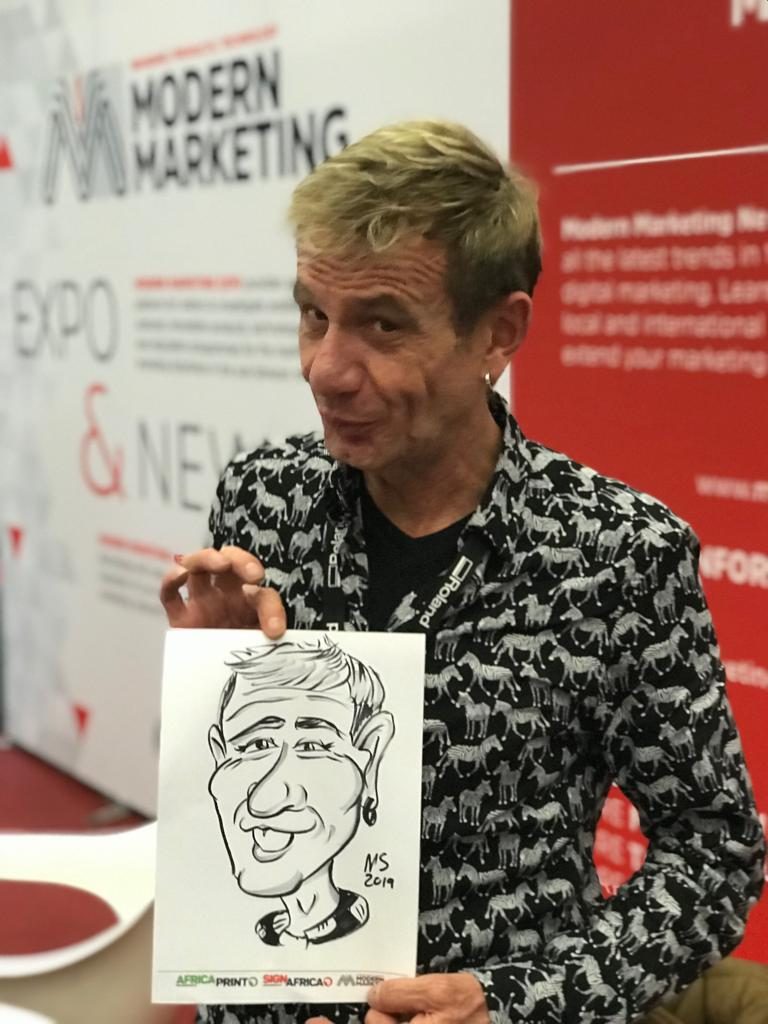
Modern Marketing has a stand at the Sign Africa Cape Town expo, taking place from 5-6 June at the Cape Town International Convention Centre. There is also a caricature artist on the booth for an extra fun element.
The caricature artist on the Modern Marketing stand.
The stand will highlight opportunities to be part of the Modern Marketing Expo in September. The event is a holistic, adaptive methodology that connects brands with real customers and drives business results by blending strategy, creative, technology and analysis. The event provides an ideal platform for visitors to investigate available business ventures, innovative products, technology, applications and education programmes for the marketing and branding industries in the sub-Saharan region.
Radio presenter Alex Jay.
The September event is targeted at advertising and marketing professionals who want their clients to be seen; at creatives who want something different; at those who want to be inspired. The event will feature the most innovative promotional and marketing products, as well as seminars from experts on the latest industry trends. It’s an opportunity to explore different marketing channels, branding, products, technology and campaigns that’ll help you deliver on your brand objectives.
If you’re interested in visiting the stand at the Sign Africa Cape Town Expo, and to pre-register online, visit: https://signafricaexpo.com/cape-town/
Andrew Dabbs, Digital Media Strategist at The MediaShop.
Andrew Dabbs, Digital Media Strategist at The MediaShop, recently came across two very interesting articles on Facebook and Google. The underlying theme was content safety. Here are some of his thoughts.
The world of AI and content
Facebook has come under extreme scrutiny over the last few years and even more so following the latest global terrorist attacks. Mark Zuckerburg has pledged to hire an army of content moderators to clean up the content on their platforms including WhatsApp and Instagram. Why? Because Facebook has been blamed for everything from provoking genocide to undermining democracy and abetting suicide.
We keep hearing about AI, but why does one of the world’s largest internet giants with billions of dollars in profits need to hire 30,000 moderators for content? We are clearly leaps and bounds away from what the actual possibilities are, and it is imperative to remember that the code for AI is only as strong as its input. Consumers also have various perceptions in terms of what’s offensive, so it will be interesting to see how the clean-up goes, although it appears it may be easier to change the interface of the newsfeed (vertical) to the Stories format, to try and clean up the content! There will be more to say on that at a later stage.
Chrome encryption
Google has been in talks for ages regarding the reformatting of Chrome, changing the algorithm to remove cookies and to have their own encryption. These steps however will make it harder to block harmful material including everything from pornography to terrorist propaganda. The new version will bypass most parental control systems and undermine attempts to increase internet safety which, is also reliant on broadband providers identifying harmful or age inappropriate material. An encrypted browser makes it impossible for companies to detect and filter out offensive or illegal material.
We already face limited sight of advertising spend and user information, so an encryption on the browser would ultimately result in less transparency and flexibility to work with on Google. This will leave advertisers powerless and customers helpless on the internet giant’s interpretation and ability to provide information. With a blemished track record in content interpretation, is encrypting the browser just a step too far in removing any third party verification?
What’s the takeout?
We often turn towards Facebook and Google when advertising in South Africa because of the size of their audiences. They have amazing user demographics, location information and ad formats to reach our audiences.
However, could we be sacrificing reach for context? Is there value in having advertising on a platform where your friend marks himself safe in the Durban floods, a death of a beloved pet or another tagged post from that annoying couple who is always letting you know that they are eating out?
Transparency should be key to change an algorithm that could affect customers and ultimately benefit your own business. Ultimately, we need to do what’s right for our brands, operating in a safe environment, next to certified relevant content and with trusted open partners. With all that’s happened in recent times, maybe life behind the walled gardens is not as pleasant as one is meant to believe.
Jeff Ehrenkranz, President, Marketing International, Octagon Worldwide said that they are exceptionally pleased to welcome their new Octagon Africa office in Johannesburg to the global Octagon portfolio in 2019.
‘This begins a new and exciting chapter to the story of Octagon in the region, and allows us to further enhance our offering of award-winning strategy, creativity, marketing and operational excellence to clients in South Africa and across the entire African region south of the Sahara,’ Ehrenkranz added.
Octagon Africa is 51% directly black owned, with a BBBEEE level 2 status. As part of the move, Octagon has named 25-year industry veteran Franco Barocas as Chairman of Octagon Africa. The announcement marks Barocas’ return to the Octagon Group, following his departure in 2003. The leadership team in Octagon’s Africa office will be made up of Barocas and Devian Nadasen, who was recently appointed Managing Director of Octagon Africa.
Octagon’s worldwide offices have provided campaign marketing, event activation and sponsorship consulting services in the region for nearly two decades. Octagon Africa will continue those efforts, in addition to new assignments with principal clients Mastercard and Standard Chartered Bank.
The Octagon Sports and Entertainment Network (OSEN), within the Interpublic Group (NYSE: IPG), encompasses industry leaders Octagon, FRUKT, ITB, Rogers & Cowan and Milkmoney. The formidable family of agencies specialises in sports, entertainment and lifestyle management, marketing and public relations for brands, properties and sports, news and entertainment talent.
As part of OSEN, and having direct access to all of the organisation’s specialist agencies, experience, expertise, research and best practices, Octagon Africa is well positioned to be a one-stop marketing company in the region for any brand exploring the use of sport or entertainment as part of its marketing strategy.
The awarding of UK Agency of the Year and European Agency of the Year titles to Octagon in 2019 is recognition of the benefits to brands that such an integrated offering provides and it is these same benefits that Octagon Africa will bring to its African clients.
Richard Lord - Media And Operations Director At Meta Media.
Richard Lord, Media and Operations Director at Meta Media, has been in the advertising and media industry for almost 23 years. He says that data is the big buzzword of the moment and has advice for creating successful campaigns.
Early life
Lord attended the AAA School of Advertising and specialised in Media Management, because one of his lecturers told him and his friends that media is where all the money is, and that ‘media planners get cool gifts and trips’.
Jokes aside, Lord has a very analytical mind, and so he enjoyed the logic and science that gets applied to media planning.‘I enjoy formulating strategies and finding places where our clients’ messages will resonate the most with the intended recipient. I started my career at Lindsay Smithers FCB, and have been with the IPG group ever since, having worked at UM in London, The MediaShop, and now Meta Media.’
What do you enjoy most about working in the industry?
‘Working with clients and media owners is very stimulating and it is a challenge to come up with new solutions for our clients’ problems. I also enjoy working with world-class people to help come up with those solutions.’
When asked about the industry changes he has noticed, Lord said he has seen an explosion in how quickly consumers have adopted digital media and how it has become a ubiquitous part of their lives. He has also seen the number of digital channels available to advertise on grow exponentially, and how digital has entwined itself with more traditional channels like TV, radio, print and even outdoor. ‘The level of data that we have available to us now is unprecedented and it is exciting to see how technology is facilitating the matching of data with consumer behaviour to ensure that our messages are seen by the right people in the right place.’
2019 industry trends
‘Everyone knows that data is important and everyone wants it, but the reality is that no one really knows what to do with it or how to use it properly.’ He pointed out how people also always seem to refer to data in a digital sense – but there is so much data from a traditional media perspective that can be used to create insight-rich media campaigns as well. ‘The agencies that work out how to effectively use the data they have are going to be the winners.’
Keys to success
According to Lord, these include hard work, diligence, taking responsibility and keeping up with the latest trends. ‘Media has changed a lot in the past 23 years and you need to stay ahead of these changes to remain relevant.’
Favourite project and tip for creating successful campaigns
‘We recently won a Gold Amasa Award for a Cell C campaign where we partnered with Google to run a YouTube campaign using a little-known feature that allowed us to do something that had never been done before in South Africa. The campaign was exciting to work on because we had a brave client who took a risk, we had a creative agency that created relevant content, and a media owner partner who gave us data and insights into our audience. All of this allowed for a breakthrough campaign that was simple, innovative, and most importantly, relevant.’
Lord’s key to creating a successful campaigns is partnership. He suggests that one works with media owners in order to get the best from their channels. ‘No one knows their audiences like media owners do, and if we work with them, we can create magic.’
Hobbies
Lord’s big passion outside of media is the outdoors. ‘I love going camping with my family as often as possible, and I enjoy riding my mountain bike through our beautiful country.’ He has ridden six (three day long) Sani2c mountain bike races, and a 265km race from the foot of the Sani pass in the KwaZulu-Natal Drakensberg down to the beach at Scottburgh on the South Coast.
According to Sheila McGillivray,Tribe Leader at One Lady And A Tribe, individuals born from mid-1990 to 2014 are Gen Z consumers who are growing up to be ‘millennials on steroids’. These digital natives will make up 40% of all customers by 2020, so its best we elevate their potential buying power to become a marketing priority.
Sheila McGillivray, Tribe Leader at One Lady And A Tribe.
As the focus in June is youth, here are 16 ways in which to market to the Gen Z demographic.
1. Use real(ish) people
’67% of Gen Zs prefer seeing real people in ads,’ according to Dana Communications. ‘Real people’ means micro-influencers and not the hugely paid Instagram celebs. The unofficial definition of a micro-influencer is to have an average of 10,000 followers and that they be who they say they are – not who they’re paid to appear. Indeed, Google found that 70% of teenage YouTube subscribers relate to YouTube ‘creators more than traditional celebrities’.
2. Personalisation over data privacy
‘Gen Z is the first generation to intrinsically combine the digital and the physical worlds’ – WP Engine. The idea that Gen Z would be less concerned about data privacy than personalisation came as a surprise to me, but it seems this is actually because they are so astute at using ad blockers and savvy privacy settings. Having said that, a report by WP Engine report found: ’45% of Gen Z will provide data to prioritise a personalised experience over privacy with a further 55% of Gen Z believing websites will become more human in experience.’
3. Use language wisely
Gen Z want quality products but are also big on authenticity, so advertising jargon or marketing speak will be an instant turn off. User generated content (UGC) is a good way to attract the attention of the youth as they rely heavily on online reviews and comments. Have open social media platforms for real discussions to take place and don’t try to jump on every trend. Be real and mediate honestly on social media.
4. Deepen the Connection
This speaks to the previous point of languge too. To deepen the connection with Gen Z, showcase real stories. As Saja Chodosh of Emotive Brand writes, ‘Think experiential events, mixed medium, VR – experiences that allow individuals to shape them.’ Also consider engaging the youth by doing surveys, having community conversations and focus groups to get real-world insight into the difficulties Gen Z face on a daily basis.
5. Monthly subscription boxes
Subscription e-commerce offerings are escalating rapidly and have had, according to Genzinsights.com, over 100% growth each year during the past five years. A ‘mystery’ or ‘try before you buy’ box satisfies the cautious spending habits and the curiosity of Gen Z. Starting off mainly in the beauty industry, there are now subscription boxes for everything, including book clubs, ‘dog products’, ‘geek gear’ and more. It’s a great opportunity for cross-pollination of like-minded but different products within one subscription box.
6. Ship up or shape out
In Morning Consult’s study of Gen Z’s Top 25 Favourite Brands, one of the things which impacted on brand love was whether it had fast, reliable shipping of goods. Gen Z literally have a world of options at their fingertips. If brands don’t move quickly, they are out of the picture. For brands to be successful with Gen Z, they’ll need to have super speedy shipping and keep their delivery promises.
7. Transformation and education
Many Gen Zers aspire to a life of ongoing personal transformation. This includes being as highly educated as possible, for as little expense as possible. Education technology or EdTech is a ‘global phenomenon’ and has a market expected to grow at 17% per year, to US $252 billion by 2020.
According to the Digital Marketing Insitute, ’33% of Gen Z prefer to watch their lessons online, while 32% choose to collaborate with their classmates via the internet.’ This makes an alliance with an EdTech platform a good idea for brands wanting to appeal to the Gen Z market.
8. Don’t dictate
We can learn from the Chase Bank’s recent #MondayMotivation Twitter fallout. In a hypothetical conversation between a customer (about the low funds in their bank account) the bank’s Tweet suggested they, ‘Make coffee at home’, ‘Eat the food already in the fridge’, as well as ‘You don’t need a cab, it’s only three blocks’. Corporate greed dictating to their fictional customer? Not going to work.
9. Know you don’t know more
We live in a world where the Gen Z customer really is always right because they’re hard wired to research everything, to question quality and to speak up about the things that don’t align with their values.
10. Act more frugal
Many Gen Zers grew up learning how to be frugal and luxury brands are taking note of this and moving away from the so-called ‘culture of exclusion’. We see this happening with brands such as Hermès, who are trying to become more ‘street’ and accessible to the Gen Z audience.
11. Be ‘Glogal‘
Gen Z are also known as the world’s first global generation and according to cultural mythologist John Bucher, Gen Zers generally prefer phygital (mixed-reality) experiences as they provide a ‘best-of-both-worlds chance’ to take a break from their constantly connected lifestyle. This means being ‘glogal’: keeping a close eye on global digital and physical trends and, especially in the case of South Africa, integrating them with local flavour.
12. Individual fluidity
For this point I can’t say it better than this insightful article on Gen Z from Mckinsey: ‘For Gen Zers, the key point is not to define themselves through only one stereotype but rather for individuals to experiment with different ways of being themselves and to shape their individual identities over time. In this respect, you might call them ‘identity nomads.’
13. Entrepreneurial
Gen Z want to be independent. An HBR study found that 25% of Gen Z students are interested in starting their own business and according to Gallup, eight out of ten kids want to be their own boss. Many teens already have a side hustle, whether it’s online or babysitting. Brands who can tap into, encourage and support Gen Z’s entrepreneurial flair will be noticed.
14. Make it entertaining, and be quick about it
‘It doesn’t matter how good your ad is if only the first three seconds get watched. Be funny, be compelling or be skipped,’ said Head of a Gen Z Marketing Firm Crimson Connection Michael Pankowski. He reinforces the statistic that the average attention span of a Gen Zer is reckoned to be eight seconds. ‘Boredom strikes us almost immediately; sometimes we’ll click ‘skip’ on advertisements before we even know what the product is.’
15. Follow them
Gen Z basically grew up with, and were largely educated by, YouTube – which is actually still their favoured website. Facebook is for ‘old’ people, so focus on Snapchat or Instagram and chat message rather than email.
16. Values and purpose
I’ve saved my favourite point for last. Gen Z are going to cleave to brands who are real, authentic and unique but most of all, who have purpose. Growing up in the shadow of the unsustainable footprint left behind by previous generations, Gen Z want to see real change – politically, socially and environmentally. Long-term sustainable values, visibly mapped out by brands, will see them becoming favourites with Gen Z. True brand values will be the only way to keep the loyalty of a generation who will continue to search for true activists of global change.