

Home Blog Page 39

PR Needs To Reclaim Its Strategic Mandate

PR Is Not Dead. It’s Simply Forgotten As To What It Is
Kwame Senou, THOP.

Kwame Senou, Executive Director at THOP, says before we rally against Sir Martin Sorrell’s recent claim that ‘PR no longer exists; it has morphed into social media’, we should pause and ask an uncomfortable question: Why was his comment even possible?

When An Industry Loses Its Shape, Others Redefine It

The uproar surrounding Sorrell’s claim reveals less about Sorrell and more about a long-standing identity crisis within our profession. If a global business leader can so casually reduce decades of theory, practice, and institutional knowledge to a platform-driven caricature, we must ask why our field has made such a simplification plausible.

Public relations remain one of the few professional disciplines unable to describe itself with the clarity that law, audit, or financial advisory fields have institutionalised. Lawyers do not debate what constitutes legal work. Auditors do not rebrand themselves each time technology evolves. Yet in communications, our boundaries fray with every new channel, trend, or attempt at ‘integration,’ allowing the loudest, most visible expressions of our work, often social-first content, to stand in for the entire discipline.

The International Public Relations Association (IPRA) defines public relations as ‘a decision-making management practice tasked with building relationships and interests between organisations and their publics based on the delivery of information through trusted and ethical communication methods’. But instead of embracing this managerial anchor, the industry has allowed its identity to be shaped by execution rather than intent. We have let tools eclipse counsel and visibility eclipse legitimacy.

When You Perform Tactically, You Will Be Perceived Tactically

Sorrell’s remark resonates not because it captures the essence of PR, but because it reflects the posture the industry has projected. Over the past decade, PR has gravitated towards marketing, content production, and digital management not through a strategic lens, but through commercial pressure and a fear of losing relevance.

As a result, the discipline has been flattened in the public imagination to its most tactical expressions. Yet the foundational scholars of our field have always been unequivocal: public relations is a management discipline. James Grunig’s work on the two-way symmetrical model in his 1992 published book positioned PR at the core of organisational decision-making, not as a collection of outputs.

Robert Heath’s research on issues management situates PR as an organisational conscience engaged in shaping legitimacy and long-term societal expectations. W. Timothy Coombs’ life’s work scholarship shows that PR is central to risk, responsibility, and behaviour during crises not content scheduling. When we neglect this intellectual infrastructure, we invite misunderstanding.

In Africa, this erosion has even deeper consequences. Our context is defined by political complexity, institutional fluidity, and cultural nuance, an environment where stakeholder intelligence, legitimacy-building, and what I call corporate diplomacy are not optional but indispensable. Organisations operating in Africa do not fail because of weak social media; they fail because they misunderstand power, misread culture, or undermine trust. When PR is misinterpreted as content production, leaders handicap their own ability to navigate the continent’s realities. The practice loses its authority, and Africa loses one of its most powerful instruments for aligning business, government, and society.

This Is Our Inflection Point, Not A Moment For Outrage

The controversy around Sorrell’s comment should not provoke defensiveness; it should provoke clarity. His claim that PR has ‘morphed into social media’ is not an attack on our field. It reflects what we have allowed to become our public face. We can either respond emotionally or treat this as the inflection point it is.

Reclaiming the discipline requires returning PR to its rightful place: as a strategic management function grounded in ethics, behavioural insight, and relationship stewardship. It demands that we reassert the distinction between communication that shapes decisions and communication that merely occupies feeds.

The future of PR, particularly in Africa, lies in articulating a broader and more strategic practice. Corporate diplomacy, as articulated by thinkers like Witold Henisz at Wharton, offers a far more accurate reflection of the work senior advisors perform: navigating perception, policy, culture, and power in environments where trust is as influential as regulation.

If we redefine PR around this core, anchored in management, amplified by Joseph Nye in his book about Soft Power, and responsive to Africa’s socio-political dynamics, we will not only correct the misconception behind Sorrell’s statement; we will restore PR to its rightful place in the architecture of leadership.

The question is not whether PR still exists. The real question is whether we have the courage to practise it at the level the moment demands.
THOP
https://wearethop.com

Study Shows That Brands Can’t Afford To Ignore Creator-Led Strategy

Study Shows That Brands Can't Afford To Ignore Creator-Led Strategy

The Institute of Practitioners in Advertising’s (IPA) study analysed 220 campaigns from 144 brands across 28 markets and represented over £133 million in influencer spend. It showed that influencer marketing delivers the strongest long-term multiplier effect of any media channel, outperforming even television with a long-term ROI index of 151 versus TV’s 100.

The Digital Media Collective (TDMC) has welcomed the findings of the IPA’s groundbreaking study. The United Kingdom’s professional body for advertising, media and marketing communications agencies published ‘The ROI of Influence’ in October 2025, revealing some fascinating data, much of which the TDMC team agrees is relevant to South African marketing.

According to TDMC founder and CEO Cheryl Ingram and Strategic Director Nicola Ashe, who heads up the agency’s influencer division, the findings validate what they have observed first hand in the South African market since officially launching its influencer division in 2020. ‘While some might argue that South Africa lags behind markets like the UK in measurement maturity, we have found implementing a robust creator-led strategy exceptionally relevant here,’ said Ashe.

The South African Advantage

TDMC points to three critical factors that make influencer marketing particularly potent in South Africa:

1. Mobile-First, Creator-Ready Audiences

With 50.8 million internet users (78.9% penetration) and 34m social media identities as of early 2026 (source), South Africa has both the reach and the behaviour patterns to support scaled influencer activity. Significantly, according to a Meltwater Global Digital Trends 2025 report, 33.6% of South African social media users actively follow influencers, well above the global average of 22%.

2. A Young, Digitally Native Population

South Africa’s median age sits at 27.7 years, placing the country squarely within the demographic sweet spot identified by the IPA study, Gen Z and younger millennials, among whom trust in influencer recommendations reaches 44%, compared to just 26% among the general population.

3. Cultural Nuance As Competitive Advantage

‘What makes South Africa unique is the cultural and linguistic diversity that content creators can authentically navigate,’ Ashe explained. ‘When brands speak directly from corporate pages, we find engagement can flatline. When the same message is delivered through a trusted creator speaking in vernacular, understanding local references, and reflecting lived experience, the results are transformative.’

The South African Context: What The IPA Study Doesn’t Reflect

While TDMC applauds the rigour of the IPA research, Ingram cautioned against adopting a plug-and-play approach for South African brands.

Trust Is Fragile And Regulation Matters

South Africa’s Advertising Regulatory Board (ARB) Appendix K and the IAB SA Content Creator Charter mandate make a clear disclosure around sponsored content and paid partnerships, placing compliance responsibility firmly with brands. ‘This isn’t the Wild West anymore,’ Ingram noted. ‘Authenticity isn’t just good practice, it’s a legal and ethical requirement. Brands that treat creators as distribution channels rather than strategic partners will fail, and they’ll damage the ecosystem in the process, sowing doubt in a powerful emerging sector.’

Agility Trumps Production Value

Unlike markets where long lead times and heavyweight creative agencies dominate, South African audiences respond to speed, relevance and cultural agility. ‘Content creators can react to cultural moments, trending conversations, inside-joke comedic trends, and seasonal shifts in real time,’ said Ingram. ‘That’s not a nice-to-have. It’s a competitive necessity in a country as diverse as ours.’

The Category Question: Food, FMCG, And ‘Show Don’t Tell’ Sectors

While the IPA study included FMCG campaigns (15% of the total sample), Ingram argues that food and lifestyle categories are uniquely suited to creator-led strategy in South Africa. ‘In South Africa especially, food is experienced publicly and with many specific cultural nuances, in recipes, budget shops, lunchbox prep and taste tests. It’s inherently visual, socially transmitted and trust dependent. That’s influencer marketing’s natural habitat.’

The Million-Rand Question: How Far Should Brands Go?

Ingram is direct about the limits of influencer investment. ‘The question isn’t ‘how far should we go’, it’s ‘are we treating this channel with the same strategic rigour we apply to TV, out-of-home, or paid search?’ Because the data now says we should be.’

TDMC’s Recommendation For South African Brands:

– Build always-on creator engines, not campaign bursts.
– Use creators for jobs that ads can’t do well. Trust in their demonstration, cultural translation and community-building abilities.
– Plan for distribution as seriously as production. Organic posting, paid amplification and retargeting are an essential aspect of the sales journey.
– Measure rigorously. Matched-market tests, geo splits and incrementality analysis must be applied to campaigns.

‘The UK may be ahead on measurement infrastructure, but South African brands have something more valuable: a young, mobile-native, creator-engaged audience that’s ready to be reached,’ said Ingram. ‘The question is whether brands are ready to meet them where they are, and whether they’re prepared to do it properly.’

TDMC
https://tdmc.co.za/

Dentsu Creative SA Ranks #5 In Official Loeries Ranking

Dentsu Creative SA Ranks #5 In Official Loeries Ranking

As reported in the official Loeries ranking, Dentsu Creative South Africa has steadily strengthened its creative standing over the past three years, ranking into the Top 10 in 2025. Their strength in digital creativity was affirmed with a Top 10 ranking #5 across the region.  Dentsu Creative South Africa ranked #2 in the entire Africa & Middle East region for Design.

This excellence is driven by people who live and breathe design.

– Brandt Botes, Head of Design, holds Loeries recognition across Creative Director and Design rankings, reflecting his sustained contribution to design leadership, craft integrity, and the evolution of visual storytelling.

– Josie Gailey, Lead Multimedia Designer and currently #1 ranked Designer in the region, drives best-in-class execution through continuous collaboration.

Their strength in design is reinforced by an integrated team spanning creative direction, strategy, art direction, content production, client leadership, and social influencer content. Each discipline contributes to the depth, diversity, and modernity of our work. It is this collective capability that enables us to deliver ideas.

Roxana Ravjee, CEO of dentsu South Africa, said, ‘Our teams across Dentsu Creative South Africa continue to prove that when data, strategy, design, technology and a committed team work in harmony, the work becomes transformative. As we navigate 2026, we remain committed to raising the standard of excellence in every idea we shape and in every person who brings that idea to life.’

DENTSU CREATIVE SOUTH AFRICA
https://www.dentsucreative.com/location/south-africa

Checkers Is Number One In Quarterly Buzz Rankings

Checkers Is Number One In Quarterly Buzz Rankings

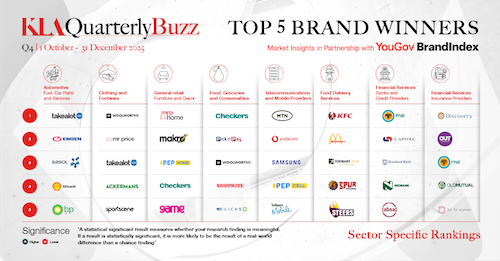
The Quarterly Buzz, powered by YouGov’s BrandIndex platform, continuously tracks public sentiment across more than 200 brands in South Africa. KLA, the exclusive partner for YouGov in Sub-Saharan Africa, has released the twelfth edition of The Quarterly Buzz, revealing Checkers’ rise to the number one position and MTN’s return to the top 10 in South Africa’s most talked-about brands.

The tool measures 16 different metrics spanning the entire marketing funnel, with the standout ‘Buzz’ metric capturing whether consumers have encountered positive or negative brand information in the past two weeks. Scored from +100 to -100, these rankings offer a real-time pulse check on brand performance relative to competitors.

The Big Movers: Checkers’ Path Back To The Top

Checkers’ ascent to the top spot comes after continuous improvements over the last two quarters, reclaiming the number one position last achieved in Q2 2024. Checkers has steadily improved on 10 metrics throughout the funnel, from reaching consumers, resonating with them, and leading to a reaction.

The Food, Groceries and Consumables sector dominates the top 10 with five brands featuring in Q4 of 2025. Takealot jumps one spot to regain second position, showing consistency throughout the year by featuring in the top three in each quarter.

Both Woolworths’ brands have improved in rank over the last quarter with Food moving up three positions to fourth and Clothing moving up two positions to eighth. Woolworths Clothing has noted a significant increase in ad awareness. Shoprite has continued their strong performance, rising two positions to sixth place.

MTN has returned to the top 10, having last featured in Q2. The brand has improved on all 15 metrics and shown significant increases on five of them.

Sector specific results for Q4 of 2025 highlight a relatively stable top five within each sector across the eight sectors tracked.

Channel Spotlight

Digital, TV and social media remain the dominant channels across sectors, but there are clear movements beneath the top three.

TV and digital have softened in relative importance in the clothing and footwear and food and groceries sectors, with social media gaining traction. The rankings point to strong omnichannel behaviour, which encourages a mix of broadcast, digital and human-led touchpoints to reach customers.

Banking: Channel hierarchy remains very stable, with Digital and TV leading recall. Rewards programmes improve slightly. This reinforces the importance of trusted, broad-reach formats in credibility-driven categories.

Insurance: Word of mouth softens slightly with Billboard gaining a rank. Recall in this category is tightening around broadcast and out-of-home channels, but word of mouth is still relevant.

Quick Service Restaurants: Digital, TV and social media remain consistent, whilst word of mouth improves. Radio declines slightly. Peer influence has become more successful in reaching consumers over passive radio reach.

Clothing and Footwear: The biggest change in top-tier channels, with social media now ranked number one. Magazines drop from sixth to ninth, suggesting weakening impact of traditional print channels. Rewards programmes improve from ninth to sixth, pointing to a more value and benefit-led hook becoming salient in recall.

Food and Groceries: Social media strengthens to second position, reinforcing influence of social content in this sector. Rewards programmes jump to fourth position from eighth, signalling a stronger salience of loyalty and value mechanics alongside mass channels.

Home: Magazines improve to fourth place indicating a renewed strength of more browseable and inspiration-led media in this category. Word of mouth drops to number ten, a meaningful decline that suggests peer influence is not driving recall in the same way as the previous quarter.

Telecoms: Word of mouth softens, while in-store and brand representatives are stronger. Service and interaction play an important role in building credibility.

Fuel: Generally, the category is fairly stable with word of mouth increasing from Q2 to Q3, and again from Q3 to Q4.

Three Key Takeaways For Marketers

1. Embrace Omnichannel Strategy. The data confirms that South African consumers engage with brands across multiple touchpoints. Different categories are leaning towards different supporting channels beneath digital, TV and social media. The winners are those who understand how to orchestrate them.

2. Invest In Loyalty And Value Mechanics. Rewards programmes are rising in salience across multiple sectors, particularly in clothing and food and groceries. Consumers are responding to value-led messaging and loyalty benefits.

3. Don’t Underestimate Social Media’s Momentum. Social media has claimed the number one channel position in clothing and footwear and risen to second in food and groceries. Brands that master social content creation will have a competitive advantage in 2026.

Q4 2025’s results confirm that the marketing landscape continues to evolve towards a genuinely omnichannel approach. Consumers don’t see channels; they see brands. The brands winning the Buzz battle understand this fundamental truth: in today’s fragmented media landscape, presence isn’t enough. You need orchestration, integration, and above all, a clear understanding of how each channel contributes to your brand story.

KLA
https://kla.co.za/

We Need To Stop Treating Programmatic As The Better Way Of Buying OOH

We Need To Stop Treating Programmatic As The Better Way Of Buying OOH
Richard Lord, Freelance media specialist.

Richard Lord, a freelance media specialist, asks the controversial question: is programmatic digital OOH (pDOOH) a gimmick in its current state? Is it more about the ‘wow’ of the tech than the ‘win’ for the brand?

Increasingly the South African media industry is being told that the future of OOH (out of home) is digital. More specifically, we are being told the future is programmatic. We are promised ‘surgical precision’, ‘data-driven triggers’, and ‘audience-based buying’ that supposedly brings the efficiency of the web to the physical world.

Let me start by saying that I’m a big believer in OOH. It is one of the most impactful media platforms in South Africa. When done right, it can build brand saliency and drive upper-funnel awareness better than most. But as we move further into 2026, I have to ask: Are we actually improving the medium, or are we just overcomplicating it for the sake of technology?

It begs the question, in its current state, is pDOOH a gimmick?

The Case For The ‘Old School’ Static Board

I have always been in favour of static OOH over DOOH. Why? Because it offers advertisers better value, rand for rand.

When you buy a static board, you aren’t paying off a media owner’s massive LED capex. You are buying 100% share of voice (SOV). Your brand owns that space 24/7 reaching every vehicle or pedestrian that passes. It is an uncluttered, permanent environment where your message isn’t rotating with 10 other brands every 3 minutes.

Yes, there is a production cost. But consider this: how many advertisers actually utilise the benefits of DOOH? In my experience, very few. We see one execution flighted for the entire day across the entire month. If you aren’t using dayparting or creative rotation, you are essentially paying a premium to get 1/10th of the exposure you’d get on a static board.

The Consistency Paradox

The primary strategic strength of OOH is its ability to create an ‘always-on’ presence. It acts as a constant mental trigger. Because humans are creatures of habit, driving the same route from Sandton to Rosebank or Soweto to the CBD day in and day out: OOH allows a brand to speak to their identified audiences with consistency.

Consistency builds brands. But pDOOH operates on the opposite logic. Because programmatic systems rely on ‘moving data’ to show messages to ‘relevant people’, your ad often jumps from board to board across a city. While the DSP (Demand Side Platform) might tell you that you’ve reached 50,000 unique people, you’ve sacrificed the one thing OOH does best: consistent exposure through habit. By chasing a moving audience across different screens, you negate the platform’s inherent power as a constant, always-on reminder. You’ve traded a permanent landmark for diluted, transient reach.

The ‘Trigger’ Trap

One of the selling points of pDOOH is the ‘tactical’ benefit. We are told we can trigger ads based on the weather, air quality, traffic density, movement patterns, device concentration, sports scores, social media trends, or economic indicators. ‘It’s raining in Johannesburg, so let’s show the umbrella ad’!

It sounds revolutionary. But look at the boards next time you’re stuck in traffic. How many brands are actually doing this? Consistently? Almost none. The industry is being sold a Ferrari of capabilities, but most brands are still driving it like a Citi Golf.

The reality is that most of this precision can be achieved (at a lower cost) through a direct buy with a little bit of effort and a good relationship with a media owner. If you want to own the morning commute, you don’t need a complex programmatic bidding system; you need a smart strategist and a direct deal.

The Problem With The ‘Pipe’

We also need to talk about inventory quality. For many media owners, pDOOH is still a way to monetise leftover or remnant inventory. Many premium, high-demand boards are still held back for direct, long-term buys. If you’re buying programmatically, you are often bidding for the ‘unsellable’ sites that didn’t make the cut for the big campaigns.

And then there is the cost. Programmatic is expensive. By the time you’ve paid the DSP fee, the SSP (Supply Side Platform) fee, and the data tech fee, a significant portion of your ‘working media’ budget has vanished before a single pixel has lit up. I know for a fact that by approaching a media owner directly, I can secure better inventory at a significantly lower effective CPM.

Is It Convenience Or Strategy?

So, why is the industry pivoting toward pDOOH? Is it actually about the data? Or is it simply convenience? It is certainly easier to tick a box on a single platform than it is to cherry-pick the best billboards from multiple media owners. But convenience for the agency shouldn’t come at the expense of the client’s ROI.

The current push toward ‘audience-based selling’ moving from selling a site to selling a person, is a clever way for certain media owners to boost their revenues, but I’ve yet to see meaningful data that proves this approach builds more brand equity than a well-planned static campaign on premium boards, offering a brand 100% share of voice!

A Call For A Reality Check

I am certainly not saying DOOH has no place in our campaigns. It is perfect for quick turnarounds, short-term tactical bursts, or if you need to be in a specific location where a static option is sold out or doesn’t exist. But we need to stop treating programmatic as the better way of buying OOH.

Until the dynamic triggers and audience precision metrics actually result in better brand performance than a high-impact static campaign, I’m sticking to my guns: pDOOH is currently more about the ‘wow’ of the tech than the ‘win’ for the brand.

Richard Lord
LinkedIn

VML’s Future 100 Report Introduces An Emerging Cultural Ethos: Dystoptimism

VML’s Future 100 Report Introduces An Emerging Cultural Ethos: Dystoptimism

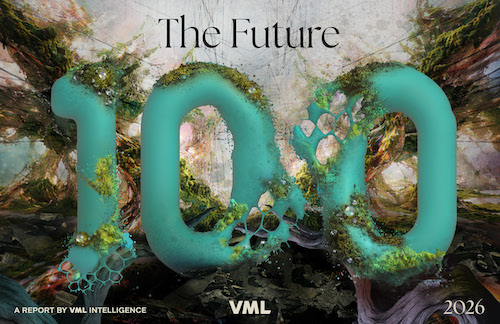
South Africans have long been recognised for resilience. Now, it appears the world is catching up. As 2026 unfolds amid global challenges, VML’s 12th annual Future 100 report introduces an emerging cultural ethos: dystoptimism. The concept captures a collective mood that acknowledges darkness without surrendering to it and is finding possibility in renewal.

The Future 100: 2026 report is based on a global survey across 16 markets and identifies 100 trends shaping global business and culture in the year ahead. It reveals that people are not merely coping with disruption, they are embracing it as a catalyst for fundamental changes in how they live, spend and connect.

‘Dystoptimism highlights that as old systems crumble, individuals, communities, and innovators are building new, human-centered solutions. It’s about designing for a better future, not just wishing for the past,’ said Emma Chiu and Marie Stafford, Global Directors, VML Intelligence and co-authors of The Future 100: 2026.

Key Themes From The Future 100: 2026

1. Looking For Enlightenment And Joy In Adversity

Exhausted by cycles of negativity, people are seeking experiences that elevate their spirits, enlighten, and shift perspectives. Eighty-six percent of respondents are drawn to encounters that inspire awe or a renewed worldview, and are seeking travel, wellness, culture and retail experiences as catalysts for personal growth:

– Transformative experiences and Immersive wellness reflect the rise of retreats and environments built for deep personal journeys.
– Resilience wellness reframes resilience as a learnable practice, blending emotional, physical and spiritual tools to help people adapt to turbulent times.
– Nano trips illustrate how short and high-impact getaways are being used to find perspective or try on new identities.
– Treatonomics highlight the rise in small indulgences, where regular pleasures become a survival strategy even as people cut back elsewhere.

2. AI’s Growth From Tool To Collaborator

– AI is a major force, both disruptive and enabling. Growing comfort with AI is reshaping how people are using it to reshape their realities while fiercely protecting what makes us human:

– Generative realities and AI storyworlds trends show how AI enables the generation of adaptive worlds in real time, pointing to a future where entertainment, commerce and customer experiences are co-created with algorithms.

– Synthetic generation and RelAItionships evolved explore AI’s increasingly intimate role in people’s lives. From emotional companions to automated ’employees’, we’re negotiating what it means to live and work alongside non-human counterparts. Almost half (49%) of gen Z say they have already formed a meaningful relationship with AI.

– Trends such as Truth literacy, Omnisurveillance, Digital intent and Coded empathy show how governments, platforms, designers and brands are being pushed to rebuild trust and make AI more transparent and accountable, even as it’s embraced as a creative and practical ally.

3. Human Connection Reigns Supreme

– Even as digital and physical realities blend, the report finds that true human connection remains vital:

– In Hyperreality, online and offline culture fully intertwine – memes become physical products, digital language becomes everyday speech, and luxury brands turn viral jokes into real-world objects. Yet across the report, people say they still prefer human contact when they’re making decisions that matter.

– Trends such as Social health and New rave scene highlight a surge in community driven spaces – from social wellness clubs and sober raves to neighbourhood ‘third places’ that prioritise belonging over transactions.

– ‘The brands poised for leadership in 2026 are those that can operate confidently in blended realities and navigate these myriad shifts in consumer behaviour,’ said Naomi Troni, Global Chief Marketing Officer at VML. ‘We must design for both the ambitious and anxious sides of consumers.’

– Across its 100 trends, The Future 100: 2026 offers marketers, innovators and leaders a clear brief for the year ahead. For more insight on what this means for brands and marketers, read the full report.

The full report is available for download here.

VML SOUTH AFRICA
https://www.vml.com/south-africa

Five Consumer Trends That Will Impact FMCG In 2026

Five Consumer Trends That Will Impact FMCG In 2026
Zak Haeri, NIQ.

According to Zak Haeri, MD for South Africa at NIQ, a perfect storm of economic volatility, new consumer expectations and rapidly evolving lifestyle choices will redefine the FMCG sector in the year ahead. For FMCG retailers and brands, this moment requires a clear-eyed understanding of how value, affordability, convenience and lifestyle choices are being redefined across income groups and categories.

South African consumers entered 2026 with a mindset shaped by prolonged uncertainty. Years of rising living costs and constant adjustment have fundamentally changed how people shop, plan and prioritise. NIQ’s latest insights point to a consumer who is pragmatic yet cautiously optimistic, digitally enabled but anchored in physical retail, and highly responsive to further price shocks. For retailers and manufacturers alike, the challenge is to adapt quickly, using insight-led strategies to stay relevant in a market where consumer sensitivity is high and expectations are rising. This piece looks ahead to the consumer trends that will matter in 2026 and beyond, and what they mean for FMCG decision-makers.

Learning To Live With Volatility

NIQ’s Consumer Outlook research shows that nearly two thirds of South Africans expect their household situation to improve as of the beginning of this year. But the reality is that this apparent confidence disguises how consumers have readjusted their expectations after years of economic stagnation and price rises. They have learned to live with volatility and have come up with a range of strategies to manage everyday expenses as borrowing costs and inflation continue to squeeze their wallets.

Actions for brands and retailers: it is more important than ever for brands and retailers to understand how consumers across different income groups are responding to ongoing economic pressures. Their strategies and tactics will need to accommodate a world where consumers are planning purchases more carefully, willing to switch brands, and splitting baskets across retailers and channels to maximise value and convenience. Promotions and loyalty programmes remain among the most effective ways to encourage repeat purchases and nurture customer loyalty.

Consumers Lose Tolerance For Further Price Increases

With consumers facing steep price increases for day-to-day essentials over the past five years, shoppers are very sensitive to price hikes, especially in discretionary categories. Even the tactic of reducing pack size is becoming less effective as consumers push back against ‘shrinkflation’. Our research shows that affordability and low pricing rank as the single biggest reason for brand choice among South African shoppers, highlighting that keeping prices down is important for brands that want to be competitive in a difficult market.

Actions for brands and retailers: Brands will need to find more innovative ways to preserve their margins, falling back on price increases as the last resort – and only where brand strength can sustain it. One powerful tactic is to focus on capturing more trips and baskets through better product assortment and private label offerings. In the longer term, market leaders are focusing on managing their input costs by reformulating products to minimise dependency on expensive ingredients like cocoa.

Seamless Commerce Is The New Frontier

Consumers expect instant, personalised shopping pathways, creating the expectation for retailers and manufacturers to be able to deliver everywhere, all at once. In response, social commerce, quick commerce and offline stores are converging into a single ecosystem. Our data for Africa and Middle East shows social shopping gaining traction through WhatsApp and Facebook Shops, but physical retail still accounts for 95% of FMCG sales.

Actions for brands and retailers: Brands must innovate across digital and physical touchpoints, balancing convenience, personalisation and cost efficiency to remain competitive. Now is the time to modernise the media mix by balancing digital acceleration with traditional channels, leveraging Retail Media Network (RMN) efficiencies to offset lower-converting high value channels, and maintaining full-funnel coverage across the consumer journey.

Convenience Redefined

Consumers’ perception of convenience is being rapidly redefined by customisation, e-commerce and experiential value. Convenience is now part of a broader value equation that includes quality, personal relevance and experience – not just price. In personal care, this might mean products tailored to individual skin and hair needs. For home care, it might refer to multi-functional products and refillable solutions. And in food and beverages, ready meals and near-instant home deliveries are booming.

Actions for brands and retailers: Brands will need to focus on remove friction from every part of the consumer experience, starting with discovery and purchase. Those that invest in data integration and artificial intelligence will have an edge in connecting and understanding signals about consumer behaviour and expectations. Building unified, centralised data systems to create a single source of truth will enable brands to make faster insight-driven decisions.

Lifestyle Changes Reshape The Consumer Landscape

Lifestyle changes will continue to accelerate throughout 2026, bringing trends that were once on the periphery to the mainstream. Shoppers are prioritising simplicity, health and minimising waste. Anti-obesity medication, especially, is bringing widespread disruption to the food and beverages category, while alcohol consumption trends downwards in younger generations and eco-conscious consumption keeps rising.

Actions for brands and retailers: Our data shows 68% of consumers in Africa and Middle East are willing to pay more for fresh, preservative-free, organic products, while 70% are prioritising healthier food and drink options. Brands that were not among those catering early to these demands will need to accelerate efforts to address consumer expectations around healthier consumption and more ethical production.

NIELSEN
https://www.nielsen.com

Woolworths Recognised At International Content Marketing Awards

Woolworths Recognised At International Content Marketing Awards

Woolworths South Africa has been recognised on the global stage at the International Content Marketing Awards (ICMA) in London, receiving the Grand Prix Gold for Best In-house Agency. Woolworths also received further accolades for its purpose-led campaign ‘This Apple Can Save the World’, winning Gold for Best Purpose-Led Content and Silver for Best Use of Innovative Technology.

The Grand Prix award recognises Woolworths’ distinctive approach to brand-owned storytelling, underpinned by an integrated in-house content model and a strong long-standing partnership with Media24 Advertising and Content Marketing (ACM).

‘Our content marketing team exists to tell the stories that make Woolworths the most-loved brand in South Africa,’ said Cathy Lund, Executive Content Director at Woolworths. ‘As an in-house team, we unite business strategy, brand, creative and content expertise around a single mission: delivering audience-first storytelling that is strategically grounded, creatively ambitious and commercially effective,’ she explained. ‘Being recognised as Best In-house Agency at the ICMA validates the model we’ve built, one that blends deep business integration with creative leadership and partners who help us bring that vision to life with excellence and scale.’

Embedded within the Woolworths business, the content marketing team leads a broad content ecosystem spanning owned platforms as well as partner-produced properties such as Woolworths TASTE and the Eat Out Woolworths Restaurant Awards, developed in collaboration with Media24 ACM. This in-house model enables close alignment with product, trading and seasonal priorities, while ensuring a consistent brand experience for customers.

The strength of Woolworths’ content ecosystem was further highlighted by multiple awards for Woolworths TASTE, produced by Media24 ACM, which received six accolades across key categories:

– Silver: Best Use of Social Media for Woolworths TASTE’s social channels.
– Silver: Best Use of Imagery for Woolworths TASTE – Our Best Ever Christmas.
– Bronze: Best Use of SEO for Woolworths TASTE – Making Culture Visible.
– Bronze: Best Use of Monetised Content for Woolworths TASTE – Ottolenghi campaign.
– Silver: Content Person of the Year for Katharine Pope (Media24).
– Bronze: Best Inter-Company Engagement for Woolworths Shop Talk (Internal Comms).

Nerisa Coetzee, Chief Revenue Officer at Media24, said, ‘These awards highlight the power of collaboration between Media24 Advertising and Content Marketing and Woolworths, combining insight-driven strategy with creative excellence to deliver high-performing content. Woolworths is a client that truly values audience relevance, craft and effectiveness, and this shared ambition enables us to create work that resonates with both consumers and employees. A special congratulations to Katharine Pope on her Silver for Content Person of the Year, a well-deserved recognition of her leadership and vision. I’m incredibly proud of what we’ve achieved.’

Elizka Ferreira, Head of Food Marketing at Woolworths added, ‘Media24 Advertising & Content Marketing’s ability to deeply understand our brand, our customers and the cultural moments that matter most has been instrumental in creating content that truly resonates. From TASTE’s visual storytelling to the Ottolenghi and Making Culture Visible campaigns, this partnership continues to deliver exceptional creativity and tangible business results.’

WOOLWORTHS
https://www.woolworths.co.za/

Real Brand Growth Is Built Through Strategic Consistency, Not Rushed Reinvention

Real Brand Growth Is Built Through Strategic Consistency, Not Rushed Reinvention
Shanna Davis, Penquin.

As the 2026 calendar year begins, the corporate world once again feels the pressure of the so-called ‘January Reset’, a belief that brands need to refresh, pivot or reinvent themselves to signal momentum. According to Shanna Davis, Senior Brand Manager at Penquin, this seasonal urgency often does more harm than good. 

‘There’s a lot of pressure at the beginning of the year to reset, refresh or reinvent,’ said Davis. ‘But from a brand perspective, growth isn’t triggered by January. It’s built through sustained effort, clarity and commitment over time. While that momentum can be useful, it can also create unrealistic expectations about how quickly meaningful change should happen.’

Consistency is one of the most misunderstood, and undervalued, drivers of brand success. Every campaign, message and customer experience creates familiarity, trust and long-term brand equity, making consistency critical to long-term success.

‘From a brand perspective, growth doesn’t respond to calendar moments, it responds to sustained effort,’ Davis continued. ‘Brands are not built in bursts; they’re built in layers. In a market obsessed with what’s next, consistency is what makes brands memorable.’

In South Africa’s dynamic market, where economic pressures and digital fragmentation demand agility, the temptation to chase quick wins is strong. Yet, Davis explained that real impact requires time for strategies to take root both internally and externally. ‘Real brand change takes time because familiarity, trust, and equity are earned through repetition,’ she explained. ‘Consistency is often misunderstood as playing it safe, when in reality it requires discipline and restraint. Brands that win are the ones that stay clear and committed while others keep changing direction.’

For many Brand Managers, the temptation in Q1 is to add more to the marketing mix. However, Davis suggests that the smarter strategic move is often to do less, but with higher precision and consistency.

‘The energy of a new year is a starting point, not a shortcut,’ said Davis. ‘Real brand progress happens after the initial momentum fades, when consistency becomes a conscious strategic choice rather than a trend. Brands that focus on fundamentals, clarity, and long-term thinking are the ones that build growth that lasts well beyond the first quarter.’

PENQUIN
https://www.penquin.co.za

2Stories Wins Best Medium-Sized Agency Of The Year At International Content Marketing Awards

2Stories Wins Best Medium-Sized Agency Of The Year At The International Content Marketing Awards

Run by the Content Marketing Association, the International Content Marketing Awards (ICMAs) attract entries from agencies and brands in over 30 countries and are judged by more than 170 content marketing experts. Content marketing agency 2Stories has been named Best Medium-sized Agency of the Year at the 2025 ICMAs in London, earning major international recognition in its first year of entering the global awards programme.

The Agency of the Year Grand Prix recognises all-round excellence, including financial performance, client retention, new-business success, team development, and creative and effectiveness outcomes. For 2Stories, the win marks a significant milestone in the agency’s growth, and a global benchmark moment.

‘2Stories was founded on a simple belief: when you put people first, your team, your audiences, your clients, the work becomes irresistible,’ said Anelde Greeff, co-founder and co-CEO of 2Stories. ‘Happy people make great work. Great work creates happy clients. And happy clients stay.’

Five years on from a two-person start, the 41-person distributed agency now works with some of South Africa’s largest institutions, as well as global organisations tackling urgent social challenges. Growth has been steady, strategic and values-driven, with client retention, new business and creative excellence reinforcing one another.

Alongside the Agency of the Year title, 2Stories also received two category wins from eight nominations, reflecting the depth and consistency of its work, particularly in financial services and internal communications:

– Best Inter-company Engagement: Silver, My Blue Book (Standard Bank Group).
– Best Financial Content: Bronze, The Messy Middle (Genfin).

Joanne Hope, co-founder and co-CEO of 2Stories, added: ‘Much of our work happens in complex content ecosystems where governance, scale and clarity are non-negotiable. Those constraints don’t limit creativity, they sharpen it. This recognition belongs to our multidisciplinary team, our trusted clients and collaborators that values carefully crafted content.’

2STORIES
https://2stories.co.za

This is Modern Marketing