

Home Blog Page 372

Kantar South Africa Helps Marketers #GetMediaRight

Fuelled by technological innovation, there are multiple new ways for brands to communicate and interact with consumers. Every consumer experience has the potential to change their attitude and behaviour towards your brand and yet budgets and resources simply cannot cover all touchpoints.

This means it is more important than ever to pinpoint the moments that matter for your customers; to ensure your brand is confidently investing in touchpoints that will drive ROI.

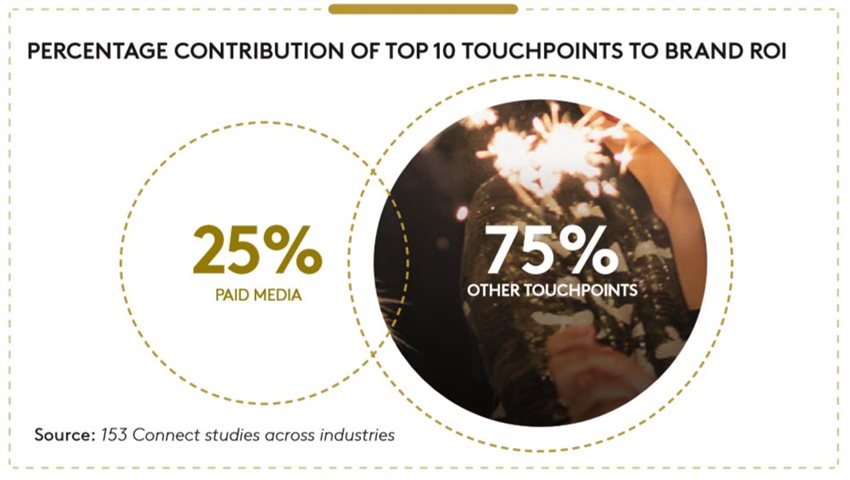
Part one of the Power of Connection series from Kantar South Africa unpacks key learnings and insights across all media touchpoints in South Africa to provide marketers with a competitive edge in optimising media investment to help them #GetMediaRight. Brands are the sum of all experiences with a product. Paid media contributes, on average, 25% to overall ROI.

Ensuring your brand invests in the right paid for media touchpoints is key to unlocking future growth. The following insights are based on Kantar’s Connect Database, which looks at touchpoint contributions across hundreds of studies from various categories.

Marc Pritchard, CMO of Procter & Gamble (P&G) said that in an effort to keep up and be present at as many touchpoints as possible, the quality and consistency of communication suffered. ‘In this digital age we’re producing thousands of new ads, posts, tweets, every week, every month, every year. We eventually concluded all we were doing was adding to the noise.’

In addition, the pressure to make use of algorithms and other ‘shiny’ tools meant brand managers felt increasingly out of touch with their brands. ‘We relinquished too much control,’ said Pritchard. So how can brand managers get back in the driving seat and bring their brand up-to-speed?

To answer this question, Kantar analysed more than 270,000 touchpoint experiences in over 450 Connect touchpoint studies worldwide.

Three key strategies were identified that help brands find extraordinary growth:

  1. Do fewer things, but excellently

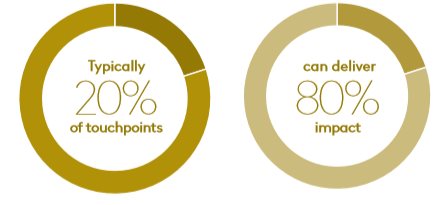
Brands have more ways than ever to reach consumers. However, to maximise ROI, brands should identify the key touchpoints that deliver the majority of brand impact, and learn from competitors to optimise these touchpoints.
Case study: coffee brands

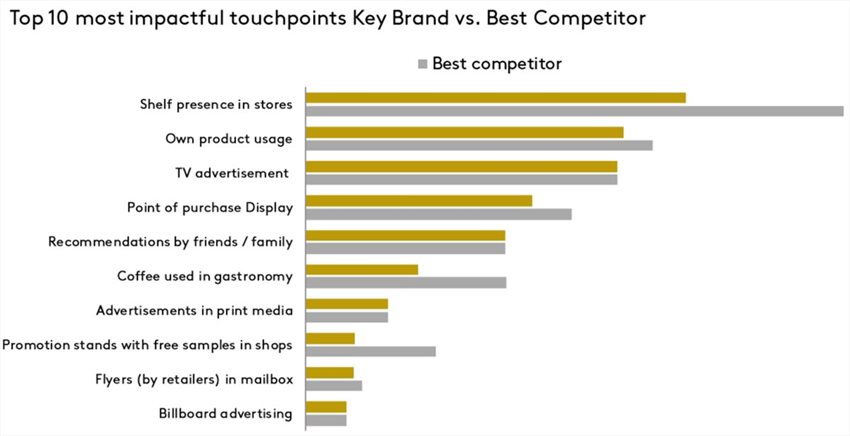
To illustrate this point, we draw on a touchpoint study in the coffee category, with coffee drinkers aged 20 to 65 years. In this case study there were 43 touchpoints where consumers might potentially experience a brand, including traditional paid touchpoints (such as TV advertising), owned touchpoints (such as the shelf presence or website), as well as earned touchpoints (such as word of mouth). Analysis showed that the top 10 most impactful touchpoints contributed 81% of brand impact. The remaining 30 touchpoints had little or no impact in the category.
2. Find brand growth beyond paid media

Consumers interact with brands across many touchpoints outside of media, including touchpoints before, during and after purchase, paid media touchpoints, owned touchpoints and earned touchpoints. One of the amazing findings of our more than 150 Connect studies is that brand building is not a matter of paid media alone. Paid media only contributes 25% to the overall brand equity and yet, many companies are optimising their media performance only. By doing so, brands have a blind spot for all the other touchpoints that contribute 75% to the brand.
Connect your audience with relevant channels

Any well planned campaign starts with your target market, which is even more crucial when deploying multiple media channels. Get to know your audience, understand exactly who they are and what they’re looking for. Different media will reach different audience segments and produce different responses. You can improve your overall media performance by understanding your audience’s receptivity to each touchpoint in their journey to purchasing your product.

3. Leave a unique brand footprint

From case studies across South Africa, the importance of non-paid-for media touchpoints is irrefutable. Although this does vary by category, more than two-thirds of brand ROI is driven by non-media touchpoints. In retail, for example, non-media (elements such as store layout and in-store experience for example) contribute almost 20% more to brand ROI than telecommunications, so understanding category nuance is key in optimising media strategy.

What works in one category will not necessarily translate into another. Regardless of categories across paid media touchpoints, TV continues to dominate importance. When looking at the importance of social media platforms combined with other digital advertising, investment across the digital ecosystem will undoubtedly deliver brand ROI.
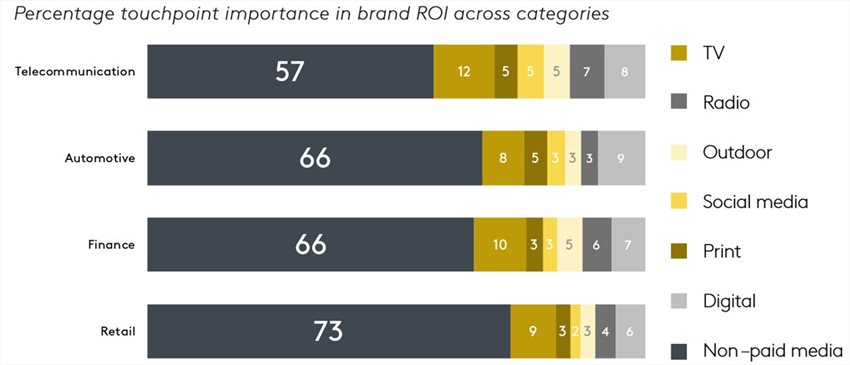
Not all touchpoints deliver the same impact across brands, thus understanding impact for your brand vs. key competitors are key in optimising future strategy.
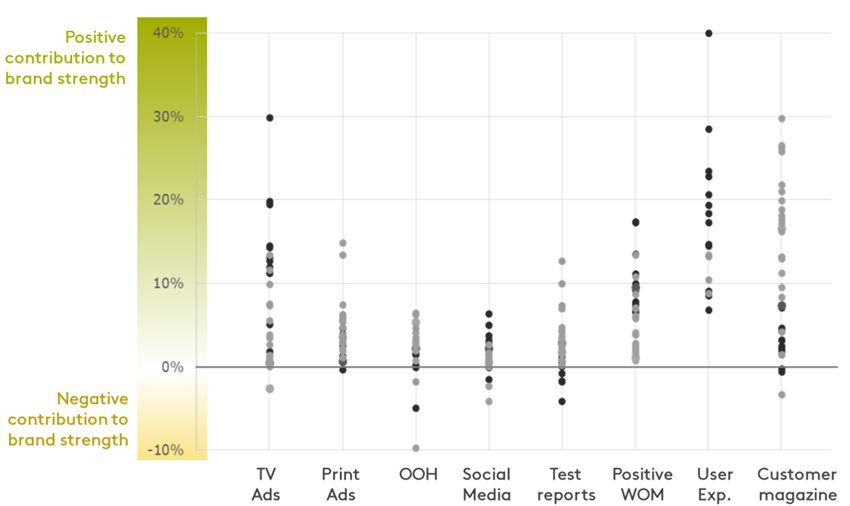
Whilst it is key for media planners and strategists to ensure the most relevant touchpoints are included in a media plan, touchpoint selection alone will not automatically guarantee great brand ROI. The impact of touchpoints varies across brands. In the above graph, every dot represents one brand. For every one of these brands, their touchpoint experience has a different impact on overall brand ROI – it can be positive (green part of the Y-axis) or negative (yellow part of the Y-axis).

Looking on the left side: we see TV advertisements for some brands work really well, but for others, TV is not working at all. The same distribution can be observed across touchpoints. The key factor of determining the extent of a touchpoint’s contribution to overall brand ROI is the quality of the creative. Cut-through creative will result in higher touchpoint contribution, whereas poor-quality creative will, in some instances, result in negative brand ROI. It is the combination of relevant touchpoints and quality creative that determines whether or not the brand ROI is maximised.

Understanding the role of touchpoints and their synergies across the consumer journey helps you activate your brand strategy more accurately and effectively. Helps you to optimise investment across all consumer touchpoints including paid, owned and earned, particular when budget conversations come up.

Connect helps you manage touchpoints holistically across your brand and competitor brands to deliver the best ROI across your marketing budget. Connect can help streamline touchpoints to those that matter the most for your particular category/customer to ensure you’re getting maximum impact.

Study Information: Sample n=1000 category users. 35 min survey. Timeline from commission to strategic workshop delivery two months.

KANTAR MILLWARDBROWN 
millwardbrown.com

How Brands Can Use Content To Stand Out During The Festive Season

The festive period from Black Friday to Boxing Day is when big brands pull out all the stops to reach into consumers’ hearts and tug on their purse strings. Brands are all saying the same thing, as loudly as possible: ‘spend your money here’ Justine Drake, Content Editor at John Brown and Editor of Fresh Living magazine, and Social Media Strategist at John Brown Media, Sharon Kariwo, discuss the role of content during the festive season.

Consumers are more concerned about inflation, the poor economy, the price of electricity, fuel and food, and interest rates (13% of respondents) than crime (1%). However, in a recent snapshot survey – Consumer 2020 Vision: South Africans and their Outlook – assessing current consumer sentiment, the biggest challenge identified (by 49% of respondents) was the expected increase in the cost of living.

The festive period will always be a time to splurge, but with the global economic downturn, customers will spend a lot more time investigating prices. How do you ensure that not only is your brand top of mind, but also that your product offering is justifiable when consumers are feeling the pinch?

Black Friday

According to Drake, ensuring your brand is seen and heard during this time is simply a case of ‘he who shouts loudest’. This is the time to be big, brash and loud – clever, creative and useful content will be lost in the fray.

On Black Friday, while there is much anticipation and excitement, there is equal frustration. The queues may be too long, the staff may not be equipped to handle the chaos or the OLS can’t handle the traffic. Take care to plan and train well or this frustration will turn to anger and resentment towards the brand.

Content vs. price

At the end of the day, everyone will be offering the same product, and with the economy so depressed, the saying ‘price is king’ is truer than ever. ‘On days like Black Friday, content won’t matter; only price and service will give your brand a competitive advantage,’ said Drake.

‘However,’ Kariwo explained, ‘prior to Black Friday there is an opportunity for storytelling.’ You can use teaser campaigns and other content ideas to tell an aspirational lifestyle story, keep the brand top of mind and encourage search.

‘We do things like polls on what you’re hoping to buy on sale and, using the data obtained, we start to build the hype with tips on how to prepare for the big day, like putting things onto your wish list,’ she explained.

Kariwo agrees with Drake that on the day, it’s about the deals and nothing else. ‘I only communicate logistics on the day,’ she said. ‘For example, if there’s a product that’s selling particularly quickly, I’ll mention how many are left at a specific store or online, or where the queues are shortest.’

Updates on website performance and responses to customer complaints like ‘How can this be sold out in just an hour?’ need to be immediate. After the event, brands will be inundated with customer service-related communication, queries and complaints about deliveries, call centres, etc. Be prepared.

And then there’s Christmas

‘Conversely, content, rather than price, remains at the heart of all things festive,’ said Drake, ‘but it only works when it’s relevant. Very few South Africans go in search of the northern hemisphere, cold-weather food, so why must brands continue to produce Eurocentric Christmas food spreads and scatter snowflake decals everywhere?’

‘Instead, create content that is accessible (luxury items mixed with more affordable bits and bobs), solution-based (how to braai a gammon) and inspiring. Try DIY gifting ideas and recipe hacks. There are myriad opportunities for genuinely helpful content around Christmas and folk are desperate for it. If the customer can see themselves in your narrative, you will convert them to buy.’

‘It’s really important to empower and inspire people with new ideas around their usual choices,’ said Drake. ‘If you’re going to buy a gammon, give them ideas for another five things to do with it. Customers need a reason to spend more that will make sense and be justifiable.’

Thinking like a shopper

When it comes to foot traffic, brands need to consider why a customer should choose their store over a competitor’s. ‘To reduce the inevitable stress on big shopping days, stores can offer things like coffee and cupcakes, and validated parking to customers. Additionally, they can use digital marketing tools such as geolocation targeting around low-traffic stores to encourage customers to come and shop,’ said Kariwo.

‘I think we’re moving towards a more frugal festive culture and consumers are gravitating towards bring-and-braai lunches and ‘Secret Santa’ draws,’ said Drake. But instead of seeing this as a drawback, create a reason to buy that one big-ticket Secret Santa gift rather than a list of meaningless little ones you would ordinarily buy for all and sundry. ‘There is always a story to be told,’ said Drake, ‘and there is no better time of year to tell it.’

The next big thing

Next year, we predict the shopping season may commence slightly earlier thanks to the world’s largest retailer, Alibaba, which pioneered Singles Day in China on 11 November 2009 as an anti-Valentines Day gifting opportunity for those flying solo.

Singles Day has been experiencing on average a 40% growth year-on-year and in 2017, Alibaba recorded $25.3bn in turnover on Singles Day, which amounts to 276 times the Black Friday sales made in South Africa that year.

JOHN BROWN MEDIA
+27214867600
Lani@johnbrownmedia.com
johnbrownmedia.co.za

Edgars Appoints Moving Tactics As In-Store Digital Signage And Media Partner

The concept of creating entertainment through shopping and socialising is enhanced and supported by Moving Tactics’ digital signage installation that includes Point of Sale signage, pillar screens, touch screen kiosks, convergence area screens, in-store music and large-impact staggered video walls that accompany the customer on their journey through the store.

Edgars appointed Moving Tactics as its in-store digital signage and media partner for its new ‘open experience’ retail concept, as revealed at its recent flagship store opening at Fourways Mall in Johannesburg. 

The new 8000sqm Edgars Fourways Mall store has been upgraded with over 65 screens in various sections of the store, including unique screen placement at Point of Sale. The Point of Sale screen content is synchronised to the nanosecond to create seamless flow over a staggered six-screen video wall solution that captivates the customer.

To complement the captivating visual display, Moving Tactics has also installed a five-zone Digital Audio Solution across Ladieswear and Cosmetics, Menswear, Kidswear, Spa and Café. The Audio solution has been professionally designed so that there is no audio interference between departments, creating an uplifting shopping experience for the Edgars customer.

‘As part of the Customer Audio and Visual Journey, we are also testing various interactive digital solutions such as Digital Mannequins to allow customers to visualise the current fashion trends and Kids’ Digital Gaming tables in the Kids department to keep them entertained during shopping expeditions,’ said Kevin Bierman, Head of Digital Signage Solutions at Moving Tactics.

MOVING TACTICS
+27118070094 
chris.day@movingtactics.co.za
www.movingtactics.co.za

Customer Behaviour: Convenience Vs Brand Loyalty

Richard Mullins, Managing Director for Europe, Middle East & Africa at Acceleration.

Richard Mullins, Managing Director for Europe, Middle East and Africa at Acceleration, says with the ability to browse, compare and order with a few swipes and taps, consumers are becoming trained to value convenience and service above nearly anything else.

What motivates them is not how much they love the brand of a retailer, service provider or manufacturer, but how quickly, conveniently and cost-effectively the provider can address their need. Wunderman Thompson recently conducted some research which shows that 88% of consumers said that service matters most to them, compared to just 78% who said brand.

Consumer expectations are rapidly shifting as technologies such as mobile, geolocation, social media and increasingly, Internet of Things devices and wearables, connect people to a world of easily accessible information and convenient services. With the ability to browse, compare and order with a few swipes and taps, consumers are becoming trained to value convenience and service above nearly anything else.

Consider the example of some of the world’s leading on-demand brands such as Uber, Airbnb and Netflix. They have captured massive global customer bases, not by making large investments in branding and advertising, but by delivering the product or service that their customers need at the right moment in time. Their brands are powerful today, but this brand power flows from their ability to serve consumers at their point of need.

To take another instance, one of the factors that make Amazon such a powerhouse is its ability to rapidly and conveniently fulfil orders for one of the world’s largest selections of products. Not only can consumers in most parts of North America and the UK get next-day or even same-day delivery of a wide range of goods, they also have the option to schedule delivery at a time that suits them for a small cost premium.  

Elsewhere, we are seeing clothes and even durable goods becoming on-demand services rather than treasured possessions. Many younger people in the UK are treating clothing as a disposable item, ordering new clothes nearly every week using services such as Asos.com’s instant delivery. What matters more than the label is having a new outfit to sport in every selfie — delivered to the doorstep at a time that is convenient to them.

This is just the beginning. The next step for on-demand brands will be to not only deliver at the point that the consumer expresses a requirement, but before the customer even knows he or she needs a product. For example, the tyres on your car may soon have embedded sensors that detect when the tread is getting thin and send a message to order new ones. This is already becoming commonplace with internet-connected devices such as fridges and coffee machines that automatically order replenishments according to your predefined preferences.  

According to research by Wunderman Thompson, consumers are already warming up to these concepts in their personal capacity, which it calls ‘programmatic commerce’. In 2016, only 10% of consumers said they were ready to enter into auto-replenishment relationships with brands. But by the end of 2017, this number had already climbed to 46% and it now sits at 57% in 2018. Steadily, consumers are looking past fears about privacy or companies billing them for products they don’t want or need to the fact that they love speed and convenience.

The brands that want to remain relevant in the future will need to understand customer engagements and technology, that allows them access and insight into their customers’ needs. The technical architectures that allow them to meet the customer’s need is going to sit at the heart of their business, to enable the right time and place of demand. 

Businesses will need to focus on creating fast-friction digital interfaces to serve an impatient consumer who will pick the service he or she can access quickest. Having a prominent brand and getting the consumer’s attention is not enough, winning is about offering the best and fastest service.

ACCELERATION
acceleration.biz

Implications Of The Fourth Industrial Revolution On Advertising And Media

Online Shopping Is Shifting Purchasing Habits Forever
Claire Herman, Media Operations Lead at The MediaShop.

Let’s first go back in time to the late 1700’s/early 1800’s, where the first Industrial Revolution brought us advances in textile manufacturing and the innovation of the steam train. A few decades later into the end of the 18th century, we entered the second Industrial Revolution that introduced steel production, the automobile and electricity, says Claire Herman, Media Operations Lead at The MediaShop.

In the 1900’s we experienced the rise of digital technology and computing and the world around us fundamentally changed. Life became much faster with information at our fingertips and communication that was instantaneous. But what does this all actually mean for us in 2019/2020?

Is that where we thought it would end? Not a chance! In fact, it is intensifying at a rapid pace. Today we are fully immersed in the Fourth Industrial Revolution, which is all about Intelligence. It is defined as the current and developing environment in which disruptive technologies and trends such as the Internet of Things (IoT), robotics, virtual reality (VR) and artificial intelligence (AI) are changing the way we live and work.

Global borders don’t inhibit when, where and how we work – we are constantly connected. Our knowledge bank seems infinite – we can find out almost anything in a matter of seconds, all we need to do is ‘Google it’. But Big Brother is watching – there is nowhere to hide. As a result, we need to adapt, and at a rapid pace. We are entering a world where our fridges will order our groceries for us, our cars will drive us to work, we will have very little need to physically go shopping, our food will adapt to the nutritional needs of our bodies, and holidays will be to other planets. Why not? The opportunities are endless.

Fourth Industrial Revolution (4IR)… I first heard this buzzword at the BCX Disrupt Conference in 2017, where I was lucky enough to see two phenomenal speakers who tackled the topic.

The first was Richard Mulholland, founder and C-3PO of Missing Link. His topic was ‘Do we need to fear the Fourth Industrial Revolution?’ It’s a term first introduced by Karl Schwabb, a German engineer and economist best known as the founder and executive chairman of the World Economic Forum. His book, simply titled, ‘The Fourth Industrial Revolution’ was published in 2016. Mulholland says predictions are that we will reach the point of singularity around 2040/2045 – the point at which machine intelligence will supersede human intellect, and computers or ‘trans-humans’ will take over the world!

The second speaker was Will.i.am, seven-time Grammy award winner, frontman for the Black Eyed Peas, Executive Producer of ‘Planet of the Apps’ and Founder and CEO of i.am+, a company that fuses the worlds of technology, culture, fashion and AI. When asked what keeps him up at night his answer was this: What will happen when two driverless cars are set for a head-on collision? How will they negotiate with each other on which one will move out of the way first? It will be based on the passengers they are carrying – who is older, who has a genetic marker for cancer, how many dependents does each one have, who is more successful and contributes more to the economy, etc.? And will all of this be detected in a split-second or will we reach a point where cognitive AI will treat all humans equally? It’s quite a terrifying thing to keep you up at night!

What are the implications of such a technologically advanced society?

Firstly, the school system as we know it will need to fundamentally change – it’s interesting to note that some schools are already pioneering in this space. For example, in 2020 South Africa’s first online high school will be launched (The Venture Institute). What does our schooling system look like in the future – what and how do teachers teach? Educators will need to be retrained, based on new subjects that are being introduced.

Several primary schools have acknowledged that they are preparing kids for jobs that haven’t even been invented yet. We have been completely taken out of our comfort zone with ‘out there’ concepts such as teaching Grade 1’s philosophical thinking – would you prefer a time machine or a money tree? When I was in Grade 1, I was learning my ABC’s and how to count. Some schools have introduced a no-homework policy, rather focusing on project-based learning in teams during school hours. It is all very ‘revolutionary’, and us as parents must blindly accept that this is for the benefit of our children. We have bought into this thinking, so we are going with it.

Secondly, what does 4IR mean for current and future employment? The latest Stats SA figures show that our unemployment rate right now is the highest it has been in 11 years at 29.1%, and the doom-sayers predict that it will only get worse.

But as each Revolution unfolded, dire predictions of massive job losses ensued, increasing each time. The first three are over, and those concerns were clearly misplaced. The number of jobs actually increased with each revolution, as did living standards and every other social indicator.

Let’s look at the Banking Sector as an example. The last three banking licences awarded were for online banks – Tyme Bank, Discovery Bank and Bank Zero. Earlier this year we also saw Standard Bank closing almost 100 branches and retrenching over 1000 staff members. But I don’t think it is all doom and gloom. We just need to think laterally, learn to apply ourselves differently and adapt. One of the most sought-after human resources in the coming years will be for Cyber Security Specialists, a profession that didn’t exist 30 years ago.

Earlier this year I attended one of the Ads24 Food For Thought sessions, where we had to choose Human vs. Robot. Rapelang Rabana, Computer Scientist and Chief Digital Officer of BCX, said that from the 1.8 million jobs lost this year, 2.3 million more jobs will be created by next year. She believes that AI stands for ‘Accelerated Improvement’ and moving forward we will only be, she says, smarter, do more, experience more, see further into the future, and ultimately be better humans. It’s a very positive outlook, which is quite comforting.

And lastly, what does it mean for advertising and media? I keep on thinking of Tom Cruise in The Minority Report, where customised ads were popping up in front of him as he walked through a mall. The movie was produced back in 2002, but it had a not-so-unrealistic view on what the future could hold.

The advertising and media landscape is constantly changing, from how we consume media (super-fast, byte-sized chunks, pictures and video over text, second-screening, etc.), to what media we are engaging with (AI, chat bots, instant messaging, social media, etc.), and what creative and messaging we are exposed to (AI generated ads, eg.https://youtu.be/CV5KvMust0Y and AI generated royalty-free models, eg.https://generated.photos). 

We also need to be super cognisant of how we engage with consumers, taking into account privacy policies and the industry’s role and responsibilities in this space. Amazon, Facebook, Instagram, Google and Apple know us better than we know ourselves.

Their algorithms are tracking everything we buy, where we go, what we read and watch, what we like, every step we take, and every heartbeat in our bodies. I made the mistake of daydreaming online about buying a house in Mauritius – my newsfeeds are now completely taken over by real estate agents in Mauritius trying to sell me houses that I can’t afford. I can keep on dreaming.

So in this fast-paced, ever-changing landscape, that makes us feel largely out of control, is it the end of the world as we know it? I think it is, but we will be fine.

THE MEDIASHOP
+27112584000 
www.mediashop.co.za

FCB Joburg And Debonairs Send A #HeadlessMan To Deliver On Halloween

FCB Joburg worked closely with costume design professionals to create a realistic Headless Man costume with a considerable ‘skrik’ appeal in the recent Debonairs Pizza Halloween campaign that delivered scary results in terms of social media uptake.

Toni Joubert, Marketing Executive at Debonairs Pizza said, ‘Our intention was to join the conversation during Halloween in a way that would capture people’s imaginations and in a quirky way, raise the profile of our delivery service. FCB Joburg’s team responded with ‘#HeadlessMan’, a campaign comprising of guerilla-style content and appearances to generate hype around the hashtag #HeadlessMan. It was perfect.’

The team shot short pieces of content that was made to feel like authentic CCTV footage, dash-cam footage or cell phone recordings. These were leaked through micro influencers, with absolutely no attachment to the Debonairs Pizza brand, which made the content more authentic and shareable, so that it could potentially go viral, semi-organically.

The first of these ‘sightings’ was leaked by Dr. Malinga, and started trending across the country immediately, driving the hashtag #HeadlessMan. Other influencers helped fuel the fire over the next few days by posting more sightings videos. These gripped the country’s imagination with ‘Dr. Malinga’s Headless Man’ making newspaper headlines, and a spontaneous #HeadlessManChallenge soon dominating the Twitter feed.

‘#HeadlessMan trended for five consecutive days across the country. We couldn’t have asked for a more engaged and exciting response,’ said Joubert.

An additional twist to the campaign was that, on the evening of Halloween, the #Headlessman delivered pizzas to a number of unsuspecting customers who had ordered online or called in. Also, Debonairs Pizza released a one minute reveal on its social media channels.

‘The #HeadlessMan stunt was about hijacking Halloween and increasing brand love by creating a series of spooky Headless Man sightings that would get tongues wagging on Twitter,’ said Kambuwa. ‘Obviously, the reveal was a vital component of the campaign. It had to ensure that all who saw it realised that #HeadlessMan was a stunt done by Debonairs Pizza in the fun spirit of Halloween.

‘All phases of the campaign worked – very, very well. Our influencers were notching up 120,000 or more impressions as individuals during the ‘tease’ phase and, by the end of the campaign, we had achieved 3,3-million potential impressions with a potential reach of 866,000-plus. It’s a really satisfying feeling. Overall, it was a unique marketing stunt, with minimal production costs, and minimal spend on paid media to promote it,’ he concluded.

FCB JOBURG
+27115666000
fcb.co.za

Two South African Creatives Join Short Film Festival Jury

Moe Kekana and Ksenija Strydom-Micic.

Moe Kekana, creative group head, King James in Cape Town and Ksenija Strydom-Micic, executive producer, The Star Film Company in Johannesburg, are the two South African creatives among 65 leading film directors, producers, agency creatives and heads of production companies chosen to serve on the jury for the eighth annual One Screen Short Film Festival. 

The festival celebrates and awards global filmmakers from both commercial advertising and film industries. It is part of The One Club for Creativity, the foremost global non-profit organisation celebrating creative excellence in advertising and design.  

The fast-growing global festival focuses on all forms and aspects of short films: narrative fiction, comedy, commercials, branded content, music videos, spec work, passion projects, animation, sound, movie poster design, title sequences and more  — and has a mission to celebrate and award filmmakers from around the world working in both the film and ad industries, with no limitation and total artistic freedom, all on one screen.  

New regional awards

In addition to awarding work in specific genre categories, One Screen expands this year to also recognise creative excellence by region with best-of awards for Asia-Pacific, Europe, Latin America, North America and Middle East/Africa. Last year’s festival saw a significant increase in global entries, with work submitted from 45 countries.

‘As the world’s leading nonprofit organisation with the mission to support the global creative community, we’re well suited to recognise the best work in every region around the world,’ said Jonathan Jirjis, executive producer at The One Club and head of the One Screen programme. ‘This festival is committed to celebrating and awarding great storytelling and film craft on a global level.’

Visit onescreen.org to view categories and submission requirements. 

THE ONE SCREEN FILM FESTIVAL
onescreen@oneclub.org
onescreen.org

HelloFCB+ Flights CANSA’s ‘Don’t Fear The Finger’ Campaign

‘Don’t Fear The Finger’ is the Cancer Association of South Africa (CANSA)’s integrated advertising campaign by HelloFCB+ and is inspired by the classic horror movie genre launched during men’s health month in November, with a TVC that removes the fear and encourages men to go for a test. 

The spot follows a man tentatively going for his first prostate exam only to find out that his fears are completely unfounded. The campaign is urging South African men to visit CANSA Care Centres for a prostate blood test.

Social videos and online banners also use suspense and fingers to point men to the campaign microsite, where they can book an appointment at their nearest CANSA Care Centre.

Mike Barnwell, CCO of HelloFCB+ said, ’Using the very thing that men fear the most to deliver a positive message felt like the perfect way to dispel some of the myths around what men think a prostate exam is all about.’

Lucy Balona, Head of Marketing and Communication at CANSA, is enthusiastic about the campaign and added, ‘It’s important that men’s cancers are met with the same vigour and commitment that women’s cancer awareness receives. CANSA is proud to be a part of this project, and we hope that we can reach more men than we have before, encouraging them to get screened and get educated as early detection is vital.’

CANSA Care Centres offer reduced cost prostate screenings to encourage men to go and get tested. Go to www.dontfearthefinger.co.za for more info. 

HELLOFCB+
+27214040300 
www.helloFCB+.co.za

2020 Digital Landscape Trends

According to Hoorah Digital CEO, Shaune Jordaan – understanding which metrics matter to your business is more crucial than ever before. When brands and businesses are monitoring the metrics that align to their commercial goals, it becomes significantly easier to gain traction in the digital space and realise opportunities for growth. 

Analytics are the competitive advantage

Big data is still all the rage, but data alone is not particularly useful. Data needs to be organised, analysed, interrogated and interpreted before it can be used to improve marketing.  In 2020 there will be even more emphasis on the insights obtained from big data, and how marketers use these insights to inform decisions, actions and strategy at large. 

Analytics help teams stay focussed, accountable and objective. There’s no hiding behind the big creative idea, but increasingly about taking the transparency that data and analytics allow for seriously and ensuring the creative is always strategically aligned to the business goals. 

As our appreciation for data grows, so does the realisation that data is not numbers, graphs and tables, it’s people. Data is your customer profile, a guideline for a dynamic strategy and better ROI. 

Shaune Jordaan, Hoorah Digital CEO.

Hyper personalisation 

Not a new trend, per se, but hyper-personalisation continues to be a key marketing consideration for all brands. Hyper personalisation sees the focus moving from the brand itself to placing the consumer at the centre of the strategy. 

As it becomes harder to capture your audience’s attention, the need to personalise is no longer a “nice touch” but central to the success of the campaign. 

Personalisation is a way to cut through the clutter, though it is important to always do it with trust and authenticity. The shareability of the personal experience is equally important, it being the 21-st century word-of-mouth. 

More video 

No surprises here as video has grown exponentially in recent years and is likely to continue for the next five to 10 years. 

Video certainly isn’t limited to YouTube and continues to grow in popularity across channels and platforms. Brands should be incentivised by the fact that Google is 53 times more likely to place a website that includes a video on the first page of search results. 

In 2020 marketers will do well to think about shoppable video content, 360-degree video content for a more immersive experience, and live video wherever it makes brand or campaign sense. 

Micro-moments 

Marketers want to make sure they’re there for the micro-moments, those seconds when people turn to their phones to satisfy a need, whether it is to know something, to buy something, to go somewhere or to do something. 

People want these momentary needs to be satisfied immediately, which is why marketers need to “be there, be useful, be quick”, as per Google’s description. And it’s not only about being there in the moment, but also about delivering relevant content, making it easy for the customer to make a purchase and to ensure that the moment is a pleasant one.

HOORAH DIGITAL
+27103125733
info@hoorahdigital.com
www.hoorahdigital.com

Assegai Awards Recognise Ads24 In The Experiential Media Category

The Assegai Awards acknowledge exceptional results in the field of integrated marketing and score the entries on: Strategy 30%, creativity 30% and return on investment (ROI) 40%. Ads24 are the proud bronze winners for the ‘Experiential Media’ category of the Assegai Awards for their 2019 Food for Thought event, Robots vs Humans.

Food for Thought is an annual event that aims to engage and inform leaders and decision makers in the media, marketing and advertising space, through a thought-provoking event that focuses on cutting-edge developments and future trends impacting business, politics and lifestyle. 

Ads24 Brand Manager Marise van der Lith said, ’We are delighted to have won our very first Assegai Award. We are passionate about creating campaigns and events that go well beyond PowerPoint presentations and fact sheets. We continuously strive to improve ourselves, so by establishing a place in the Experiential Media category of the Awards, we are setting a benchmark against which we can measure the impact of future campaigns.’

This year the Food for Thought campaign focussed its attention on the theme Humans vs Robots where the speakers Brad Shorkend, Richard Mulholland and Rapelang Rabana highlighted the pros and cons on a human vs AI reality and sparked stimulating debate among participants.

ADS24
+27112591700
ads24.co.za
This is Modern Marketing