

Home Blog Page 355

The Effects Of Load Shedding On Advertising

Sinenhlanhla Jalibane, Digital Campaign Manager at The MediaShop.

Sinenhlanhla Jalibane, Digital Campaign Manager at The MediaShop, reckons that we are all wishing that Eskom had a competitor or that they worked there themselves to better the crisis being faced as load shedding has once again become one of the most used buzzwords in South Africa.

But while we wait for the government to attain a better solution to their ‘technical problems’ and revert with plans to overcome this crisis, load shedding continues to have dire implications on everyone, particularly for television advertisers and broadcasters alike. Advertising budgets have already been reduced but now with the power out, what does this mean for advertisers and the media industry in general?

1. Viewership decreases

Television indisputably remains the largest media consumption channel in South Africa. It is still the most effective way of reaching a higher number of audiences at a high frequency. However, it is no secret that such media platforms are highly affected by load shedding. 

Viewership is a client’s first concern when there is a blackout. It means that millions of South African TV households are off, reducing the potential TV audience of a particular channel or programme that has a huge effect for advertisers.

We have been experiencing stage 2 and 4 of load shedding recently. With that said, it is imperative to remember that having these power cuts means not reaching a household for at least two or more hours during each blackout. This is of serious concern, especially when power is cut during prime time, which decreases viewership even more significantly. It results in adverts only being seen by a handful of people, who might not even be the target audience for the brand being advertised, which is then seen as wastage by many. 

Britta Reid commented on a research article in 2019 published on The MediaOnline from The Broadcast Research Council, on how adult ARs for the 18h00 and 20h00 dayparts were affected. She commented that about 2% of adults on the BRC TAMS panel were flagged as having experienced power cuts during stage two, compared with 15% of adults during stage four. This equates to a huge number of audiences being lost due to load shedding and it doesn’t seem like it will get any better. 

2. Concern overreach

Secondly, clients have become sceptical about whether their brand will be seen by the right audiences as load shedding makes it difficult to plan schedules. I remember once when Eskom had promised two hours of load shedding but it went off for 3h30mins. This left me wondering how many TV adverts were being aired during this time that I would have missed.

Clients will (if they haven’t already) start questioning the value they are getting from advertising if they lose audiences during load shedding. Yes, brands are aware that performance will be affected (not that they’re happy about it) but there is, unfortunately, nothing that marketers and broadcasters can do at this point, as it is beyond their control. 

3. Even digital is affected

Lastly, cell phone network coverage has also been getting disrupted and it seems this will continue to be the case during our electricity crisis. It’s making our jobs as marketers even more difficult. Just as we were trying to chase audiences in the digital space, it is now going to be harder to reach them whenever we’d like to.

We all love our smartphones, but their battery life is not as great as we’d like it to be. Power banks and portal chargers can help sustain battery life, but with port connectivity, it seems like it would be a struggle to get advertising messages across audiences.

People would also rather save their battery to ensure for instance that their alarm wakes them up in the morning, rather than to scroll through their phones only to come across adverts that will deplete their battery even further.

So what do we do?

While the country has enjoyed a few days of no load shedding now, there is still an unnerving sense of uncertainty around Eskom’s sustainability. President Cyril Ramaphosa announced during his SONA 2020 address that the Eskom issue was unavoidable. This shows that we’ve got a long way to go and for brands, we need to think of alternative ways to reach our audiences.

It seems like the old school ‘wireless’ radios would be of good use at this point for people to still consume news during load shedding and this, without a doubt will cause an increase in listenership on the radio.

Maybe it’s also time to put more faith into apps such as EskomSePush to plan around most areas that are experiencing load shedding to ensure audiences are not lost. Imagine scheduling adverts to be aired on a Monday, Wednesday and Thursday at the same peak time as load shedding is scheduled? Let’s hope it doesn’t come to that.

THE MEDIASHOP
www.mediashop.co.za

SportsHosts Campaign Shows The Importance Of Sport In Healing Divisions

An all-South African core team handled what is essentially an American story for SportsHosts’ latest brand film.

HaveYouHeard documented the story of a father and daughter who have polarising views on just about every major issue currently defining American politics. But, as the story unfolds, we learn that some things are more important than ideological differences; like their love of basketball and the weekly ritual of going to games together. Shot in Brooklyn and Queens in New York City, the film is peppered with references to the sport, both in his house and her car – a basketball, a coffee mug, a cap and her keychain.

‘The US right now is so divided, so fractured, that it sometimes feels its citizens will never find common ground. Then you come across a story like this and you realise that sport can show us the way back to one another,’ said Intrepid Fox’s Executive Creative Director and copywriter for on the brand film, Gavin Whitfield.  

SportsHosts Co-Founder, Darren Wall explained, ‘We were aware of a viral piece of work for Scouts that had been doing the rounds and had about 6 million YouTube views. Something about it really touched a nerve with us, and we knew we wanted to make work like that. By a stroke of luck, a strategist on our team happens to be a South African and knew the guys who made it.’

A few emails and phone calls later, and Whitfield was pitching a number of ideas to the SportsHosts executives. ‘It was a challenge as the team is spread between New York, Los Angeles, Denver, Connecticut and Melbourne. So, finding a time that made sense for everyone was nearly impossible. But, once we figured out who was doing the ‘red eye’ call, it was plain sailing. The team really let Intrepid Fox lead them creatively.’

Further increasing the South African connection were director Gregg Bailey of Figment Films; Neil Solomon, a producer based in Washington DC working for a production company called People’s Television Inc and Kabeer Shaik, an award-winning DOP who lives in Williamsburg, Brooklyn. 

‘Once we’d shot the footage, we brought it back to South Africa so that we could edit with Anthony Lee Martin at Me & My Friends. We mixed the audio at Pressure Cooker Studios and finished the online at Deliverance Post with SFX by Graeme Armstrong, grade by Terry Simpson and titles from Dylan Wrankmore – all this made the project extremely cost-effective without sacrificing anything in front of the camera,’ added Bailey.

How did the all-South African core team handle what is essentially an American story? ‘We had a year to research … and rewrite it and rewrite it!’ said Whitfield. ‘Also, on a fundamental level, we’ve had our own experience of sport uniting those who are seemingly at odds with one another. The 1995 Rugby World Cup, 2010 FIFA World cup and, more recently, what happened in Japan gave us a universal understanding of the material and specifically the importance of sport in healing divisions. Then, of course, we did a lot of research into the policy platforms that are dividing American politics right now.’ 

The film was launched during the March Democratic Primaries, which coincide with NBA’s busiest period – March Madness. And, not by accident. ‘We teamed up with the Cape Town office of HaveYouHeard to seed the content in the right place, and they identified March as the biggest month for both politics and basketball,’ said Whitfield’s creative partner, Alan Cronje.  

‘Let’s hope everyone can see that it’s possible to disagree on some things and still find space to enjoy being with one another. There are probably few things more important than that right now,’ concluded Whitfield. 

HAVEYOUHEARD
+27 11 268 1331
haveyouheard.co.za
Intrepid Fox
askintrepidfox@gmail.com
http://intrepidfox.co.za

Seamless Navigation Enhances Content Engagement And User Experiences

According to Shaneel Singh, Chief Strategy Officer at iProspect SA, digital transformation is often attributed to companies, but over the next five years, people are going to experience an unprecedented change in the way they bank, connect with family and friends, consume content and plan their lives.

Over the past decade, Africa has vigorously adopted and engaged with digital products, and with increased internet connectivity and more access to devices, consumers living in Africa have been experiencing a cornucopia of content for which they clearly have an appetite.

There is a unique opportunity for brands and businesses to feed consumers quality content and services that address their challenges and most fundamental human needs:

  • Connection: social-networking platforms.
  • Efficiency: banking apps; voice assistants, like Siri and Alexa.
  • Information and entertainment: content hubs.
  • Experiences: moments worth remembering.

Enter machine learning

Many of the recent innovations in the digital space have been bolstered by machine learning and automation, which allows a computerised system to take action by evaluating large sums of data. From a marketing perspective, iProspect, a global performance marketing agency, surveyed over 300 chief marketing officers globally in 2019, and this is a snapshot of how they believe machine learning and automation will impact consumers in the next five years.

iProspect Global Client Survey 2019’s findings based on responses about how machine learning and automation will help respondents most in the next five years: 

  • 29% Deliver personalised content at scale.
  • 26% Create better efficiencies in my business.
  • 24% Automate manual tasks and put greater focus on strategic tasks.
  • 22% Make better decisions through processing bigger data sets.

iProspect Global Client Survey 2019’s findings on activities that are partially or totally automated in organisations (percentage of respondents selecting the answer):

  • 51% Data/analytics.
  • 28% Search.
  • 28% Effectiveness measurement.
  • 27% Programmatic.
  • 23% Social.
  • 12% Creative.
  • 9% Above-the-line media.
  • 7% Other/None.

The need for feed

Consumers in Africa are pushing brands and companies, through their consumption habits, for more personalised products and services while maintaining speed and flexibility. They have been able to do this for two reasons:

1. Increased internet connectivity and more affordable data costs.
2. An easier and more seamless user experience.

These pillars will become key drivers in recruiting more customers, building loyalty and evolving products. We already know video has become a powerful force for change on social channels, and it’s not hard to see why if you consider the above. In fact, TikTok, the video-sharing social-networking platform, was the most downloaded non-gaming app at the start of 2020 because it delivers the kind of snackable, high-quality user-generated content (UGC) consumers are craving more and more. It’s not surprising, then, that brands have already been testing the waters with advertising on the platform.

Where to from here?

Modern consumers are changing and adapting as their digital environments transform, but they continue to seek out quality content that’s easy to find, consume and share. According to Harvard Business Review, consumers continue to remain loyal to the brands that meet their needs, so if the consumer’s needs change, companies need to change their service offering too. Technology is inextricably part of the consumer’s psyche and with more available touchpoints, there is a massive opportunity to build consumer experiences that will be hard to refuse.

IPROSPECT SOUTH AFRICA
www.iprospect.com/en/za

Corona Mania: The Emotional Clickbait

Chris Botha, Group Managing Director of Park Advertising.

According to Chris Botha, Group Managing Director at Park Advertising, audience equals income. This equation has been true in the media game for years. In theory, it all makes sense.

We’re all familiar with the concept of ‘clickbait’ (content whose main purpose is to attract attention and encourage visitors to click on a link to a particular web page, regardless of the accuracy of the content).

Editors and producers are incentivised to make content that appeals to the pallet of the majority of the population. Media owners pay top dollar to get the best writers, producers and editors who have the closest feel for what works in the world out there. The scary thing in modern media though is ‘what works’, and what works is eliciting an emotional response from an audience. I think we are moving into an era of ‘Emotional Clickbait’ where media owners produce content that will shock/anger/upset readers – as it is the most likely to be viewed. 

Emotional clickbait is all around us. All you have to do is go onto any major news or social platform, and you will see that the most commented on, most trending, hottest topics are the ones with the most emotional sting, and often very little substance. The appeal in media is no longer necessarily what makes for good content – but what makes for content that attracts views/comments/likes. Emotive content. 

The current emotional clickbait topic in South Africa is the Corona Virus. It is the number one trending topic on Twitter today (and yesterday, and probably for the rest of the month and into April) and for good reason. I am not an expert, so will completely refrain from commenting on the virus itself. As a media expert though, I am worried about the tone of the communication out there. Some media platforms are all of a sudden professing opinions ranging from ‘this is a common cold, ignore it’ – to ‘It’s the end of the world, panic!’. These views are not backed up by science. Not backed up by statistics. They are typical of the extremism that emotional clickbait is associated with. But because of the emotional clickbait it is impacting markets, share values and the price of oil.

The media do this the world over. I’ve been following the circus that is American politics with great interest over the past few months. Some of the Democratic Party debate has been taken up by candidates literally close to exploding and hanging campaign promises on being called by their ‘preferred pronoun’. This is a matter I would imagine is largely irrelevant to the majority of Democratic Party supporters, who actually only want to know how they can get President Trump out of the White House! 

In South Africa, I would love to know how much airtime the EFF receives relative to their political peers. I would guess far more (relatively speaking). Why? They ride the wave of emotional clickbait. Whatever the issue is, big or small, the EFF is often there to turn it into a race-related matter. And the media will report on it to their heart’s content. Why – yep, Emotional clickbait.

The EFF has done very many great things for our country, and are an important stakeholder in the national narrative. At last count, they received 1.8 million votes to the ANC’s 10 million, yet they play the online news game far better than anyone else. Kudos to them. 

It’s a fact that consumers are more attracted to the news that shocks or elicit an emotional response. So what do the media do? They try and outdo each other when it comes to news that shocks and elicits an emotional response. Does anyone remember a business called Bell Pottinger? There’s an organisation that was built on emotional clickbait.

Each media knows its audience and what will and won’t work and correctly, and adapts their editorial policy accordingly. A website called ‘The Edit’ learnt an interesting lesson not too long ago. A junior journalist wrote an article on why she thinks Beyoncé’s music is ‘overrated AF’. The article became the most clicked on and commented one on the site. You can imagine how the publishers of the site are relooking their reviewing criteria right now.

I once read an interesting article about a book entitled The God Delusion by Richard Dawkins. The book is among the many by the author stating that God doesn’t exist. Dawkins holds a strong atheistic angle throughout. 

The author of the article postulated that the book will be most read by Christians. Why? Because they disagree with it, and want to argue the point. Atheists who don’t believe in God are less likely to read a book that affirms what they already think to be true. So inadvertently, Christians are often the ones funding the writings of Dawkins. It’s the supreme irony of emotional clickbait.

As South Africans, we need to become more aware of emotional clickbait and actively work to avoid it. It doesn’t give a real perspective of reality. It is a negative incentive for media owners and drags the fourth estate to the lowest common denominator. Let’s look at the facts and figures. Let’s crack open a book and do some of our own homework on a topic before being dragged down an emotional rabbit hole.

PARK ADVERTISING 
www.parkadvertising.co.za

Digitlab Revamps Brand Image

Digitlab refreshed its brand image and has introduced an innovative positioning that encapsulates the essence of people and technology.

Kathryn Taljaard, client service director at Digitlab said, ‘What we do and what our clients have come to expect from us will remain the same but with some exciting additions. Together with our studio services of community management, content creation, SEO, media planning, web and app development, we now offer a range of new services – including interactive workshops, digital research tools and employee experience design intervention. We are fully equipped to run educational programmes within businesses to upskill and inspire people about digital. It’s truly an exciting time for our business as we take our understanding of technology and people and apply it to a host of new challenges.’

A lot of people think the name Digitlab is short for ‘a digital laboratory’, the name for a digital marketing agency. Digitlab never set out to become a digital marketing agency, they set out to find innovative ways to connect people and business through technology. The term ‘digit’ for the team at Digitlab is all about the anatomy – not the technique. It’s the digits on the end of your finger, the very same digits that you spend most of your time communicating with – the texts you send, the emails you type, the apps you open, the feed you scroll through, the links you touch and the connections you feel.

‘Naturally, we’ve done a lot of work in the marketing field over the last 10 years. We’ve designed brand experiences and sales channels that have fundamentally changed the way our clients engage with their audience. Over time, we have, however, realised that our strength comes from something deeper and more profound than great content and beautiful apps. It is actually our understanding of that enigmatic point where people and technology meet and it’s that that sets us apart and helps us continue to retain clients. We’ve seen many businesses struggle with this unique point and it doesn’t only apply to marketing departments. It’s impacting our client’s ability to grow their business, drive new revenues, retain their staff, train their people and develop products for new markets,’ said Mike Saunders, Digitlab CEO and founder.

Digitlab’s creative director Marc Fielers commented, ‘Business problems and challenges are unique to each company and can sometimes feel like an endless maze. Our ‘thumbprint maze’ icon stands for more than just the idea of solving and navigating unique business problems but also reflects how we as people communicate in a digital age. Digitlab’s new branding identity aims to reflect this simple imperative that technology fails unless it means something to someone.’

DIGITLAB 
+27317640975
info@digitlab.co.za
digitlab.co.za

Nedbank IMC Conference 2020 Postponed

Why Are Marketers Not Sitting At The Boardroom Table?

In keeping with the President’s address on 15 March and the Cabinet guidelines regarding COVID-19, the Nedbank IMC 2020 has been postponed.

IMC CEO, Dale Hefer, has advised that a new date will be established as soon as possible.  ‘We fully respect the prevention guidelines. The good news is that people who had cancelled previously due to concerns of the virus will now be able to attend. We have the full support of our sponsors, speakers and other stakeholders including the Marketing Association of South Africa (MASA) and the IAB. We undertake to supply delegates with no less than one month’s notice of the new date and are committed to a smooth transition to the revised date,’ said Hefer.

NEDBANK IMC 
www.imcconference.com

How Retailers In Emerging Economies Can Keep Up With The Latest Trends

Scott Matthews, Head of Moving Tactics Retail Analytics, mentions that retail business decision-makers are increasingly recognising the value of data and insight-driven decision-making and will continue to invest in and rely heavily on information and analytics.

But in the same breath, we must realise that retailers in emerging economies have a variety of challenges that make the implementation of the more futuristic retail technology ‘trends’ more difficult, at least for the time being. 

Retail technologies and in-store analytic tools are being used extensively across the retail industry to encourage a deeper understanding of consumer behaviour and, in so doing, optimise the industry’s brick-and-mortar performance. However, retailers in emerging economies are not in a position to employ some of the more futuristic retail technologies that are more commonplace in the US and Europe.

Self-service checkout counters

You may think that self-service checkouts are no longer a new retail technology but in emerging markets, they are still very much a futuristic vision. Although it is being tested by various retailers, it is unlikely to be rolled out in any major way as a result of two main factors. Firstly, threats of power outages and electricity load-shedding in many countries makes it risky to replace actual staff with power-reliant technologies. Secondly, the backlash of replacing people with technology and the threat of employing fewer people in this challenging economic climate may reflect badly on the retailer’s brand. 

Instead of self-service checkout counters, virtual queue management systems are being implemented by retailers to mitigate queuing and improve customer service. It not only reduces the amount of time your customers actually spend waiting but it also reduces the perceived waiting time. Most beneficially, a virtual queue management system allows customers to wander around in-store and continue to shop while they wait and, in so doing, increase their basket size.

Robotic AI-empowered shop assistants

We have already seen the uptake of touchscreen self-service kiosks that bridge the in-store environment with the online one in brick and mortar retailers across the country. We will likely not be seeing robotic or AI-empowered shop assistants in emerging markets just yet. In addition to the previously mentioned challenges such as power outages and the need to create employment, the development of the technology to respond to dynamic requests has not yet been developed adequately enough. 

Holographic, Virtual Reality and Augmented Reality marketing

Holographic, VR and AR technologies are slowly being applied by select retailers internationally to provide customers with an enhanced shopping experience. Augmented Reality, specifically, is being employed so that shoppers can try on clothing items in a virtual world before ordering the item.

To a large extent, these technologies are still being refined and have a way to go before being adopted more widely. The jump from static images or videos on a kiosk to an Augmented Reality image cannot yet be justified but with the increased popularity of holographic live performances, who knows how this will impact the retail environment in future. However, interactive fitting room mirrors are already a reality and means customers can interact with a product or request new sizes while trying on items in the fitting room.

In-store drones

During the past year, the testing of drone delivery services by companies like Amazon has created intense interest but even Amazon CEO, Jeff Bezos, believes it will take close to five years before it becomes a reality. There may, however, be pressure on brick-and-mortar retail space in the next few years as purchasing products from an in-store digital kiosk and having the product delivered direct to the customer becomes a retail norm.

In an effort to stay ahead of the threat of competition from e-commerce, brick and mortar retailers need to continue to innovate when it comes to analytics and understanding their customers’ behaviour to invest. This is particularly relevant with readily available technologies such as footfall counting tools, in-store WiFi, customer feedback pads and audience measurement tools.

MOVING TACTICS
www.movingtactics.co.za

Nedbank SimplyBiz Business Goals Recognises GreenQueen Communications

GreenQueen Communications is one of the winners of the Nedbank SimplyBiz® Business Goals 2019 Competition.

GreenQueen Communications owner, Jodi Lynn Karpes, has built a reputation as a dedicated, proficient and skilled PR professional that is proactive and actively seeks out valued-added opportunities for her clients.

Karpes said, ‘GreenQueen is built on a rock-solid belief in the power of relationship-centric marketing and business. Over the years I have seen the importance and benefit of real relationships, consistency and tenacity,  and I do my best to match this with exuberance and authentically, in order to provide my clients and their brands with the best possible exposure. And this is where the magic begins. There is always magic, and watching it unfold is enormously fulfilling.’

SimplyBiz® is an initiative by Nedbank aimed at small businesses. It is a digital community which provides South Africa’s small businesses and entrepreneurs with access to tools, information and a network of experts in order to help them take their ventures to the next level.

Business owners are able to share advice, gain inspiration, and offer mentorship while building an authentic network, and at the same time providing a platform to promote their company, products, services and opportunities. The competition was open to Nedbank Small Business clients who are registered on the SimplyBiz® platform.

In order to enter the competition, business owners were required to share their next business goal, a one-page business plan, action plan, financials and motivation on how a cash injection of R25,000, mentorship and advertising would help them achieve this goal.

GREENQUEEN COMMUNICATIONS
+27848765431
jodi@greenqueen.co.za
www.greenqueen.co.za

Data-Driven Decisions Deliver The Right Message To The Right Audience

Mayleen Bywater, Senior Product Manager for Email at Vox.

According to Statista, about 20 to 22 million people in South Africa use a smartphone, which accounts for nearly one-third of the country’s population. This, together with the declining cost of data is changing consumer behaviours, and businesses are increasingly having to turn to different channels and platforms through which to interact with their customers, writes Mayleen Bywater, Senior Product Manager for Email at Vox.

While getting your company’s message out has for long been seen as an art, the growth in capabilities of modern digital marketing tools means that organisations are increasingly taking data-driven decisions on how to deliver the right message to the right audience in order to get the maximum impact for their communications campaigns. 

Gone, however, are the days of simply spamming users with generic messaging. Organisations need digital tools that help them send out content, using data and analytics to identify customer preferences, and then modify accordingly. 

To be successful in their efforts, organisations need to be able to create intelligent, engaging, functional, and measurable communications. The need to be able to reach existing or potential customers at any time makes targeting them through mobile devices ideal, and communications should extend beyond just emails to SMS and even voice broadcasting.

According to Everlytic, the key to understanding how effective your emails are is the click-to-open rate (also known as the effective rate), which tells you what percentage of the people who opened your email also clicked on a link within the email. 

The most recent Everlytic Email Marketing Benchmarks report, released every two years, finds that most top quartile performers are achieving open rates of between 24% and 30%. Overall, the publishing and media industry continues to lead the way in the top quartile, with a very respectable click-to-open rate of 20.04%, while top marketers at some financial institutions are getting a remarkable 36.82% open rate.

While the first impression toward voice broadcasting might be negative, due to the impersonal nature of robocalls most commonly experienced by South Africans, the technology can be used in a much better way. 

Rather than being used for cold-calling, personalised voice broadcasting has the potential to add a valuable dimension to help enhance customer service and customer relationship management.

Rather than generic spam robocalls trying to sell you products and services that you are not interested in, voice broadcasting can be used in instances such as reminding respondents about upcoming events they have signed up for or even informing travellers about flight delays or changes.

In addition, the rise in data and privacy regulation in many countries globally means that organisations have to be far more careful about how they contact people, make use of their contact details, and even how they store and protect confidential customer information. This makes working with a reputable digital marketing vendor all the more critical. 

When the European Union’s General Data Protection Regulation (GDPR) was enforced in May 2018, companies made a conscious effort to get their house in order and security became a priority at board-level. Locally, the Protection of Personal Information Act (PoPI) is imminent with the Information Regulator busy putting processes in place to monitor and enforce compliance of the act.

The onus will be on organisations to understand the measures put in place to secure the data, and to have processes in place that highlight how, and where personal information is stored, used and shared – and contravening these regulations, in the case of GDPR, can result in heavy fines.

With the right platform at hand, South African companies should be able to increase customer engagement by taking out the guesswork of what type of content to send out, through which communications medium, and when.

By turning to a full feature digital marketing platform, organisations will be able to take advantage of multi-channel communications, transactional client messaging, and automate customer journeys, using the resulting interactions and engagements to better understand their customers’ preferences – helping build brand and customer loyalty and improving the potential for sales in the process.

VOX
sales@voxtelecom.co.za
vox.co.za

How To Create The Right Blend Of Traditional And Digital Marketing And Advertising

Roman Magis, Principal Director: Video, Advertising and Content for Accenture in South Africa.

Roman Magis – Principal Director: Video, Advertising and Content for Accenture in South Africa – states that modern consumers now also connect with brands at an average of four to six touchpoints and they migrate from traditional platforms to digital devices to generate deeper insights before they take the desired action. 

The media landscape continues to shift, with consumer expectations driving innovation and new players disrupting traditional ways of broadcasting. To survive in this increasingly technology-driven era, native broadcasters have no choice but to undergo a digital transformation, rethink their business models and embrace digital distribution as a new source of revenue.

Pros and cons of the new marketplace

As much as this shift to digital created a much more complex marketing and advertising landscape, it also poses several advantages and creates synergies between traditional and digital advertising. For one, it is now possible for us to obtain information on our consumers and for example learn who they are, where they live, and what their preferences are.

This inspired new marketing and advertising approaches such as audience pool selection and hyper-personalisation makes it possible for us to target our campaigns more appropriately and create messaging that appeals to our individual audiences. It also enables us to track campaign performance, monitor results and determine conversion rates and return on investment (ROI).

As a result, marketers and advertisers have increased their spend on digital channels in the belief that it is the best way to get in front of the right audiences. A study by Accenture that was commissioned by NBC Universal, however, found that television still generates superior brand-building ROI, that television has a significant enhancement, or ‘halo effect’ on the impact of digital channels and that it helps generate a multiplier effect when paired with other channels in the same publisher ecosystem.

In addition, traditional ads create a higher level of trust, which compounds the success of efforts on digital platforms. The reason for this is that digital advertising space can usually be bought anonymously, with a credit card. Traditional spots have high production costs and broadcasters typically require a credit rating before concluding an agreement with the advertiser. This means that you will almost never see fraudulent advertising on traditional media as the advertising costs are higher and the source is known.

Another knock-on effect of digitised marketing and advertising platforms is that it has created a lot of ‘noise’, as people get inundated by content from all corners. Subsequently, some of the social media platforms have even created blocking software, which enables consumers to block content from brands they no longer wish to see. In this ocean of online content, it is also becoming more and more difficult for brands to stand out from the ‘grey masses’.

Future-proof your business by converging marketing and advertising

For broadcasters, the key to getting ahead of their competitors and unlock optimal growth lies in establishing the exceptional capability to collate and interpret consumer data to gain a true, complete view of their customers. This will enable you to design the right campaign that consists of the right blend of traditional and digital marketing and advertising for optimal impact, at a minimal budget. 

It will also enable you to set yourself apart from your competitors through immersive experiences that deliver the right message to the right customer, at the right time and on the right platform. In addition, it will empower you to track your campaign performance in real-time and make the necessary adjustments timeously, to drive optimal business results. 

Whilst this is ideal, the reality is that most companies only have access to fragmented data that sits in marketing and advertising divisions that are operating in complete silos. Converging your marketing and advertising will not only help you counteract this issue, but it will also deliver several additional business benefits.

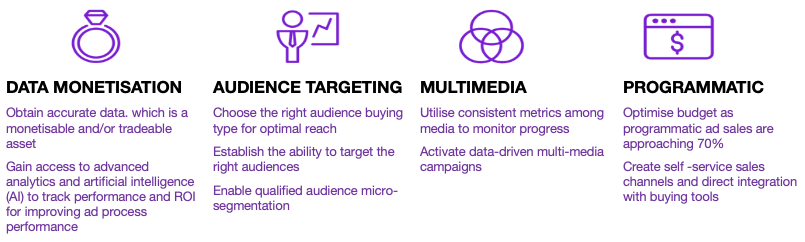
Key benefits of converging marketing and advertising

How to converge marketing and advertising

• Consolidate technology and capability: marketing and advertising convergence can be achieved by consolidating the technology and capabilities with which these two business areas perform their respective functions into one marketing and advertising technology stack (MAD-tech). The marketing department requires planning and campaign management tools to monitor and optimise their marketing campaigns, based on results and success, while the advertising sales department needs to utilise similar metrics for their clients.

• Consolidate planning across all disciplines: to be successful in converging marketing and advertising on a single MAD-tech stack requires a consolidated digital and traditional advertising and planning approach. This will ensure that the unique requirements and objectives of both functions are effectively achieved and used.

Advertising sales are more successful when it is driven by a fully integrated campaign strategy that leverages the unique proposition of all available media properties, audience pools and segments to reach the right combination of end-users through the right media, at exactly the right time. The marketing department is dependent on these very same planning skills to create successful marketing campaigns.

• Establish a singular data management platform (DMP): a single DMP will substantially enhance audience selection which will, in turn, improve the campaign success and click-through rates (CTRs). This is because a DMP enables you to collect interest and behaviour data on the entire digital audience while ingesting customer data to enhance the data set, using first and second-party data (customer relationship management (CRM) data, as well as data sets from business partners and affiliates).

The same data and audiences can be applied to external and internal properties, which also increases the value of the inventory. It benefits the advertising department as it enables them to achieve optimal audience extension with data impressions (reaching customers beyond the website via external impressions with overlaid customer data). It also benefits the marketing department by enabling them to accurately target existing consumers on external properties such as social media.

Finally, the same data can be used to create custom segments for advertisers, creating a tailored advertising approach for specific brands, while the segments can also be sold separately, using the connections into advertising exchange platforms via demand-side platforms (DSPs) and supply-side platforms (SSPs).

• Utilise one CRM system: both internal (marketing) clients and external advertising clients should use one CRM system to determine how much value is kept for marketing, and how many impressions are sold internally versus externally. Using such a single platform further enables accurate tracking and monitoring of the entire campaign history and makes it possible to leverage synergies between marketing and advertising optimally.

• Establish and share a trading desk: based on insights from datasets obtained from the DMP, the advertising team can achieve targeted audience extension and drive sales by placing ads with appropriate messages (external impressions) with the right online publishers. The same external impressions can be shared with the marketing department, to ensure consistent and appropriate communication across all consumer touchpoints.

• Sharing creative services: creative services across marketing and advertising are similar, except for the fact that marketing is using its own branding for the applicable creatives, while advertising is designing creatives using external branding and CI (corporate identity), subject to a brief, either from the agency or the advertiser directly. These creative skills are needed in both areas and are more dependent on the media used (audio, video or display) than the actual brand.

• Campaign management: the management of advertising campaigns is always based on a certain outcome and key performance indicators (KPIs). Marketing and advertising typically use the same metrics, such as cost per thousand (CPM), conversion per impression (CPI), cost per click (CPC), cost per action (CPA), etc. and are aiming at a certain return on investment (ROI) and success rate. The skills to execute those campaigns are almost identical and learning from internal campaigns can both be employed externally and used for case studies.

Ultimately, to captivate the attention of their audiences in a multichannel marketing and advertising environment, broadcasters need a unified source of accurate consumer profiles that are updated in real-time, and that can be activated across traditional and digital channels, through a singular, intelligent and scalable system. Converging your marketing and advertising will help you to accomplish exactly that.

ACCENTURE SOUTH AFRICA
accenture.com/za-en

This is Modern Marketing