Home Blog Page 352

Be Part Of The Modern Marketing Digital Trendcamp

Take part in our Modern Marketing Digital Trendcamp by sending us a 3-4 minute audible video of yourself at home. The video should be about a general advertising/branding/marketing trend/topic (not a product or company promotion).

Suggested guidelines:

• State your name, company and designation.
• Briefly state what you’ll be talking about.
• Delve into the advertising/branding/marketing trend/topic.
• Conclude with the main point.

We will post the video on our Youtube channel for the public to see and include the article of your video in our weekly newsletter that goes out every Thursday to our database of over 19,000 subscribers.

Contact thapy@practicalpublishing.co.za for more information.

MODERN MARKETING
+27114501650 
info@modernmarketing.co.za
www.modernmarketing.co.za

Possible Jail Time For Coronavirus Fake News Spreaders

The Minister for Cooperative Governance and Traditional Affairs, Dr Nkosazana Dlamini-Zuma, set out the Regulations in terms of Section 27 (2) of the Disaster Management Act.

According to the Government Gazette, ‘Any person who publishes any statement, through any medium, including social media, with the intention to deceive any other person about— (a) COVID-19; (b) COVID-19 infection status of any person; or (c) any measure taken by the Government to address COVID-19, commits an offence and is liable on conviction to a fine or imprisonment for a period not exceeding six months, or both such fine and imprisonment.’

According to the minister, the threat of a prison sentence or fine for spreading fake news about the outbreak will hopefully end the string of false claims about the virus, which have been flooding social media and creating general confusion. The regulation applies to both the creators of fake COVID-19 news and those who spread the news through social media and other channels.

Lying about being infected

Dlamini-Zuma said any person who intentionally misrepresents that he, she or any other person is infected with COVID-19 will be charged. On conviction, the person will be liable to a fine or to imprisonment for a period not exceeding six months, or both a fine and imprisonment.

For more information, citizens can also visit the Department of Health’s official website: https://sacoronavirus.co.za

ACA Postpones 2020 Effie Awards South Africa

The Association for Communication and Advertising (ACA) has announced that the 2020 Effie Awards South Africa summit and gala event have been postponed and will now take place on 7-8 October 2020, respectively.

In response to the continuing developments of the Coronavirus (COVID-19) pandemic in South Africa, and following recent announcements from the government, the ACA has taken the necessary steps to ensure the safety and wellbeing of all involved by postponing all Effie Awards South Africa related events.

The shift in dates will result in an extended entry period, and new judging dates.
The revised dates are as follows:

Early Bird Deadline: 05 May.
On-Time Deadline: 18 June.
Last Minute Deadline: 09 July.
Round 1: 06 Aug.
Round 2/Final: 27 Aug.
Effie Summit: 07 October.
Effie Gala: 08 October.

According to the the organisers: ‘Our focus now falls on planning in accordance with the new calendar of events and remain fully committed to celebrating and awarding effectiveness in marketing and communications in terms of the remarkable work conceptualised and executed in our market.

‘We will continue to keep abreast of all developments and updates, adhering to all appeals from the South African Government as we face these unprecedented challenges together. We have trust and confidence in South Africa’s Government and experienced health care professionals to ensure that the effects of the pandemic are limited, and will keep you informed of any further updates as may become necessary in the coming weeks.’

EFFIE AWARDS SA
effieawards.co.za

Social Media Analysis Of The COVID-19 Pandemic

Meltwater states that data from a social media sentiment analysis indicates that the general consensus around Coronavirus is progressively negative around the world, with 83% of social media mentions on ‘coronavirus’ being negative in March. These feelings are attributed to the virus’s impact on stock markets, working environments, restrictions put in place, the sickness and ill-health of citizens around the world, fatality rates and countries being on lockdown.

While China and Italy are the top two countries, respectively, with the most confirmed cases of COVID-19, the USA is the top country to be talking about Coronavirus on social media (27.23%), as US citizens have also been making use of online forums and message boards to have social conversations about COVID-19. Rounding up the top three countries talking about the coronavirus is the UK (3.54%) and Spain (2.92%).

While ‘Coronavirus’ has made waves in many news media articles around the world, in South Africa, users have been predominantly talking about the virus on social media, with ‘#CoronavirusInSA’ emerging as a hashtag being used to keep users updated and engaged with news on the virus in the country.

So far, there have been a total of 6 times where social media mentions in South Africa using the hashtag ‘#CoronavirusInSA’ were more than 10,000 per day, exceeding the daily global news media mentions on ‘coronavirus’.

Here are the dates on which this occurred, and what happened in South Africa on those dates respectively:

  • 7 March 2020 – reactions to the first confirmed case of the Coronavirus in South Africa.
  • 12 March 2020 – Twitter account ‘EWN Reporting’ tweeting about the first local transmission case of Coronavirus in the Free State.
  • 15 March 2020 – university institutions announcing that students have 72 hours to vacate their residences.
  • 18 March 2020 – President Ramaphosa briefing the media on the restrictions that have been put in place to help prevent the spread of Coronavirus.
  • 23 March 2020 – number of confirmed cases rose to 274; President Ramaphosa addresses the nation and implements a 21-day national lockdown from midnight 26 March 2020
  • 24 March 2020 – number of confirmed cases rose to 554.

Reacting to bans

A number of countries around the world – such as Germany, France, Japan and the Dominican Republic – have implemented travel bans and restrictions in an effort to ‘flatten the curve’ and prevent the spread of the virus. Since the beginning of March, there have already been over 170,000 global social media conversations that mention ‘travel bans’ in relation to the Coronavirus.

While other countries had already implemented travel bans, on 5 March 2020, the South African Department of Health Twitter account tweeted that travel bans had not been put in place in the country and that the government would be monitoring the situation. But, following this tweet, there was an increase in South African social media users engaging with ‘#CoronavirusInSA’ as this was also the day that the first case of the coronavirus was confirmed in South Africa.

Trending themes that emerged on social media mentions that included ‘travel bans’ and ‘#CoronavirusInSA’:

  • ‘Positive spin’ and ‘Tourism lecturer’ – which relates to a Newzroom Afrika tweet about a tourism lecturer’s opinion on the travel ban in the USA potentially boosting tourism in South Africa.
  • ‘Economic emergency plan’, ‘new governance structure’ and ‘school closure’ referring to a tweet shared by influential social media user, Ferial Haffajee, and her thoughts on #CoronavirusInSA.

The impact on industries and society

With travel bans and restrictions in place, as well as certain countries, like South Africa, now officially on lockdown, the impact of the ‘Coronavirus’ have been felt in other ways – including businesses across various industries and society overall.

For South Africans, the travel ban has not only been implemented for international travel but local movement too as #SouthAfricaLockdown began at midnight on Thursday, 26 March 2020. Over 45,000 social media mentions have included this hashtag, with mentions ranging from messages of hope and encouragement to support behind President Ramaphosa.

Trending themes on #SouthAfricaLockdown include:

  • ‘Prohibited acts’, referring to social activities, which were once considered normal to do, that are now not allowed.
  • ‘Home’, referring to the all South African residents instructed to stay home during the 21 days of lockdown.
  • ‘Dogs’, referring to the inability for dog owners to walk their pets outside.
  • ‘Work’, referring to the encouragement to be considerate of those who will still be working and providing ‘essential services’ during this time.

As various nations implement restrictions in an effort to help prevent the spread, South Africans are preparing to play their own role during the lockdown. The coming days will be crucial in seeing the silver lining of these measures, as South Africans come together to fight COVID-19 by staying at home.


MELTWATER
meltwater.com

Driving Brand Innovation Through Complex World Views

Stephanie Matterson, MD of Kaufman Levin Associates (KLA), has been in the business of understanding consumers for the past two decades and analysing patterns and anticipating trends. She believes that we are in an unprecedented stage in our history which demands that we create circumstances that allow complexity to surface.

In today’s fast-paced, digitally-driven world, we are constantly under pressure to simplify and streamline our views, sentiments and beliefs. Indeed, in the age of the emoticon, complexity and depth of meaning or emotion is shunned in favour of speed and easily digested information.

Stephanie Matterson, MD of Kaufman Levin Associates (KLA).

In your own context, have you found yourself providing an explanation or opinion that is so superficial that it bears very little resemblance to the truth – only because you were under pressure to be quick and succinct? Or, you simply shut down and avoided the answer altogether – which prevented a deeper understanding or connection in that scenario. Consumers’ stories are not straightforward, and even they themselves are not too sure how they feel. There is complexity in how they view the world and in what influences their choices.

Missing out on meaning

Sadly though, instead of allowing this complexity to surface, marketers tend to take comfort in data and metrics – increasingly wanting information faster and cheaper – and staying away from the deep and the complex. They avoid the things that can be difficult to measure and that sometimes feel hard to cluster under statistical models. Some experts refer to this preference as the ‘quantification bias’: namely, the unconscious belief of valuing the measurable over the immeasurable.

Introducing ‘thick data’

Tricia Wang, a technology ethnographer, talks about our fixation on big data or quantified data in order to understand the consumer – and argues that real understanding lives in our ability to marry this data with ‘thick data’. By thick data, she is referring to data from humans: stories, observations, and emotions that cannot be quantified but which deliver depth of meaning. Importantly, what makes this data so thick and valuable is the experience of understanding the human narrative.

Capturing the emergent trends

Critically for marketers, integrating big and thick data allows us to form a complete picture – seeing the emergent human dynamics as well as the established. The cost of missing emergent trends, Wang argues, is what happened to Nokia… and the value of seeing them is what happened to Netflix. So, whilst dynamic and fast-changing markets demand that we keep ahead of the curve with faster, cheaper data, we must not overlook thick data and the underlying human narrative.

This means that as marketers, we need to create the right circumstances to uncover the complexity and the emergent that will often be the route to winning. Indeed, it is in finding the sweet spot between complexity and efficiency that brands and businesses will drive innovation and gain invaluable competitive advantage.

KLA
+27114478411 
enquiries@kla.co.za
kla.co.za

Loeries Challenges Brands To Creatively Tackle Coronavirus Issues

Based on the principle that now, more than ever, the world needs brave creativity to keep it thriving, the Loeries and Constitution Hill has challenged the brand communication industry to come up with proactive ideas to help alleviate critical problems currently facing society as the COVID-19 pandemic takes a foothold across Africa and the Middle East.

The Loeries and Constitution Hill – the venue for this year’s Loeries Creative Week, taking place in September, launched this innovative campaign to elicit creative solutions to deal with challenges around the Coronavirus/COVID-19 pandemic.

Potential campaigns include ideas to prevent consumers from stockpiling, helping to deliver remote education solutions, raising awareness of staying safe while using public transport, delivering care and food to the elderly in isolation, helping people who are struggling with isolation and why there is a need to cancel events that exceed government-mandated maximum thresholds, such as weddings and funerals.

Individuals in brand communication, from across the region, are invited to choose a brief (available at https://www.wakethenation.org.za) and send their brave and innovative creative solutions to createchange@loeries.com. Brands will fund the bravest ideas to help raise funds to help prevent the spread of COVID-19.

In addition to challenging creative thinkers into utilising their skills for a social purpose, the campaign also allows brands to identify creative solutions, from the creative community, and bring them to life in ways that create societal value.

Preetesh Sewraj, CEO of the Loeries said, ’Throughout our history, the brand communication industry has moved society in a positive direction through a range of different campaigns. Considering the scale of threat that is posed by COVID-19, this campaign could be another great example of how we create positive change in society through our ideas.’

LOERIES 
www.loeries.com

Dentsu Aegis Network Gives Media And Marketing Leaders A Crisis Guide

Dawn Rowlands, CEO of Dentsu Aegis Network.

According to Dawn Rowlands, CEO of Dentsu Aegis Network, all of us have been impacted by the spread of Coronavirus (or COVID-19) and therefore it is imperative that marketers equip themselves with agile strategies that can help navigate the potential obstacles and barriers to revenue and success; and it is key that they address how best to deliver for their customers in this challenging climate.

In many countries, there is already a major economic effect due to COVID-19. We are seeing four main trends:

  • Building consumer confidence.
  • More sales promotions.
  • Launch of new services.
  • CSR.

Here are some ways in which to promote your brand and help customers during this period of uncertainty.

1. Subsidies, promotions and joint ventures for pandemic-related industries – this has the potential to grow new customers.
2. Continuing transformation and enhancing digital maturity to avoid risks.
3. Accelerate omnichannel strategies to reduce reliance on brick and mortar. Encourage in-home consumption.
4. Best timing to divert your approach to a data-informed CRM programme. Understand more about the customer’s journey.
5. Social commerce tactics – inspiring creative experiences, driven by data in media versus the real world.
6. Brand communication – associated with safety and security.
7. Implement the realisation of the future media e.g. gaming.
8. Accumulate energy for acceleration, as opposed to declining marketing expenditure, by identifying opportunities for growth.

The role of the media

Based on reactions to media by the Asia-Pacific market, where the majority of cases have been established to date, we can see the following:
–
The key access points for media are YouTube, local news broadcasts and social media platforms.
– Geolocation of certain services in an emergency situation will add value to customers.
– Pharmacy, hospital locations and operating hours will be widely searched.
– All movies, games and TV content that relate to contagious diseases will see an increase in viewership and/or usage.
– Prevention and information alerts by brands will be seen in a positive light. Emotional reaction and overreaction will be seen in a very negative light.

In conclusion, virus or not, our customers need brands and services that reassure them and innovate during difficult times. There is definitely a space for brands that tread carefully during this period of anxiety and provide innovative solutions and entertainment for customers. Think long term and make plans for a quick return to the new normal in six months. Get ready to celebrate life and togetherness again.

DENTSU AEGIS NETWORK 
+27214425600 
HelloSSA@dentsuaegis.com
www.dentsuaegisnetwork.co.za

Publisher Audience Measurement Survey Delivering 20/20 Vision

Given the current Government lockdown, the Publisher Research Council’s (PRC) release of the Publisher Audience Measurement Survey (PAMS) 2019 results will now be done via a webinar delivered via Zoom video conferencing on 7 April 2020.

The PRC is set to deliver data reflecting their commitment to quality fieldwork, and a sample in excess of 15,000 of brand data. The #PAMS2019 survey results reinforce the PRC’s commitment to ensuring stability and the reliability of the methodology and gathering of data. These are fundamentals the media sector has become accustomed to over the past five years.

First-time additions such as the introduction of Household Income in the sample frame and weighting, plus using renowned demographers GTI to share their expertise in matching rapidly urbanising profiles, are designed to provide users with greater depth and understanding. The PRC has gone to great lengths to supply media planners with the data required to prepare plans for clients on a consistent basis. 

Renowned global media expert, Robert Ruud said, ‘The PAMS 2019 sample design as developed by Professor Ariane Neethling seems to be well adapted to the particular socio-economic landscape of the South African market. The innovations adopted in terms of appointing a new demographic data partner GTI to provide accurate population movements into metro areas, combined with the inclusion of income sampling and weighting should result in a well-balanced and efficient sample as in line with global best practice.’ 

PAMS 2019 offers an interesting picture of South Africa’s consumers and their relationship to brands across the Automotive, Banking, Cellular, Food, Fashion and Furniture categories. 

Josephine Buys, CEO of the PRC said, ’PAMS2019 is South Africa’s largest income weighted sample of over 15,000 respondents, with the latest, most representative sample and survey in South Africa that contains brand information.’

For further details visit https://www.prc.za.com/pams-webinar

PUBLISHER RESEARCH COUNCIL 
www.prc.za.com/pams

Influencer Marketing Crisis Management Tips

Owning The Narrative In Marketing

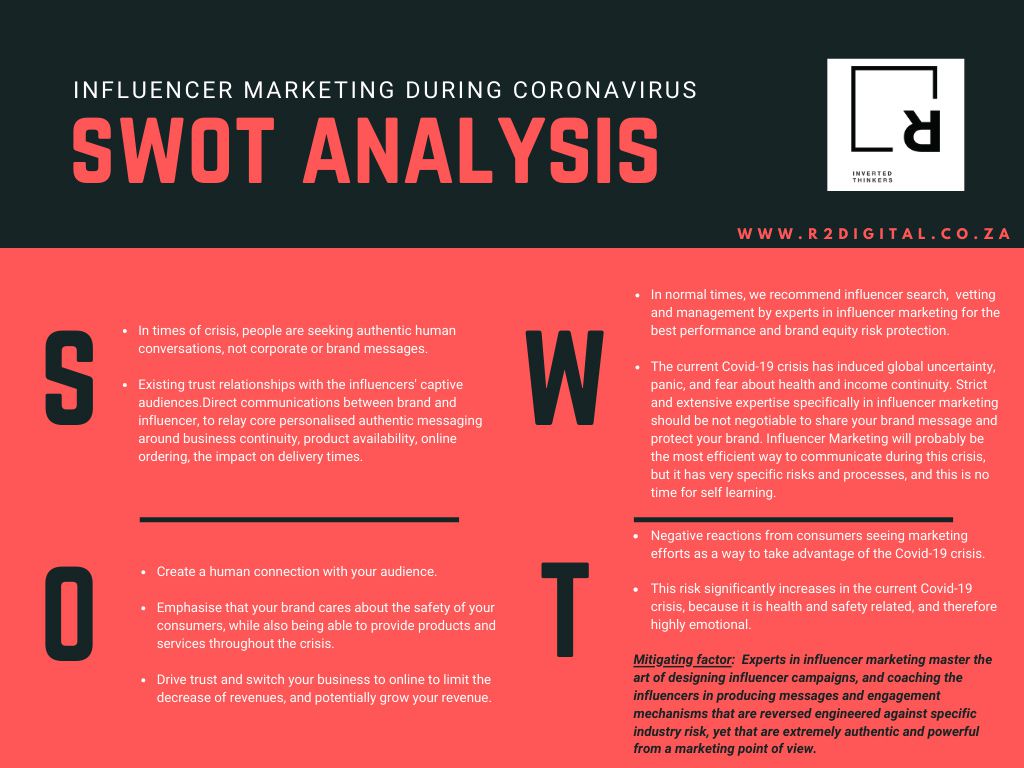
According to R-Squared, some things will change due to crisis management during Coronavirus, but the following guidelines are nevertheless true at all times.

Strategies: ensure that your dedicated influencer marketing strategic direction is aligned with the external circumstances, e.g. online buying in a time of real-life isolation (buying from the safe comfort of your sofa), confirmed information about product availability, delivery, etc., by a trusted influencer who has direct confirmation with the correct brand information.

Engagement mechanisms: set engagement mechanisms that are designed to trigger specific reactions according to the campaign KPIs. Don’t ask open questions, as this may lead to negative engagement (including competitive brand endorsements) from the influencer’s audience, especially in times of a global health crisis. People are more sensitive and reactive right now, so designing an engagement mechanism that will help in achieving the marketing objectives, while avoiding brand crises, requires a very specific skillset.

Vetting: ensure that all your influencers are strictly and carefully vetted for content quality, relevance, relatability, engagement rate, conflicts of interest, and anything else that can backfire on your brand. Strict and masterful vetting by influencer marketing experts is mandatory during this global health crisis as no one can afford a brand crisis over and above the existing circumstances.

Briefing: coaching and briefing of influencers by experts in the field, who will communicate the brand’s needs effectively, while having a sound understanding of the industry, are able to anticipate all opportunities and challenges, and able to communicate these to the influencers in a format that the influencers are able to understand and adopt easily.

Contracts: ensure your contracts are very detailed and adapted to the risk and process specificities of the influencer marketing industry, and tailored per influencer according to the individualised missions that have been set. The clearer and more detailed the contract, the lower the risk of misunderstanding and frustration (which may backfire online) and the greater the potential campaign success.

Content validation: with consumers and influencers reacting to the Coronavirus crisis, it’s more important than ever that all content should, without exception, be validated before the pieces of content go live, to ensure full alignment and no misunderstandings with the brief. All regulations should be respected per the industry vertical, all reactive risks should be mitigated, and all call to action (CTAs) should be double checked, in order to drive the expected results.

Content monitoring: always-on monitoring of posts and engagement, to ensure quick reaction times and reassurance to audiences when necessary. This transforms fear of no business continuity at a time of an impending health crisis, into trust and brand love. This is where real conversations about business continuity, product availability and delivery along with other business-specific topics during this abnormal period will happen. These topics will be addressed to and handled by the influencer, so it’s of utmost importance that there is masterful influencer management in close partnership and collaboration with the brand.

R-SQUARED
+27212760265
partners@r2digital.co.za
r2digital.co.za

Smollan And DYDX Take Home Two Bookmarks

The Bookmarks panel awarded DYDX Digital’s client Smollan with a Silver Craft Award for Excellence in Research and a Gold pixel in the Emerging Digital Technology: The Internet of Things (IoT) category.

David Smollan, CEO of Smollan said, ’We believe the best way to fight poverty and environmental issues is to build inclusive, profitable businesses. This changes the mindset from dependent to independent, from despondent to engaged.’

Expressing his delight at the awards, he said, ‘The two Bookmarks showcase our commitment to being a business with a purpose that serves our clients and the communities we work in. It is also indicative of our commitment and the quality of work achieved as a team with DYDX.’

Excellence in Research Bookmark 

This Bookmark was awarded to DYDX for the development of the innovative, iterative research process that enabled the rapid discovery and testing of insights into the South African informal market. 

‘Despite the size of the informal market (35% of all retail sales) there is very little data available and most of the data and estimates are enormously contradictory. Therefore, we needed an innovative research plan that supported the company’s ideation and experimentation flexibly and quickly,’ explained Smollan.

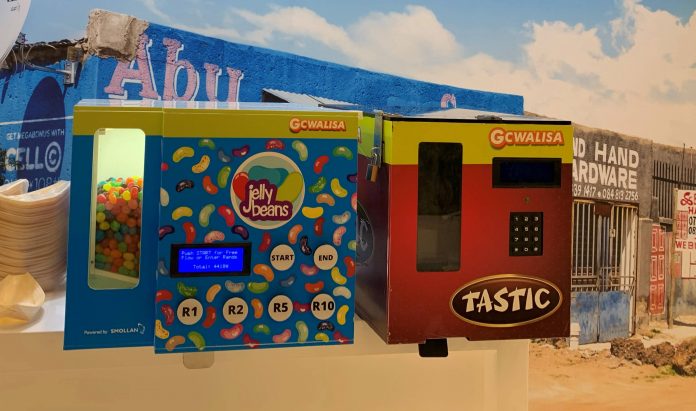
Templar Wales, Partner at DYDX, explained that a hackathon was hosted as part of the research process before the final ideation session. ‘After weeks of ideation and further research, a prototype, ‘Gcwalisa’, was created. Gcwalisa, meaning ‘Fill up!’ in Zulu, is an IoT product dispenser that allows customers to buy everyday products in whatever amounts they can afford, using their own containers, thereby eliminating the need for single-use packaging.’

‘The solution was a sustainable, scalable business with a positive social and environmental impact while gathering valuable, granular purchase data for the brands,’ he said.

Excellence in Emerging Technologies Bookmark

Smollan and DYDX also received a Bookmark for Gcwalisa in the Excellence in Emerging Technologies: The Internet of Things (IoT) category in which atypical internet devices (not phones or computers) are used to achieve marketing and communication goals.

DYDX  
info@dydx.digital
dydx.digital
This is Modern Marketing