Home Blog Page 344

Brands Shifting Focus Towards Digital Channels 

Ed Flower, Chief Commercial Officer at Acceleration.

Ed Flower, Chief Commercial Officer at Acceleration, mentions that businesses, from big-brand, high-street retailers, to the personal trainer at the local gym, are needing to deliver their services and products online.

Governments and central banks are unleashing radical measures to support economies. That would have seemed unthinkable, even during other times of global economic stress such as the Great Financial Crisis.

The Covid-19 pandemic has ruthlessly swept away many of the assumptions we once held about how companies, economies and governments should work. Regulations that were once sacrosanct – such as competition laws – are being paused to allow large and small retailers to work together to ensure supply chains are robust in a time of upheaval.

This profoundly changed landscape will not leave the commercial relationships between brands and their agencies untouched. As brands look to their partners in this hour of need, it will be trusted agencies and consultancies that know how to drive ‘speed to value’ that will emerge strongest from the turmoil.

Here are a few trends unfolding in the grip of the Coronavirus, many of which we can expect to accelerate even once some semblance of normality returns to the world: 

Consolidation of client spend accelerates consolidation of the market

Like some of the other trends I highlight in this article, this trend is an acceleration of an existing move in the market. For several years, brands have been looking to consolidate marketing spend with one or two key partners globally, while marketing consulting firms and agencies have pursued mergers and acquisitions to offer a more complete and integrated offering.

These related trends will speed up as brands consolidate spending with trusted, strategic suppliers, cut back on discretionary spending and take a cautious stance on partners and projects. Brands will have more leverage in their relationships with their service providers, while agencies will have more incentive to work with key clients.

Fast-tracked shifting of budget to online and digital channels

With no footfall in high streets around the world, brands are focusing their immediate attention to ecommerce and logistics to get the product into the hands of the consumer. Articles recently written by Wunderman Thompson Commerce show that all brands are now in the delivery business.

Remote working

Despite the hype around remote and mobile working for the past 15 years, many global organisations have been reluctant to adopt it on a larger scale. Covid-19 and the era of physical distancing has forced even companies that were once reluctant to embrace remote work to get on board.

Except for some essential services workers, everyone is a remote worker for now. The genie is out of the bottle and it will be difficult to jam it back. While there are some hiccups around managing remote staff and the infrastructure, the sheer number of people successfully working from home right now shows that it can work. 

As this situation is normalised, brands will be less concerned about whether agency resources are on-site, near-shore, off-shore or even in the same time zone. They will simply want to know whether they are seeing ‘speed to value’ and if the agency or consulting partner has the tools and processes to effectively manage virtual teams. Partners that have embraced remote working for the last decade are best positioned for this shift because they have the right processes and tools in place and a culture that embraces them.

Agile methodologies

Many brands use the buzzword ‘agile’ while very few work in a truly agile manner. However, this is changing fast as we find ourselves working in virtual teams. The Delivery Management Office (DMO) in agencies and consultancies is playing a significant role in managing this change in the way we work. The DMO is, of course, meeting each day with clients and delivery teams — what we refer to in agile methodologies as the daily stand-up. 

With the need to show rapid results when driving leads into the funnel or optimising the existing funnel, there is more emphasis on ‘quick wins’. Brands are looking for wins within two-week windows to keep pace with their evolving environments. These windows dictate that their partners deliver value in two-week sprint cycles. We are moving to agile working faster than ever, at times without realising it. 

Cooperation across the supply chain

Most organisations realise that everyone is in this pandemic together and that the best shot at coming out of it stronger is to collaborate. Brands simply cannot allow their supply chains to fail because of the revenue and reputational risks. Some are looking at how they can help partners up and down the supply chain by, for example, paying earlier or investing in key business partners.

A move towards value-based pricing

This is perhaps the most important change I’m expecting to see over the next few months. With brands asking their suppliers for instant value, they are less concerned about where resources are located or the number of hours they work, but they do care a great deal about the value and the output.

Consultancies and some agencies have been using ‘value-based pricing’ for a while, in other words, asking clients to reward them based on their output. This ensures the supplier is remunerated for the value they drive, not just the hours they work. Brands will be more open to value-based pricing as it gives them speed to value. Some may even drive the conversation. 

Closer partnerships between commercial and procurement teams

In these times when companies are looking to save cash, we can expect to see brands turn to the partners they trust the most for support. The agencies and consultancies with the breadth and depth of service to support them across the entire sales funnel will be best placed to succeed in these uncertain months. 

One of the keys to success will be the relationship between commercial teams at agencies and procurement teams at brands. The commercial process will be streamlined to unblock the quickest pathways to value, with a focus on accelerating negotiations and building a platform for mutual success. 

As Mark Read, CEO of WPP, recently said, we are seeing 10 years of innovation unfold in the space of just four weeks. He is correct when he says the way we communicate, travel, work, shop, use financial services and educate our children, have all been turned on their head. What has not changed is the need for close collaboration between consulting firms/agencies and brands. Our relationships may have moved to the virtual realm, but they are more important than ever.  

ACCELERATION
+27 11 267 0700
acceleration.biz

What To Do When Your Brand Is Impacted By A Negative Event

Bianca Balt and Reinard Krüger from Spoor & Fisher South Africa.

According to Reinard Krüger and Bianca Balt, Spoor & Fisher South Africa, none of us has a crystal ball. This is why a business, when choosing a name or re-branding, must exercise a measure of caution in crafting its corporate identity.

It is well-established that a brand consists of much more than just a name, but we must still acknowledge that the name of a business goes directly to the heart of its identity. Think about it: no matter how affectionately and earnestly Juliet might have proclaimed that Romeo’s identity was not intertwined with the name Montague, it is clear that the play’s central struggle turns around his name; the reason that their love was forbidden.

Much of the risk associated with selecting a name can be averted by conducting a simple trade mark availability and registrability search. To illustrate the importance of this search, look at General Motors’ decision to release the Chevy Nova in Spain, where ‘nova’ is Spanish for ‘no go’. This outcome could have been avoided with a prior trade mark search. 

But what happens when a business’s name is tarnished by association with an unavoidable occurrence of a negative nature? A trade mark search would not be able to mitigate this. 

Consider the experience of the Belgian confectionery creator, the IT company and the Denver books and gift retailer – all of whom became associated with the terror organisation The Islamic State, better known as ISIS, even though they had named their brands after the ancient Egyptian goddess, Isis. The aforementioned businesses took the logical step to change their names in response to dramatic drops in sales and new business, but the name had such a negative connotation for US citizens that the Denver retailer was even vandalised. Its aggressors clearly didn’t know much about Egyptian mythology.

But the tarnishing of brand names is hardly a thing of the past 

More recently, media attention and social media memes have gripped Corona lager in a similar controversy, as a result of the novel Coronavirus (Covid-19). This association has severely affected the global sales of this lager, with reports showing that its owners, Anheuser-Busch InBev, have declared a 10% decline in first quarter sales. 

Media sources report that the decline is unlikely to because customers are confusing the beer with the Coronavirus. But what does chocolate have to do with the Islamic state? Is it really possible that consumers could believe that beer transmits Covid-19? Google reports that internet searches for the phrase ‘Corona lager’ increased by 1100% in the first quarter of 2020, with users specifically searching for ‘beer virus’ or ‘corona beer virus’.

This cannot be a coincidence 

So how did it happen that a deadly virus was assigned the same name as a famous beer? The word corona is Latin for ‘crown’, hence the crown device on the label of Corona lager. Unfortunately for Corona lager, the Coronavirus has characteristic club-shaped spikes that protrude from its surface. In electron micrographs, these create an image that is reminiscent of the solar corona, from which its name derives. Similar inspiration; different implication.

The question arises: what is a company or brand to do when their name is co-opted by a deadly or even unflattering event? The decision of whether to retain the name or re-brand depends largely on whether the company is commercially affected, i.e. whether or not the people who hold the negative opinion are, or could be, its customers.

In the case of Corona lager, it appears that AB InBev’s customers hold the negative opinion, so it will be interesting to see whether the company elects to change the name of a beer that is almost 100 years old. Is a name change needed to save a century-old reputation?

What is certain is that the companies that elected to change their brand names, and survived, did so in a very short space of time – to limit the duration of the association. If AB InBev is going to adopt a safe approach, it should move quickly. Because, the longer it waits to make its move, the greater chunk of its clientele it could potentially lose.

Here is a final piece of advice: scientists, and more particularly virologists, have long enjoyed a love affair with Latin. For this reason, situations such as our current one, surrounding the name ‘corona’, will most likely come again. Because it is conceivable that any future virus may be named in Latin, you might try to avoid using Latin in generating your next brand name. After all, a virologist may just fancy it for the next global pandemic.

SPOOR & FISHER SOUTH AFRICA
spoor.com/en/home/

Using Relatable And Authentic Content To Market A Brand

The Aromat Comedy Club is a YouTube series created by Unilever, Oliver, and the cream of South Africa’s rising comedy stars. 

When research indicated Aromat lacked traction among Millennials, Unilever turned to its on-site digital and creative agency, U-Studio – run by Oliver, to come up with an answer. What they created is the Aromat Comedy Club, which combines South Africa’s upcoming comedy and influencer talents for a fresh image of Aromat.

Giving Millennials a taste

‘We know our audience is accessible online all the time — sharing, creating and engaging with rich content,’ said Thobeka Mkhize, Aromat Brand Lead at Unilever. ‘Specifically, our audience is engaging with online comedy skits, so it was a natural fit for the brand as well.’ 

The campaign’s first season features seven local comedians: Mzee Mbuli, George Mnguni, Siyabulela Deli, Siphelele Cele, Bridget Mahlangu, Fash Ngobese, and Siviwe Lutseke. They were matched with themes chosen by the U-Studio team, touching on everyday scenarios that resonate with Millennials. 

Mbuli’s video is a funny take on ranting, where he plays a series of different characters sitting in the back of a rideshare car. Mahlangu created an elaborate episode where she and her mother had to speed-clean before an insufferable church gossip visited them. Lutseke sets up the worst blind date in history and Mnguni starts work as an intern only to get into a staff competition like no other!

Creativity empowered by Oliver

U-Studio decided on the topic for each skit based on the thorough understanding of Aromat’s market and the comedians’ style. The shared goal was a well-produced YouTube series of skits that were funny, relatable and authentic. But there wasn’t a necessity for micro-management from either the agency team or Unilever’s brand team. The forged relationship of trust, a result of Oliver’s model, was particularly useful for this campaign, as the comedians had considerable creative free reign, allowing their personalities to shine for Aromat.  

This synergy is evident when viewing the various skit videos. Despite no mandate to put Aromat in the videos, the comedians found creative ways to include the brand.  ‘We wanted to use upcoming talents and give them a platform to grow and co-create with one another,’ explained Nkululeko Vilakazi, Oliver’s Conceptual Copywriter for Aromat. ‘Our brief to the comedians wasn’t to create an Aromat-centric skit, but focus on interpreting the relatable topics. We are creating a platform for the comedians and helping them increase the production value of their skits.’ 

The first season’s videos have already gathered over 100,000 views each, and several are surpassing 200,000. The campaign shattered its subscriber growth and engagement benchmarks and catapulted Aromat’s YouTube channel as the biggest among the Unilever South Africa brands. There was also a marked rise in sales of the much-loved seasoning. The Aromat Comedy Club nails that crucial mark for advertising: marketing is not about branding or persuasion. It’s about good content that resonates with an audience. 

OLIVER AGENCY
oliver.agency

PRISMs Recognise Havas PR With Three Awards

Havas PR received three PRISM awards for two campaigns done for Right 2 Read in Limpopo and Gauteng. The awards ceremony was hosted virtually on a live stream by PRISM Convenor, Palesa Madumo, and PRISA President, Victor Sibeko.

The Limpopo campaign was a community intervention that saw Right 2 Read galvanise people to help raise awareness of the state of education in Limpopo. The campaign received a silver award in the ‘NGO campaign’ category.

The second campaign was another community intervention aimed at collecting books for the library in Alexandra township, Johannesburg. Working with ‘wastepreneurs’ in Johannesburg, Right 2 Read collected more than enough second-hand books to stock the library within a three week period. The campaign won a bronze award in ‘NGO campaign’ category and a silver award in the ‘PR on a shoestring category.’ 

Speaking about the awards, Havas CEO Lynn Madeley said, ‘This is a fantastic win for Havas in South Africa. The recognition means a lot to us, and we are proud of the teams that worked on these campaigns. They were integrated campaigns that brought the best of our expertise across different disciplines within the group. The successes of the campaigns really made a meaningful difference in the community, and that’s what we are about at Havas.’

Head of Havas PR, Larry Khumalo, said of the win, ‘Congratulations to PRISA and the PRISM Awards for hosting an incredible virtual event. We were together as an industry, although apart, celebrating the best of South Africa’s PR Practitioners, even with this new normal. We are very pleased with the recognition of these worthy campaigns. Each of them is a great study of the continued evolution of the craft of PR. We sat with the best of our strategy and creative arms within the Havas Village and executed smart, impactful work that drove stakeholder participation and changed communities. For that to be recognised at this level is something we are truly proud of.’

HAVAS SOUTH AFRICA
+27115493600
info@havas.co.za
www.za.havas.com

HaveYouHeard Study Shows That South Africans Expect Brands To Remain Active Amid Lockdown

Ryan McFadyen, Co-Founder and Head of Strategy at HaveYouHeard.

According to Haveyouheard’s Head of Strategy, Ryan McFadyen, the overall expectation of the 780 respondents to the survey is that brands should be active and should be useful, whether to them, the actual consumer, or the general public at large. In fact, 37% spontaneously stated they wanted brands to continue advertising or being active in their lives while only 8% felt otherwise.

More respondents were in favour of brands being in their lives than keeping quiet during lockdown. They added that this communication should shift to those channels where they’re spending more time – for some this was in the traditional media, but for many more, it was social and online media. Those who said brands should not be advertising suggested marketing or advertising budgets should be spent helping consumers either through cheaper product offerings or by launching programmes that support South Africans’ efforts to remain safe from infection.

The study also highlighted that consumers are holding brands to the highest possible standards during the pandemic. Maybe more so than what is financially possible, but consumers do expect these brands to behave with a responsible ‘humanity first’ approach.

Some consumers spoke of brands first protecting their own staff and saving jobs within their companies, being transparent and clear in how they have been impacted and explaining measures they would be taking.

Here, many respondents spontaneously mentioned which brands they felt were behaving responsibly. The 14 brands with the most spontaneous mentions were Pick n Pay, Woolworths, Checkers, Spar, Shoprite, Nando’s, Dettol, Vodacom, Dis-Chem, Lifebuoy, Coca-Cola, Old Mutual, Tiger Brands and Discovery.

McFadyen stressed that the pandemic and the measures put in place to curb its spread, such as lockdown, are already influencing consumer behaviour and perceptions. This will have a profound impact on how brands behave post-Covid-19.

Consumers have had to alter their lifestyle, change their behaviours and find new ways to purchase. They have been pushed into a zone of experimentation based on new ‘need-and-want’ parameters and these changes are impacting how consumers are benchmarking value. It is still unclear if this will create permanent change, or a fast swing back to old norms, or something in the middle. But what is clear is that brand choice is undergoing forced shifts. 

Half of the consumers are spending less money, both because they have fewer opportunities to spend as well as the need to save money due to reduced income. However, those in the lower income levels had to spend more money at the start of lockdown, with the majority of this spend being on food groceries (88%), household essentials (59%), medical supplies (33%) and entertainment/internet (32%).

People need people, and have a desire to belong, which is an important role of any brand. But lockdown, face masks and social distancing are all limiting social connection and are creating an opportunity for social intimacy to be fostered within the constraints of the law. How brands provide spaces or ways for people to come together and to belong will be important.

Further, ‘Corona Fatigue’ is starting to set in and it is very difficult to escape. This, therefore, will become a big driver for consumers and they will look for brands who can facilitate escaping the overwhelming stress and threat of Covid-19 to being able to think, do, believe and engage with what life used to be, what life could be, or what life would never be.

McFadyen’s advice for brand owners is that it is more critical than ever for brands to have a very clear understanding of the role they play within their consumer’s lives. As such, he said brands should develop clear answers to four critical questions:

1. As a brand, what do we believe gives us a distinctive viewpoint about the world and our place therein?
2. What do we sell? Must be clearly articulated and simple to understand.
3. What do we do? Our role within the world, linked to our product and the needs of our audience.
4. How do we do it? In a way that is authentic to our distinctive viewpoint and done in a way in which only we could do it.

Brands need to gain a clear understanding of their audience. The Covid-19 crisis will inevitably change the world in which we function and so the insights around your audience prior to the pandemic will have changed significantly. Efforts spent to uncover these insights will be invaluable as a simple insight may be the difference between success or failure. 

Consumers don’t want to be a part of your story, you need to become a part of theirs. Build work that matters, is authentic to the brand and that creates real-world impact in order to reap long-term rewards. 

Examples of respondents’ quotes with respect to brands:

●  ‘The worth of the brand for me is determined in terms of their social responsibility. Brands depend on consumers and it is time that they showed their civic responsibilities.’

●  ‘Assist where they can, and behave in the best interests of the communities that have supported them over all the years.’ 

●  ‘Profiteering at a time like this is like shooting fish in a barrel. We all need to get through this in one piece, and that also applies to our finances.’

●  ‘I definitely think advertising has to stay up to date with the latest developments as they happen. This isn’t the time for advertising creams to make you look younger. It is the time to educate people who aren’t getting educated because of their lack of knowledge of how to use online learning. Perhaps advertising should be geared towards teaching this.’

●  ‘I feel brands should be aware of the severity of the issue, while not overtly leveraging coronavirus for financial gain. Respond with solutions to the world’s new problems. Put their money where their mouths are and work to make a positive impact wherever possible.’

●  ‘Show real appreciation of the impact this is having. Price reductions, ways to practically help customers. No more ‘we have your back’, mass mailed, insincere letters – they are meaningless.’

●  ‘I hate the way brands have responded to this. Whilst I know there is a place for business to evolve during a trying time, more companies are capitalising off of this than anything. They have lost their sense of purpose. So, I believe brands should be thinking more about the communication they are sending out there as opposed to being so reactive.’

●  ‘Brands should come together to assist people in need, whether it is food or musical and art platforms, online lessons etc. Right now is the time we need to work together because every single person is affected.’ 

●  ‘A large percentage need to focus on the role they can play in people’s lives and not get too caught up in trying to have a purpose relevant to Covid-19.’

●  ‘Brands should be sensitive to the current times and focus on delivering light-hearted and highly-targeted content [not ads] to build meaningful connections with their consumers.’ 

●  ‘I think food brands should realise that everyone is cooking so much more home-food for the family (no quick packed sarmies for lunch!) so they can maybe suggest 10-minute meals using their products. I think food brands can highlight their immune-boosting ingredients. Brands can offer bulk specials and emphasise how it will cut down on grocery store visits.’

●  ‘Now is the time to win new customers, provided you provide solid value. We have seen there are other means of sourcing goods and products. You need to become even more convenient and improve your value offer.’

Other key findings from the first survey include:

●  The government was seen to have performed their role very well and ensured that the majority of South Africans were largely in agreement with the lockdown measures. Only 10% feel that the Government’s response is lacking and 16% felt that it was too late, driven by lower income respondents. There is unity across the board on the acceptance of this due to the severity of Covid-19, (although this sentiment has likely shifted in the past weeks).

●  A third of individuals with a monthly household income less than R5000 a month believe contracting Coronavirus will no longer be a problem by July 2020. The majority of respondents agree that it will be much longer. 

●  Concerns around income loss/retrenchments and the economy are currently more top of mind than the spread of the virus. During lockdown, the direct consequences of these financial losses were immediately felt by many South Africans, as well as indirect consequences such as increased inequality, hunger, homelessness, violence, crime and civil unrest. A health pandemic of this nature hasn’t been experienced by this generation and is difficult to imagine. The impact on loss of life was not felt at the time of lockdown by many.

●  The majority of South Africans believe this pandemic will have a negative impact on South Africa’s future, while still feeling more optimistic about their own.

●  The long-term positive impact is likely to be increased social cohesion, empathy and respect for frontline workers. Some are forced or are choosing to reevaluate and reinvent themselves. Trust in Government’s capability has improved with a need to adapt and fix the inequality and problems South Africa faces.

●  Half of the consumers are spending less money, both because they have fewer opportunities to spend and reduced income. This is skewed towards upper-income brackets.

●  However, many people with lower household incomes had to spend more money at the start of lockdown, with the majority of this spend being on food groceries and household essentials.

●  The majority of people are baking and cooking more, but this is contrasted with many people who are going without food and struggling to pay rent. Cleaning, spending time with family and creativity has increased while people are limited to the confines of their homes.

780 respondents were recruited through HaveYouHeard’s existing consumer panel, influencer network and through Facebook and WhatsApp. This sample included seven different household income groups from those earning less than R5000 a month (27%) to those earning more than R50,000 a month (12%). Fieldwork was conducted between 26 March to 28 April 2020.

To see a full copy of the report, email claudia@haveyouheard.co.za.

HAVEYOUHEARD
+27 11 268 1331
haveyouheard.co.za

Take Part In Our Modern Marketing Adobe Workshops Survey

Modern Marketing is conducting a survey on running a series of in-depth skills development Adobe workshops. Please participate in the quick survey and give us feedback on the topics you’d like us to cover. The survey deadline is 19 May 2020.

MODERN MARKETING
+27114501650 
info@modernmarketing.co.za
www.modernmarketing.co.za

Modern Marketing Digital TrendCamp: Embracing Creativity During The Lockdown

Our Modern Marketing Digital TrendCamp video features Pepe Marais, Founder and Group Chief Creative Officer of Joe Public United, whose video highlights embracing and enhancing creativity during the lockdown period.

The video is live on our YouTube channel – don’t forget to subscribe to the channel for more videos on advertising/branding/marketing trends and topics.

Send a 3-4 minute audible video of yourself at home. The video should be about a general advertising/branding/marketing trend/topic (not a product or company promotion).

To submit your video and for more information, please contact thapy@practicalpublishing.co.za

JOE PUBLIC 
www.joepublicunited.co.za

Engaging With Consumers Through Outdoor Advertising In Uncertain Times

Remi Du Preez, Commercial Director at Tractor Outdoor.

With the levelled lockdown that commenced on 1 May, movement has gradually started to return to the outdoor arena, providing Out-of-Home (OOH) media owners and advertisers with new hope. 

Remi Du Preez, Commercial Director at Tractor Outdoor, believes that there is a strong need to engage with consumers in uncertain times, and urges brands to leverage new opportunities to connect with their audiences, brought about by the levelled lockdown. 

OOH advertising was one of the many casualties of the hard lockdown, with marketers understandably finding it hard to justify their spend in a time where everyone was required to stay at home. 

In the Level 5 lockdown, OOH would be expected to suffer – and it did. However, Du Preez believes that we will now start to see the industry slowly recover, as a result of the phased reopening of the economy. And with it, new opportunities for outdoor advertisers. 

Level 4: movement gradually returns to metros

With the move to Level 4, South Africans are gradually returning to their workplaces, yet a large contingent will stay at home. ‘We expect to see more movement outside of the residential areas, yet OOH media will remain significantly discounted for some time. The temporary pivot away from outdoor has provided advertisers with a valuable opportunity to recalibrate, and plan their next steps. As lockdown lifts, there will be fierce competition for prime inventory, and advertisers are currently very well-positioned to secure high-value, scarce inventory. With the vast amount of inventory now available, there’s a lot of added value to be found by those booking future holdings.’

Certain inventory will continue to take an expected knock in the near future. ‘Airports, for example, currently offer little value from an advertiser’s perspective. Yet, this value will return as travel resumes, albeit with a new behavioural experience in mind.’ While currently under siege, he anticipates that airport inventory will see a proverbial boom once economic recovery starts. Also consider that the world, as we know it, has been forced to slow down. While there are fewer people about, they are also less distracted, which means you are likely to experience a more receptive consumer who is exposed to your messaging – delivered among a lot less clutter.’

Level 3 and beyond: it’s all about the messaging 

From Level 3 and beyond, life will increasingly return to our streets, albeit with additional and necessary safety precautions. Lockdown has accelerated digitalisation – consumers who had not previously engaged much with online retailers are now incentivised to shop online; something that will likely continue post lockdown.

However, noted Du Preez, advertisers will increasingly struggle to cut through the noise as e-commerce takes off. This is where offline media can complement online, ‘Studies have shown that consumers are significantly more likely to interact with a digital advert after being exposed to a billboard, or another form of outdoor media.’

Du Preez also cautioned that brands should not become overly zealous, and should continue to think carefully about their content. ‘While consumers may be far more receptive to your messaging than before, they are also very much aware of the unprecedented situation unfolding in front of them. Brands should not ignore the new context in which they operate; they should craft content that adds deeper value or a sense of connection.’

He believes that content should be relevant and purpose-driven. ‘This includes highlighting and reassuring customers of safety measures as it relates to your product or service offering, and developing a sense of solidarity with consumers. A bit of humour is also a welcome relief, but you should take care not to be flippant, offensive or undermine what consumers are going through. It is not the time for hard-selling, rather use the opportunity to focus on long-term outcomes – establishing brand presence and building relationships – an area where OOH, as a medium, excels,’ he said. 

TRACTOR OUTDOOR
www.tractoroutdoor.com

Retailers And Businesses Can Use Digital Signage For Effective Covid-19 Communication

Moving Tactics says several experts are predicting that societies will need to social distance until 2022. How do you get business done in this ‘new’ normal? One solution is using technology, such as digital signage, to overcome the difficulties.

On-the-Go content

Communicating effectively to customers and staff in-store is essential during a health crisis. Instead of handing out pamphlets or communicating face-to-face, one could use in-store digital signage. It’s a medium through which retailers can update information instantaneously and use graphics and videos to make the content dynamic enough to be noticed.

Not only can retailers communicate up-to-the-minute government messaging on Covid-19, but they can also use it to share retailer-specific messaging relating to in-store hygiene standards or promotions.

Controlling the number of shoppers in-store

As businesses open again, controlling the number of customers in a retail or restaurant environment will be crucial. One way of doing this is to use a digital footfall counter that will electronically monitor the amount of people entering a venue. When combined with digital signage, such as a single screen at the entrance, retailers can communicate to waiting customers what the store’s capacity is at any given time and indicate when they can allow more customers to enter. 

Digital drive-through menu boards replace in-house dining

As Quick Service Restaurants (QSRs) are not as yet allowed to open their in-restaurant dining areas, digital drive-through menu boards are playing a bigger role in informing consumers as to what’s available. They allow for menu flexibility and provide restaurateurs with an opportunity to upsell and promote special deals to their drive-through customers.

Digital training medium for staff

Despite the fact that companies are unable to hold workshops or training programmes, it is crucial that staff get adequately and appropriately trained to handle the current trading conditions. Digital screens can be used in stores and restaurants to do just this. If you have screens in-house, it’s a great opportunity to start using them to train employees so that they stay up-to-date with regulations and company policy during this period.

Maintaining social distancing

Enforcing social distancing in-store can be difficult, especially when it comes to queueing. One way around this is to implement a virtual queue solution, which allows customers to check-in, maintain their place in line, and be notified when it’s their turn for service. Ultimately, removing the need for customers to physically stand in a queue, and at the same time, keep shopping.

MOVING TACTICS
www.movingtactics.co.za

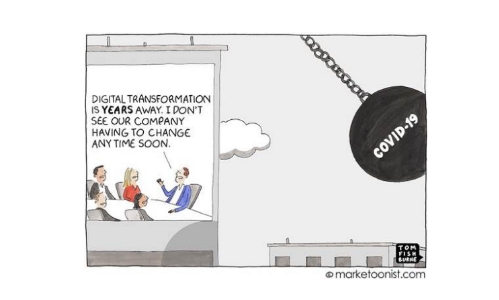
Digital Transformation Can No Longer Be Delayed

Andrew Dabbs, Digital Media Strategist at The MediaShop, says that business has been caught out more than ever before and the companies that held back on their digital transformation may not make it through 2020. But what is digital transformation?

They said: ‘there is time’, ‘the investment in technology could be made next year’, that ‘things were not going to change overnight’, ‘consumer habits will remain the same’, ‘don’t change something that’s not broken’, and then Covid-19 happened.

Andrew Dabbs, Digital Media Strategist at The MediaShop.

The world has spun into absolute shock with global economies taking the brunt of the devastation. South Africa is providing relief to the tune of at least R500bn, while other countries like the UK announced an unprecedented package of government-backed and guaranteed loans to support businesses, making an initial £330 billion of guarantees available (R23 to £1 = R7,590,000,000,000Tn).

According to Technopedia, ‘Digital transformation is the changes associated with digital technology application and integration into all aspects of human life and society. It is the move from the physical to digital.’

According to Mckinsey, ’16% of respondents say that their organisations’ digital transformations have successfully improved performance and also equipped them to sustain changes in the long term. An additional 7% say that performance improved but that those improvements were not sustained. In traditional industries like oil and gas, automotive, infrastructure and pharmaceuticals, digital transformation is even more challenging: success rates fall between 4% and 11%. Success rates also vary by company size. Organisations with fewer than 100 employees say that their respondents are 2.7 times more likely to report a successful digital transformation than those from organisations with more than 50,000 employees.’

It’s not a promising picture and this has been substantiated by the budget speech, UIF temporary relief, the Solidarity Fund, etc., so on a positive note, let’s consider which industries have successfully embraced digital transformation. In my opinion, the fitness/health and wellness industry is a leader in adopting technology.

The myriad of online content covers anything from dieting to high intensity exercise, which can all link back to a virtual leader board if you require it for your medical aid. Virtual games can be created between you and your colleagues, friends, family or even people who have the same interest and live in an area around you. The applications and associated brands who have connected individuals, built communities and collated databases based on goals, body weights and heart rates are endless.

If we consider the pure shortage of live sport and the inability for people to connect at races and events right now, it’s been wonderful to see people running a virtual two oceans marathon and multiple other races around their houses or on treadmills. We’ve also been lucky enough to see the world’s top cyclist competing on SS1 in a virtual tour.

Ultimately, technology is there for us to embrace and to make life easier. It’s time consuming and costly, but in the long run, it might help you keep your doors open and keep customers engaged. Hopefully we didn’t hedge all our bets on there being another day to look at digital transformation.

THE MEDIASHOP
www.mediashop.co.za

This is Modern Marketing