The Lime Envelope has secured rapidly rising law firm, Lopes Attorneys,as a client. Founded by Rui Lopes, Lopes Attorneys is a specialised law firm that is grounded in a ‘client first’ philosophy.
This is the approach the firm is taking into the African market, with a drive for success in mind. Lopes established the firm based on his vision to provide cost-effective and cutting-edge legal services throughout Africa.
‘We look forward to working with the client in building the Lopes Attorneys brand and are confident that this is a firm with a bright future, driven by effective PR and communication,’ said Sarah Martin, Agency Director of The Lime Envelope.
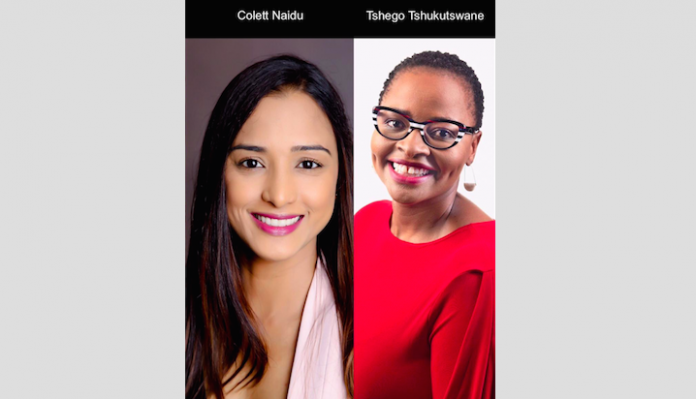
Colett Naidu, new Division Managing Director and Tshego Tshukutswane, new Group Chief Strategy Officer at Wunderman Thompson SA.
Wunderman Thompson SA has made two new appointments: Colett Naidu in the role of Division Managing Director with Telkom and ABSA, and Tshego Tshukutswane as Group Chief Strategy Officer.
Naidu has already been part of the agency team since May 2017 as a Group Account Director. The agency created a new role for a new division that will focus primarily on Telkom Group and ABSA Retail Business Banking. Agency CEO, Miles Murphy, shared, ‘Naidu has done an amazing job leading our team working with Telkom, and we are so proud of the work we do for them. She has consistently exuded ambitious energy, effortlessly advancing the work we do for some of our largest clients.’
Throughout her 13 years in the advertising business, Naidu has gained experience across renowned brands, including Edgars, Unilever, Clover, Tiger Brands, Omega Labs, Boehringer Ingelheim, ABSA and Standard Bank Digital.
‘I’m super excited about this opportunity,’ added Naidu. ‘I intend to nurture my team’s strengths, as well as support and help drive the diversity and inclusion objectives. I firmly believe that mentorship is more valuable than management, so I’ll continue to mentor and empower our young talent. Further, my ambition is to ensure that we consistently offer efficiency, integration, great work, talent and value to our clients while strengthening our partnerships even further.’
Tshukutswane will join in April, succeeding Moagi Bodibe as Group Chief Strategy Officer. Tshukutswane has a formidable reputation as a strategic marketer who effortlessly unlocks human-centric growth for brands and transforms businesses. She boasts 20 years of brand strategy experience with Unilever and Kimberly Clark’s client roles. She gained deep brand consulting experience at Added Value and most recently as Business Director for Kantar Consulting. She has also served as a non-executive director on the NCC Environmental Services and Standard Insurance Limited’s Board of Directors.
‘Tshukutswane has exceptional experience across many of the disciplines Wunderman Thompson delivers for its clients, including customer experience strategy, CX design, data and insights, strategic consulting, organisational transformation and brand building. Her approach to life and business is entrepreneurial and collaborative. We’re delighted to have her join us. I know she will help us deliver on our promise of part creative agency, part technology company and part consultancy,’ commented Murphy.
‘I’m so excited to be joining the Wunderman Thompson leadership team in South Africa. When Murphy and I started talking, I immediately saw the visionary positioning of Wunderman Thompson as a technology and data lead creative and consulting powerhouse. I also love the can-do culture and commitment to diversity and inclusion,’ expressed Tshukutswane.
Murphy continued, ‘I’m so energised by an even stronger and diverse leadership team to help us make 2021 a great success for our clients.’
Kalideck’s new Displayline Print SAPINO is an environmentally friendly and cost-effective all-weather solid board solution for highly effective retail displays, point of sale (POS) materials, outdoor street pole promotions and election campaign boards.
The FSC® certified chipboard is water-resistant for up to one year outdoors and is therefore the perfect choice for outdoor promotions instead of plastic materials. It is also recyclable.
Key features:
90% wood fibre forms part of a closed-loop material’s life cycle.
Quicker to assemble and dispose of than existing placards.
According to Meltwater, in the midst of the Covid-19 pandemic, new social media platforms have been welcomed with open arms by online users, in the search for new and meaningful ways to connect differently to the usual social media platforms like Instagram and Facebook.
Although Telegram, Omegle and Clubhouse existed long before the pandemic, 2020 saw these platforms boom among Gen Z and Millennials across the globe. Meltwater tracked and analysed social media data to see how these new social networks are outshining the old in the age of uncertainty.
Telegram
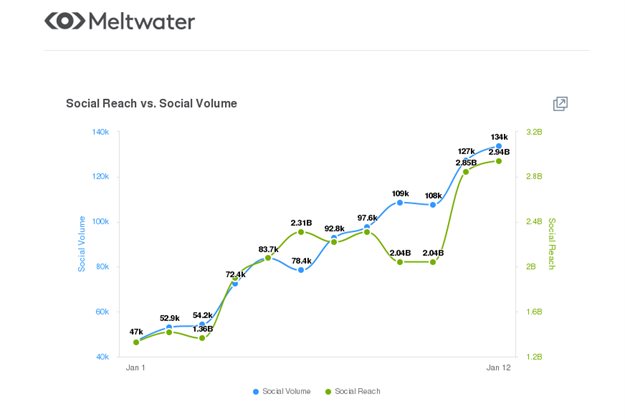
Global Social Volume (blue) vs Social Reach (green) on ‘Telegram’ Social Media Mentions between 1 January 2020 and 12 January 2020.
Telegram is also not a stranger to the online world, as the app has been around since 2013. However, after WhatsApp recently made the announcement on 4 January 2021 regarding its new privacy policy, many people took to social media to share how they would consider switching to Telegram instead.
Since the start of January 2020, there have been over one million social media mentions on ‘Telegram’, and these mentions have been increasing, with the most significant increase occurring on 4 January 2020.
On this day, the social volume of ‘Telegram’ mentions increased by 34% and the social reach increased by 39%. This was the day that WhatsApp announced their policy changes, and the data recorded more than 72,000 global social ‘Telegram’ mentions, which had a global social reach of 1.9 billion people.
WhatsApp, on the other hand, has been mentioned over three million times on social media, in relation to its new privacy policy. These mentions saw an increase on 4 January 2020, where the data recorded more than 250,000 social media mentions on the day. As the graph above indicates, these mentions on WhatsApp had some impact on the ‘Telegram’ mentions recorded on the same day.
While 79.1% of all ‘Telegram’ mentions were neutral in sentiment, this was primarily due to natural language processing attributing a neutral sentiment score to social media mentions in different languages and using a number of emojis. However, from what the data could provide a sentiment analysis on, 10.6% of online users feel positive towards ‘Telegram’ while 10.3% of online users feel negative.
Those who like ‘Telegram’ prefer it for its enhanced security, as well as having surpassed 500 million active users on the platform. The negative sentiment is attributed to mentions surrounding tech giant, Apple, potentially muting the app on their devices, as well as the data picking up on ‘Telegram’ mentions that included the keywords ‘WhatsApp’, ‘hate’, ‘leaving’ or ‘migrating’.
Clubhouse
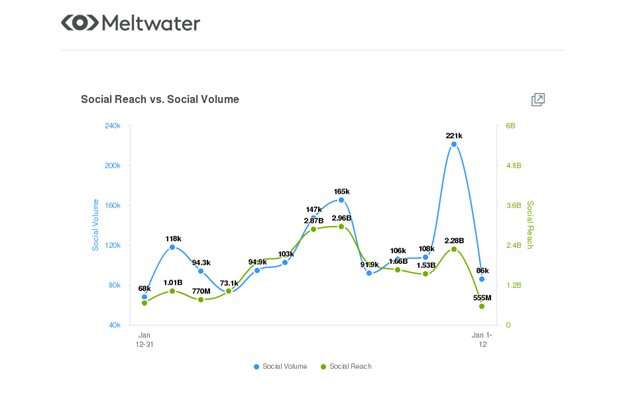
Global Social Volume (blue) vs Social Reach (green) on ‘Clubhouse’ Social Media Mentions between 12 January 2020 and January 2021.
Launched in 2016, Clubhouse is a new social networking platform that is based on voice, and allows users from around the world to come together to talk, listen and learn from one another in real-time.
In contrast to both social volume and social reach for Omegle, mentions on ‘Clubhouse’ have garnered a consistent social reach of over one billion people worldwide since April 2020, with the highest global reach being just under three billion people in August 2020. During this time, the data recorded 165,000 social media mentions on ‘Clubhouse’, as the app began to gain popularity among high profile individuals.
By December 2020, the data recorded the highest number of ‘Clubhouse’ mentions – 221,000 – as most online users had become familiar with the app and were now taking a bigger interest in how the social networking platform worked.
The majority of ‘Clubhouse’ social media mentions came from the USA (26.2%), followed by the United Kingdom (UK), Canada, Nigeria and India, making these the top five countries to be mentioning the app the most on social media.
Overall, mentions on ‘Clubhouse’ from the USA have been related to sharing. High profile celebrities or influencers were hosting discussions on various rooms and social media was used to either advertise the room or encourage people to get invites to join discussions. The data also showed similar tweets from users in the UK doing the same.
In Canada, most users are still trying to understand how the app works and use social media to query this, while in Nigeria, online users like the interactive discussions that take place on the platform. In India, online users have shown interest in Clubhouse’s potential to replace other audio-based apps, and become a leading app this year.
Taking a closer look at the high social volume of ‘Clubhouse’ mentions during December 2020, some of the trending themes included:
‘Clubhouse room’, which refers to different rooms in the app that users can enter, by invitation only, to participate in discussions.
‘Invite’ and ‘phone’, which refers to the ways in which you can access the platform.
Omegle
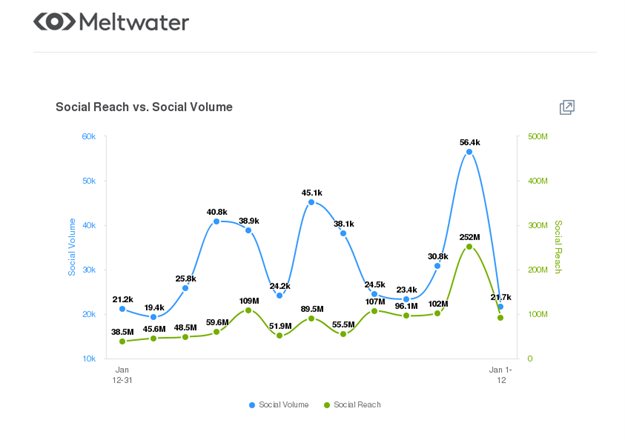
Global Social Volume (blue) vs Social Reach (green) on ‘Omegle’ between 12 January 2020 and 12 January 2021.
Launched in March 2009, Omegle is a free online chat website that randomly pairs users in one-on-one chat sessions, with conversations taking place anonymously. During the course of 2020, there were three key moments where social media mentions on ‘Omegle’ peaked worldwide.
The first was in April 2020, where the data recorded just over 40,000 social media mentions on ‘Omegle’. This was due to high interest in a woman, dubbed ‘Crazy Cat Lady’, and her animal abuse videos. Other mentions include users on Reddit asking for people’s experience of the platform as lockdown restrictions were implemented around the same time.
In July 2020, the data recorded more than 45,000 social media mentions on ‘Omegle’. Mentions around this time include one social user going viral for meeting American beauty YouTuber and influencer, James Charles, as well as users beginning to share their experiences on the platform – both good and bad.
December 2020 saw the highest number of mentions related to ‘Omegle’, with just over 56,000 social media mentions and reaching 252 million people. One Reddit discussion highlighted how Omegle is primarily being used by Gen Z’s while most online users shared YouTube video content that looked back on their Omegle experience throughout 2020.
The majority of ‘Omegle’ social media mentions are coming from the USA, followed by Brazil and the Philippines. Reasons for the mentions surrounding the social network within these three countries range from users in the Philippines using ‘Omegle’ to find love similarly to Tinder, to users in Brazil finding the platform a great way to meet new people.
In the USA, mentions on ‘Omegle’ from users include how President Donald Trump has been banned from the platform (although this was never officially verified or confirmed), while other users are warning against the use of the platform (particularly around the dangers of actually talking to strangers).
Since global mentions on ‘Omegle’ peaked the most during December 2020, some of the trending themes to emerge during this period included:
‘LSD trip’, which refers to another Reddit discussion regarding Omegle strangers ending up at a McDonald’s after taking hallucinogenic drugs.
‘Questions or concerns’, which refers to some online user’s general feelings towards the platform.
While Omegle is not a new social networking platform, it certainly gained much attention from online users looking for new ways to connect with others during the pandemic. However, despite its growing popularity, not everyone is on board with using the platform.
he 15.6% of social media users that like ‘Omegle’ feel this way because of how it has been helpful in socialising and meeting new people, as well as maintaining their social skills during the pandemic.
Mohamed Bhyat, new Chief Financial Officer at Havas South Africa.
Havas has appointed Mohamed Bhyat as its Chief Financial Officer (CFO), with his appointment coming into effect at the beginning of 2021. Bhyat will be working on the business in South Africa, across the entire Havas Village, which includes: Havas Johannesburg, Havas PR, Havas Media and the digital arm, Havas Boondoggle. He will also collaborate, where necessary, with the Vivendi Africa team, which includes Universal Music Group and GameLoft.
Bhyat’s work experience covers a wide range of businesses in the marketing and media sector. He was in the role of CFO for SuperSport for over five years, working closely with the CEO. He led Paycorp Holding’s finance function as the Group Financial Executive and held the position of CFO at Primedia Sport, among other organisations.
Havas Southern Africa CEO, Lynn Madeley, said, ‘We are very pleased with the appointment of Bhyat to lead our finance operations. He is a seasoned chartered accountant with extensive experience working with businesses in marketing and media in South Africa. His role will also see him sit on the Havas Village’s leadership team, helping steer the direction of the business into 2021 and beyond.’
Managing Partner at Havas Africa, Vineel Agarwal added, ‘Having Bhyat join the leadership team is a great jumpstart into the year. His role is crucial in fostering the existing integration across all disciplines within the Havas Village in South Africa, and the rest of the continent. We are looking forward to building a stronger Havas brand together.’
‘I am excited to have joined the Havas team, leading finance and sitting with the leadership team to help drive the business to generate strong profit margins. Havas’ culture is centred on the delivery of excellent work to clients, and the business’ ongoing commitment to transformation, diversity and inclusion is exemplary. I look forward to playing my part in making a meaningful difference to our clients, our people and South Africa,’ said Bhyat.
Grant Lapping, MD at DataCore Media, suggests that companies should be moving towards measuring the lifetime value of the customers they convert through their digital campaigns and channels. This is easier said than done because it demands that digital agencies look beyond digital campaign data and also draw on company-owned insights about their customer base.
Brands often ask their digital agencies what the industry norm is for cost per click (CPC), cost per lead (CPL) or even cost per acquisition (CPA), presuming that they will know whether their marketing is efficient and effective and if their cost per engagement compares favourably to the average in their sector.
Leaving aside that the comparisons are not always meaningful because each business is unique. Knowing that one business’s CPA is lower or higher than the competition does not paint a complete picture of customer lifetime value (CLV). A brand could, for example, be achieving a low cost per acquisition, but attracting customers who quickly churn to the competition or are unprofitable to serve.
This is outside digital media agencies’ comfort zone, since they are more accustomed to working with creative agencies to ensure that the creative is seen by the most relevant audience. They do not, for the most part, have the technical skills to tap into customer data housed in back-office systems to get a clearer picture of how campaigns are driving ROI.
Digital marketers can no longer merely be the people who load and optimise ads across programmatic ad platforms — they must also understand the customer metrics that drive the profitability of the business.
Closing the customer insight gap
Yet, the benefits of closing this gap are potentially large. Marketers would gain a far better grasp of ROI if they could not only understand CPC, CPL and CPA, but also the CLV of converted customers and the cost of sales (COS – media spend as a percentage of the revenue generated).
They would be able to see which channels, sources and campaigns are bringing in the most valuable customers, and could optimise executions accordingly. With a clear perspective on profit margins for a product or customer profile, marketers could adjust COS targets for each. This has created a powerful opportunity for digital media agencies to set themselves apart.
Digital agencies know how to work with clients to use programmatic ad platforms such as Google and Facebook to drive smart campaigns. The key performance indicators (KPIs) for these campaigns are usually determined by an action a user takes on the website, be it clicking through to a landing page, completing a lead form or making a purchase. In the background, algorithms harvest customer behaviour data via site tags and automatically adjust to targeting and bid ranges in line with the KPIs.
Understanding the tech stack
This approach is already more measurable than traditional media and offers ways to rapidly optimise performance. It can, however, be taken to a whole new level when the algorithms can be fed data from a company’s internal business systems for a more comprehensive view of CLV.
The advertiser could then pay more per click for a product with a bigger margin or for an audience segment likely to have a higher CLV, knowing that it is achieving a good ROI. Conversely, it could spend less on customers or products that are ultimately less profitable. The business is thus empowered to look beyond industry-standard KPIs to smart goals tailored to its own definition of business success.
To support clients with this transition, digital agencies will need to develop new technology skills and partnerships. They will have to be able to analyse a client’s tech stack and then integrate it with the relevant analytics and ad platforms. Again, this is not a simple shift to make, but it will be a major differentiator for those that get it right.
Great creative paired with the right media placements remains important, but we believe that this will just be table stakes in the not-too-distant future. Agencies that really want to add value and set themselves apart will need to be able to help their clients maximise profitability by optimising their campaigns based on the metrics that really matter to their business – not KPIs based on industry averages.
The new Toyota Agya targets a younger audience buying their first car. The FCB Joburg team of executive creative director Tian van den Heever, creative director Julie Thorogood, art director Leesha Harington and copywriter Matthew Shafto opted to position it as ‘a big deal for a small car’ in their latest campaign.
‘Seeing as the Toyota Agya has a number of features not typically associated with a small car, we decided not to speak about it like a small car. Instead, we introduced the Agya in the same way that people are typically introduced to luxury, high-end vehicles, but with a bit of a twist,’ said van den Heever.
‘In line with well ‘specced’ luxury cars, which are always featured gliding through winding mountain passes with ease, our commercial opens in a very similar way to draw in the viewer and make them believe that they are watching a commercial for a new luxury sports car.
‘Grand music and a voice-over detailing the features of this new car are interrupted midway when we reveal the car is actually a compact hatch. And then the driver starts conversing directly with the voice-over explaining that all those features are in fact available in the Agya.’
The campaign comprises above-the-line, digital and social, Out-of-Home, print and below-the-line (print collateral in dealerships). ‘We kicked off with a social media teaser campaign to get people guessing what Toyota would be launching in the next few weeks,’ explained van den Heever.
‘The posts featured extreme close-ups of the sleek design of the bodywork coupled with some of the feature highlights. This really served to point the target audience in the ‘wrong’ direction and ensure the reveal of the Toyota Agya and its tremendous features really grabbed their attention,’ he said.
Ener-G-Africa – a sustainable energy company – and Firejuice have joined forces to implement a marketing strategy that will expand Ener-G-Africa’s footprint throughout Southern Africa.
This particular collaboration is a six-month engagement, during which Firejuice will act as an outsourced marketing department and support Ener-G-Africa as it expands. It will provide the services traditionally associated with those of a marketing director and marketing manager, but on a flexible and affordable basis.
Richard Bunderson, a director of Ener-G-Africa, pointed to the solar panel factory as a major reason for engaging with Firejuice, which will ‘help Ener-G-Africa to take a strategic approach to generating demand once the plant is operational’.
Bernard Jansen, founder and principal consultant at Firejuice, said, ‘This partnership is exciting not only because Ener-G-Africa is a high-growth business with international backing, but also because it has ambitions to grow regionally.’
Jansen further highlighted the role played by technology and virtual tools when it comes to delivering flexible services to companies in Africa, ‘What has become apparent over recent months is that it is possible for a small team like ours to support companies as they scale their marketing operations – despite being based in Johannesburg.’
Stuart Walsh, Chief Strategy Officer at Grey Advertising Africa.
Stuart Walsh, Chief Strategy Officer at Grey Advertising Africa, says the lack of ‘skin’ in the game in advertising creates an unfortunate credibility gap, especially when advice involves the client spending more money.
Every time you tell a client they should take more risks – that the greater the risk, the greater the reward – try it. See how easily it rolls off the tongue? That’s because it is not your money you are proposing gambling with. As one strategist put it, ‘Everything’s easy when someone else is paying for it’.
Downturns and budget cuts
What makes it doubly unfortunate is that even demonstrably sound advice is treated with circumspection. Never has this been more apparent than during 2020, the year of lockdowns, restrictions and personal, financial and health crises.
I doubt there is an advertising agency in the country that did not have to deal with clients cutting their budgets in the months following our first descent into lockdown. Advertising spend plummeted across most categories and brand building initiatives ground to a halt, despite all your advice to the contrary. But of course, you would advise to the contrary, wouldn’t you? We are ad agencies, after all. Well, yes, but not for those reasons.
In the subjective world of advertising, the argument around whether or not to advertise during a recession is probably about as close as we will ever come to a ‘settled’ debate or to anything resembling an indisputable fact. There is over a century of research and evidence all pointing to the benefits of advertising during a downturn and, consequently, to the negative effects of pulling advertising during such a period.
But this evidence seldom gets an airing beyond the desks in the planning department, serving no purpose other than to clog up strategists’ hard drives in the vain hope that one day somebody will see the argument and its indisputable truths. Instead, because of moral hazard, because we don’t have ‘skin in the game’, our recommendations are often seen as self-interest rather than impartiality.
Putting our money where our mouth is
Armed with the current research from the Scopen Agency Study, detailing exactly brands’ strengths and weaknesses relative to many competitors, set yourself some marketing and advertising objectives and write yourself a creative brief, just the same as you would for any other brand in your portfolio. Then put these OOH adverts for your own brand on billboards strategically placed to catch the eye of clients and agency staff.
These billboard creatives are the product of the same creative processes, the same reviews and the same budgetary constraints as experienced by all brands. Do for your own brand exactly what you do for your client brands on a daily basis. Although, it has to be said, this client certainly takes the cake when it comes to ‘difficult’.
Will people like the campaign? Some will. The boards are, if nothing else, amusing and will trigger a bit of playful rivalry with other agencies. Will people hate the campaign? Some will. Without a doubt. This is advertising after all and, if you have not yet learnt that trying to please everyone is a mug’s game, you might want to reconsider your career choices.
Most importantly, will it work? A campaign has three chances at success. If it attracts new clients to our brand, it works. If it attracts new talent to our brand, it works. And If it succeeds in dispelling the myth that agencies act out of self-interest in the mind of just one client, it works. Know that no campaign delivers immediate results, which is why continuous presence is so important.
Either way, any of these three results might just make those budget chats a little easier. As we enter year two of the pandemic and brands continue to operate under financial constraints while competing for customer awareness and loyalty, know how important it is to remain visible. It is time we all put some skin into this game.
Red & Yellow Creative School of Business is turning the lens inwards to take a look at some of the not-so-stellar advertising from 2020 with the introduction of the‘Ag Shame’ Ads of the Year, a light-hearted, tongue-in-cheek campaign that reminds us to remember to laugh at ourselves every once in a while.
These are the ads that have seemingly arbitrary hashtags; the ones that we skip over or block and the ones that feature influencer partnerships that make no sense. ‘This campaign is not about pointing fingers, but rather about learning and embracing our mistakes, and moving onwards and upwards. There cannot be a single creative or client that has not messed up at some point, but who has then learned from the experience and become stronger,’ said Taryn van Heerden, Head of Marketing at Red & Yellow.
‘As an education provider, it is important for us to embrace this as a learning experience. That is why the campaign is not about the adverts, it is about the stories behind them. The nomination categories have been carefully selected by industry professionals – people who are all too familiar with these common mistakes – having done many of them themselves,’ said van Heerden.
Categories include:
1. The ‘Perfect ad for a bathroom break’.
2. The ‘Most skippable YouTube ad’.
3. The ‘What’s that billboard for again?’.
4. The ‘Best use of a random hashtag’.
5. The ‘Most obvious use of a paid influencer’.
6. The ‘Make people dance for no reason’.
The ‘Ag Shame’ Ads of the Year campaign runs from 20 January to 20 February 2021. Everyone is encouraged to visit discover.redandyellow.co.za and add their thoughts on which ads made them think ‘Ag Shame’.
‘The one thing I learnt very early on in my career in advertising was to become accustomed to criticism, because bad ads happen to the best of us. This campaign is as brave and fun as the industry itself should be. It is time for people to share their thoughts on who nailed it in 2020… or in this case, who didn’t. If the youth think they can do it better, they now know where to go to start their careers in advertising. Red & Yellow needs fresh talent, and so does the industry that we all love so dearly,’ said Ahmed Tilly, Creative Consultant and judge of multiple industry awards including the Loeries, Cannes and New York Festival.
In the spirit of growing new talent and paying it forward, Red & Yellow is also offering one of their highly acclaimed online short courses to the value of R16,500 to one lucky creative thinker. Go to discover.redandyellow.co.za for more information.