

Home Blog Page 25

Brands Should Pay Attention To The Influence Of SA’s Code-Switching Middle Class

Amu Mathebula, Kaya 959.

South Africa’s most powerful new consumer generation has arrived. They are in their prime earning years, raising children, investing in homes and education and steadily moving up the income ladder. Kaya 959’s latest research shows that the centre of gravity in the Black middle class is now between 35 and 49, with an average age of 37.

The numbers underline their influence. UCT data estimates the Black middle class at more than 3.4 million people with R400 billion in annual spending power. BrandMapp findings show that this group grew by 7.5 percent in 2024, with more households entering higher income brackets.

This is a generation shaping their own futures as well as that of their communities. They are building wealth, carrying financial responsibility for extended families, influencing workplace culture and guiding the educational and lifestyle decisions of the next generation.

We call them ‘Code-Switchers.’ Multilingual, they embody a fluid cultural mindset. They move with ease between kasi and city, between traditional values and contemporary lifestyles, between heritage and ambition. Their identity is not fixed to one place or aspiration. Many are investing back into townships and communities, rejecting the old narrative that success only means leaving. They are comfortable in both worlds, and they expect brands to understand and respect that balance.

Too often, this group remains overlooked in brand strategies. They are not passive consumers but discerning decision-makers who demand value, authenticity, and convenience. Campaigns that stereotype or generalise will fall flat. Campaigns that show cultural fluency, reduce friction in daily life, and deliver consistent reliability will win trust and loyalty.

Amu Mathebula, Kaya 959 Research and Development Specialist, said: ‘South Africa’s code-switching Black middle class is already shaping the economy. At an average age of 37, they are building careers, families and communities while making the biggest purchasing decisions of their lives. Brands that ignore their influence will be left behind. Those that connect authentically will gain loyal customers and powerful advocates whose choices ripple across households, workplaces, and entire communities.’

Radio continues to be their trusted cultural bridge. In an era of fragmented attention spans, radio offers credibility, connection and community that digital platforms cannot replicate. It is where brands can meet this audience on their own terms, in their own voices.

The opportunity is urgent. This generation is defining South Africa’s economic future right now. They want brands that recognise diverse family structures, honour both tradition and innovation, and show respect in every interaction. At 37, they are making life’s biggest decisions, carrying influence across households and workplaces… and they are looking for partners who understand their journey and will walk alongside them.

KAYA 959
https://www.kaya959.co.za

AMC Highlighted Opportunities And Challenges Facing African Marketers

AMC Highlighted Opportunities And Challenges Facing African Marketers

The African Marketing Confederation (AMC) recently concluded its annual conference alongside TICON Africa. Held in Accra, Ghana, the conference brought together marketing professionals, academics, and business leaders from across Africa and beyond. This year’s event attracted more than 400 delegates from 29 countries.

Ghana led with 229 participants, followed by Uganda (42), South Africa (38), Zambia (26), and Zimbabwe (24). Delegates also came from countries as far afield as Austria, Canada, India, Romania, the United Kingdom, and the United States, underscoring the AMC’s global reach.

Keynote speakers examined both the opportunities and challenges facing African marketers in a rapidly changing global landscape. Charles Murito, Google’s Regional Director for Government Affairs and Policy in Sub-Saharan Africa, highlighted the role of artificial intelligence, saying: ‘AI is not about replacing human creativity, it’s about supercharging it. It gives every single African entrepreneur the tools to tell their story to the world in the most compelling way possible.’

Discussions on AI continued throughout the conference, reflecting Africa’s growing interest in harnessing technology to expand markets, enhance data-driven decision-making, and give small businesses a competitive edge. While some speakers emphasised its potential for innovation, others raised concerns about ethical use, infrastructure gaps, and the need for clear policies to avoid widening inequality.

Other sessions featured insights on digital transformation, brand storytelling, and the power of collaboration in unlocking Africa’s economic potential. ‘Africa’s greatest resource is no longer beneath the ground. It is our young people. By investing in education and innovation, we can unlock a future defined by progress and resilience,’ said Professor Fred McBagonluri, Provost and President at Academic City University.

The diversity of perspectives reinforced the importance of cross-border collaboration and professional development. With participation from nearly every corner of Africa, the conference demonstrated AMC’s growing influence in shaping the future of marketing on the continent.

The event closed with a renewed commitment to advancing the profession through training, ethical practice, and innovation. This ensures African marketers remain active players in global conversations on technology, creativity, and economic growth.

AFRICAN MARKETING CONFEDERATION
www.africanmarketingconfederation.org

Effie College Launches In SA To Nurture The Next Generation Of Marketing Leaders

Effie College Launches in South Africa

Effie South Africa is proud to announce the official launch of Effie College – a pioneering initiative designed to nurture the next generation of marketing leaders by bridging academic learning with real-world application. Effie is a globally recognised authority on marketing effectiveness, best known for its prestigious Effie Awards, which honour the most impactful and results-driven marketing campaigns across the globe.

Effie’s mission is to lead, inspire, and champion the practice and practitioners of marketing effectiveness globally. Effie College is an initiative of the Effie LIONS Foundation. Working with students, universities and leading brands, the Foundation provides rising talent the real-world experience, network, and platform needed to shape the future of marketing through their unique lens.

With Nedbank as the inaugural brand sponsor, Effie College launches with the YouthX Challenge – a powerful collaboration that invites students to apply creativity, strategic thinking, and the principles of marketing effectiveness to a live client brief.

Four leading institutions – the University of Cape Town (UCT), University of Johannesburg (UJ), North-West University (NWU), and the AAA School – will participate in the 2025 YouthX Challenge, tackling real consumer needs through innovative, insight-led campaigns.

The programme sees student teams working under the mentorship of industry professionals. Each submission will be judged using the official Effie Awards judging process, applying the same rigorous standards used globally to assess marketing effectiveness.

‘Effie College brings the real world into the classroom, and the classroom into the world of brands,’ said Gillian Rightford, ACA Executive Director for Effie South Africa. ‘We’re excited to be launching this programme as part of our commitment to skilling up the next generation of marketing professionals. With the support of Nedbank, the YouthX Challenge gives students a platform to apply their ideas to a genuine brief, while learning the fundamentals of effectiveness in action.’

The YouthX Challenge goes beyond theory. It provides students with practical exposure to client-side marketing and prepares them for the realities of brand building in a fast-evolving landscape. The campaigns are judged by a panel of respected professionals from across the marketing and communications industry.

Winners will be announced at the prestigious Effie Awards South Africa Gala 2025, recognising excellence not only in student work, but in the collaboration between academia and industry. Modern Marketing is a proud media partner of the awards.

‘Effie College represents our belief that the future of marketing must be built on access — access to opportunity, mentorship, and the chance to solve real brand challenges,’ said Allison Knapp Womack, Global CEO, Effie LIONS Foundation. ‘We’re proud to see the programme take root in South Africa, bringing together students, educators, and industry leaders to shape a more open, effective, and globally connected industry.’

For more information on Effie College visit the Effie South Africa website or  www.acasa.co.za.

EFFIE AWARDS SOUTH AFRICA
www.effieawards.co.za

Lucky Hustle Announced As Small Agency Of The Year At WesBank New Generation Awards

Lucky Hustle Shines at Next Generation Awards with Four Wins

The WesBank New Generation Awards celebrate bold, future-facing creativity in advertising and marketing across Africa. Lucky Hustle made a dazzling mark at the awards ceremony, clinching four major accolades for its campaign ‘Ringside Fitness: The Legacy of Ludumo Lamati’. Lucky Hustle’s wins highlight the agency’s ability to harness technology, creativity, and resourcefulness to deliver powerful campaigns that punch above their weight.

The wins included:

– Silver: Best Use of Technical Innovation.
– Gold: Best Use of AI.
– Gold: Best Low Budget Campaign.
– Black Onyx: New Generation Awards Small Agency of the Year.

The celebrated campaign, ‘Ringside Fitness: The Legacy of Ludumo Lamati,’ paid tribute to the South African boxer’s enduring legacy, blending storytelling with innovative digital tools to inspire audiences and connect them with the Ringside Fitness brand in fresh, dynamic ways.

‘These awards are more than just trophies – they’re a testament to the heart, hustle, and ingenuity that fuels everything we do,’ said Darren Morris, Lucky Hustle CEO. ‘Winning across categories that spotlight AI, technical innovation, and smart use of budget shows that great ideas can truly come from anywhere, and with any resources.’

In his heartwarming comeback story, former world boxing champion Ludumo ‘9mm’ Lamati’s legacy was under threat. Lucky Hustle had 20 days to ensure the gym’s doors stayed open.

‘For me, boxing was never just about winning fights — it was about showing people that no matter where you come from, your dreams are worth fighting for. If my journey inspires even one person to keep going, then my legacy lives on. I am so grateful for the Lucky Hustle team for partnering with me in keeping my legacy alive.’

The wins build on a growing wave of recognition for Lucky Hustle, coming on the heels of its CEO being named Rising Star (Agency Category) at the inaugural Mark Awards in August.

LUCKY HUSTLE
https://luckyhustle.co.za

Brands That Invest In Data And AI To Personalise Experiences Will Build Long-Term Trust

How AI personalisation is changing the way South Africans shop online
Kunal Badiani, MoEngage.

According to Kunal Badiani, Vice President: Business and Growth, Middle East, Africa and Turkey, MoEngage, South African consumers are no longer satisfied with products and services that just ‘do their job’. They want experiences that feel relevant to them, delivered at the right moment and in the right way.

This shift comes as the country’s online retail sector surged 35% in 2024 to reach about R96 billion, and is forecast to top R130 billion by the end of 2025, making up nearly 10% of total retail sales, according to World Wide Worx. With growth like this, the real challenge for businesses isn’t reaching customers, it’s connecting with them in a way that matters.

For too long, personalisation has meant little more than dropping a customer’s first name into a bulk email. Real engagement requires much more. Many businesses, despite investing heavily in digital tools, still struggle to deliver experiences that feel joined up and personal.

A big part of the problem is data fragmentation. Imagine Lebo spots a dress on your Instagram feed, browses it on your app and then pops into your Sandton City store only to find her size is not available. The next day she gets a generic email about a sale. For Lebo, the brand feels disconnected, like it does not really see her. It is frustrating and makes it easier for her to look elsewhere.

The solution is to create a unified customer view (UCV): a single, real-time profile that pulls together everything a customer does across both online and offline channels.

With this in place, brands can:

– Understand individual preferences and behaviours.
– Tailor communication across every channel.
– Ensure consistency in tone, timing and message.
– Make smarter decisions based on the bigger picture.

Think of it as building a puzzle. Without all the pieces, the image is incomplete and so is your strategy.

The South African Context

South Africa’s rapid digital transformation has raised the bar. According to a PwC study, 90% of local consumers say a consistent, high-quality experience is key to building trust. It is no longer enough to compete on products alone. Customers are comparing experiences, and those who get it right will win loyalty quickly.

This is where AI-powered customer data and engagement platforms (CDEPs) come in. They help businesses build a UCV and then act on it in real time. AI can:

– Segment smarter: quickly build precise audiences using natural language.
– Automate journeys: turn campaign goals into ready-made customer journeys
– Make decisions in real time: choose the right message, channel and timing for each customer

For marketers, this means spending less time crunching data and more time focusing on creativity and strategy.

In retail, two high-value customers may look the same on paper but respond differently. Thandi, who loves discounts, might get a 10% off email. Sipho, who values exclusivity, receives an SMS about a limited-edition launch.

In banking, Michael, a young professional, could get an in-app nudge about a fintech investment while Priya, a homeowner, receives an email guide to education savings. The impact is simple: people feel seen, valued and more likely to stay engaged.

Building this capability does not have to be overwhelming. Businesses can begin by asking:
– Are we speaking to customers with one consistent voice across all channels?
– Do our teams have access to the same data when making decisions?
– Are we using AI to move beyond broad segments to truly individual engagement?

South African brands are at a turning point. Customer expectations are rising and digital competition is only getting tougher. Those who invest in unifying data and applying AI to personalise experiences will stand out not just by driving revenue but by building long-term trust.

Now is the time to connect the dots and build businesses that understand their customers as individuals, not just as data points.

MOENGAGE
www.moengage.com

SA Furniture Manufacturers Need To Invest In Marketing To Drive Growth

Investing in marketing: The key to local growth and export success

In today’s fast-changing business environment, South African furniture manufacturers face both opportunity and risk. Competition is intensifying, consumer expectations are shifting, and export markets are more demanding than ever. For this reason, marketing must be seen not as an expense, but as a strategic investment.

Strategic investment in marketing – traditional and digital – builds credibility, strengthens local trade, and opens the door to export opportunities. As Tracy Symons, Relationship Marketing Manager for the South African Furniture Initiative (SAFI), explained: ‘Marketing is not a cost; it is an investment in visibility, trust and long-term value.’

Why Marketing Matters Locally

Domestic trade is the bedrock of any manufacturer’s success. By investing in marketing at home, firms not only grow their customer base, but also sharpen their understanding of buyer preferences and build operational discipline. These capabilities become crucial when scaling into export markets.

Market Orientation Theory highlights that companies that systematically gather and act on customer insights consistently outperform their competitors. For South African manufacturers, this means using marketing to listen, respond and position their products where demand is strongest.

As Symons noted: ‘If you cannot win over local retailers and buyers, convincing international distributors becomes even more difficult. Domestic credibility is the springboard for export success.’

From Local Strength To Global Reach

Moving from local to global requires more than operational readiness – it demands credibility. Export buyers consider not just the product but the professionalism of the company behind it. This is where marketing takes centre stage. Whether through a polished catalogue, a strong online presence, or professional trade show materials – the way a business communicates determines how it is perceived abroad.

Symons said: ‘When you step onto the export stage, your marketing does the talking before your furniture even gets seen. It signals professionalism, reliability and vision. Buyers want to know they can trust you not just for one order, but for the long-term and marketing is how you prove that before a single container leaves the factory.’

What Works Best: Relationships, Branding And Digital Integration

SAFI encourages manufacturers to adopt a layered approach to the following channels-building, brand development and digital channels:

– Relationship marketing builds long-term trust with customers, distributors, designers and retailers, fostering cooperation and reciprocity that ultimately drives sustainable growth.

– Branding and storytelling elevate perceived value, especially as international buyers are influenced by supplier reputation and country-of-origin image. South African manufacturers can differentiate by emphasising craftsmanship, sustainability and our unique design heritage.

– Digital marketing now underpins both of the above. A website, social media channels, e-catalogues and targeted online campaigns make it possible to maintain relationships and showcase brand stories locally and globally at relatively low cost. Buyers increasingly research suppliers online before committing, which means digital visibility is as critical as a handshake at a trade show.

Symons stressed: ‘Digital marketing doesn’t replace traditional methods – it amplifies them. A visual presence in print, or a meeting at a trade fair, will create the first impression, but digital channels sustain the conversation long after the event and increase your reach.’

Why Digital Is A Game-Changer

Digital tools also offer measurable advantages. Manufacturers can track engagement, analyse which designs generate the most interest, and refine their strategy accordingly. They also help drive local sales by boosting visibility, building customer loyalty, and creating direct pathways for consumers to connect with brands online. This aligns with the Resource-Based View, which identifies brand equity and digital presence as intangible assets that create lasting competitive advantage.

For exporters, digital channels reduce distance. Virtual showrooms, video walk-throughs, and responsive websites give overseas buyers confidence without always needing to visit in person. Symons explained: ‘Your digital presence is often your first handshake with an international buyer. It reassures them that you are professional, reliable and ready to deliver.’

Marketing As A Strategic Imperative

For South African furniture manufacturers, marketing is not a luxury – it bridges your products with your customer values. Every rand you invest, whether in a showroom display, a digital campaign or a trade expo, is a rand invested in your business’s future.

For furniture manufacturers, the challenge is not only to produce quality products but to ensure that the right audiences see, value and trust them.

‘Digital marketing doesn’t replace traditional methods – it amplifies them. A trade fair creates first impressions, but digital channels sustain the conversation long after the event,’ said Symons.

Top Five Marketing Priorities For SMEs

– Build a professional, mobile-friendly website with product catalogues.
– Strengthen relationships with retailers, distributors and designers.
– Invest in branding that highlights South African craftsmanship and sustainability.
– Combine traditional expos with digital marketing to extend visibility.
– Track and measure customer engagement to refine your marketing strategy.

SAFI
https://southafricanfurnitureinitiative.co.za

Francophone Africa Could Be The Missing Piece In The African Growth Story For International Brands

The Francophone consumer: Young, connected, and redefining brand loyalty
Passy Nopoudem, Irvine Partners.

According to Passy Nopoudem, Regional Communications Expert at Irvine Partners, too often, Francophone Africa is overlooked in global expansion strategies, overshadowed by larger Anglophone markets like Nigeria, South Africa, or Kenya. The assumption is that consumer behaviour in one part of the continent mirrors another. That’s where global headquarters get it wrong.

French-speaking markets are distinct: shaped by cultural nuance, language, and consumer perceptions that play by different rules. Brands approaching them with copy-paste strategies quickly learn that what worked in Lagos or Johannesburg may fall flat in Abidjan or Dakar.

Walk into a café in Abidjan or Douala and you’ll see it instantly: young people with their smartphones, scrolling TikTok, paying via mobile money, switching between French, English and local slang in a single breath. This always-on, mobile-money lifestyle makes switching brands effortless, so loyalty hinges on convenience and cultural relevance rather than long histories. Their discovery happens through viral trends and peer validation more than traditional advertising, forcing brands to win trust in real time. This is the face of today’s Francophone African consumer: young, connected, and radically reshaping how brand loyalty is built and sustained.

Young And Hungry For Connection

More than 60% of Africa’s population is under 25. This is a mobile-first generation that consumes entertainment, news, and advertising on their phones. This means they actively engage with brands that speak their language (literally and culturally). They follow influencers on TikTok, buy from local entrepreneurs on WhatsApp, and trust what feels relatable. While price matters, authenticity and cultural resonance are what turn first-time buyers into lifelong advocates.

Loyalty Is Built Differently Here

In many Western markets, loyalty comes from rewards programs or seamless digital experiences. In Francophone Africa, it’s more personal. People go back to brands that show up consistently, prove they can be trusted, and align with local values. This is why Spotify has gained traction by amplifying francophone creators — streaming French-language music, podcasts, and audiobooks to millions of users both within and outside traditional French speaking regions; and by investing in creator-support programmes like its Africa Podcast Fund, which backs content in French and ensures listening experiences rooted in local culture. Trust and credibility are the new currency of loyalty. That’s where we come in. We sit at the intersection of global ambition and local resonance, helping.

One of the biggest mistakes we see is over-centralisation of strategy. A campaign designed in London or Paris, translated into French, and then pushed into Dakar will rarely stick. Local consumers are quick to spot what feels like a one-size-fits-all approach. They want brands that understand their humour, their slang, their cultural references. Without this, global brands risk being seen as tone-deaf or opportunistic.

Unlocking Market Gems

More than just a new sales frontier, this region is one where brand loyalty can transform into brand advocacy if nurtured correctly. The opportunities are enormous thanks to its young consumers, rising digital adoption, and untapped cultural influence. But it demands a local-first strategy that’s globally aligned while remaining deeply human.

Expanding into Francophone Africa demands more than a launch plan; it requires partners who can bridge global ambition with local resonance. Brands that combine on-the-ground insight with strategic global thinking avoid the blind spots that derail expansion. With a deep understanding of media landscapes, consumer habits, and cultural codes, the right support can turn unfamiliar markets into loyal communities—and loyal communities into lasting movements.

For international brands, Francophone Africa could be the missing piece in the African growth story. The question isn’t if these markets are worth the investment; it’s whether brands will take the time to understand and approach them the right way. Those who do will find themselves not just selling products but building movements.

IRVINE PARTNERS
www.irvinepartners.co.za

Momentum’s Five-Year Billboard Showed The Benefit Of Long-Term Consistency

The billboard that (mostly) didn’t change and why your investments shouldn’t either

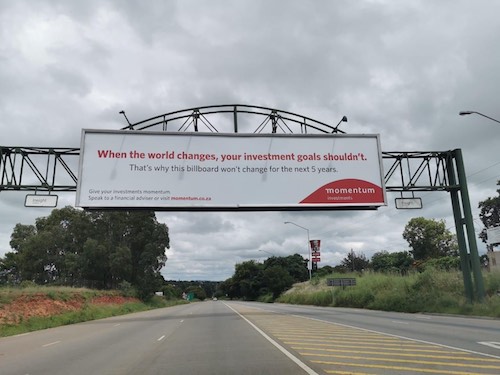
After five years of standing firm on Solomon Mahlangu Drive, Momentum Investments’ billboard with an important message recently came down. Momentum Investments intended the billboard to stay unchanged for five years, in contrast to the changes commuters would see daily.

Since then, Solomon Mahlangu Drive has been upgraded with additional lanes, large housing projects are underway, and the new Castle Gate Shopping Centre has been added. The road is now a major arterial road linking Pretoria East with its surrounding areas. And the world has also changed. Within a few months of putting up the billboard, the whole planet was dealing with the effects of COVID-19. Its message to commuters: ‘When the world changes, your investment goals shouldn’t’, was to highlight the importance of long- term thinking in uncertain times.

Although the billboard had some slight alterations – a countdown with years and months was added – and was stolen and had to be replaced, the main message always stayed the same: ‘When the world changes, your investment goals shouldn’t.’

‘Too often, investors are distracted by market trends, hype, and a short-term news cycle. As a result, they are prone to making short-term investment decisions that are not aligned with their long-term goals,’ said Fränzo Friedrich, Head of Marketing at Momentum Investments.

It’s a pattern Momentum Investments tracks closely. According to the latest Behavioural Science of South African Financial Decisions (Sci-Fi) Report, investors lose millions due to poorly timed switches between funds.

When markets fall, switching activity spikes. Switching activity gradually increases as panic sets in, investors move to safety and then scramble to get back into markets in the recovery. Many investors sell ‘low’ and buy back ‘high’, if they ever return to the market.

This ‘behaviour tax’ highlights exactly the kind of short-term thinking Momentum Investments warns against. As Friedrich reflected, ‘2020 was a watershed year, and its ripple effects are still being felt. Today, we live in a world that is constantly shifting and with increased volatility, it has never been more important to stay focused on long-term goals. Our research makes it clear: many investors are prone to making short-term investment decisions not aligned with their long-term investment goals. They rush for safety and get stuck in safe asset classes where they remain for a large portion of the inevitable market recovery.’

The Momentum Investments’ billboard on Solomon Mahlangu Drive remained (mostly) unchanged for five years while everything around it evolved. Just as the billboard stood steady amid the shifting landscape, investors should be reminded of the value of staying the course amid constant change. Because while everything else may change, your investment goals shouldn’t.

MOMENTUM
www.momentum.co.za/momentum/personal

TikTok Hosted #LevelUpAfrica Creator Education Day

TikTok's #LevelUpAfrica Creator Education

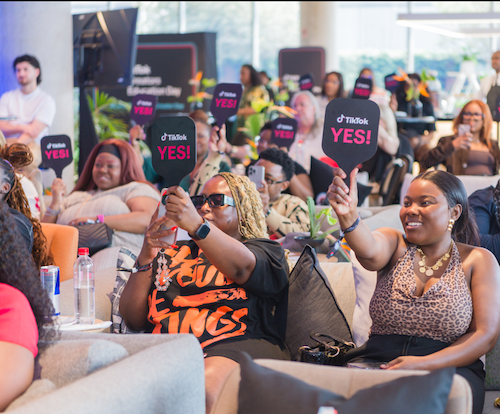
TikTok recently held its annual #LevelUpAfrica Creator Education Day in Johannesburg, bringing together a dynamic mix of creators, media, industry leaders and government representatives. The session highlighted TikTok’s ongoing investment in the digital creative economy by empowering youth and expanding access to meaningful opportunities on the platform.

The event is part of TikTok’s flagship #LevelUpAfrica programme announced at the Creator Roundtable in June, designed to support and empower 3000 creators across sub-Saharan Africa by the end of 2025.

Beyond networking, the Creator Education Days offered creators the opportunity to interact and learn directly from the TikTok team as well as industry experts through a series of highly engaging sessions. Covering a wide range of topics including monetisation, account health, storytelling and content creation tips, the session was also designed to help creators grow their content and unlock new opportunities for impact.

‘The #LevelUpAfrica Creator Education Day is a powerful opportunity for us to connect with our vibrant creator community across Africa,’ said Boniswa Sidwaba, Head of Content Operations, sub-Saharan Africa at TikTok. ‘It’s not just about skills development, it’s about fostering a sense of community, inspiring collaboration and opening doors for creators to take their careers to the next level.’

Present at the event were creators such as DreamBoys and Keegan Gordon, popular for their large-scale, impactful challenges which often involve giving back to the community; Nathan Molefe, known as the ‘King of Skits’, with over 3.2 million followers enticed by his comedic videos and Yolenda Jawe, affectionately known as Yolzchannel, who offers clear, easy to understand lifestyle and property advice. Reflecting on his journey, Gordon shared, ‘TikTok has allowed me to bring ideas to life in a positive way. I like that creators have the ability to reach the world by telling a story with one device, if you use it the right way. Everyone has the ability to change something, it can be their own life, or the lives of others.’

Ayanda Halimana, revered film and TV practitioner added, ‘Take your content seriously. Additionally, you can only do this effectively if you know your ‘why’. Why are you doing this? What is the broader story you need to tell?’.

By combining TikTok’s global reach, with the shared commitment and support of partners such as Special Effects Media, and National Film and Video Foundation to nurture talent, the sessions gave creators the skills, exposure and support they need to build lasting careers. It’s a partnership that proves when creativity is empowered, opportunities follow.

TIKTOK
https://www.tiktok.com/

Publicis Groupe Africa Expands Commerce Division

Publicis Groupe Africa Expands Commerce Capability to Meet the Demands of a Converging Commerce Ecosystem
Paula Hulley, Publicis Groupe.

Publicis Groupe Africa has expanded its commerce division, Publicis Commerce, to give brands stronger, more integrated support as shopping habits continue to shift across digital and physical channels. Publicis Commerce focuses on solving real client challenges, from optimising product visibility on digital shelves to linking media investment directly to sales.

The expansion brings together global best practices with local market insights to create practical, results-driven solutions. The move means clients will now have access to a broader set of connected commerce services, spanning media, creative, data, experiential, and platform expertise – all designed to help brands reach shoppers wherever they are and to measure the impact more effectively.

Paula Hulley, Publicis Commerce Lead in South Africa, explained: ‘What excites me most is that we’re creating a space where brands can connect more meaningfully with their customers. Our job is to cut through the complexity and help clients grow, whether that’s through better use of data, sharper creative or making sure their products are seen and bought in the right places.’

In addition to leading Publicis Groupe Africa’s commerce strategy, Hulley also chairs the newly formed IAB South Africa Connected Commerce Committee, a cross-industry initiative designed to unify and elevate South Africa’s digital commerce ecosystem.

The committee brings together senior leaders across media, retail, tech, and data to drive collaboration, innovation, and the development of actionable standards. It is aligned with the IAB’s global Connected Commerce agenda, which champions:

– Smarter measurement and unified attribution.
– AI-powered personalisation and automation.
– Shopper-centric design across digital and physical shelves.
– Commerce media convergence across platforms, publishers, and retailers.

The committee will serve as a strategic platform to help South African brands stay ahead of global trends while delivering measurable growth and consumer value.

PUBLICIS GROUPE AFRICA
https://publicisgroupeafrica.com/

This is Modern Marketing