Home Blog Page 22

Effie Awards South Africa Extend Deadline

Effie Awards South Africa Extends Deadline

The Association for Communication and Advertising (ACA) and Effie Awards South Africa have extended the deadline for entries into the 2026 Effie Awards South Africa programme and encourage agencies, brands, media owners, specialist agencies and clients to make use of the additional time to submit their most effective work.

The new extended deadline for entries is scheduled for Friday, 12 June 2026.

Please note that the extended deadline period carries a different entry pricing, which will apply to all submissions received and completed during this time.

The extension provides entrants with additional time to finalise and refine submissions ahead of judging for the 2026 programme, which continues to recognise and celebrate marketing communication that delivers measurable business results.

‘Effie remains the benchmark for marketing effectiveness globally, and the standard of work being submitted into the South African programme continues to reflect the importance agencies and clients place on proving the impact of their campaigns. We encourage entrants to use the additional time to ensure their cases clearly demonstrate the strategic thinking, creativity and results that underpin effective marketing,’ said Gillian Rightford, Executive Director of the ACA.

Entries must be submitted exclusively via the Effie Awards South Africa entry portal before the final extended deadline. Full details on categories, eligibility and entry requirements are available on the Effie South Africa website.

The first round of judging for the 2026 programme is scheduled to take place on 16 July 2026, with the final round of judging taking place on 13 August 2026. The prestigious Grand Effie judging session, where a select jury determines the most effective campaign of the year, is scheduled for 10 September 2026.

EFFIE SOUTH AFRICA
https://effie.org/partners/south-africa/

Castle Lager Celebrates The Nation’s Football Faithful

Castle Lager Celebrates The Nations Football Faithful

Castle Lager has launched its FIFA WORLD CUP 2026™ campaign, aptly titled The Fans That Stood the Test of Time. The first chapter of the campaign sees Castle Lager partnering with Bafana Coach, Hugo Broos to search for Mzansi’s Ultimate Superfan.

In a search sparked by Coach Broos’ LinkedIn post, fans are invited to follow Castle Lager on their platform of choice and submit a 30-second video explaining why they deserve to be named South Africa’s biggest Bafana Bafana Superfan. To enter, fans must post their video and tag @CastleLagerSA. Entries close at midnight on 1 June 2026, after which six successful candidates will be shortlisted for the final round of the competition.

The chosen Superfan will play a key role in rallying national support by attending fan viewing events, Castle Lager led watch parties, engaging with fans and embodying the passion and spirit of South Africa football culture.

Castle Lager built The Fans That Stood the Test of Time to honour every loyal supporter who stood with Bafana Bafana through the years, through every high and low, every near-miss and every moment of quiet, unrecognised loyalty.

‘This is a massive moment for football and we are going into it, not only as sponsors of our national male football team, but as the official sponsors of the FIFA World Cup 2026 as well. It was therefore befitting that we mark this year, with a gesture that bears significance,’ said Castle Lager Brand Director, Thomas Lawrence.

‘There is absolutely nothing else that can bring people together like sports. This campaign has the potential to once again bring South Africans together, through sports ,The That Stood the Test of Time is our way of saying to every loyal supporter who held on through 16 years with Bafana Bafana: we saw you, we appreciate and celebrate you. You were always standing right there with us,’ added Lawrence.

To drive momentum during the FIFA World Cup 2026™ period, a campaign film produced by Retroviral and Banana’s Agency will premiere nationally, charting Bafana Bafana’s World Cup story from 1992 to their 2026 qualification.

The film recreates defining moments from South African football history leading into the FIFA World Cup 2026™, following stadiums across 16 years as fans rise when hope is alive and sit when it fades. Showcasing the fans who carried belief through near misses, heartbreak, rebuilding years and the moments that united a nation, the film culminates in 2026 as qualification is confirmed and the fans rise, this time, they do not sit back down.

CASTLE LAGER
https://www.castlelager.co.za/

Why Gifting Has Become A Strategic Tool For Brand Engagement

Why Gifting Has Become A Strategic Tool For Brand Engagement
Vicki Scheffel, GeSkenk.

Studies in psychology and consumer behaviour consistently tell us that emotionally charged experiences are remembered vividly. Purely functional ones? Vicki Scheffel, Founder and Creative Director of GeSkenk, doubts many of us can even recall one of them, which honestly should concern more businesses than it currently does.

Why? Because companies are spending significant amounts of money on moments people barely remember five minutes later. In fact, in 2025, the global corporate gifting market was valued at over $925 billion. To put that into perspective, that is larger than the GDP of many countries.

This massive valuation highlights the major shift in corporate strategy where gifting has moved from a polite ‘thank you’ or quick ‘happy birthday’ to a measurable tool for employee retention, client loyalty, and brand engagement.

And yet, so many companies are still getting their gifting moments so fundamentally wrong.

I have watched this happen for years. It starts with an urgent email for a launch that needs a gift or a client needs a thank-you. Cue the quick scramble. A budget gets signed off, and procurement gets moving. Boxes arrive. People politely smile. And then the whole thing quietly disappears into the back of a cupboard, the donation pile, somebody else’s desk, or worse, the bin.

Not because people are ungrateful. Because they felt absolutely nothing.

That is the part businesses miss. They think the spend itself creates value. It doesn’t. If the recipient is not moved in some way, emotionally, nostalgically, personally, then the moment has no real life beyond the handover. It simply becomes another corporate object floating around the world with no story attached to it.

What people hold onto is something entirely different, and this gap between intention and execution is where so many business moments collapse.

One of the projects that changed my thinking around this completely was a Bakers Biscuit media drop many years ago. At the time, the expected route was the fairly predictable cycle of nice gift along with product, pretty packaging. Instead, we asked a slightly wild question: what if this could become an artefact of joy?

Why Gifting Has Become A Strategic Tool For Brand Engagement

Because Zoo Biscuits already carried emotional memory long before we touched the campaign, we decided to leverage the brand to connect with media. They are the epitome of joy in South Africa. Most people have some kind of childhood memory attached to them, and almost everyone has their own ritual for eating them. Some leave the icing for last. Some bite around the animal shape. There is playfulness attached to that biscuit, grounded in nostalgia and familiarity.

Rather than simply delivering the product, we created giant Zoo Biscuit pillows in collaboration with an NGO in Orange Farm. Together we developed the patterns, samples and final product. It was not some off-the-shelf promotional item pulled from a catalogue at the last minute; it was co-created, locally made and carried the real story, with the real feelings attached, inside it.

Media photographed the pillows. They tweeted about them and spoke about them long after the actual drop happened. Years later, people still remember them. I still even have mine.

Suddenly, I could see very clearly how creative thinking could influence procurement decisions, and once you influence procurement decisions, you influence where money flows. Corporate spend did not have to end with generic branded swag and forgettable objects. It could support makers, communities and initiatives while still creating something emotionally memorable.

From a neuroscience perspective, this makes complete sense. Emotion strengthens memory. When something carries feeling, people remember it differently. They speak about it, hold on to it, share it, and they connect that feeling back to the business behind it. Surely that is what companies should want from these moments?

Instead, so many businesses begin with a catalogue, and nobody stops to ask the deeper question: what is this moment actually supposed to do?

For me, this has never really been about gifting. It is about what happens when businesses stop treating human moments as admin. The smallest decision can completely change how somebody experiences your company, your brand, or your leadership.

And honestly, corporate South Africa only has to shift a little to get this right. Just a little more thought, with a little more time (and a little more bravery). A little more care around where the money goes and how the moment feels. Because when people feel something genuine, the moment travels. Just imagine where it could take your brand.

GESKENK
https://ge-skenk.co.za

DKMS Africa Celebrates Major Achievement At MMA SMARTIES South Africa

DKMS Africa Celebrates Major Achievement At MMA SMARTIES South Africa

On 21 May 2026, DKMS Africa celebrated a major achievement at the Marketing + Media Alliance SMARTIES South Africa 2026 awards, where the organisation was recognised for its impactful campaigns focused on blood cancer awareness and stem cell donor recruitment.

DKMS Africa was nominated in all the below categories and received awards for the following campaigns:

– Gold in Diversity and Inclusion: World Blood Cancer Campaign 2025.
– Silver in Social Impact Marketing: World Blood Cancer Campaign 2025.
– Gold in Small Budget, Big Impact: From Patient Appeal to Transplant: Saving Baby Leo.

The SMARTIES Awards are globally recognised as a benchmark for marketing innovation, creativity and measurable impact, celebrating campaigns that drive meaningful engagement and social change.

‘As an organisation, we remain committed to using every platform available to educate, inspire and ultimately help save lives. This recognition is a powerful reminder that purpose-led storytelling can drive meaningful action. Every campaign we create encourages people to register as stem cell donors, giving hope to patients waiting to find a matching donor. We are honoured to see this work recognised on such a respected platform,’ said Palesa Mokomele, Head of Community Engagement and Communications at DKMS Africa.

DKMS Africa’s award-winning campaigns highlight the organisation’s ongoing commitment to increasing awareness around blood cancer and blood disorders, encouraging people from all walks of life to register as stem cell donors and sharing powerful patient stories that inspire action and meaningful public engagement through impactful storytelling.

Each award-winning campaign reflected a different dimension of DKMS Africa’s purpose-driven work. World Blood Cancer Campaign 2025 highlighted the importance of diversity and representation within stem cell donor registries, while encouraging more people to register as potential donors. From Patient Appeal to Transplant: Saving Baby Leo demonstrated how emotionally driven storytelling and digital awareness campaigns can translate into real-world impact by mobilising public support and contributing to a life-saving transplant journey.

‘The jury team consisted of highly experienced and respected CMOs and creative executives in marketing who evaluated top-performing campaigns to determine the most deserving winners. We thank them for the incredible work they put into ensuring that outstanding campaigns receive the recognition they deserve,’ said Mpho Dlamini,
Regional Programme Director SSA of Smarties Awards.

DKMS AFRICA
https://www.dkms-africa.org

New Youth Study Reveals A Generation That Doesn’t Think The Way Brands Expect

New Youth Study Reveals A Generation That Doesn’t Think The Way Brands Expect

Reaching young audiences in South Africa is becoming increasingly complex. To better understand this generation on their own terms, ReachPlayers surveyed 10,000 young South Africans aged 13 to 25, gathering responses directly inside gaming environments where this audience is active and engaged.

The findings point to a generation that is ambitious, practical, and highly selective, highlighting a growing gap between where brands invest and where attention is actually held.

A Generation That Doesn’t Think The Way Brands Expect

The data challenges common perceptions of youth behaviour. 45.5% of respondents say making money is their top priority, followed by 37.6% prioritising career success and 18.7% focusing on supporting their family. Starting a business came in at 14.2% and fame ranked near the bottom.

Spending habits reinforce this shift. Saving money or helping family is the single largest spending category at 44.7%, followed by clothes and fashion at 37.3% and food and going out at 26.6%. Gaming, games, and skins sit at 9.7%, ranking ahead of music, events, and entertainment at 6%. This is not a generation defined by impulsive consumption. They are thoughtful, practical, and oriented toward the people around them.

Influence also comes from unexpected places. Family is the strongest purchase influence, followed by self-decision making and friends, while influencers and creators account for just 9.5%, and ads trail at 4.9%.

This signals a generation that is more grounded, independent, and practical than many brands assume.

When it comes to trust, quality leads at 58.8%, followed by fair price at 36.0% and personal recommendation at 16.3%. Seeing a brand frequently online sits at just 10.4%. Repetition is not building the relationships brands think it is any more. 45% of Gen Z are also using ad blockers to actually avoid this repetition.

Social Wins Discovery But Not Attention

The research confirms that social platforms remain the primary gateway for brand discovery, with 57.5% of respondents saying they first encounter brands on TikTok.

However, this also reflects where brands are capitalising. Far fewer brands are activating inside gaming environments, creating a clear imbalance in how channels are being used. With over 30 million Gen Z and Gen Alpha South Africans representing more than half the country’s population, the scale of this audience is not in question. The question is whether brands are engaging them in ways that actually land.

At the same time, 15% of respondents say they do not like advertising at all.

From Passive Scrolling To Active Attention

By contrast, gaming environments show a fundamentally different type of engagement. 39.5% of respondents said they are much more focused, and a further 16.5% said they are a little more focused. Combined, that is 56% of respondents reporting meaningfully higher attention inside gaming environments than on social media, highlighting a clear difference in attention quality.

Social drives reach, but it does not consistently hold attention. What many brand managers do not realise is that social media and gaming reach nearly the same share of the South African population, 41.5% versus 44%. The difference is what happens once you have that attention. Social media engagement averages under 9 seconds per post. ReachPlayers research shows in-game branded content engagement averages between 2 and 8 minutes depending on the activation. The gap between those two numbers is not a marginal difference in performance. It is a fundamentally different category of engagement.

This is reinforced by real behaviour, not just perception. Spending on gaming (games, skins, in-game items) ranks higher than music, events, and entertainment, showing that gaming is not just where attention exists, but where real economic activity is already happening.

Unlike passive scrolling, gaming is active and participatory. Players are making decisions, interacting, competing, and engaging in real time. This creates a fundamentally different opportunity for brands, one based on participation rather than interruption. Attention is earned through interaction, not captured through placement.

‘What this study gave us was a much more complete picture of how young South Africans actually think,’ said Michael Anav, CEO of ReachPlayers. ‘They are ambitious, they are selective, and they respond to brands that understand them. That should change how marketers plan, not just where they place added.’

What This Means For Marketers

Taken together, the findings point to a generation that is harder to reach through conventional means but highly responsive when brands show up with genuine relevance. Family influence, self-directed decision making, and quality over familiarity are the real drivers of purchase behaviour.

Discovery may happen on social, but trust is built elsewhere, through people, through experience, and through environments where this generation is genuinely present and engaged. For those 18 and under, gaming has become the social backyard of their generation. The skin their avatar wears is more important to them than the brand on their back in real life.

REACH PLAYERS
https://reachplayers.com

Don’t Mistake Fluency For Insight

Don't Mistake Fluency For Insight
Bradly Howland, Alkemi Collective.

Bradly Howland, CEO, Alkemi Collective and President of the Public Relations Institute of Southern Africa (PRISA), says one of his team leads submitted a first draft of a client strategy document in under two hours. It was polished, well-structured, and covered all the expected ground. It was also, on closer reading, almost entirely generic. The AI had done its job. The thinking had not.

That moment sits with me, because it captures something the industry is not yet being honest enough about. Artificial intelligence has not simply made us more efficient. It has changed what efficiency means… and in doing so, it has created a new and underappreciated risk: that we begin to mistake fluency for insight.

The productivity numbers are real. Research from MIT and Harvard Business School consistently shows that AI-assisted knowledge workers complete tasks 20% to 35% faster, often with measurable quality improvements. Across the communications and marketing industry, output volumes have surged.

Agencies that once needed teams to produce a content campaign can now do it with a fraction of the headcount. Clients are asking for more, faster, and at lower cost. The market is obliging.

However, here is the argument I want to make and I accept it may be unpopular in some boardrooms: the productivity gains from AI are real, but they are also creating a form of output inflation that we are not yet equipped to manage.

Output inflation works like this. As the cost of producing work drops, so does its perceived value. When content is abundant and cheap to generate, differentiation becomes harder. The premium shifts away from production capability and towards something far more difficult to automate: judgment, interpretation, and the ability to navigate genuine complexity. Yet the commercial pressure is moving in exactly the opposite direction. More deliverables. Faster turnaround. Shorter thinking cycles.

This is not a technology problem. It is a leadership problem.

Organisations embedding AI into their workflows are making implicit choices about what they value. If the metric is speed and volume, then depth and originality will be quietly deprioritised. Nobody announces this. It simply happens, gradually, as the incentive structure shifts. Over time, it hollows out the very capability that justified the premium in the first place.

In South Africa, this dynamic carries an additional layer of complexity. AI adoption is uneven – not just across industries, but within them. Some organisations are accelerating rapidly, deploying tools across research, content, and client service. Others are still building foundational digital infrastructure. The result is a dual pressure: to catch up quickly, often without the governance frameworks or strategic clarity needed to do so responsibly.

The risk of moving fast without that clarity is not only reputational, it is also structural. An organisation that uses AI to replace thinking, rather than to enhance it, is not becoming more competitive. It is becoming more fragile, dependent on tools it does not fully understand, producing work that is difficult to defend when it matters.

For the communications industry specifically, this should prompt some uncomfortable self-examination. Our value proposition has never been rooted in volume. It lies in the capacity to read a situation accurately, to shape a narrative under pressure, to exercise judgment when the facts are contested and the stakes are high. These are not capabilities that can be automated. But they can be eroded, through neglect, through underinvestment, and through the slow substitution of speed for thought.

The organisations that will succeed in this next phase are not those that use AI most aggressively. They are those that are most deliberate about where it stops.

That means protecting time for thinking, even when technology makes it possible to move faster. It means being explicit about where human judgment is non-negotiable, and building that distinction into how work is structured, priced, and evaluated. It means resisting the temptation to let a client brief become a prompt, and then mistake the output for a strategy.

AI has made work faster. Whether it makes work better depends entirely on the choices that sit around it, the questions we ask before we run the tool, the standards we apply when we review the output, and the intellectual honesty to know the difference between something that looks good and something that is good.

Speed is not the test. Judgement is.

Sources: 1 and 2.

ALKEMI COLLECTIVE
www.alkemi.global

AI Should Power The Process, Not Replace The Point Of View

Agencies Should Not fear AI, They Should Be Scared Of Lazy Thinking
Darren Morris, Lucky Hustle.

Darren Morris, CEO of Lucky Hustle, says half the room thinks AI is coming for everyone’s jobs. The other half thinks it can magically do everyone’s jobs. Both sides are missing the point: AI is not the threat; unoriginal thinking is.

AI Adoption Is No Longer The Debate

The South African industry is already deep inside this shift. Agency Scope 2025 found that 76.9% of marketers and agencies identify adapting to AI as their top challenge, almost double the 2023 figure, with the central tension being efficiency on one side and the risk of creative convergence on the other. In other words, the question is no longer whether agencies will use AI, but whether they will use it in a way that makes the work sharper or simply makes everything sound the same.

The real danger for creative agencies is not that people are using AI; it is that too many people are using it badly. They are asking it for a headline, copying the first answer, dropping it into a deck and calling that strategy. Sadly, that is not innovation but a Ctrl-C with better lighting.

There is a massive difference between using AI to replace thinking and using AI to sharpen thinking. The first makes the work generic while the second can make the work faster, smarter and more useful.

Local research published in the South African Journal of Information Management shows that South African marketing agencies are already adopting AI for content strategy optimisation, content creation enhancement, insight integration and personalisation, as well as automation and process improvement. Importantly, the same research found that agencies still believe the human element is necessary, and that content marketing cannot depend entirely on AI.

The agencies that will win are not the ones pretending AI does not exist. They are the ones building intentional AI stacks into the studio, not as a gimmick, but as part of how better work gets made.

AI Should Power The Process, Not Replace The Point Of View

For progressive agencies, AI has become part of the production brain, helping us move more intelligently through the heavy lifting that can slow creative momentum, from storyboarding, visual references, location recce, wardrobe direction, casting considerations and mood boards to production planning, performance insights, audience behaviour, first-draft exploration and scenario planning.

That does not mean AI makes the idea. It means AI helps us get to the right idea with more speed, more clarity and less waste. The original thought still has to come from humans. The instinct still has to come from people who understand culture, tension, timing, humour, emotion and the weird things that make audiences care.

The best agencies of the next decade will be the ones that understand the difference between output and judgment. AI can help with output, but humans must lead the judgement.

This matters even more in a performance-focused environment. Creativity cannot just look good anymore. It has to earn attention, sell, shift behaviour, build memory or solve a business problem.

It can help clients see an idea before production money is spent or help teams eliminate weak routes earlier. It can help us make more informed creative decisions without killing the magic. Because the magic is still the point.

Protect The Thinking

The problem is not AI-assisted creativity, it is AI-assisted sameness. That is why agencies need to stop treating AI like a shortcut and start treating it like a discipline.

You need rules and standards. You need people who know when to use it, when to ignore it and when to kill the thing it produced. You need an intentional AI stack that supports the way your studio thinks, creates and delivers, not a random collection of tools everyone plays with when the deadline is close.

We are interested in smarter ways of doing things. Not because speed is everything, but because we know that wasted time is expensive. Our AI studio was built to turn briefs around in under 48 hours, because we understand that production is expensive and creative decisions need to be sharper before budgets are committed.

We have used these AI superpowers on campaigns that required a considered creative approach without the luxury of big production budgets, from Ringside Fitness, Woodrocks’ Kennel to the Crib, to Unlucky Lemonade and other work where the challenge was not to replace the idea, but to stretch the thinking, sharpen the execution and make every rand work harder.

We understand that wasted thinking is expensive, and AI can help reduce the waste, but only if the agency already knows what it stands for creatively.

More clients are asking for braver ideas, clearer thinking and better-performing creative, which means they need agencies that can use technology without losing taste, humanity or instinct.

So yes, agencies should use AI. Use it to explore. Use it to pressure-test. Use it to visualise. Use it to save time and money. Use it to make the work sharper before it gets expensive. But do not use it to avoid having an opinion.

Because in the end, the best work will still come from original thought. AI can help improve that thought, stretch it, shape it and bring it to life faster. But first, you need to have one.

LUCKY HUSTLE
https://luckyhustle.co.za.

Penquin Announces Strategic New Hires

Penquin Announces Strategic New Hires

Penquin’s latest hires bring a wealth of experience, fresh perspectives, and specialist skills that will further strengthen the agency’s capabilities in strategy, digital, creative, and client service.

Leading the new appointments at a senior level are Nomalanga Mphuthi and Vuyo Tena, who step in as Account Directors. Their combined experience strengthens Penquin’s client leadership and strategic delivery, ensuring the agency continues to drive impactful, results-led campaigns for its growing client base.

Further bolstering the agency’s strategic and digital capabilities are Ayanda Zulu and Palesa Boikanyo, both appointed as Digital Strategist/Account Managers, alongside Xolile Mabuza, who joins as Senior Social Media Content Manager. On the media and creative front, Amogelang Habyane has been appointed as Traditional Media Planner and Buyer, while Nthabiseng Kekana joins as Digital Buyer. Supporting the creative team is Buzwe Mjali, who comes on board as Graphic Designer.

The agency has also invested in its internal operations and future talent pipeline, welcoming Nontsikelelo Pokelo as Human Resource Coordinator and Hazel Tsodzo as an intern.

‘We are incredibly excited to welcome this talented group of professionals to the Penquin family. As we continue to grow, it is vital that we attract people who not only bring strong technical expertise but also align with our values of creativity, collaboration, and bold thinking,’ said Veronica Moleele, CEO at Penquin. ‘These new hires significantly strengthen our offering across strategy, client service, digital, and creative. We’re confident they will play a key role in delivering even greater impact for our clients while helping take Penquin to the next level.’

PENQUIN
https://www.penquin.co.za

Google Announces New Products At Google Marketing Live

Google Announces New Product At Google Marketing Live
Copyright: Google LLC.

Google announced the latest ads and commerce product innovations coming to Google and YouTube at Google Marketing Live (GML).

Key News From GML 2026:

Creating Ads That Actually Answer

Announcing new formats for Search and AI Mode to transform ads into seamless interactions, bridging the gap between a user’s initial discovery and their final purchase.
Google has also made it easy for partners to access these new formats with new features that best align with their brand goals.

When researching a topic, consumers want to know exactly how a product suits their unique situation. In fact, 75% of people report making faster, more confident decisions using AI Mode in Search. That’s why Google is testing two new types of ads, built with Gemini, that offer relevant product details along with helpful guidance.

To help people evaluate their choices, both of these new formats will feature an independent AI explainer as part of the ad. The Gemini model evaluates and synthesises information about a product or service, and displays that context alongside the advertiser’s creative. This coherent, independent response ensures transparency and builds trust. These formats will also continue to be clearly labeled as ‘Sponsored’.

Transforming Automation Into Intelligence

Google is connecting its agents through a unified experience called Ask Advisor. Rolling out later this year, Ask Advisor works across Google’s products to offer proactive personalised recommendations that save users time and help them reach their business goals. Ask Advisor orchestrates a team of expert agents across Google products, serving as an always-on collaborator and problem solver throughout a campaign journey.

Scaling Human Creativity:

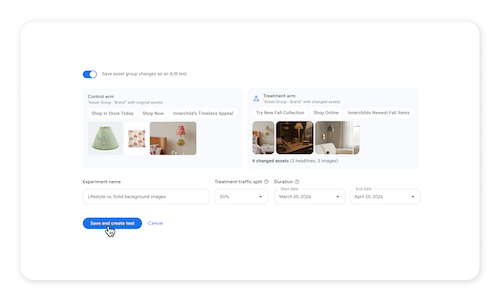
The new Asset Studio features, powered by Gemini, will help marketers remove the guesswork from the creative process by scaling a team’s unique vision globally and ensuring assets connect with the right audience.

Asset Studio is a one-stop-shop for developing creative assets in Google Ads, helping brands multiply the magic of their creativity and scale it across the globe. Google is making it even easier to create the range of assets needed to drive performance across Google and YouTube.

Asset Studio understands a user’s marketing brief, brand guidelines, website, and goals to instantly generate a high-quality range of assets across multiple creative themes and asset types. Users can create and refine them to match their vision using natural language. And users can soon build compelling video assets all in one place with the integration of Gemini Omni, the new multimodal model.

Harnessing The Next Era Of Agentic Commerce:

Google is bringing more Universal Commerce Protocol (UCP) capabilities, including the checkout experience on AI Mode in Search and the Gemini app, and further evolving the experience for merchants by integrating Direct Offers.

The new Universal Cart is a truly intelligent shopping cart that works across retailers and across services like Search, Gemini and more. When shoppers are ready to buy, UCP makes checkout from their cart smooth. They can check out with Google Pay in just a few taps with many of their favourite brands, or transfer items to the merchant’s site to complete their purchase. Shoppers can try these select checkout features soon across retailers like Nike, Sephora, Target, Ulta Beauty, Walmart, Wayfair and Shopify merchants such as Fenty and Steve Madden. Regardless of how a shopper chooses to buy, the retailer always remains the merchant of record.

Driving Discovery Across More Surfaces, Verticals, And Markets:

Google is introducing new AI-powered Demand Gen features, like new Google Maps inventory that connects brands with people exploring the local area, and checkout links in nine new markets. Product feeds are expanding to more surfaces and verticals, including auto. Users can get started faster with AI-assisted Demand Gen campaign creation.

With just a few prompts, build more relevant and performant YouTube ads with Multimodal video creation in Asset Studio. Advertisers can also easily boost authentic creator partnership videos directly within the asset picker during Demand Gen campaign setup.

For retailers, serving dynamic product videos at scale will soon be even more seamless. Simply upload videos to Google Merchant Center to dynamically distribute them across Demand Gen campaigns based on real-time user interest.

Leveraging Data By Unified Measurement

Google is bringing Meridian, their open-source Marketing Mix Model, into Google Analytics 360.

Soon, users will be able to:

– Unify insights: Bring together first-party, cross-channel data and metrics signals in one place.
– Pinpoint what is working: Users can measure causal performance to prove exactly what is driving their business and optimise their media mix.
– Forecast outcomes: Use predictive scenarios to guide smarter investments.

GOOGLE MARKETING PLATFORM
https://marketingplatform.google.com

Rogerwilco Wins MMA Smarties South Africa Awards For Innovation In Modern Marketing

Rogerwilco walked away with five more awards for its generative engine optimisation (GEO) and AI-driven digital work at the Marketing + Media Alliance (MMA) Smarties South Africa Awards. The Smarties wins include four golds for Small Budget, Big Impact; AI Powered Data Insights / Contextual Marketing; Innovative Use of AI in Advertising and Audience Engagement Excellence Using AI, as well as a silver for Advanced Technologies Marketing.

‘We saw early on that generative AI was going to fundamentally change how people find information online,’ said Charlie Stewart, CEO of Rogerwilco. ‘This recognition is about far more than the awards, it validates that GEO is becoming one of the most important shifts in digital marketing and search visibility today.’

GEO, the practice of ensuring a brand’s content is discoverable and cited by AI-powered search platforms such as ChatGPT, Google AI Overviews and Perplexity, is rapidly reshaping online behaviour. Industry research indicates that more than 30% of adults will use generative AI tools as their primary search mechanism in 2026.

To respond to this shift, Rogerwilco developed GEOFF (Generative Engine Optimisation Forecasting + Fulfilment), a proprietary AI platform with direct API integrations into ChatGPT and Gemini. The tool audits web content against the ranking factors that drive visibility in AI-generated responses, analysing content, structure and technical markup at scale before generating prioritised recommendations for human-led implementation.

Rogerwilco also developed a complementary AI-powered link engine that automatically identifies online mentions of both institutions and prompts webmasters to convert citations into live hyperlinks, accelerating domain authority growth at scale impossible through manual outreach alone.

Building on the increasingly important role of AI in discovery, Rogerwilco has also created Echo, a proprietary closed generative AI search engine. Unlike generic AI search tools that pull information from across the open web, Echo delivers instant, accurate responses sourced exclusively from an organisation’s own verified content. This enables them to own the search experience on their digital platforms, ensuring that target audiences receive trusted, brand-controlled answers at every point of online engagement.

ROGERWILCO
https://www.rogerwilco.co.za/

This is Modern Marketing