Home Blog Page 21

The World Cup Could Be A Powerful Brand-Building Moment For Africa

The World Cup Could Be A Powerful Brand-Building Moment For Africa
Matongo Matamwandi, African Marketing Confederation.

Matongo Matamwandi, the President of African Marketing Confederation, says Africa is fielding a record 10 teams and some of football’s most recognisable stars on fields across Canada, Mexico and the US. Beyond Moroccans Achraf Hakimi and Yassine Bounou, both heroes of the 2022 World Cup run, many other African soccer players are globally influential.

Senegalese player Sadio Mané is respected for both his football achievements and philanthropy, while Nigeria’s Victor Osimhen represents a new generation of African stars. Then there is Riyad Mahrez, one of the continent’s most decorated modern players.

This is not Africa’s first turn on football’s biggest stage. In 2010, South Africa became the first African nation to host the World Cup, the world showed up, and the Rainbow Nation blew the Vuvuzela loud in the opening match when Bafana Bafana took on Mexico.

But Shakira’s Waka Waka became the tournament’s anthem even though the beat came from Cape Town’s Freshlyground, who added the song’s bridge, and vocals in Xhosa, and their signature Afro-fusion instrumentation such as African-inspired percussion, guitar, and flute lines.

While the world belted along, with Waka Waka eventually being downloaded 15 million times, Shakira eclipsed Freshlyground even as she sang about this time being for Africa.

Culture In Our Veins

Freshlyground is one band that typifies talent, skill, vibrance, and rich heritage, characteristics that are embedded in our culture from north to south and east to west. Nigerian artists Burna Boy, Wizkid, Tems and Rema top international charts. South Africa’s Tyla introduced millions to Amapiano through a single global hit.

Nigerian authors Chimamanda Ngozi Adichie and Chinua Achebe are read worldwide, with Achebe’s Things Fall Apart remaining a top novel almost 70 years after he penned it. Nollywood is one of the largest film industries on earth by output. South African-born Trevor Noah took African perspectives to American primetime. These are not niche success stories. They are mainstream, global, and growing.

More importantly, they demonstrate that audiences around the world are already engaging with African stories, talent and creativity. The challenge is that those stories are often consumed as individual successes rather than as part of a broader narrative about the continent itself as they are almost always told in isolation.

Burna Boy is a Nigerian artist. Tyla is a South African singer. Mohamed Salah is an Egyptian footballer. Their achievements reflect positively on their home countries but rarely are they framed as part of a broader African story.

The emotional power of African talent is captured market by market, country by country, while Africa as a continent is not seen as a brand. This changes when our players run onto the field.

Watching soccer, that beautiful game, together in venues across Africa fills us with a sense of belonging. Each time one of our, and we should and do claim all African footballers as ours, crosses into the opposing side’s half, we are filled with optimism.

The question is whether we can take that instinct, that pride, and that sense of belonging off the pitch and turn those feelings that brands across the globe will pay billions for into something that advances Africa as a whole. The World Cup offers a rare opportunity to change that.

Own The Continental Brand

A unified African narrative would not replace national identities or achievements but rather connect them. With a record 10 teams competing, the tournament creates a platform on which audiences can celebrate not only individual nations, but a continent increasingly producing world-class talent.

Rather than building campaigns around individual countries, brands could tap into themes that resonate across borders: achievement, ambition, creativity, excellence. The opportunity is not simply to celebrate football success, but to tell a larger story about Africa’s growing presence on the world stage.

If the tournament helps create even a small shift from ‘my country is succeeding’ to ‘Africa is succeeding’, it could become one of the most powerful brand-building moments the continent has seen.

Not by treating Africa as a single market, but by recognising the pride, aspiration and sense of possibility that increasingly connect audiences across its borders. Africa has never lacked talent, creativity or ambition.

What it has often lacked is a stage large enough to showcase them all at once. The World Cup may be one of those rare moments well beyond the final whistle. That conversation continues in Livingstone, Zambia, from 23 to 25 September, where we host some of the world’s top marketers, and showcase the seventh wonder of the world, the Victoria Falls, the Smoke That Thunders, Mosi-oa-Tunya, as we reposition Brand Africa.

AFRICAN MARKETING CONFEDERATION
www.africanmarketingconfederation.org

Advertisers Should Think Beyond The Broadcast For Greater Audience Engagement

Advertisers Should Think Beyond The Broadcast For Greater Audience Engagement

The 2026 FIFA World Cup will attract billions of viewers, but the biggest opportunity for brands may lie with the multi-screen fans consuming more than just the live games, says Leslie Adams, Sales Director at Reach Africa.

The big match is on the big screen and everyone is buzzing. The biltong is sliced, the drinks are ice cold and the people are bringing the gees. It is a yellow sea of Bafana Bafana jerseys as we support our boys at the World Cup. This is the kind of audience and engagement advertisers dream of, with eyeballs glued to the screen for 90 minutes. And for decades, that paid off handsomely.

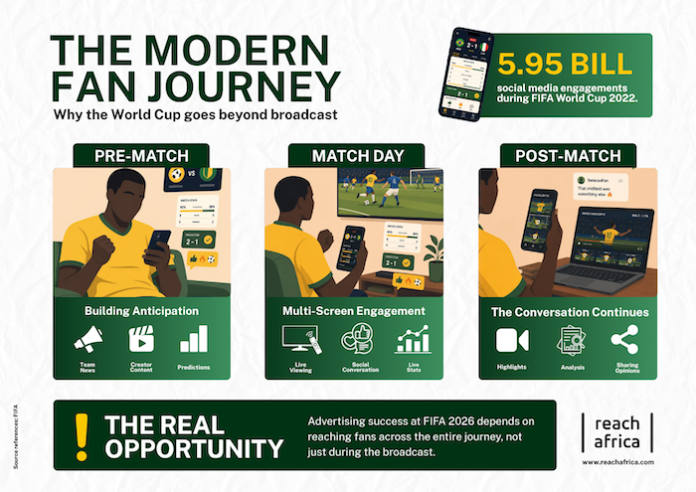
But the 21st century sport fan is no longer just watching the match alone. Before, during and after the game, they are checking team news on X, watching analysis on TikTok, having WhatsApp watch party debates, and sharing YouTube clips. The final whistle has not even blown, but the conversation has moved well beyond the live broadcast.

In fact, the most influential football journalists are no longer found on television screens, but on social platforms, where team announcements and breaking stories often emerge long before traditional broadcasters report them. The rise of creator-led coverage is also changing how fans experience tournaments. With social media creators increasingly being granted access traditionally reserved for journalists, fans are gaining new perspectives through behind-the-scenes content, player interviews and creator commentary.

For years, brands followed a simple playbook: if you wanted to reach fans, you bought into the live broadcast. That made perfect sense when the only screen available was a TV. But today, while audiences remain just as engaged, their attention is distributed across a far wider range of environments.

Recent data from the Marketing All Product Survey shows the way people consume sport has changed, with streaming and social media now accounting for more time spent than traditional television, particularly among younger, mobile-first audiences. FIFA has adapted quickly to this by putting the game where audiences are, rather than locking it into one media channel. They have followed the data and partnered with TikTok as an official social media partner, YouTube as a global streamer, and niche sports apps to expand the tournament’s reach across the platforms fans already use.

The live game is no longer the only place where the action is, and smart brands will follow FIFA’s example and update their planning to include a broader mix of channels. And while broader streaming distribution may challenge the traditional broadcast monopoly, it also gives fans more choice and greater access to the tournament than ever before.

The biggest audience opportunity might be everything happening around the live broadcast, from the build-up to reactions and commentary. There are so many opportunities for brands to engage with fans that were simply not possible years ago.

This includes connected TV (CTV), which is increasingly at the centre of the global viewing experience. As fan consumption habits have evolved, so too has the television itself. Connected TVs now bring broadcaster apps, streaming services, gaming and linear TV together in one place, allowing fans to access the full spectrum of football content and viewing experiences on the largest screen in the home.

For brands planning around the 2026 FIFA World Cup, the first step is knowing the sheer number of viewing options available to consumers. If you Are not already social savvy, get scrolling, because each platform presents a different opportunity to connect with your audience.

Then, figure out what role each environment plays in the audience journey and where your brand can best fit. Perhaps it Is partnering with a content creator who gives analysis and commentary, or sponsoring a podcast for deeper discussions, or harnessing Instagram with viral reactions and memes.

The golden metric is attention, especially in a global event such as this one. With such a large audience, meaningful engagement is the true measure of success, not just eyeballs.

Most importantly, brands need to think beyond the broadcast. It remains incredibly powerful, but it is no longer the only place where fandom lives. Find the fans, and you will find where the real action is. The game is on.

REACH AFRICA
https://www.reachafrica.com

Comrades Marathon’s YouTube Broadcast Could Change The Future Of Sports Broadcasting

Comrades Marathon's 2026 YouTube Broadcast Could Change The Future Of Sports Broadcasting

Kelvin Watt, Chairperson of Nielsen Sports SA, says for the first time, he watched Comrades the way the rest of the world will increasingly watch live sport. It worked. That is the headline and it is one worth taking seriously.

I did something I had never done before. I watched a live sports event, start to finish, on YouTube. The event was the Comrades Marathon, a 13-hour live broadcast, and I stayed with it for more than nine of those hours across my Smart TV and my phone. By the time the day was done, one thing had become impossible to ignore: the line between ‘streaming’ and ‘television’ has quietly disappeared.

The Viewing Experience

Let me start with the honest verdict, because that matters more than the theory.
The stream itself was flawless. No buffering, no drop-outs, no quality wobble between the big screen and the handset. There were definitely audio issues, especially the ambient sounds from the start and finish and with a number of on the road and finish line interviews, but these came from the event site itself, which is a production-on-the-ground challenge that sits well outside the platform’s control. On a 13-hour live feed, holding that standard is a serious achievement.

What lifted it from ‘watchable’ to genuinely compelling was the storytelling:

– The narrative arc held across the full day, from the elite battle at the front to the human drama at the back of the field chasing the cut-offs, backed up by a fabulous and informative group of commentators.

– The graphics package did real work. Live runner positions, gap times, pace-bus tracking and split data gave the broadcast the texture of a Grand Tour cycling feed rather than a regional road race. The route graphics for the first time gave the viewer a real sense of the road from Durban to Pietermaritzburg, including all the climbs, twists and turns.

– The information layered on screen respected the viewer’s intelligence and kept a casual watcher invested for hours.

– I particularly enjoyed the companion app, a technology enabled by Streambridge where viewers could choose their on-route camera and watch only that feed. We used it to watch a number of our close friends and family as the crossed the finish line during the afternoon. This type of innovation is a real winner and the big advantage of streaming over more traditional linear broadcasting of the past.

There was no shortage of drama to carry it, either. Records fell at the front, including new Up Run benchmarks, which gave the long middle hours real stakes. That is the test of good television: it has to reward the time you give it. This race certainly did. It never fails.

The Bigger Point: Stop Calling It ‘just Streaming’

Here is the part our industry needs to sit with. I watched this on the same Smart TV, in the same seat, with the same expectation of quality that I bring to any broadcast. The delivery pipe was YouTube. The experience was television.

We have spent years treating YouTube as a secondary screen, a home for highlights and clips and second-window catch-up. But during Comrades it was the primary screen for a national tentpole event and it held up to that billing without an asterisk. If a platform delivers a flawless 13-hour live broadcast to a living-room set, the distinction between ‘TV’ and ‘YouTube’ is a category we are keeping alive out of habit.

A Genuine First And Why It Matters 

For the first time in its 106-year history, the world’s greatest ultramarathon was watchable anywhere on the planet. A race that has always been a deeply South African ritual became, yesterday, a global live event. That is a meaningful unlock for the property, for the sport but most importantly for the country. The value to our travel and tourism industry was immense and if measured properly, will yield significant real impact and economic benefit long after the 12-hour gun was fired.

For the South African sports industry, this was an important first in its own right:

– One of our annual tentpole events was carried primarily on YouTube, with free, global access for the first time.

– SABC Sport, our free-to-air national broadcaster, ran the event domestically alongside it.

That dual structure is the interesting bit: a working example of YouTube and linear operating together, each doing what it does best. SABC delivered the domestic free-to-air reach. YouTube delivered the global access and the on-demand long tail. Rights holders here now have a live, local proof point to study, instead of an overseas case study to translate into our conditions.

The Measurement Question

This is where it gets interesting for those of us who sell audiences for a living. A development like this is only as valuable as our ability to measure it properly and that is the work. Over the next few days our team at Nielsen Sports SA will be doing a great deal of audience analysis to understand the true impact of yesterday. The goal is to give sponsors and advertisers a total consumption view, which means:

– Live audience across both the YouTube stream and the SABC broadcast. Importantly, YouTube numbers will reflect views, unique views and concurrent views, but it is important to note when measuring these and comparing them to SABC Sport Viewership and last year’s SuperSport viewership numbers, that they reflect connected devices and not the number of eyeballs behind those devices which may multiple the number up 3 to 4 fold.

– The long tail of video-on-demand on YouTube, where a 13-hour event keeps accumulating views for days and weeks after the gun.
– The accompanying shorts and highlights, which is increasingly where a modern audience actually meets the content. These are really the numbers to watch as this content is as valuable as the live content and on YouTube with it’s VoD capability is likely to yield the most value, turning the Comrades Marathon into a 365 days a year viewing experience and not a one day affair.

Counting only the live linear number would badly understate what happened at the event. A modern understanding of viewership has to capture the full footprint: live, on-demand and the clip ecosystem that travels far beyond the broadcast window. That total view is what turns a broadcast innovation into a credible commercial proposition for partners.

Where This Leaves Us

YouTube is a major play in this market going forward and it deserves a clear-eyed assessment on its merits. A few open questions are worth holding onto, in the interest of balance:

– The economics still need to be proven. Global reach and strong consumption are a long way from automatically translating into the rights fees and sponsorship yield that fund a property at this scale.

– Discoverability and audience ownership matter. The platform that owns the relationship and the data shapes the long-term leverage between rights holders broadcasters and sponsors.

– Repeatability is unproven. Comrades sits in a particular rights position. The event unfortunately has a complex or contested rights situation and not all parties will necessarily see the world in the same way.

Those questions sharpen the opportunity rather than dimming it. The event gave us a clean, local, large-scale demonstration that YouTube can carry a national tentpole event to television-grade standard and to a global audience at the same time. The job now is to measure it honestly, understand the full consumption picture and let the commercial story follow the evidence.

NIELSEN SPORTS
https://nielsensports.com

CA&S Group Acquires Strategic Shareholding In TDMC

CA&S Group Acquires Strategic Shareholding In TDMC
Cheryl Ingram, TDMC.

CA&S Group (‘CA&S’ or ‘the Group’) announced the acquisition of a strategic 30% shareholding in The Digital Media Collective (‘TDMC’). The investment forms part of CA&S’s strategy to build a more connected growth platform for brand owners and retailers across Southern and East Africa, combining the Group’s established physical route-to-market scale with TDMC’s specialist digital commerce, performance marketing and e-commerce capability.

The transaction includes a pathway to majority ownership over a phased transition period.

As consumer journeys become increasingly fragmented across stores, digital channels and marketplaces, brand growth depends on the ability to connect demand generation, online conversion, physical availability and in-market execution. This investment in TDMC gives CA&S deeper capability in the digital channels where consumers increasingly discover, engage with and purchase brands.

‘Consumer journeys are no longer linear, and growth increasingly depends on how well brands connect physical availability, digital visibility and meaningful customer engagement,’ said Duncan Lewis, CA&S Group CEO. ‘Our investment in TDMC gives us access to deep digital commerce expertise and enhances our ability to help clients build relevance, drive performance and unlock growth in an omnichannel world.’

TDMC brings capability across e-commerce strategy, Shopify development, marketplace management, performance media, CRM, content, creative, data and analytics. This complements CA&S’ existing strengths in retail execution, advisory, warehousing, distribution, fulfilment, technology and route-to-market solutions.

Together, the two businesses are positioned to offer clients a more integrated route from insight and demand generation through to conversion, fulfilment and execution, across both physical and digital channels.

CA&S Group Acquires Strategic Shareholding In TDMC
Duncan Lewis, CA&S Group .

‘We’ve always said that as the market changes, our offering has to change with it,’ said Cheryl Ingram, CEO and founder of TDMC. ‘CA&S reaches parts of the retail journey we don’t, and we reach parts they don’t. That is the whole point of this coming together of our two businesses. Very few partnerships start from that kind of genuine fit, where each side brings something the other can’t easily build for itself. This was never about scale for its own sake. It was about finding the partner whose strengths made ours worth more.’

TDMC’s credentials reflect the depth and calibre of its digital expertise. As a Shopify Plus Partner, Google Premier Partner, Meta Business Partner and Klaviyo Gold Partner, the agency holds a combination of accreditations that sets it apart in South Africa and across Sub-Saharan and East Africa. Together, these partnerships position TDMC to deliver fully integrated, end-to-end e-commerce solutions for retailers and brand owners across the region.

For CA&S, this investment reflects a deliberate move to expand its digital commerce ecosystem over time, creating new ways to help clients reach consumers, activate channels, convert demand and support growth across both physical and digital routes to market.

‘This is a deliberate move to widen what we offer the brand owners who rely on us,’ said Lewis. ‘TDMC gives clients access to specialist digital commerce capability, backed by CA&S’s regional scale, operating discipline and on-the-ground execution. It is a powerful combination for clients looking to grow in a changing market.’

TDMC will continue to operate with its entrepreneurial culture, specialist focus and current leadership structure, while gaining the benefit of CA&S’ regional scale, client relationships and wider group ecosystem.

TDMC
http://www.tdmc.co.za

CA&S Group
www.cas.group

Creating Cultures That Keep Moving When Conditions Are Tough

Creating Cultures That Keep Moving When Conditions Are Tough
Conn Bertish.

Under the 2026 theme Shift Happens™, Conn Bertish’s talk, Happy, Purposeful Businesses Are Harder to Kill, looks at a shift every business leader can recognise: how people recover, create, adapt and perform when pressure keeps rising. Bertish is a featured speaker at The Nedbank IMC, taking place on 17 September 2026 at Mosaïek, Johannesburg. Modern Marketing is a proud media partner.

Bertish is a global creative strategist and purpose advisor. His argument is simple: happy, purposeful businesses are not soft. They are harder to break because their people are more connected to what they are building and better equipped to keep creating under pressure.

Bertish helps organisations build cultures that are more resilient, more creative and better able to perform under pressure. His advisory work has supported major African businesses across retail, insurance and high-growth entrepreneurial environments.

For Bertish, purpose only matters when it changes how people think, work, recover and perform. His perspective is not theoretical. Having used creativity, play and purpose as part of his own recovery from cancer, Bertish brings a rare mix of lived experience, creative intelligence and commercial relevance to the stage.

At the Nedbank IMC, his session will show how leaders can use purpose more practically: as a source of resilience, energy and performance when business is under pressure. It is a timely message for marketers and business leaders who need cultures that can keep moving when conditions are tough.

‘Bertish is that rare combination of creative powerhouse and genuinely inspiring human being. His work, and his own recovery story, make his message impossible to dismiss,’ said Dale Hefer, CEO of the Nedbank IMC.

Africa’s biggest marketing conference, the Nedbank IMC, advances marketing’s place in the boardroom and uplifts young talent across the continent. Proudly endorsed by MASA and PRISA. Book your tickets now.

NEDBANK IMC CONFERENCE
www.imcconference.com

Marketing Needs Empathy And Empathy Needs Humans

Marketing Needs Empathy And Empathy Needs Humans
Nicky Turnbull, VML South Africa.

Nicky Turnbull, Strategy Director at VML South Africa, says B2B marketing has a new problem. For once, it is not technological, it is all human. There is this persistent belief in B2B marketing that deals are won in the pipeline. In reality, they are won much earlier, often before the process even formally begins.

Buyers are researching, shortlisting and forming preferences long before they engage with suppliers. So by the time a conversation happens, the outcome is already leaning somewhere.

The data reflects this clearly: 61% of buyers make a decision before speaking to sales, 81% of deals go to the first-choice vendor, and 95% of winners are already on the shortlist from day one. That means if your brand is not known early enough to be considered, it will not be chosen later.

It Starts And Ends With Humans

It makes sense that AI is accelerating this behaviour change, but it is not happening in the way many marketers assume.

Most buyers are not starting from zero. These are experienced decision-makers who arrive with a point of view already formed. They have often been through multiple buying cycles before, understand their categories, and already have a shortlist in mind. So the buying journey starts in their heads, not necessarily with Copilot.

Where AI does come in is in the validation phase. AI helps buyers compare, validate their assumptions, and sense-check their choices. It is not creating the shortlist, but it may be reinforcing it.

Only humans can go ahead and commit, however. AI increasingly shapes what gets discovered, interpreted and surfaced, but when the time comes to make a decision, it is humans who are making the final call. The question is, why are they taking so long?

The Collective Bottleneck

To understand why decisions are slowing down, we need to look beyond the individual and towards the group.

B2B decisions are rarely made by one person. They are made by buying groups, typically involving around ten stakeholders, many of whom never engage directly with suppliers.
This makes traditional lead-based thinking increasingly inadequate. A ‘lead’ represents only a fraction of the decision-making reality. The true task is to influence a network of stakeholders, all with different priorities, pressures and perspectives.

It is not an easy task, and even when you get it right, there is still another barrier to contend with.

Hesitation Under Pressure

In B2B, your greatest competitor is often not another brand, but simple indecision. Research shows that 63% of deals fail because of inaction, while 40% are abandoned before completion.

Those are opportunities that just disappeared. And often it is not that the buyers lacked information. In fact, they may have been overwhelmed by it. What they really lack is confidence. When confidence is lacking, buyers don’t focus on whether a solution is right, so much as whether the decision is safe: to sign, defend, and stand by even if things go wrong.

The truth is, in environments defined by risk, scrutiny and multiple stakeholders, the cost of being wrong often outweighs the benefit of being right. So, when in doubt, many choose to do nothing.

Helping Buyers Buy

When you approach it from that point of view, it is no longer enough for marketing to enable sales. Marketing must enable the buyer.

The hardest part of B2B is choosing between options. That is why the most effective organisations focus on building familiarity long before any sign of intent. They shape how buyers understand the category. And they establish trust early, so that when decision time comes, they’re not simply one option among many, but the preferred option.

The challenge is that most buyers aren’t actively in-market at any given time. And because it is hard to predict exactly when they will be, being purely reactive will not work. Instead, marketers must maintain an always-on presence of consistent, relevant visibility that builds familiarity over time. That way, when intent does emerge, you are not trying to create engagement from zero, but rather building on an established foundation of awareness and credibility.

Human First, Not System First

This is where a Human First perspective becomes essential. Yes, AI can generate signals, content and activity. But more does not necessarily mean better. Signals alone do not create understanding. They indicate when something might be happening, but not what it means.

As one insight captured succinctly, signals tell you when to show up, but it is how you interpret those signals that determines what you do when you get there. And for that, you need an understanding of the context, the organisational dynamics, and the pressures influencing each stakeholder within the buying group.

In other words, you need the kind of complex human variables that cannot be automated.

From Personalisation To Relevance

For years, B2B marketing has focused heavily on personalisation. But while it seemed like a good strategy in theory, in practice a lot of this has been superficial, relying on basic signals, like company names or industry references.

Buyers do not disengage because the messaging is not personalised. They disengage because it means nothing to them. The data supports this. While 71% of marketers believe their brand stands out, 68% of buyers feel that brands sound the same.

Being relevant means understanding what buyers are dealing with on the ground. It means getting to grips with their context, constraints, and the outcomes they are accountable for. That is a strategic capability, not a creative execution.

Impact Is Human

As AI continues to reduce the cost and effort of execution, the risk is that marketing becomes a volume exercise: more content, more campaigns, more activity. But ‘more’ doesn’t drive decisions. In fact, often it has the opposite effect, making messaging unnecessarily complex and diluting its meaning.

The moments that ultimately move decisions forward are human. It is the conversation that reframes a problem; the interaction that demonstrates real understanding; the experience that builds trust across a buying group. Because at its core, a B2B decision is a commitment to an outcome, and a willingness to be accountable for it.

It is tempting to prioritise volume and efficiency. But the role of marketing is not simply to inform or persuade; it is to give people the confidence to decide. That takes empathy. And empathy needs humans.

VML SOUTH AFRICA
https://www.vml.com/south-africa

Building Genuine Strategic Partnerships With Agencies Drives Superior Business Outcomes

Building Genuine Strategic Partnerships With Agencies Drives Superior Business Outcomes
Sean Devlin, Penquin.

Many brands spend months searching for the right agency, only to spend years treating them like suppliers. As businesses face mounting pressure to move faster, prove ROI and deliver consistent growth, agency relationships can often become reduced to a cycle of briefs, deadlines and deliverables.

While efficient on paper, Penquin’s Business Development Director, Sean Devlin, believes this approach frequently limits the very strategic thinking brands are looking for.

‘The biggest misconception many businesses have is that strategic value automatically comes with hiring an agency,’ he explained. ‘In reality, if an agency only receives a brief, they can only deliver against that brief. If you only share the brief, you will only ever get expected outcomes.’

According to Devlin, the most successful agency partnerships are built on something far deeper than project management. They are built on trust, transparency, context and shared accountability.

‘The brief is the starting point, not the solution,’ he said. ‘Great work comes from challenge, not just agreement. The best agencies do not simply execute instructions. They interrogate the brief, uncover the real business challenge and help clients solve problems they may not have fully identified yet.’

This shift from supplier to strategic partner requires commitment from both sides. For clients, it means providing agencies with greater visibility into business objectives, market pressures, commercial realities and long-term ambitions. For agencies, it means taking ownership beyond campaign delivery and being willing to challenge assumptions, ask difficult questions and contribute strategic thinking.

‘Dual accountability is critical,’ said Devlin. ‘Clients need to create an environment of openness and trust, while agencies need to earn their seat at the table by bringing insight, perspective and meaningful solutions.’

The result is often better work, stronger relationships and more sustainable business growth.

‘The more your agency understands your business, the more accountable they can be to your results,’ said Devlin. ‘You don’t get strategic value from a supplier relationship. You get strategic value from a partnership.’

As marketing landscapes become increasingly complex, Devlin believes brands should be evaluating agency relationships through a longer-term lens.

Too often, agencies are measured against individual campaigns, short-term outputs or isolated deliverables. While these metrics remain important, they can overlook the broader value agencies create when given the opportunity to contribute strategically over time.

‘The more your agency understands your business, the more accountable they can be to your results. Partnerships are about building momentum as much as they are about delivering campaigns,’ said Devlin. ‘When agencies have access to context and trust, they can help create consistency, identify opportunities earlier and contribute to stronger business outcomes over the long term.’

For marketing leaders looking to unlock greater value from their agency relationships, Devlin offers a simple piece of advice. ‘Stop treating the brief as the finish line,’ he said. ‘Treat it as the beginning of a conversation. Great work comes from challenge, not just agreement. The quality of the work is a reflection of the quality of the relationship behind it.’

As businesses continue to navigate an increasingly competitive marketplace, the brands that achieve the greatest success may not necessarily be those with the biggest agency rosters, but those that invest in building genuine partnerships with the agencies they choose to work with.

PENQUIN
https://www.penquin.co.za

Pepkor, Dentsu And CSA Create Access For Youth Into SA’s Expanding Creator Economy

Pepkor, Dentsu And CSA Create Access For Youth Into SA's Expanding Creator Economy

From Amapiano and fashion to comedy, gaming and township storytelling, creators have become some of South Africa’s most influential cultural voices. Yet while audiences continue to grow, many young creators remain excluded from the commercial opportunities their influence creates.

Recognising this gap, Pepkor’s FoneYam has partnered with the Dentsu School of Influence powered by CSA to help unlock the next generation of digital entrepreneurs and create new pathways into South Africa’s rapidly expanding creator economy.

The programme aims to shift the conversation from likes and followers to long-term commercial value, equipping creators with the skills needed to transform influence into enterprise.

For many aspiring creators, the challenge is not talent or ambition. It is access to technology, industry networks, mentorship and opportunity. And in today’s creator economy, access to technology is no longer a luxury. It is infrastructure.

FoneYam, a smartphone rental offering available at retail giants PEP and Ackermans, was created to make smartphone ownership more accessible through flexible and affordable solutions. Through this partnership, the brand is extending that commitment by helping young creators access opportunities within the digital economy.

From Creator To Entrepreneur

At the heart of the programme is ‘One Big Week’, an intensive creator accelerator where participants gain exposure to industry leaders, live business challenges and real-world brand engagement. The objective is simple: to help creators build sustainable businesses around their influence.

‘South Africa’s creator economy represents one of the country’s most exciting opportunities for youth employment and entrepreneurship,’ said Roxana Ravjee, CEO of dentsu South Africa. ‘Through the Dentsu School of Influence, we are giving young creators access to the skills, mentorship and opportunities required to build sustainable careers.’

Added Davin Phillips, Executive Director and Partner at CSA.global: ‘South Africa has no shortage of creative talent. What has been missing is the infrastructure to help that talent scale. This programme is about helping creators turn cultural influence into commercial opportunity and building careers, not just content.’

DENTSU

The Future Of Agencies Isn’t Bigger Teams, It’s Sharper Ones

The Future Of Agencies Isnt Bigger Teams, Its Sharper Ones

Lucky Chery says before any agency relationship begins, more brands should ask who will actually do the work. Not who is in the credentials deck. Not who is in the pitch room. Not who appears in the case study after everything has gone well. Who is going to sit close to the business, understand the pressure, make the calls, carry the work and stay accountable when the real job begins?

That question matters because brands are no longer operating in a slow, predictable marketing environment. They are dealing with tighter budgets, faster competitors, more fragmented audiences, more demanding consumers and leadership teams that want proof that marketing is creating business value. The pressure on brand teams has changed. The agency model has to change with it.

For a long time, agencies asked clients to fit into their structures. A brand would sign with an agency and then inherit the team, the process, the layers and the pace of that agency. Sometimes it worked. Often, it created distance between the people making the decisions and the people doing the work. That distance is expensive.

It slows things down and dilutes the thinking. It creates too many handovers and too many places for accountability to disappear. It also makes it harder for the agency to become properly immersed in the client’s world, which is where the best work usually begins.

This is why bespoke, high-performance teams are going to become more important for brands that expect more from their agency partners.

A bespoke team is not a smaller version of a big agency model. It is not a loose group of freelancers pulled together at the last minute. It is a deliberate team built around a specific brand, a specific challenge and a specific standard of delivery. It starts with the client’s ambition and works backwards from there.

What does this brand need to win? What kind of thinking does the category demand? Where does the work need to be faster? Where does it need more depth? What level of senior leadership needs to be close to the account? What specialist skills are required from day one? Who has the right temperament for the pace of the business? These are the questions that matter.

For car brands for example, this thinking is especially important. Automotive is not a casual category. People do not wake up, see a clever line and buy a car on impulse. They research, they compare and they ask people they trust. They look for value, safety, design, performance, after-sales confidence and a sense that the brand understands their life.

That means the work has to do more than look good; it has to build belief. That kind of work needs the right team around it.

Talent is everywhere but focus is harder to find. A bespoke team works when talented people are given a clear problem, a clear role and a clear standard. It works when people know why they are in the room. It works when there are fewer layers between the thinking and the doing. It works when the client knows who is responsible and the agency knows there is nowhere to hide.

For brands, one of the biggest benefits of this model is that accountability becomes visible. In a large fixed structure, responsibility can sometimes disappear between departments. But a high-performance bespoke team has fewer hiding places and creates ownership. It makes standards easier to hold. It keeps the team close enough to the problem to solve it properly.

The second benefit is speed. Speed does not mean rushing work out the door. It means reducing unnecessary drag by ensuring that the right people are in the conversation earlier. It means decisions are made with context, not through endless relays. It means the team understands the brand well enough to move with confidence.

That matters because brands are competing in real time. A campaign that takes too long to make its way through the machine can arrive polished but irrelevant.

The third benefit is depth. When a team is purpose-built around a brand, it has a better chance of becoming immersed in that brand’s world. It understands the customer and category better. It understands the internal pressures better. Over time, that closeness creates sharper work because the team is not only responding to briefs but also helping the client see what the next brief should be.

The brands that win will be those with the clearest thinking, the sharpest teams, and the strongest partnerships. Because when the ambition is serious, the team behind it cannot be accidental.

LUCKY CHERY
https://www.linkedin.com/company/lucky-chery

How Brands Can Leverage World Cup Marketing Without Crossing Legal Boundaries

How Brands Can Leverage World Cup Marketing Without Crossing Legal Boundaries

According to law experts Darren Olivier, Danielle van Deventer and Mandla Ngidi from Adams and Adams, few global events capture public attention like the FIFA World Cup™. It is important for businesses who are not sponsors but are seeking to capitalise on the excitement of the FIFA World Cup™ to strike a careful balance, leveraging the cultural moment without crossing legal boundaries.

For brands, such events present a unique opportunity to engage audiences, build visibility, and connect with consumers through the universal appeal of football. At the same time, the World Cup operates within one of the most tightly controlled commercial frameworks in sport. Sponsorship rights are sold at significant value, and the exclusivity granted to official partners is actively protected.

The Core Principle

The key distinction is straightforward but essential. Brands are free to market around football and the broader enthusiasm for the sport. However, they cannot market the World Cup itself unless they are an official sponsor or have obtained the necessary rights. Maintaining this distinction is central to avoiding both legal and reputational risk.

Why Caution Is Required

The commercial success of the World Cup depends heavily on official sponsorships. In return for their investment, sponsors receive exclusive rights to associate themselves with the event.

To protect this exclusivity, rights holders monitor marketing activity closely and enforce their rights rigorously. Campaigns that overstep the line may be challenged swiftly, often in a highly visible manner.

Consequences can include the immediate withdrawal of campaigns, legal proceedings, and reputational harm. In jurisdictions such as South Africa, additional regulatory frameworks may also apply, further restricting marketing that suggests an unauthorised association with major events.

Understanding Unauthorised Association

Unauthorised association arises when marketing creates the impression that a brand is linked to the World Cup, whether directly or indirectly. The assessment is not a technical legal exercise. Instead, it is based on how an ordinary consumer would interpret the message. If the overall impression is that the brand is an official partner or sponsor, the risk of infringement is high. This type of association can arise through explicit statements, but it can also result from more subtle cues, such as the overall look and feel of a campaign, its timing, or the themes it adopts.

Common Sources Of Risk

In practice, most problematic campaigns fall into a few recurring categories. One category involves suggesting a connection with the event, even where none exists. Another arises from the use of protected intellectual property, including event names, logos, slogans, or similar elements.

There is also the risk of so-called ambush marketing, which is a form of guerilla marketing. Guerilla marketing itself is a legitimate and widely accepted strategy, but ambush marketing sits at the point where such activity may or may not cross into unlawful conduct, depending on how it is executed. In the context of major sporting events, risk most commonly arises in four ways:

1. By intrusion into the event environment (for example, physical presence in or around stadiums).

2. By creating an impression of association with the event or its sponsors.

3. By using protected intellectual property such as event marks or imagery.

4. Through jurisdiction-specific legal restrictions that regulate event-related commercial activity.

Campaigns that fall within these categories are more likely to attract scrutiny, particularly where they create an overall impression of an unauthorised commercial link to the event.

A well-known example is the Bavaria Beer alleged ambush at the 2010 FIFA World Cup™. In this case, the Bavaria brand was not an official sponsor but allegedly arranged for a group of spectators to attend a match wearing coordinated orange dresses associated with its campaign. The dresses were allegedly designed to attract attention despite the absence of prominent branding, and the group was allegedly positioned in a way that ensured visibility during the televised match. The participants were ultimately removed from the stadium, and legal action followed against the organisers. While the campaign generated significant global publicity for the brand, it also attracted strong enforcement measures.

Increasingly, risk arises in online environments, where real-time marketing, targeted advertising, and the use of event-related hashtags can quickly create an impression of association.

Permissible Marketing Activity

Despite these restrictions, there remains significant scope for creative and effective marketing.

Brands may run campaigns that celebrate football as a sport and tap into the excitement surrounding major matches. The messaging with focus on the enjoyment of the game, fan culture, or shared experiences is generally acceptable, provided that it does not reference the tournament itself. Expressions of support for national teams are also permissible, particularly where they rely on general themes of national pride. However, care must be taken to avoid linking such support directly to the World Cup or specific fixtures.

Athlete endorsements can be effective, but they require care. Brands may feature players in campaigns, provided they avoid referring to the player’s participation in the tournament, specific matches, or opponents. However, focus should remain on the individual, not the event. Likewise, brands may engage audiences through general football-related content, internal activations, or viewing experiences, as long as these do not suggest a commercial link to the tournament.

Prohibited Marketing Practices

There are clear boundaries beyond which marketing activity is likely to be considered unlawful or to attract legal challenge.

The use of official event intellectual property is strictly reserved for authorised partners. This includes the event name, logos, trophies, slogans, and other distinctive elements associated with the tournament.

Marketing should also avoid any suggestion of sponsorship, endorsement, or official affiliation. Even indirect or ambiguous wording can create a misleading impression and give rise to legal issues. Promotional activity linked to the tournament is particularly high risk. Competitions, giveaways, or campaigns tied to matches or tournament outcomes may be interpreted as attempts to exploit the event’s commercial value. Social media presents additional challenges. The speed and visibility of online content can amplify risk, particularly where posts are linked to matches or use event-related terminology in a promotional context.

Areas Requiring Careful Judgement

Not all situations are clear-cut. Some forms of marketing sit in a grey area and require a more nuanced assessment.

Campaigns timed to coincide with key matches, influencer activity during the tournament, and player-related content released at peak moments of public interest can all increase the risk of perceived association. In these instances, a useful guiding question is whether the campaign feels like it is attempting to benefit from the event in a manner similar to an official sponsor. If so, caution is warranted.

Insights From Case Law

Judicial decisions across multiple jurisdictions provide useful guidance on how courts approach unauthorised association and ambush marketing in the context of major sporting events.

In FIFA v Metcash Trading Africa (Pty) Ltd (2009), the Pretoria High Court interdicted the distribution of ‘Astor 2010’ lollipops. Although the product did not expressly refer to the FIFA World CupTM, its packaging incorporated soccer imagery and elements of the South African flag in a manner that was held to create an indirect association with the tournament. The case demonstrates that even subtle visual cues, when viewed collectively, can result in unlawful association.

A similar emphasis on implied association appears in Australian Olympic Committee Inc v Telstra Corporation Limited [2017] FCAFC 4. In that matter, Telstra’s ‘I Go to Rio’ campaign was found to suggest a connection with the Olympic Games, despite avoiding explicit use of official Olympic branding. The court considered the overall impression created by the campaign and concluded that it conveyed a misleading message of sponsorship or affiliation.

The principle that certain event-related wording is strictly protected is illustrated in San Francisco Arts & Athletics Inc v United States Olympic Committee 483 U.S. 522 (1987). The United States Supreme Court upheld the Olympic Committee’s right to prevent the unauthorised use of the word “Olympic” in a commercial context. This decision highlights that certain names and descriptors associated with global sporting events may be protected to a degree that prohibits their use altogether without consent.

Courts have also shown a willingness to intervene in high-profile ambush marketing scenarios. While some campaigns attempt to operate at the margins of legality, the consistent trend is that where the overall impression is one of commercial association with a protected event, enforcement action is likely to follow.

Taken together, these cases confirm that the legal assessment goes beyond technical wording. Courts consider the overall impression created by the marketing, including visual elements, timing, and context. Even where no explicit reference is made, liability may arise if the campaign is perceived as trading off the reputation or commercial value of the event.

Practical Application

In practical terms, campaigns that focus on football in general, celebrate the sport, or engage with fans in a broad and non-specific manner are less likely to attract legal scrutiny. Conversely, campaigns that reference the World Cup, align closely with tournament fixtures, or incorporate promotional mechanics tied to the event are more likely to be challenged.

Where uncertainty exists, seeking legal input before launch remains the most effective way to mitigate risk.

The World Cup offers a valuable marketing opportunity, but it must be approached with care. The most effective campaigns are often those that embrace the spirit of football without attempting to appropriate the event itself. By remaining creative, authentic, and mindful of the legal framework, brands can successfully participate in the global conversation while avoiding unnecessary risk.

Adams & Adams
https://www.adams.africa/