

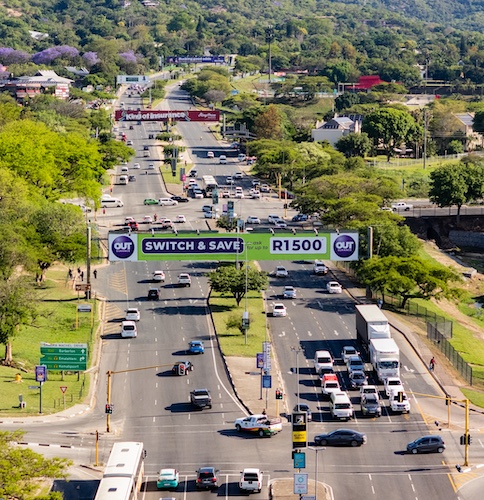
As the year winds down and the country gears up for its annual summer migration, South Africa is about to hit peak movement. For businesses, it’s a golden window. The months ahead offer one of the most powerful environments for Out-of-Home (OOH) advertising to do what it does best: connect brands to people in real, physical moments – when they’re out exploring, spending and making decisions.
Jacques du Preez, CEO of Provantage, said the festive season remains one of the strongest conversion periods for Out-of-Home: ‘When people travel, their mindset shifts. They’re planning, buying, gifting, exploring, or simply open to inspiration. OOH moves with them along highways, at airports, in shopping hubs and on public transport. It’s media that matches mobility.’
By mid-December, millions of South Africans will be in transit. Last year, ACSA reported record passenger volumes through major airports, processing 3.7 million passengers in December 2024 alone, while SANRAL noted some of the heaviest festive traffic in years, with traffic volumes reaching a high of 853,564 vehicles in December 2024 as reported by toll concessionaires. Add in commuter flows between provinces, family road trips and local tourism, and it’s clear that audiences aren’t sitting still. They’re out there, and they’re spending.
That makes the next three months prime territory for brands that want to translate awareness into action. Whether it’s a new product, a travel promotion, or retail campaign, OOH provides a full-journey canvas, from roadside to retail, taxi rank to runway.
Every journey creates a series of decision points: where to stop, what to eat, how to entertain the kids, or which store to visit when you arrive. Smart Out-of-Home strategies follow that path.
On the road, large format billboards and digital rotators offer a combined exposure potential of an impressive 290 million viewed impressions (VACs) monthly – reinforcing brand familiarity and driving impulse buys from cold drinks and snacks to tech accessories.
At transit hubs, such as taxi ranks, frequency and proximity are key. These spaces reach 22 million South African commuters daily on their way to work or home for the holidays, turning routine journeys into brand moments. At airports, more than 3 million monthly travellers are in high-dwell environments with time to absorb messaging. Here, brands win by speaking to premium mindsets: insurance, banking, tech, fashion and gifting.
In suburban streets and shopping mall zones, hyper-local small format advertising faces close the loop, nudging last-mile action just minutes from purchase points. And within lifestyle and golf estates, a growing Out-of-Home category is taking shape where audiences are receptive and relaxed with 3 million monthly impressions. These environments reach families and professionals in moments of leisure: on the fairway and at the clubhouse. Messaging in these settings aligns naturally with themes of family, lifestyle, health and aspiration, from automotive and financial brands to travel, tech and home products.
Each space plays a different role, from hyperlocal to broader reach, but together they form an ecosystem that mirrors real audience behaviour. Du Preez explained: ‘The power of Out-of-Home is that it’s not a single medium; it’s a network of touchpoints that follow people from planning to purchase. When you connect those moments creatively, you drive measurable action.’
Summer amplifies attention. People spend more time outdoors, leisure time increases and consumer confidence generally lifts with the festive mood. Families are shopping, travelling, and celebrating, all of which translates into heightened receptivity to brand messaging at a time when many traditional advertising channels are showing signs of effectiveness fatigue. In this environment, Out-of-Home media stands out by meeting audiences where they’re most active, emotionally engaged and where media can’t be switched off.
While traditional advertising channels face declining effectiveness driven by shifting consumer behaviour, fragmented attention and overexposure to digital messaging, OOH media continues to prove its strength through globally benchmarked audience measurement standards.
Du Preez added: ‘Despite the rise of online media, overall marketing effectiveness has declined. The biggest challenge today is attention. In an oversaturated digital landscape, consumers are bombarded and increasingly able to block or ignore one-to-one ads. Since OOH is a one-to-many medium it’s able to cut through that noise. It earns attention in real, physical moments without being intrusive and that’s what makes it one of the most effective mediums in the modern mix.’
Using advanced methodologies that go far beyond simple ‘opportunity to see’ metrics, today’s OOH systems measure VACs, converting potential impressions into actual viewed impressions based on factors such as location, travel patterns, visibility and dwell time. This data-driven accuracy, aligned with international best practice, enables advertisers to plan and evaluate campaigns with precision. When combined with programmatic buying and behavioural insights, it ensures OOH delivers measurable reach, real engagement, and sustained growth in an era of declining ad effectiveness.
‘Brands that win this season will think like travellers. They’ll understand where people are, what they’re feeling and when they’re most open to connection. That’s the art and science of Out-of-Home: helping brands move with their audiences in ways that feel timely, relevant and real.’
PROVANTAGE
www.provantage.co.za