

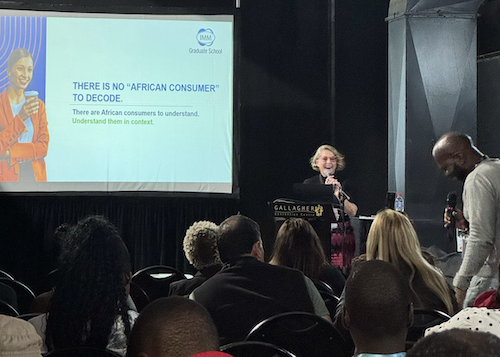
Following her presentation, ‘The African Consumer Decoded’, at the Modern Marketing Power Hour (held during September at Gallagher Convention Centre), Anisa Fielding, Head of Marketing at the IMM Graduate School, examines what marketers need to understand before attempting to scale across African markets.
One of marketing’s most convenient shortcuts is geography. Draw a boundary around a market, find a few demographic averages and start describing ‘the consumer’. At a continental scale, that shortcut becomes dangerous. There is no single African consumer.
There are African consumers shaped by different markets, cultures, income rhythms, languages, devices, household structures, retail systems, ambitions and levels of trust. That distinction is not semantic. It changes the strategy. The fastest way to get Africa wrong is to make it simple.
Scale Is Real. Homogeneity Is Not.
According to the United Nations Economic Commission for Africa, more than 70% of sub-Saharan Africa’s population is under 30. Meanwhile, the GSMA reports that mobile technologies and services contributed an estimated US$240 billion to Africa’s economy in 2025, equivalent to 7.8% of GDP. Yet it also estimates that 63% of Africans live within mobile-broadband coverage but do not use mobile internet.
– ‘Young’ does not tell us whether someone is a learner, entrepreneur, salaried professional or parent.
– ‘Mobile-first’ does not mean universal smartphone access, affordable data or a fully digital purchasing journey.
– ‘Growth’ does not mean frictionless access.
Averages are useful for understanding scale. They are much less useful for explaining why an individual consumer chooses one product, channel or brand over another. The better question is not: What is the African consumer like? It is: What context is shaping this consumer’s choice?
Seven Lenses for Decoding Context
Before designing a campaign for an African market, marketers can use seven lenses to interrogate the assumption behind the brief:
– Context: What makes this particular market structurally different?
– Capacity: How and when can people afford to buy?
– Culture: What meaning surrounds the category?
– Connectivity: How is the digital world accessed?
– Community: Who transfers trust?
– Channels: Where does discovery become purchase?
– Cohort: How do age and life stages reshape behaviour?
These lenses overlap.
– Connectivity can be shaped by income.
– Channel choice can depend on trust.
– Culture can change the meaning of a product.
Two people of the same age, living in the same city, may have completely different wallets, responsibilities and routes to purchase. That is precisely why ‘African youth’ is not a strategy.
Context Travels Less Easily Than Campaigns
The mobile money service M-Pesa remains one of the clearest examples. Its success in Kenya was supported by a particular ecosystem: strong demand for domestic money transfers, Safaricom’s established market position, a rapidly expanding agent network and a regulatory environment that allowed the service to develop.
South Africa provides a useful contrast. Vodacom discontinued M-Pesa in South Africa in 2016 after concluding that the service was unlikely to achieve the critical mass required to make it sustainable. The company specifically cited South Africa’s high levels of financial inclusion.
The product idea could travel. The conditions that made it useful at scale did not automatically travel with it. This illustrates the difference between an exploratory strategy and a reproduction strategy. A reproduction strategy starts with a successful model and asks how it can be rolled out elsewhere. An exploratory strategy starts with local evidence: the consumer problem, trust, access, distribution and regulatory conditions. Before reproducing what is visible, identify the ecosystem that made it work. Export the learning, not the assumption. Consistency can protect the brand. Sameness can destroy relevance.
Affordability Is About More Than Price
Another easy assumption is that financially constrained consumers primarily want the cheapest possible product. Sometimes they do, but often the picture is more complicated. Income may arrive daily, weekly, monthly or irregularly. A product can be affordable in total but inaccessible at the moment someone needs to buy it. Consumers respond through smaller packs, prepaid models, informal credit, shared purchases, lay-by and month-end stocking.
These behaviours should not automatically be read as low sophistication or low aspiration. A consumer with limited disposable income may still care deeply about quality, reliability, identity and status.
Value does not mean cheap. A smaller pack does not mean a smaller ambition. The useful strategic question is therefore not simply how to reduce price. It is how to redesign access without destroying the meaning that makes the product desirable in the first place.
Culture Must Shape the Idea, Not Decorate It
Culture is another area where localisation often happens too late. A global strategy is developed first. Local language, casting, music or visual references are then added to make it ‘African’. That is adaptation. It is not necessarily insight.
Guinness’s celebrated Sapeurs work connected its ‘Made of More’ platform to pride, identity, self-expression and community.
Nike’s 2020 Naija collection did not simply place Nigerian symbols onto generic football merchandise. Nike’s own account of the design describes Nigerian craft and visual traditions as direct influences: the home jersey drew on traditional agbada robes, details on the away kit referenced the Nigerian artistic movement Onaism, while Ankara fabrics informed elements of the wider apparel collection. Nigerian culture therefore influenced the design system itself rather than being added as surface decoration.
The lesson is not to imitate either campaign, but to understand why they worked. Local culture influenced the underlying proposition rather than being painted onto the execution afterwards. Translation changes words. Localisation changes meaning. Participation changes who has agency.
Mobile-First Does Not Mean Digital-Only
The same discipline applies to technology. Calling Africa ‘mobile-firs’ can be useful shorthand. It becomes dangerous when shorthand turns into strategy. Network coverage does not automatically mean participation. Device cost, data affordability, storage, electricity, digital confidence, language, fraud concerns and content relevance can all affect whether someone uses a digital service.
At the same time, consumers across African markets are not passive recipients of global digital culture. Amapiano demonstrates the reverse. The genre moved through DJs, nightlife, file-sharing, phones, creators, dance culture and playlists before accelerating globally. According to Spotify, global Amapiano streams grew by 114,377% between 2018 and 2024. Consumers were not simply consuming the culture; they were part of its distribution infrastructure. That should change how marketers think about influence too.
The most important influencer in a purchase may be a family member, trader, WhatsApp group, colleague or community voice rather than the person with the largest public following.
Localisation Is Also a Governance Question
Getting cultural relevance wrong is not always a creative problem. Sometimes it is an organisational one. The 2020 Clicks and TRESemmé controversy in South Africa demonstrated what happens when poor assumptions survive the entire approval process. Images of Black women’s hair were described as ‘dry and damaged’ and ‘frizzy and dull’, while white women’s hair was described as ‘fine and flat’ and ‘normal’.
The strategic question is therefore not only whether a campaign contains diverse representation.
– Who shaped the insight?
– Who had authority during development?
– Whose lived experience was present when decisions were made?
– Who was empowered to stop the work?
A diverse casting list cannot repair a decision-making system that lacks diversity.
Decode Before You Deploy
Better marketing across Africa does not require 54 isolated strategies. It requires greater discipline in deciding what should remain consistent and what must respond to local evidence.
– Segment by reality rather than geography.
– Localise the strategy before copy and casting.
– Design the entire ecosystem around offer, access, trust and channel.
– Give local consumers and specialists authority, not simply visibility.
– Test in individual markets, learn from the evidence and only then decide what can scale.
One successful market is evidence, but it is not pan-African proof. For the IMM Graduate School, staying connected to industry means ensuring that marketing education reflects current consumer behaviour, cultural change, technology and commercial reality.
There is ultimately no ‘African consumer’ waiting to be decoded.
There are African consumers to understand, and the brands that succeed will not be those that simplify the continent most efficiently. They will be the ones that recognise its complexity, find the right local truth and turn that truth into meaningful value.
Sources
https://vodacom.com/news-article.php?articleID=3268&
https://www.vodacom-reports.co.za/integrated-reports/ir2016/ourgrowth.php
https://blogs.worldbank.org/en/africacan/how-kenya-became-a-world-leader-for-mobile-money
https://www.nike.com/soccer/naija-behind-the-design
https://sahrc.org.za/index.php/sahrc-media/news/item/2461-sahrc-intervenes-in-clicks-hair-row/
THE IMM GRADUATE SCHOOL
www.imm.ac.za