Home Blog Page 316

Brands And Agencies Can Support Local Talent With SA Stock Image Platform

Alison Blair, marketer and business owner.

Photie is a new South African Stock Image platform for royalty-free photographs, illustrations and videos, and is the brainchild of marketer and business owner Alison Blair.

‘I realised I needed to focus on my creative process and generate something meaningful. Drawn by South Africa’s distinctive culture, Photie aims to be as unique as the country’s stories,’ said Blair.

Marketers and advertising agencies alike know all too well there is a need for real South African stock images to engage local markets. When browsing international sites for South African imagery, search results often yield images that speak to the international version of South Africa and are not a true reflection of what we know and see on a daily basis.

As the Mpumalanga representative for the Businesswoman of the Year Awards, presented by the South African Businesswomen’s Association, Blair is fiercely passionate about entrepreneurship, and with 20 years of diverse marketing experience, she has decided to personally fund the development of the platform. ‘Photie is a valiant step for me as a business owner to create something important for South Africans and the South African creative industry,’ she said.

How does it work?

Photie enables local photographers and creatives who contribute to the platform’s image library to earn a 50% royalty on contribution, compared to other sites that start at 15%. Users get to support local talent and help grow this sector. With a strict approval process in place for all of the content uploaded to the platform, Photie prides itself on offering top quality images to ensure user searches yield the desired results.

As contributors earn a royalty for each image downloaded, they are incentivised to continue adding to their personal portfolios, thereby increasing the image library with photos, videos, illustrations, or designs that will appeal to users. By enabling local artists to earn an income from their contributions, not only will brands and agencies be supporting local talent, but they will acquire content that is relevant to the local market. ‘The content is by South Africans for South Africa, so it is truly authentic and will allow advertising to be more relevant to its audience,’ said Blair. 

PHOTIE
photie.co.za

Consumers Make Certain Brand Associations With Specific Smells

Dr Roland Goldberg, a senior lecturer in marketing at the North-West University.

Dr Roland Goldberg, a senior lecturer in marketing at the North-West University, states that your wallet is more closely connected to your nose than you might think. One of his fields of expertise is retail atmospherics, which includes scent marketing. 

‘I am flabbergasted by retailers who still use outdated forms of marketing like the distribution of flyers, newspaper advertisements and billboard messages. The fact of the matter is that traditional vehicles of marketing have become totally redundant and ineffective. Even via social media platforms like Facebook and Twitter, it is becoming increasingly difficult to reach the consumer, especially if the target market is not well defined,’ said Goldberg.

‘We need to become more strategic and penetrate on a subconscious level. Appealing to a consumer’s senses is the primary method we as marketers use to get our message across. The ideal is to go beyond that and to appeal to multiple senses simultaneously. My research has indicated that consumers make certain brand associations with specific smells. When one smells a specific aroma, you link that to a brand, and this then aids brand recall. It also allows you to lure consumers to your shop or to your product.

In a study, conducted by Goldberg and his team at high-end fashion stores in South Africa, it was found that there is a discernible link between smell and a consumer’s decision-making process, brand association and recall. It also subconsciously affects a consumer’s approach or avoidance behaviour. Do they enter a store or do they walk past it? The team also found that a pleasant aroma increases browsing time and the likelihood that a consumer will purchase a product.

Brands should, therefore, aim to affect as many of a consumer’s senses as possible. Due to factors such as perceptual blocking and selective perception, we do not notice the traditional vehicles of marketing any more, nor we do not notice them after a certain amount of time has passed. Let us say you are driving from Johannesburg to Cape Town and you start feeling queasy as you enter Colesberg because of something you may have eaten. You are not going to notice fast food or fashion advertisements, but rather those for medical treatment, be it for a doctor or a pharmacy. That is what we call selective exposure – you look at what you need.

In order to penetrate consumers’ perceptual vision, one needs to think bigger, better and out of the box. Especially during the pandemic, one really needs to stand out and make a statement to gain market share. Consumers have limited resources and they are very careful about where and how they spend these resources during these times.

NORTH-WEST UNIVERSITY 
nwu.ac.za

Radio And Audio Is Still Relevant To Media Plans In Times Of Crisis

According to Monique Claassen, Client Service Director Media and Digital at Kantar, there is no denying that the Covid-19 pandemic has influenced consumer media behaviour, with more time spent at home meaning more at-home media consumption. But now as lockdown levels lift, brands are wondering how sticky these trends are likely to be in the future.

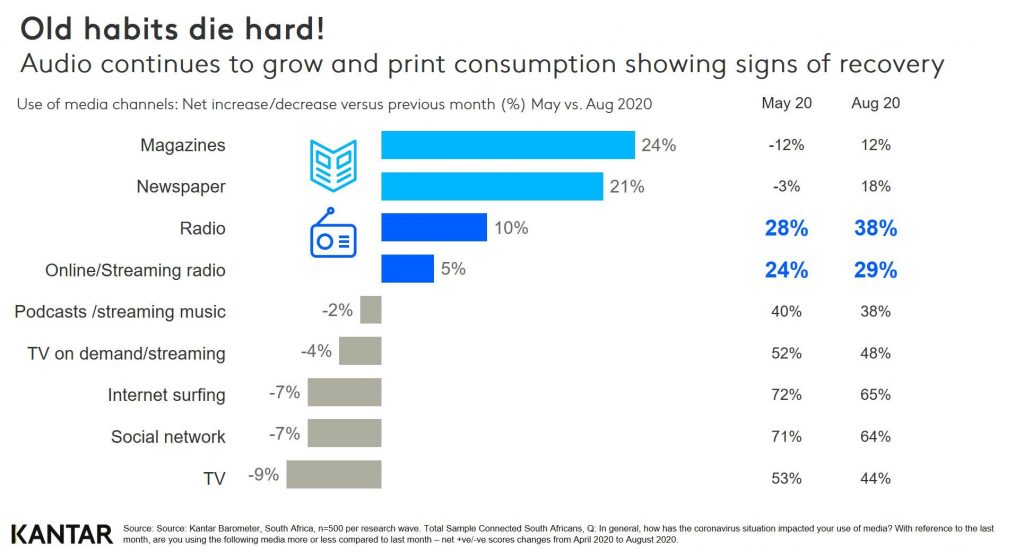
Kantar’s Covid-19 Barometer study of connected consumers’ media habits, behaviours and general sentiment in South Africa was conducted in eight waves from the beginning of lockdown in March to August 2020. It reveals that consumers’ media consumption behaviours have indeed changed, with an average increase in claimed media consumption up 24% in March and 38% at the start of May as we went into the peak of the pandemic locally.

True state of South African media consumption under lockdown 2020

This doesn’t mean more people turned to media than before as the number of consumers engaging with different media is relatively the same – it is frequency rather than reach, as the time spent engaging across media platforms increased, from internet surfing on on-demand streaming of podcasts as we spent the bulk of our time at home in the earlier parts of lockdown.

Encouragingly, even in August as the more severe lockdown restrictions fell away, the average percentage increase of claimed media consumption was 43%. Looking at the stickiness of these trends, the peak towards the end of August shows how consumers’ consumption patterns are now changing back to largely what they were like before the pandemic hit, except for radio and online streaming.

This jump in media consumption makes frequency a hugely important consideration when planning campaigns across platforms. The sheer amount of consumer engagement right now means there is a real chance of overextending and wearing out the creative faster than before.

One of the top questions in media circles today is whether radio and audio is still relevant to media plans in times of crisis. Here is why the answer is a resounding ‘yes’. Studies show that ad-viewing behaviour and skip rates on YouTube and Facebook are much the same now as before the pandemic struck. So, while lots of things have changed, many have stayed the same. We need to think about overall consumer fatigue as they are consuming 34% more media than previously, so we think of synergies to maximise overall ROI. In particular, high levels of frequency across campaigns enables radio to build strong connections with consumers.

How radio really rules the media roost

Where audio consumption patterns have changed has largely been from commute drive-time shows to longer listening blocks. Kantar’s CrossMedia database, delving into R2.4bn in campaign spend based on average reach and frequency across the delivery of each touchpoint proves radio remains king of reach. No other touchpoint offers this level of frequency, giving brands the ability to create connections with consumers by telling them wonderful stories that resonate.

In addition, radio delivers unique audiences, with the South African CrossMedia database showing 9,5% incremental reach from radio in 2019/2020 as the medium continues to grow despite the proliferation of TV channels and content-sourcing platforms. Often, radio is much more expensive than TV for every 1% audience reached, but radio offers less wastage as its largely local or regional structure means brands can focus on key marketing areas. Given the number of vernacular stations, this means brands can target their consumers in their own language at a much lower cost than TV.

So, the winning formula is ‘TV + radio’, as it is time to think of those unique audiences working together rather than as an either-or scenario. Looking at the value of radio and digital in audio planning across categories of retail, auto, finance and FMCG, radio works well with digital to deliver higher levels of unique reach, offering additional campaign frequency at a very effective rate.

The big shift: from radio to audio planning

Now, as the industry starts to think of video rather than platforms, it is time to do the same with audio – it is more than just ‘traditional radio’ or ‘digital sound’, as that is where the true value of the medium lies. Looking at the ROI of radio in particular in driving sales and brand in South Africa, it becomes clear that the biggest downfall of radio in a media plan is the creative aspect, with Kantar’s Creative Database proving great radio creative usually under-indexes against TV and print. But even weak radio creative is not as unproductive as weak creative in other media and works differently across different categories.

Get it right and radio advertising can effectively drive awareness in personal care FMCG, while going beyond mere brand uplift in auto, tech and telecommunication categories and over-indexing on motivation for auto brands. Done well, radio advertising also boosts call-to-action intentions of consideration, favourability and ‘likelihood to do business’ in finance categories. Looking to the future, digital is clearly more than just a value-add and radio is still relevant. Brands just need to take the time to optimise their radio creative into a true brand-building block.

KANTAR 
kantar.com

Advertising In The News Drives Consumers To Act

According to IAB SA, key findings show that advertising in the news is brand safe, increases trust and drives consumers to take action. More than 40% of consumers would be willing to try a brand after seeing an ad in a news outlet.

This and more is evidenced in the latest research conducted in the US by the IAB in collaboration with Magid Research. Riaan Wolmarans, head of digital: media at Arena Holdings and chairperson of the IAB SA’s Publishers’ Council said, ‘South African publishers go to great lengths to ensure they offer a brand-safe, quality-driven environment for advertisers. Combined with the trust that readers place in the country’s long-established news publications with their massive reach in print and online, it means our readers will have a similarly positive view of advertising in their favourite news publication.’

Here are some of the other findings:

Advertising in the news drives consumers to act

Consumers like brands more when they advertise in the news:

  • 49% of respondents saw these brands as relevant to them.
  • 47% saw these brands as customer-focused.
  • 46% believed these brands were of high quality.

As a result of seeing a brand advertising in their favourite news outlets:

  • 45% of respondents were more likely to visit the brand’s website.
  • 43% would consider buying from the brand.
  • 39% were comfortable recommending the brand.

Consumers trust the news

  • Three in four consumers seek national/international news weekly. On average, consumers follow four news sources.
  • Seven in 10 consumers find their chosen news sources to be trustworthy

The halo effect: contrary to popular belief, advertising in news is brand safe and improves trust for the brands that advertise

  • For 84% of consumers, trust remains neutral or increases for news advertisers.
  • Only 16% of consumers said it makes them trust brands less.
  • Advertising in the news can increase consumers trust by 6%.

‘Never has trusted news been more important in our society. Over the past year, we have seen significant growth in news consumption as we increasingly rely on news to keep us safe, connected and informed. The IAB study sought to understand the brand impact of advertising in the news. While historically some brands have avoided news due to negative association concerns, the study found that those concerns were unfounded,’ said David Cohen, chief executive officer, IAB. ‘If a consumer sees an ad in a news outlet they deem legitimate, they are more likely to consider trying the brand, telling a friend about it, visiting the brand’s website and, ultimately, finding that brand more trustworthy. News outlets provide a powerful platform to connect with consumers. Put simply, news saves lives and news builds brands.’ To download the report, click here.

IAB SOUTH AFRICA
+27 10 900 3338 
hello@iabsa.net
www.iabsa.net

Riverbed Agency’s Ad Crashers Campaign Elevates SMEs

As the South African economy reopens steadily, and with small to medium business picking up the pieces following the multilevel lockdowns, a diverse group of nine black-owned small and medium-sized enterprises (SMEs) have been named as the recipients of high-end marketing support valued at over R3 million through Riverbed’s Ad Crashers campaign. 

Riverbed launched Ad Crashers in May this year in the wake of the Covid-19 pandemic, with the aim of helping small businesses affected by the pandemic get back on their feet through free media, marketing and advertising services. The campaign offers entrepreneurs much-needed marketing support to recover as the economy reopens.

Interested SMEs were invited to apply for support, and the nine businesses that were chosen and whose marketing campaigns will be launched:

  • Thusi Holdings, a financial literacy, debt counselling and business consultancy with offices in Johannesburg, Pietermaritzburg and Umtata.
  • Ebukhosini Properties, a manufacturer in Johannesburg that has developed the mo-Wash mobile hand washer, designed for outdoor events that delivers amazing water savings while maintaining hygiene.
  • Mgabhazi Investments operates Studio353 hair salon based in Johannesburg, which specialises in ethno-African hair for women and men.
  • L&S Shuttle Service, which provides shuttle tours in the Western Cape.
  • Thumela Express, a KwaZulu-Natal delivery service that offers, groceries, food, medication and other errand delivery services.
  • Get Law, a digital start-up online legal services platform from Cape Town that seeks to simplify law and enables anyone to access registered attorneys on-demand at a fraction of traditional legal costs.
  • Bolwa Security Services, a Johannesburg-based security and guarding services company that provides trained and accredited officers to both the public and private sectors.
  • The Transformation Legacy, an enterprise development company in Midrand that specialises in developing and supporting entrepreneurs by propelling them to grow their small businesses into sustainable enterprises.
  • House of Mack Nail Bar, a nail care salon located in Meyersdal that also runs Christmas feeding drives for the needy in the area.

Monalisa Zwambila, Riverbed CEO said, ’After receiving a considerable number of applications from SMEs around the country, it became immediately clear that the lockdown had a devastating impact on business owners. The stories from each of our applicants was a stark reminder of the seriousness of the pandemic and its impact on small businesses. Each of the chosen entrepreneurs demonstrated that they would be able to effectively leverage Ad Crashers to not only elevate their own businesses but create sustainable jobs beyond the crisis.’

Riverbed developed through-the-line advertising campaigns for these SMEs, giving them the same level of national and regional media exposure as big brands. Global media agency Mindshare supported the campaign as the strategic media partner and secured free media inventory commitments amounting to R3 million from media owners. These include JC Decaux, and Provantage Media Group, along with Kaya FM. Additionally, Ad Crashers welcomes Vodacom as a major partner, contributing valuable digital media space, which will have a major impact on building much-needed exposure for these entrepreneurs. 

The Talk with Rams Live streaming platform dedicated an on-air commitment, while the Black Umbrellas incubation programme has committed to enrol the selected businesses. ‘Drawing from our own 13 years’ experience as an independent agency, we understand the struggles of entrepreneurship, and with this initiative being so close to our hearts, it was inspiring to meet authentic businesses that are deeply motivated and focused on making a real difference in the economy and people’s lives, including those of their employees and clients,’ Zwambila added.

THE RIVERBED AGENCY
www.theriverbedagency.co.za

How Is Online Ad Viewability Affected?

According to Ad Operations Lead at OleConnect Cape Town, Daniel Schmidt, viewability has been a buzzword in the advertising industry for a number of years. Clients want their ads to be seen by prospective buyers and agencies have been selling them ‘viewability solutions’.

It is interesting to note that agencies use demand-side platforms (DSPs) as ad serving tools and they rely on their DSPs to not only ensure that ads are viewable, but also to ensure that viewability is reported accurately, which can be a tough task.

What is viewability and how is it affected?

Viewability is measured by how often an ad is viewed over the number of times it is served. If an ad was served 100 times and viewed 70 times, the viewability of that particular ad unit is 70%. Different DSPs have different criteria for what constitutes a ‘view’, so in order to remove disparity from any comparisons in this piece, we will disregard all social and programmatic engines and focus on what is quantifiable in Google Ads.

Google uses its ‘Active View’ technology and supports the IAB and MRC definition of viewability: a minimum of 50% of the ad is in view for a minimum of one second for display ads, or two seconds for video ads.

So how is viewability affected? There are cases when the users scroll past an ad quickly, or abandon a tab in their browser and may even have seen the ad, but not long enough for it to be counted as viewable. There are probably also cases where the ad is served below the fold and is simply never scrolled down to – on a CPC bidding model you’ll be safe from being charged for this ‘impression’. While these are natural reductions in your campaign’s viewability, there are also more sinister ways in which viewability can be diminished.

Whenever money is involved, fraudsters and opportunists will try to profit using dirty tactics, and unfortunately, ad serving is no different. When ads are served through exchanges, unscrupulous characters will reliably attempt to benefit by committing ad fraud, defined as any deliberate activity that impedes the regular delivery of ads to their intended audience. The two main methods of collecting ad revenue fraudulently are ‘bot traffic’ (posing as human traffic) or ‘domain spoofing’ (misrepresenting low-quality inventory as high quality). There are also other methods and that list is likely to grow as ad exchanges figure out how to curb fraudulent activity, and fraudsters invent new ways of gaming the system.

This fraud, measured by Google as ‘invalid clicks’, currently accounts for around 1% of ad revenue according to The Drum, while other sources estimate it to be even higher. Although the tech giant refunds advertisers for invalid traffic, this traffic still costs money at the outset and exhausts client budget, contributing to a loss of viewability. It should be noted that all stakeholders also run the risk of never getting full transparency into how Google calculates invalid traffic – whether their methods are accurate is a debate for another day.

The numbers from Google

During any given day of ad serving over Google’s search and display networks – the largest ad networks of their kind – invalid clicks account for a percentage much larger than you may think. The following figures are extracted from a finance client running ads on Google: for search ads, invalid traffic hovers between 9-23%. All impressions are counted as viewable on the search engine. For display ads, invalid traffic hovers between 28-35%. Viewable impressions are measured at around 75% (three quarters of all ads served are not seen).

Finding workarounds

There are a few interesting takeaways that leave more questions than answers. On any given day, between 10-35% of clicks account for invalid traffic, and Google apparently refunds it but seems unable to clamp down on their chain of inventory supply – click fraud would not be happening if fraudsters were not benefitting.

If these are the invalid traffic numbers from Google, then it would be interesting to see the real numbers from the less vigilant and transparent mobile DSPs, whose supply chains are more intricate, convoluted and easily manipulated.

While we may not have the tools to completely eradicate click fraud in 2020, the big players will certainly be looking at ways of coding at a higher level of click validation standards. Invalid traffic is something that we have to find ways of working around for now, and in the meantime, there are certain strategies to improve viewability on Google and other DSPs, with slightly different tactical approaches for each targeting niche.

OLE!CONNECT 
oleconnect.com

DStv Media Backing The Creative Ecosystem At #Loeries2020

Rani Bisal, Executive Head of Business Optimisation at DStv Media Sales in Sub Saharan Africa.

In keeping with the Loeries’ commitment to ‘reward, recognise, inspire and foster creative excellence’, DStv Media Sales will be supporting the Loeries Creative Week 2020 in its mission to back the creative ecosystem.

DStv Media Sales will be adding to the already phenomenal speaker line-up by bringing creative strategist Rani Bisal to share her insights with the creative community. Bisal has more than 15 years of experience in building strategies and technology platform and solutions across various domains such as media, IT, telecom, publishing, broadcasting and advertising. She is currently the Executive Head of Business Optimisation at DStv Media Sales in Sub Saharan Africa and collaborates with the CEO on designing future business models.

As the Loeries CEO Preetesh Sewraj said,  ‘I am delighted to have the support of DStv Media Sales in a year when the industry needs innovative insights into how we can ensure a robust creative ecosystem. Bisal has incredible insights in this key area. DStv has been a valuable partner over the years and I am excited to continue working with them to further support the brand communication industry.’ 

Fahmeedah Cassim-Surtee, CEO of DStv Media Sales said, ‘We are proud to be associated with the Loeries once again. The great work that we have witnessed over the years inspires us to play our part in supporting the creative sector and making a difference. We are committed to driving good creative and innovation within the advertising industry, and adding value to this year’s event.’

LOERIES 
www.loeries.com

Looking At Post-Pandemic Consumer Behaviours

Claudia Schonitz, Head of Insights and Consumer Research, HaveYouHeard.

According to HaveYouHeard’s Head of Insights, Claudia Schonitz, there are a number of significant challenges the post-pandemic South African consumer will have to face, noticeably on the financial and mental health fronts.

As South Africans are reaching the end of the Government’s pandemic management cycle, it seems as if the post-apocalyptic world is not the place many predicted it would be, and that the pandemic – reinforced as it has been by a recession – has not led to a host of new and sustainable consumer behaviours.

This is the conclusion from the final phase of a study conducted during lockdown by HaveYouHeard, which understands that consumer behaviour and preferences are influenced by many factors, most notably the times we find ourselves in – often referred to as the Zeitgeist.

Acknowledging that different cultures across the globe would respond differently to the same pandemic, HaveYouHeard set out to contextualise South African consumers’ response, and how that impacted their lives in terms of their feelings, finances, shopping behaviour, entertainment and socialising. 

And, it turns out, the post-pandemic South African consumer is not that much different to the pre-pandemic iteration. Many, many South Africans have emerged from the pandemic with considerably less spending power. Not only will this put pressure on brands and businesses to fight for less, they will need to work harder to convince consumers to support them.

At the same time, in a country that already boasts the highest levels of anxiety in the world, financial insecurity will acutely negatively affect its citizens’ emotional wellbeing. This will cause different responses in different people.

Some will look to fight (in different ways such as activism, proactive positive action etc.), others will flee or look for escapism (emigrate or binge watch series), some will freeze (do nothing except experience increased levels of internal stress) while others will look to flock or herd (socialise, connect, laugh, or fight) in tribal groups.

Brands will need to be cognisant of the evolving emotional state of their consumers across the different brand touchpoints, occasions and at the point of purchase. Behaviour has, of course, changed, and the most noticeable shifts have been in three ‘domains’: social, home and e-commerce.

When it comes to social, many people have realised just how much they need others and, over the next 12 months, connecting socially will be central to much of our activity and behaviour. Further, while many key purchase decisions were previously made based on status, badging and image, this has been stripped back for now. We anticipate these drivers will once again kick in as we start socialising more.

At home, and in a way contradicting what I have just said, being at home has become a new comfort zone, unleashing new habits, rituals and comfort-providing activities. We have become better at not doing much (while also doing more in the home) and enjoying it. This, I predict, is a behaviour that will persist for much longer.

Finally, purchase behaviour has been forced online, but not in the whole and not with a sense of everlasting adoption. That said, this is a powerful new sales channel that brands need to take advantage of as it is scalable and efficient.

While we are all aware that e-commerce is going to become a staple of many brand teams’ focuses, what the research has highlighted is that this loyalty is currently low. 81% of respondents shopping for groceries online stated that safety from Covid-19 is the biggest benefit to online grocery shopping, but only 27% claimed they were likely to continue once Covid-19 is no longer a threat.

This highlights how brands need to proactively innovate further if they want to entrench ongoing online purchase. Perhaps the biggest change to behaviour has yet to manifest itself: ideological in-grouping.

The pandemic has affected us in one of two ways when it comes to germs and viruses: we either believe in the science and listen to what the experts say, or we believe in the conspiracy theories flouted across social media. 

What drives our reaction is ideological in-grouping, which is a fancy way of saying that we no longer evaluate issues as an individual and make up our own mind by weighing up the facts and arguments presented by both sides. Rather, we follow our tribe. Ideological in-grouping isn’t about what is right, rather who is right. So, badging, beliefs and behaviour are now set via association, or who you want to be seen with.

And this relates to brands in the following way. There has been for some time a growing expectation for these entities – brands, businesses, people – to make positive impacts on society and play responsible roles. These issues provide direction for what consumers care about, and what brands should prioritise when wanting to be seen as a positive and influential contributor to their community, tribe or country.


HAVEYOUHEARD
+27 11 268 1331
haveyouheard.co.za

Grey Africa’s Campaign Scoops Creative Circle Award

The #SavannaVirtualComedyBar was developed by Grey Africa and launched during the Covid-19 lockdown to support comedians and help cheer up the nation. The agency is proud to announce that the campaign has been recognised by the Creative Circle and won first place in the Digital Interactive Award category.

Steph van Niekerk, Creative Director at Grey and Liquid, WPP’s bespoke agency solution for Distell said, ‘We’re thrilled that the campaign was recognised by the Creative Circle Awards. We’re proud to have developed a campaign that helped entertain South Africans and connect them through laughter during a difficult time when they felt alienated and alone.’

The campaign consisted of two elements: the weekly Bar Nights and bi-weekly Comedy Specials which ran from April until July. The weekly Bar Night events, which were hosted on Zoom, featured two talented comics and an equally talented comedic host. The first Weekly Bar Night featured well-known comedians David Kau and Nik Rabinowitz, with Coconut Kelz as the host.

The Comedy Specials were run every two weeks for 12 weeks and had nine different comics and their host comedic barman. The line-up of comics included Chris Forrest, Angel Campey and Lindy Johnson. The specials were hosted on Savanna’s social media channels, including Instagram Live, Facebook Live and YouTube Live, and provided a full 90 minutes of entertainment.

The campaign proved very popular with South Africans, reaching over 25 million views online. It offered aspiring comics a platform to showcase their talent and ensured more established comedians did not get rusty during the lockdown. Importantly, the #SavannaVirtualComedyBar also gave financial support to these comedians to keep them going during a time when they could not otherwise earn a living.

Commenting on the success of the campaign, Eugene Lenford, Marketing Manager for Savanna, said, ‘If there is one thing we have realised over the past seven months, it’s that no matter what level of lockdown we find ourselves in, there is no ban on serving unrestricted laughter. Covid-19 just forced us to think on our feet and find different ways to show our support for the comedy industry and to entertain our fans when they were feeling isolated from family, friends and fun. Now that we are on level 1, we are thrilled to bring back the #SavannaVirtualComedyBar to an even broader audience for Season Two.’

GREY JHB
www.grey.co.za

Township And Rural Malls Showing Strong Growth

According to the South African Council of Shopping Centres (SACSC), competition is intense in South Africa, which has more than 25 million square metres of retail space. The MSCI South Africa Quarterly Retail Trading Density Index for the quarter that ended March 2019 concluded that while the amount spent per local shopper is currently growing at a rate just below inflation, foot count per square metre continues to decline.

Yet a segment of South African retail – township and regional shopping malls – seems to be bucking the trend. Real estate investment trusts (REITs) retail companies explain why they are backing this category for growth.

Township and rural for the win

‘I would advocate for a higher percentage of brownfield site redevelopment or retail improvements on current centres to be targeted at township and rural areas,’ said Itumeleng Mothibeli, managing director of Southern Africa at Vukile Property Fund. ‘As things stand, with one of the highest mall/GDP per capita ratio in the world, I don’t think anyone should be advocating for the need to develop more retail centres in South Africa.’

Fairvest Property Holdings is also backing this category for retail. The company owns a R3.16bn portfolio of 42 retail centres, which cater mostly for lower-income shoppers in townships and rural areas close to commuter networks. Fairvest reported a dividend that increased 7.9% in the six months to June 2019.

Vukile Property Fund holds 52% of its retail in rural and township assets. Mothibeli says this segment has shown stronger growth in the past 12 months than the portion of their retail centres located in urban locations. Trading densities for the Vukile Township portfolio are close to R10,000/sqm higher per annum on an aggregated basis than that of its urban portfolio. Township and rural areas are definitely showing more growth.

‘There are many reasons that drive this, but primarily at the supply level, the urban context has a greater number of shopping centres per catchment. Catchments in the township context are also more densified, which when combined with an asset on a commuter route, gives the assets much more critical mass,’ Mothibeli explained.

Fairvest Property Holdings CEO Darren Wilder said Fairvest’s focus on a differentiated sector of the market and its ‘unrelenting drive to excel at property fundamentals’ has allowed its investors to reap the rewards of consistency. Although consumers remain under pressure during 2019, he said that South African Property Owners Association (SAPOA) data shows that trading density growth has been positive for eight consecutive months.

‘Smaller formats such as community and neighbourhood centres have recorded growth of 2.5%, after a sharp decline in 2017,’ said Wilder. ‘The vacancy rate of these centres has been lower than that of other types of centres since mid 2018. Fairvest’s vacancy rate was 4% of the total lettable area as at June 2019.’

‘Community-centric regional malls are in the community and from the community,’ said Wilder. So customer engagement occurs more regularly. ‘Landlords and tenants at these shopping centres therefore have the advantage of much greater awareness and sensitivity to consumer and community needs and preferences.’

They also have more flexibility and willingness to cater for the needs of alternative traders around their shopping centres through innovation. ‘These might include providing trading space and upgraded facilities to informal traders in proximity to the shopping mall, and/or providing the opportunity to sell vendor produce through established retailing channels such as food anchor tenants, both of which Fairvest has initiated in our shopping malls.’

Mothibeli said centres must exist as part of the community and not as an island. Operational times of malls also play a role. He suggests looking to spaza shops for direction. ‘There are about 100,000 competitive spaza shops in South Africa – some close at 10pm.’ Malls, for the most part, are only open during general business hours.

He added that shoppers from townships and rural areas mostly use public transport and get to their neighbourhoods long after malls have closed. ‘Is this customer-centric? Township malls should operate as part of their communities and understand locality nuances, just as the informal sector does.’

This article was sourced from www.sacsc.co.za

This is Modern Marketing