Home Blog Page 100

Cell C Unveils Bold New Brand Identity In Partnership With SHIFT

Cell C Unveils Bold New Brand Identity In Partnership With SHIFT

SHIFT was briefed to redefine Cell C’s brand to reclaim its spirited disrupter status with a sense of boldness, edginess and feistiness to resonate with the South African market. The rebranding initiative aimed to create a human-centric, innovative identity that both reflects and elevates the brand’s core purpose.

According to Simone Rossum, Executive Creative Director at SHIFT: ‘We focused on creating a visual identity that feels iconic but also deeply rooted in Cell C’s heritage, ensuring the brand is both relevant and inspiring. The refreshed look reflects Cell C’s commitment to putting people first.’

Every element of the visual language, from the approachable lowercase wordmark and inclusive open C-icon to the bold brand colours and local imagery, reflects the brand’s commitment to allyship.

Cell C Press release_Page_01

‘Our aim with Cell C’s brand refresh was to clearly convey the strategic intent behind our transformation, reaffirm our commitment to customers and highlight our purpose as an ally to South Africans through the enhancement of their experiences and the value we provide,’ commented Melanie Forbes, Chief Marketing Officer at Cell C.

These elements combine to create a brand experience that is both impactful and accessible, reinforcing Cell C’s role as a spirited disrupter in the telecommunication sector.

Rossum added: ‘SHIFT is honoured to partner with Cell C on their growth journey to win the hearts and minds of South Africans.’

SHIFT

Type Directors Club Opens Global Call For TDC71 Competition Entries

Type Directors Club Opens Global Call For TDC71 Competition Entries

The annual programme is a single competition under the TDC71 umbrella consisting of three disciplines: Communication Design, Lettering and Type Design. Physical entries will once again be accepted, details on each are available on the entry website.

For the first time in its more than seven decades of existence, the competition will use Jury Presidents. These top creatives from around the world, to be announced shortly, will lead judging for each discipline, guide discussion, and have a vote on the work.

To be eligible, work must have been produced or published in the 2024 calendar year. Early bird deadline for entry is November 1, 2024, with entry fees increasing for the regular deadline of January 31, 2025, and final deadline on February 28, 2025.

Branding for this year’s competition was created by Paprika, based in Montréal, with fonts generously donated by Klim Type Foundry, in Wellington, NZ.

The design concept features intricate patterns using the letters and numbers ‘TDC71’ as a visual motif, transforming them into a cohesive design where traditional readability is reshaped to achieve a striking visual impact.

‘This deliberate obscurity is meant to draw viewers in, creating a sense of curiosity and engagement,’ said Joanne Lefebvre, Paprika president. ‘The resulting patterns, while abstract, carry a distinct identity that is unmistakable and instantly recognisable. Throughout the campaign, the patterns are applied at various scales and paired with a diverse palette of background colours, introducing a sense of freshness and variability within the system.’

By exploring unexpected letter connections, the design evokes other scripts beyond the Latin alphabet, hinting at a universal language of typography. The choice to have the patterns bleed and extend beyond their frames symbolises TDC’s mission of reaching out, knitting together different typographic traditions, innovations and communities.

Competition Details

TDC71 judges will be announced shortly. Across the three juries, the competition will have native experts for writing systems spanning Arabic, Cyrillic, Indic, CJK, Thai, and African scripts, reflecting TDC’s commitment to have a greater number of the most appropriate experts judging work for which they have a deep knowledge.

The TDC competition regularly receives entries from more than 60 countries. To make TDC71 as accessible as possible on a global level, the organisation is offering significant regional discounts on entry fees.

Winners of TDC71 receive a Certificate of Typographic Excellence and digital seal certifying their work is among the world’s best of the year. Winning work will also be featured in the highly respected TDC Annual, The World’s Best Typography®, and showcased in eight exhibitions that travel to museums, schools and design organisations around the world.

TDC71 winners are also part of The One Club’s prestigious Global Creative Rankings, earning points alongside winners in The One Show, ADC Annual Awards, Art Director Club of Europe (ADCE), and ONE Asia Creative Awards to chart the world’s leading independent creatives, ad agencies, production companies and brands.

TDC71
https://enter.tdc.org

Media Is Being Shaped By Creators Who Are Redefining How We Connect, Influence And Engage

Murray Legg, Webfluential.

As traditional media struggles to keep pace, a new era of direct-to-audience content is redefining the landscape. Creators are the new media titans.

The downfall of traditional media is no longer a distant prediction; it’s unfolding before our eyes. Creators, not corporations, are now at the helm, reshaping how content is delivered and consumed. The times of waiting for the evening news broadcast or the morning paper is fading fast. Content now reaches audiences instantly, directly from the source to the consumer, bypassing the slow, antiquated channels that once dominated the media industry.

The Collapse Of Traditional Media

For centuries, the flow of information was dictated by those who controlled the means of distribution. From the slow relay of news by horse to the rise of print and broadcast media, the channels were firmly established and tightly controlled. But the digital age has shattered this model.

As Murray Legg, Co-Founder of Webfluential, observed: ‘The immediacy of content delivery has rendered traditional media obsolete. News doesn’t break; it emerges in real-time, directly from the creators themselves.’

One striking example of this shift occurred when Brazilian influencer Murilo Duarte live-streamed from the Jardim João XXIII slum in São Paulo, Brazil, in April 2023. His stream, which showcased the real-time impact of government policies on local communities, reached millions of viewers on platforms like TikTok before traditional media outlets could catch up. This demonstrated the growing influence of creators as the first line of news and information.

The Rise Of The Creator Economy

The creator economy isn’t just a response to the limitations of traditional media; it’s a complete reimagining of how content is created, shared and monetised. Creators are no longer just influencers, they are the new media moguls, commanding vast audiences with content that is personal, immediate and deeply resonant.

Economic Impact

The economic implications of this shift are significant. The global creator economy has hit an all-time high in value, with an estimated worth of $21.1 billion at the end of 2023, according to Webfluential’s latest research.

And it’s not stopping there, the creator economy is rapidly expanding. The report highlights that a growing number of marketers are shifting their budgets from traditional advertising to influencer marketing, recognising the value and effectiveness of these partnerships in driving engagement and sales. It’s this increasing influence that creators have on consumer behaviour that far surpasses traditional media channels in immediate reach and impact.

The New Media Landscape

The rise of the creator landscape has fundamentally changed how we consume content and engage with media. Creators, with their ability to connect directly and authentically with audiences, are leading this transformation, driving both the conversation and commerce in real-time. This is redefining the roles within media, where traditional gatekeepers are being replaced by individuals who can command vast and engaged followings.

As brands increasingly look to tap into this dynamic, the importance of having the right tools and partnerships becomes clear. This is where influencer platforms come into play, providing the infrastructure needed to support these new media powerhouses. By enabling creators to maintain their authenticity while expanding their reach, they help bridge the gap between brands and the highly connected audiences they wish to engage.

Legg highlighted this evolution, stating: ‘Creators are now the most influential voices in media, and the value of these direct connections is becoming increasingly clear. Supporting this will drive the future of media.’

The New Normal

The creator economy is not a fleeting trend – it’s the new reality. Traditional media, with its slow processes and hierarchical structures, simply cannot compete with the immediacy and authenticity that creators bring to the table. This is more than just a change in how content is delivered; it’s a transformation of the entire media landscape.

As this new era continues to unfold, those who fail to adapt will find themselves left behind. The future of media is here, and it’s being shaped by the creators who are redefining how we connect, influence, and engage.

WEBFLUENTIAL
https://webfluential.com

Aligning Media And Website Development Is Essential

Aligning Media And Website Development Is Essential
Grant Lapping, +OneX.

Grant Lapping, digital executive at +OneX, says that most enterprises are keen to work with partners that offer an integrated media and creative offering when they’re building or revamping a website, whether that solution is offered by a single agency or two that work together in a tight collaborative relationship.

As advantageous as this can be, my experience in digital media suggests that it’s even more important to find a partner that brings together digital media and website development in a single solution.

Over the years, I have worked closely with dozens of clients embarking on major website builds. As anyone who has been involved in such a project knows, the dev team will need to crunch through a massive backlog of tasks to meet the go-live deadline. The focus inevitably falls on getting the important features into place and making sure that everything works properly. Media tends to fall by the wayside in the rush to launch the website.

The result is that the website will usually go live, more-or-less on time and without any showstopping bugs, but also without generating the expected volumes of traffic. Many companies see traffic, leads and conversions take a dive after making a substantial investment in a shiny new website. Fingers will generally be pointed at the digital media agency for not meeting its brief of bringing in sessions and conversions.

However, the root cause of the problem is usually that the website hasn’t been configured to work properly with multiple third-party advertising platforms. There is a long laundry list of requirements here that will usually fall out of the scope of the website development project as well as outside the expertise of most standalone web development agencies, including:

– Setting up Google Tag Manager with all the appropriate ad platforms.
– Linking catalogue feeds such as Google Merchant Centre (GMC).
– Ensuring the correct tags are in place and that they are working as they should.
– Implementing server-side tracking.
– Configuring Meta CAPI, Google Merchant Centre, Meta and TikTok catalogues.
– Integrating first party data for custom audience lists.
– Setting up GA conversion goals.
– Building real-time reporting dashboards to provide the necessary data to make informed decisions.

Why It Makes Sense To Have Media And Dev Under One Roof

Without this functionality in place, it is near impossible to attract and convert users or to optimise campaigns. That’s why it’s important for companies to work either with a website partner that can offer media and web dev under one roof, or that has a close collaborative relationship with a digital media agency. This will ensure ad spending to promote the new website generates a return on investment from the day it launches.

Teething issues are inevitable when a new website goes live. If there’s a tag out of place or the GMC is not correctly set up, site performance in terms of traffic will drop. If the media and dev teams are closely aligned, they will be quicker to identify and resolve these challenges. The media team is responsible for tracking conversions as they move through the website. If there is a break in this flow, they can spot it fast and work closely with the dev team to fix it.

Having one contracting party responsible for media and the website also improves accountability. It avoids the finger-pointing that is commonplace when two separate agencies work independently on media and development. Instead, there is a single team that works together to not only ensure that the website is stable and functional, but also that it supports the conversion objectives.

I reiterate that this isn’t meant to minimise the importance of creative or of the development work that goes into a website. However, the mistake that every company wants to avoid is building a beautiful website with rich functionality that no one visits. If digital media isn’t set up correctly from the outset, a company may miss out on months of traffic and conversions, even if it scrambles to catch up and optimise. Aligning media and website development is essential to ensure that campaigns to promote the website yield the highest possible ROI from the moment it launches.

+ONEX
https://www.plusonex.com

Castle Milk Stout’s AfriKaraoke Campaign Inspires A Cultural Revival Through Traditional Song

Castle Milk Stouts AfriKaraoke Campaign Inspires A Cultural Revival Through Traditional Song
Khwezi Vika, Castle Milk Stout; Ntate Stunna; Yanga Chief and Smash Afrika.

Afrikaraoke, a campaign launched by Castle Milk Stout ahead of Heritage Month, is a groundbreaking cultural initiative designed to revive, celebrate and preserve African traditional songs. The campaign is based on the insight that the urban young adults of today do not know the lyrics or meaning to traditional songs, and this puts the longevity of these songs at risk and removes the significant meaning these songs play at traditional ceremonies.

To ensure that the brand reach their target audience of young adults by highlighting the importance of traditional songs, the brand initiated the artists Yanga Chief’s and Ntate Stunna’s journeys to their rural homes in Eastern Cape and Free State, where they met their elders to learn the lyrics and meaning to traditional songs. Their journey home also reflects deep connections to their cultural roots.

The Afrikaraoke Docuseries is set to premiere on SABC 1 on Heritage Day, 24 September 2024 and a repeat on Saturday 28th September.

The partnership with Yanga Chief and Ntate Stunna is central to the AfriKaraoke campaign. These artists were chosen not only for their musical talents but also for their powerful social commentary on culture, making them ideal ambassadors to bridge the gap between generations and inspire young adults to reconnect with their heritage.

Khwezi Vika, Marketing Manager at Castle Milk Stout, explained the significance of this collaboration: ‘We selected Yanga Chief and Ntate Stunna because they resonate with today’s young adults through their music and their reflections on culture. AfriKaraoke is about more than just music; it’s about highlighting the importance of learning and preserving traditional songs, and we did this by taking the artists back home, so they can learn traditional songs that define who we are.’

The AfriKaraoke campaign ingeniously combines the modern appeal of karaoke with the profound history of African ceremonial songs. ‘We’ve used a fun platform like karaoke and infused it with traditional African songs that carry deep cultural meaning,’ Vika added. ‘Through this, we hope to educate and inspire young adults to embrace traditions that are often overlooked in today’s fast-paced world.’

Through the Afrikaraoke docuseries, Ntate Stunna and Yanga Chief embark on a deeply personal journey to rediscover and learn traditional African songs. Filmed in QwaQwa, Free State and Stutterheim, Eastern Cape, the artists explore the songs performed at significant African traditional ceremonies, such as weddings, coming-of-age ceremonies, and moments of mourning. Through their unique experiences, they highlight the significance of these songs and their role in preserving African cultural identity.

Yanga Chief expressed his pride in being part of the campaign: ‘Being a part of AfriKaraoke is incredibly important to me, not just as an artist, but as someone deeply connected to my Xhosa cultural roots. I hope to inspire others to explore and celebrate their heritage.’

Ntate Stunna, whose segment of the docuseries was filmed in Qwa-Qwa, shared his personal experience: ‘Showcasing my roots was a powerful reminder of where I come from. Going home with an experienced production team like that and documenting at home was beautiful. This campaign is about preserving our identity and ensuring that the music and traditions of our ancestors are not forgotten.’

The campaign’s official launch event at The Artistry in Sandton was hosted by Smash Afrika, a vibrant radio and television personality known for his passion for music and culture. He highlighted the campaign’s cultural impact: ‘AfriKaraoke is about reviving our cultural songs and reconnecting with our roots through music. It’s a celebration of who we are and where we come from.’

As part of the AfriKaraoke campaign, Castle Milk Stout also announced a radio competition where listeners can finish the lyrics of traditional songs Africans sing at traditional ceremonies; for a chance to win cash. This competition, running alongside the docuseries, encourages South Africans to engage with their heritage in a fun and interactive way.

Vika concluded by outlining the long-term vision for AfriKaraoke: ‘We envision a future where these traditional songs are sung during key ceremonies, not just in rural areas but in urban settings too. Our goal is to make these songs accessible to all and preserve them for generations to come.’

CASTLE MILK STOUT
https://www.castlemilkstout.co.za

The PRISMS Awards Announce Students And Young Professionals Selected For 2024 Young Voices Programme

The PRISMS Awards Announce Students And Young Professionals Selected For 2024 Young Voices Programme

The PRISMS Awards has welcomed ten young voices selected for the 2024 Young Voices Programme. The diverse group, made up of students and young professionals, was carefully selected by the PRISMS Young Voices committee from applications received.

‘This initiative, now in its 7th year, is an important part of sustainability, mentoring and development for the next generation of PRISMS judges,’ said Paul Reynell, Chief Judge of the PRISMS Awards 2024. Congratulations to all the selected young voices and I am excited about working with you going forward.’

Congratulations to:

– Yonela Mbalo, creative and communications assistant at Warner Music Africa, Johannesburg.
– Mikateko Maswanganyi, account manager at Nerd Narrative, Johannesburg.
– Angel Xakeka, senior account executive at Magna Carta, Cape Town.
– Thapelo Neftaly Chabalala, third-year student at the University of Johannesburg,
– Gudani Musinyali, recent bachelor of arts communication graduate from the North-West University.
– Mahudi Tselana, public relations intern at Duma Collective, Johannesburg,
– Gertrude Nkemeleng Molaba, final year public relations student at Pretoria University.
– Sinothando Malangeni, senior account manager at Dialogue Cape Town.
– Vanya Singh, junior project manager at Alkemi Collective, Cape Town.
– Kaylin Van Der Vent, junior account executive at Paddington Station PR, Cape Town.

‘I am very excited to be embarking on this journey with these young voices,’ said Ayanda Siswana, PRISMS Committee Lead of the 2024 Young Voices Programme. ‘I loved my young voices experience, and hope that the learnings, growth and development that the team will be exposed to will stand them in good stead as they progress in their PR careers. I also thank the experienced judges who have freely given of their time for mentorship and development this year.’

PRISA
https://www.prisa.co.za

Kantar Report Finds That Marketer Confidence In X/Twitter Declined Significantly In The Past Year

Kantar Report Finds That Marketer Confidence In X:Twitter Declined Significantly In The Past Year

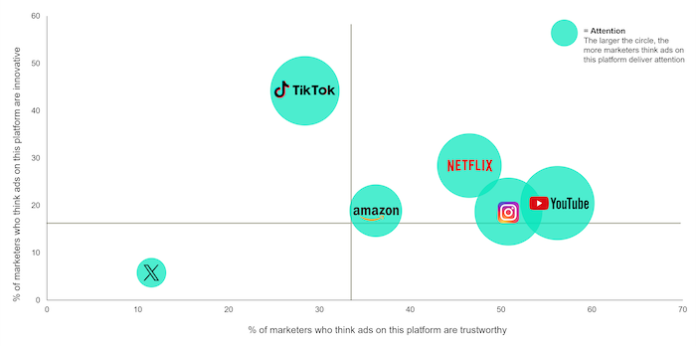
YouTube has emerged as marketers’ favourite ad platform for 2024, Amazon and TikTok have come out top among consumers and Netflix has been revealed as an advertising darling. Kantar has found that marketer confidence in X (formerly known as Twitter) declined significantly in the past year, driven by brand safety concerns and poor perceptions around innovation and trust.

The findings are included in Kantar’s Media Reactions 2024 report, an annual study exploring the evolving media landscape.

The study was based on interviews with c.18,000 consumers in 27 markets and 1000 senior marketers globally.

The Fall Of X: A Shift In Confidence

Kantar’s findings reveal that a net 26% of marketers have reported plans to reduce ad spend on X in 2025, the biggest recorded pullback from any major global ad platform. Marketers’ trust in adverts on X, historically low, has decreased further under Elon Musk’s leadership, from 22% in 2022 to 12% in 2024.

Only 4% of marketers think adverts on X provide brand safety (in contrast to Google, which comes top for brand safety at 39%). X scores outside of the global top ten for trust and for the perception of how innovative advertising on the platform is. This contrasts with TikTok, the most innovative advertising publisher for the fifth consecutive year, and YouTube, the most trusted.

Gonca Bubani, Global Thought Leadership Director – Media at Kantar, commented: ‘Advertisers have been moving their marketing spend away from X for several years. The stark acceleration of this trend in the past 12 months means a turnaround currently seems unlikely. Marketers are brand custodians and need to trust the platforms they use. X has changed so much in recent years and can be unpredictable from one day to the next – it’s difficult to feel confident about your brand safety in that environment. Ironically, decreasing spend by marketers on X will make consumers happier with the platform as they come face to face with fewer ads.’

Top-ranking digital media brands, by preference (brackets denote change in ranking)

Consumers Marketers
=1. Amazon (-) 1. YouTube (-)
=1. TikTok (+2) 2. Instagram (+1)
3. Instagram (+1) 3. Google (-1)
4. Google (-2) 4. Netflix (new)
5. Netflix (new) 5. Spotify (-)


This year, Amazon and TikTok are a first-place tie for consumer preference. Kantar’s research has found that Amazon ads are perceived as being more relevant and useful, whereas TikTok ads are perceived as more fun. However, neither brand features in the top five ranking among marketers. Netflix, measured by Kantar as an ad platform for the first time this year, achieves a top five position among both consumers and marketers, helped by its top-three position for brand safety among marketers. YouTube has solidified its position as the top choice for marketers.

Point-Of-Sale Ads Become Consumer Favourites

Kantar’s 2024 analysis shows that point-of-sale (PoS) ads hold the top spot, replacing sponsored events in terms of consumer preference. PoS ads are seen as particularly trustworthy and useful and don’t hold negative connotations such as being intrusive. Other favoured channels include cinema ads, sponsored events, newspaper ads and out-of-home advertising.

Top-ranking media channels by preference, brackets denote change in ranking

Consumers Marketers 
  • Point of sale ads (+3)
  • Digital out of home ads (+2)
  • Cinema ads (-)
  • Sponsored events (-)
  • Sponsored events (-2)
  • Online video ads (-2)
  • Newspaper ads (+3)
  • Out of home ads (+7)
  • Out of home ads (-2)
  • Ecommerce ads (+1)


Other Key Findings

Kantar’s Media Reactions 2024 survey offers a comprehensive view of the evolving attitudes of marketers and consumers in response to the changing media landscape:

• Mixed attitudes towards GenAI: 62% of consumers and 68% of marketers are positive about GenAI more broadly, but the same feeling doesn’t yet extend to AI-generated advertising. While most marketers (71%) are not bothered by AI-generated ads consumers are not so sure yet: two in five (41%) say AI-generated ads bother them.

• Good news for advertisers as consumer receptivity grows: Ad receptivity among consumers has been growing for the past decade as marketers find the sweet spot for nascent formats through trial and error and consumers are normalised to seeing ads on more channels. Almost half of consumers (47%) are now receptive to adverts, up from only 24% in 2020. The increase of 9 percentage points on last year (38%) is the highest change since 2020.

• Generational stereotypes are a myth: the brands most preferred by consumers vary significantly and there are some surprises: Gen Z prefers ads on Amazon, Facebook and Google, and among millennials and Gen X, Snapchat comes out on top. Older generations also welcome ads on TikTok, which appears in the top three among both Gen X and boomers.

Bubani concluded: ‘Campaigns that reach more receptive audiences are seven times more impactful. That’s why it’s so important for marketers to find the sweet spot between the right channel, the right media brand and the right format. To thrive in today’s fragmented environment, brands have to do more than understand shifting cultural and media dynamics – they need to care about their creative quality and make sure they’re customising it for the right environment. That means finding opportunities to stand out meaningfully, meet consumers in their diversity, and connect with audiences in more authentic and impactful ways.’

Download the Media Reactions 2024 report here.

KANTAR
kantar.com

First Programmatically-Available Digital Delivery Bike Network In SA Launches In Gauteng

First Programmatically-Available Digital Delivery Bike Network In SA Launches In Gauteng

Polygon has partnered with Swift Media to digitise Smart Boxes on Uber Eats’ delivery bikes in Gauteng, introducing the first programmatically-available digital delivery bike network in South Africa. The fleet of bikes racks up a total of 70,000km and around 5000 deliveries every month.

‘We plan on expanding our pool of delivery partners over the coming months,’ said Remi Du Preez, Managing Director at Polygon.

Du Preez said that delivery bikes have been used as a vehicle for out of home (OOH) campaigns for several years, particularly since the Covid-19 pandemic. ‘The pandemic saw a significant spike in the number of goods ordered online for delivery, and so these bikes became highly popular as an advertising medium, given their high visibility and reach.’

While bikes historically featured static OOH ads on delivery boxes, Du Preez sais that this is the first that boxes have been digitised and programmatic digital out of home (pDOOH)-enabled, allowing a more dynamic, responsive and engaging format. ‘These digital screens can be activated by any compatible Demand Server Platform (DSP) connected to Polygon’s network, including Google-based platforms.’

Du Preez said that a compelling feature of the digitised Smart Boxes is that advertisers can accurately track how many people are exposed to their ads, through the installation of a camera on each bike combined with vehicle tracking software.

‘This enables us to understand how many commuters and pedestrians are exposed to advertising,’ said Du Preez, adding that a pilot project is currently underway to access the mobile phone location data of those in the vicinity of the bikes, which would provide an even more granular picture of campaign reach.

The Smart Boxes are also GPS-enabled, which allows Polygon to ascertain the location of the bikes during each ad play. ‘This allows us to give advertisers a clearer picture of their campaign coverage.’

Lucky Maduna, Managing Director at Swift Media, said: ‘We are excited to partner with Du Preez and the team, with Polygon leading the charge in the programmatic DOOH arena. We believe our network will complement theirs, incorporating another touchpoint in the consumer journey via a delivery vehicle that is a consumer attention drawcard.’

Said Du Preez, ‘Research shows that receiving a delivery inspires feelings of anticipation among consumers, meaning that these audiences are often in a receptive and positive frame of mind, making them amenable to brand messages.

‘This network is ideal for brands looking for effective and novel ways to create awareness of their products or services, through a high-reach, ultra-measurable medium.’

POLYGON
http://pdooh.co.za

AI In Paid Media: Friend or Foe?

Nokuthula Mayisa, Paid Media Specialist at Nerdware
Nokuthula Mayisa, Nerdware.

Nokuthula Mayisa, Paid Media Specialist at Nerdware, says AI is transforming paid media, making us rethink how we create and manage advertising. It’s the hot topic everyone’s buzzing about where some see it as a game-changer, and others wonder if it’ll eventually steal our jobs.

As a paid media professional, I’ve had my own ‘Wait, what?’ moments with AI, questioning whether algorithms could really replace the magic of human creativity and strategy. Spoiler: they can’t. But the story doesn’t end there.

My First AI Encounter: Skeptic Turned Believer

When I first heard of AI-driven advertising, I pictured a bunch of code taking over my job. I thought, ‘Sure, AI can crunch numbers, but can it brainstorm killer ideas or tweak a campaign based on gut feeling?’ Fast forward to today, and I’ve learned AI isn’t here to replace us – it’s our co-pilot. It does the heavy lifting, giving us more time to get creative.

Targeting: The Ads You Didn’t Know You Needed

Remember that time you were shopping for sneakers, and boom – an ad pops up for exactly the pair you want? That’s AI doing its thing. By analysing massive amounts of data, AI spots patterns we could never catch and serves ads so personalised, it’s like it’s reading your mind. Suddenly, you’re not just selling sneakers; you’re selling the right sneakers to the right person at the right time.

Automation: More Free Time for Coffee Breaks

Picture this: you’re running five campaigns, but instead of manually adjusting bids, tweaking placements and refreshing performance reports every hour, AI’s got it covered. AI-driven platforms can optimise in real-time, adjusting bids and placements faster than a human could blink. This means less time spent on nitty-gritty tasks and more time brainstorming the next big thing, or, you know, grabbing that second cup of coffee.

Data Doesn’t Lie – But It Needs Us To Make Sense Of It

With AI, we’ve got access to more data than ever before. But here’s the thing: data is only as good as how we use it. AI serves up insights, but it’s up to us to decide how to pivot our strategies. Think of it as a treasure map – we’re still the ones holding the compass.

But is AI always the hero? Like any superhero, AI has its kryptonite.

Transparency Drama

Ever run an AI-powered campaign and wonder why your ad is showing up on a site that feels, well, off-brand? Sometimes, AI’s decision-making process is a black box, and without human oversight, things can go sideways – fast. It’s like setting your GPS to ‘surprise me’ and ending up nowhere near your destination.

Automation Overload

AI can get a little too efficient. Remember the 2020 holiday season? Some AI-driven ads continued running campaigns with jolly cheer while the world was dealing with, well, everything. Without a human touch, you risk coming off as tone-deaf or out of sync with real-world events. And that’s where we come in – AI may know the data, but we know the context.

Data Privacy: The Elephant In The Room

AI thrives on data, but the more we rely on it, the more we need to think about ethics and privacy. Using AI to target ads is great until people start wondering just how much we know about them (spoiler: probably more than we should). Balancing performance with privacy is the key to not ending up in hot water.

Man Vs Machine: A Tale As Old As Time

Former PayPal CEO Peter Thiel said it best: ‘Computers are tools, not rivals.’ In other words, AI isn’t here to take our jobs – it’s here to make us better at them. The future isn’t about man vs machine; it’s about man and machine teaming up for world domination (or, you know, better ad performance).

The Future: Powered By AI, Guided By Us

So, is AI a friend or foe? It’s both, depending on how we use it. When we pair human creativity with AI’s brainpower, magic happens. The key is finding balance – using AI for data-driven decisions while we focus on big-picture strategy and the creative spark only we can bring.

In the end, AI won’t replace us, it will empower us. And if that means less manual number crunching and more time for creative strategy, I’m all in. So, ready to embrace the future? It’s bright, it’s exciting, and it’s powered by AI. Let’s ride this wave together!

NERDWARE
https://nerdw.com

SPAR Launches Humorous New Video Encouraging Support For Our Paralympians

SPAR Launches Humorous New Video Encouraging Support For Our Paralympians

SPAR is celebrating South Africa’s ‘can-do’ spirit with the comedic video ‘Paris Impossible’, encouraging support for our Paralympians while showcasing its SPAR2U delivery app.

The video follows Lenny (Themba Robin) and Boetie (Andre Oberholzer) on a mission to deliver care packages filled with beloved South African products to our athletes.

After countless attempts to devise a plan to bring South Africa’s best to its very best in a country far away, Lennie is about to give up, until Boetie suggests using SPAR2U. With SPAR2U’s help, their plans finally take off.

While SPAR doesn’t deliver internationally, the brand has a long history of proudly supporting SA athletes and South Africans everywhere. In this comedic twist, the ‘SPAR2U guy’ steps in to ensure the mission is a success.

”Paris Impossible’ is a tribute to international sporting events and the grit and determination of our stellar athletes, all with a distinctly local flavour,’ said The SPAR Group. ‘South African expats and those on extended stays away always miss South African products, so we wanted to get some to them – a taste from home delivered by SPAR2U. The video aims to capture hearts and laughs across the nation, while encouraging South Africans to rally behind our Paralympians with the same enthusiasm they showed during the games a few weeks ago.’

The video not only spotlights South African humour but also celebrates the spirit and resilience of our people – our world-renowned ‘can-do’ attitude.

The SPAR Group continues its unwavering commitment to supporting South African athletes, particularly female athletes through the sponsorship of South African netball, and female runners, many of whom will be returning from the games to compete in the SPAR Women’s Race in Johannesburg on 6 October.


SPAR
www.spar.co.za

This is Modern Marketing