
Vicki Scheffel, Founder of Ge:Skenk, writes that in a country where a match has a way of bringing people together like very few things can, she believes the moments that unite us also create an opportunity to think differently about where our spending goes and who benefits from it.
Most of us have been a part of it. During a World Cup, the office becomes louder and conversations around the coffee machine start with last night’s match. Fridays are ‘wear your supporter jersey to work’ days. It’s also the perfect time for businesses to join in because gifting has never been more Proudly South African. Events ramp up, desk drops and hampers get teams excited, and branded merchandise is the order of the day.
I love seeing it and being a part of it, but I’ve also realised that I look at it rather differently these days.
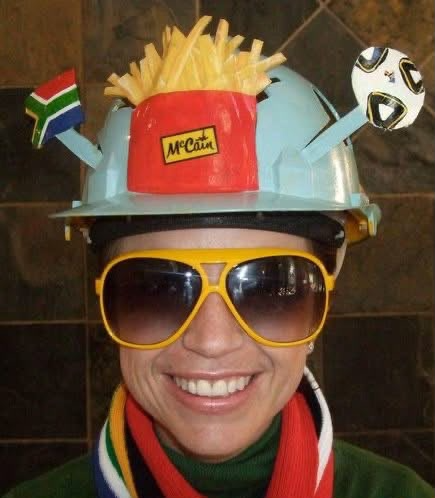
Watching the 2026 FIFA World Cup unfold has taken me back to a project I worked on ahead of the 2010 tournament. At the time, I was involved in the procurement for a campaign for a large international food brand. One of the client’s gifting ideas was a makarapa, a colourful hand-cut and hand-painted miners safety hard hat, and it really felt like the perfect choice. It celebrated something unmistakably South African and reflected the excitement surrounding the tournament.
Like many procurement projects, the job started with finding a supplier who could meet the brief. But it wasn’t until we began exploring different options that I realised we were making a much bigger decision than I first thought.
One promotional company recreated the makarapa using conventional manufacturing techniques. The finished product looked polished and carried the branding beautifully, meeting our every requirement.
The other option was to source authentic handcrafted makarapas from South African makers whose work had first given the makarapa its place in South African football culture.
As I spent more time understanding the people behind those creations, I came across the story of Alfred Baloyi, the entrepreneur widely recognised for transforming the decorated miner’s hard hat in 1979 into the colourful makarapa that became one of South Africa’s most recognisable football symbols. Long before the 2010 FIFA World Cup, he had built a successful business around that creativity, and as demand for authentic makarapas grew, so did opportunities for other artists working alongside him.
The more I learnt, the harder it became to see this as a straightforward supplier decision. We weren’t simply comparing two suppliers who could produce something similar; we were deciding whether the budget would support the people who had created the story.
That project completely changed my perspective. Now, whenever I see branded merchandise or client gifts for a major event, I find myself asking questions I probably wouldn’t have asked before. Who is already doing this work? Who has spent years developing the skills behind the product? If there is a genuine choice, what would it mean to place that order with them? What is the long-term impact a simple procurement choice can make?
I often think about that when I remember the completely unexpected South African craze that shook the 2010 World Cup: vuvuzelas.
Around 800,000 vuvuzelas were sold in South Africa during the tournament, with another one million sold internationally. Areport from 2010 estimates that up to 90% of those sold in our country were made in China. It’s an extraordinary number. Now imagine if more of those orders had consciously supported the businesses, makers and entrepreneurs whose creativity helped shape South Africa’s football culture instead.
That doesn’t mean every order belongs with a small business or a local artisan. The reality is that procurement is not that simple. Of course, there will always be commercial realities that influence the final decision, but believe impact deserves a place in the conversation whenever there is a genuine choice.
After the final whistle, shirts will be packed away, branding will come down, gifts will be given to kids or packed in a storage cupboard and the excitement will fade. But the businesses we chose to support will still be living, working, growing and, most importantly, sustaining themselves and the communities around them.
Every purchase order tells a story. I think it’s worth asking whose story we’re helping to write.
GESKENK
https://ge-skenk.co.za