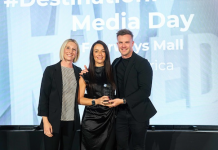


According to André van Tonder, Managing Executive, On the Dot and the company distributing the Financial Times Weekend in South Africa, most companies manage their identity through language: a mission statement, a brand voice guide, a value proposition rehearsed until it stops meaning anything to the people reciting it.
Almost none of that is what actually makes a brand trusted. The identity that sticks is usually attached to something a person can hold, not something a person is told.
I’ve spent my career in print circulation, most recently helping bring the Financial Times Weekend back into local print in South Africa after more than a decade away, and that instinct is exactly the one the media industry forgot when everyone rushed to digital. Identity doesn’t transfer well through a screen. It transfers through something you can hold.
The Psychology Is Not Sentimental, It Is Measurable
Nostalgia used to be treated as a slightly embarrassing emotion, a wistful detour rather than something serious. That’s changed. Research led by psychologists Constantine Sedikides and Tim Wildschut, published in the Journal of Experimental Social Psychology, found that nostalgia increases psychological wellbeing specifically by increasing authenticity, a sense of alignment with one’s true self, tested across both Western and East Asian samples. A separate body of research (Hepper et al.) found that nostalgia is overwhelmingly directed at specific tangible things: keepsakes, photographs, objects from a particular time, not abstract memories floating free of any physical anchor.
Nostalgia is rarely about a feeling in general. It’s about a specific object, not a memory floating free of one.
At a collective level, the effect scales up. A 2023 meta-analysis in the Journal of Business Research found that collective nostalgia, longing tied to a shared past rather than a personal one, strengthens group identity and social cohesion. That is precisely what a physical object with real history behind it can do for a brand that most digital-only experiences cannot.
The Financial Times did not set out to build a heritage asset when it started printing on pale pink paper in 1893. The decision was almost embarrassingly practical: unbleached, lightly tinted stock was marginally cheaper than bright white, and it happened to make the paper instantly distinguishable from its rival at the time, the Financial News. Nobody in that print room was thinking about brand heritage. They were thinking about cost and shelf differentiation.
What happened next is the interesting part. Within a generation, the pink became the whole identity. Today, the economics have completely reversed, dyeing paper pink now costs more than leaving it white, yet the FT has never once considered switching back. A cost-saving decision from 1893 is now protected at a premium, because the object itself, not the reasoning behind it, became the thing people trust.
That is a heritage story in the truest sense: not a value statement written by a marketing team, but an inherited, physical detail that outlived the logic that created it and became more valuable than the logic ever was.
What This Means For Anyone Building A Brand, Not Just a Newspaper
The FT’s own story makes the same point in reverse. The identity that actually sticks tends to be the one attached to something tangible, a specific object, ritual or artefact, that a person can physically return to and that carries meaning independent of whoever explains it.
The FT didn’t choose pink for meaning. Meaning arrived afterwards, once enough people kept doing the same physical thing for long enough: opening the same pink pages, in the same order, on the same kind of morning, for well over a century.
That’s worth remembering before writing another values statement for the wall. A mission statement can be rewritten in an afternoon. A genuinely trusted object takes decades to earn. Language doesn’t buy you a shortcut.
References
Kelley, N.J. et al., 2022. Nostalgia confers psychological wellbeing by increasing authenticity. Journal of Experimental Social Psychology, 102, Article 104379.
Hepper, E.G. et al. Prototype studies on the content and structure of nostalgic experience, cited in: Sedikides, C. and Wildschut, T., 2025. On the Nature of Nostalgia: A Psychological Perspective.
Journal of Business Research, 2023. A meta-analysis on the psychological and behavioural consequences of nostalgia: The moderating roles of nostalgia activators, culture, and individual characteristics.
Braithwaite Communications. Why is the Financial Times Pink? Available here.
Made Good Designs. Financial Times Brand Guidelines: The Pink Paper. Available here.
ON THE DOT
www.onthedot.co.za