
It’s a strange quirk of humans that, for all our talk about living healthier lives, we routinely forget to prioritise the habits that matter. Case in point: We’ll happily perform a 10-step skincare ritual, but neglect to do a quick breast cancer self-examination.
It seems counterintuitive, but from a behavioural-science perspective, it makes sense. Health behaviours feel like obligations, while beauty rituals feel like rewards. Our brain perceives one as ‘I must’ and the other as ‘I get to.’ That distinction makes all the difference to behaviour.
Self-Check Behaviour Gap
In South Africa, where breast cancer is the most common cancer among women and 1 in 26 will be diagnosed in their lifetime, according to the Cancer Association of South Africa (CANSA), this phenomenon becomes more than a curious psychological quirk, it’s a public health challenge.
‘Early detection dramatically improves treatment outcomes. Yet only 5% of South African women regularly check their breasts, despite self-examinations being one of the most accessible forms of early detection,’ said Pavla Sessions, Head of Brand, Dove and Dove Men at Unilever South Africa.
This presents a conundrum: how to transform a behaviour people avoid into a habit they want to repeat?
Behavioural science teaches us that habits piggy-back on existing routines far more easily than they form from scratch. It’s called habit stacking: linking a new behaviour to one that’s already embedded.
People fail to start new health behaviours not because they’re lazy, but because:
– The behaviour feels like effort.
– It requires remembering.
– The reward is too abstract or too distant.
A self-exam has no immediate payoff. So, Dove and its creative agency VML South Africa took inspiration from a ritual that women already keep, which does feel good in the moment: applying body cream.
Dove’s research revealed that around two-thirds of South African women apply body cream every day, including on their breasts. What if that moment of self-care could carry an additional benefit: a daily breast self-exam? What if a treat could also be a tool?
By combining the two, the Dove team reframed a familiar ritual as a moment of care with two layers of benefit: beauty and wellbeing.
‘We realised women weren’t opposed to checking their breasts, they simply weren’t in the habit,’ said Theo Ferreira, Executive Creative Director at VML South Africa. ‘But moisturising is a moment they already prioritise. That insight became our behavioural key: take something women want to do and embed something they need to do.’
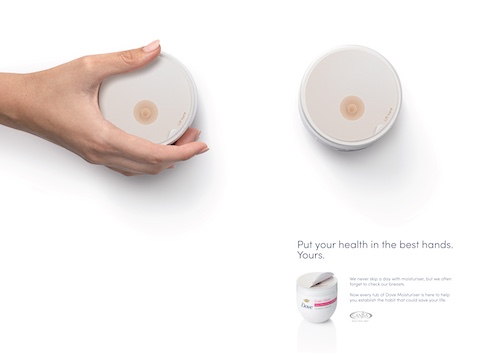
This thinking became Dove’s Breast Cancer Awareness Month campaign: ‘Turn Self-Care into Health-Care.’
VML’s creative team collaborated with Dove and CANSA to design a campaign that felt like an invitation, rather than a public service announcement.
Special-edition Dove Body Cream tubs featured a peel-back label. Under the label, a QR code linked to CANSA’s Touch-Look-Check guide and a short educational video with step-by-step instructions. As women moisturised, they were guided to perform a self-exam, transforming a beauty ritual into a new health habit.
To share the love, a portion of every purchase of a special-edition tub was donated to CANSA and participants were encouraged to tag their friends and spread the message.
‘Our goal was not another awareness message,’ said Dominique Baxewanos, Creative Director at VML South Africa. ‘Our goal was behaviour change. We wanted to meet women in the moments they already inhabit, with tools they already use. If creativity can remove friction and add meaning, it’s doing its job.’
What Brands Can Learn From This
This campaign offers a blueprint for brands wanting to contribute meaningfully to public health without falling into the ‘worthy but forgettable’ territory of traditional PSAs.
1. Relevance Beats Reminders
Information alone rarely changes behaviour. Relevance, personalised, contextual, and built into a routine, does. By locating the behaviour within a beauty ritual, Dove removed the biggest barrier: remembering.
2. Micro-Behaviours Matter More Than Big Intentions
A daily breast self-exam sounds daunting. Checking for small changes while moisturising feels doable. Behaviour change succeeds when the action is small, repeatable, and emotionally neutral or positive.
3. Design Should Guide, Not Overwhelm
The peel-back label with the Touch-Look-Check guide is deceptively simple. It’s also a masterclass in behaviour design. A single prompt, in the right place, at the right moment, can outperform an entire awareness campaign.
4. Brands Can Play A Role In Public Health
Consumers don’t want brands to preach, but they welcome brands that empower. Dove’s long-standing equity in care and confidence made the message both credible and welcome.
‘We remember to moisturise our bodies but forget to check our breasts,’ said Jerusha Naicker,. Marketing Innovation Lead, Unilever South Africa, and Anele Nzimande-Maphanga, PR and Influencer Lead for Beauty, Well-being and Personal Care, Unilever South Africa. ‘If we can help women turn a daily ritual into a life-saving habit, that’s the kind of impact that matters.’
VML SOUTH AFRICA
https://www.vml.com/south-africa